

Shown: · With its frame:
 Peržiūrėti realaus dydžio版
 Pasidalinti
 Dalintis
 Išsamiau
 Vadovas

 Atsisiųsti
 Panašūs eksponatai
 Rentgeno spindulių nuotrauka
 Automatinė diorama
 Q&A
Q&A Statistika
- 92.0 x 131.0 cm


€ 239
Rankų darbo aliejinės reprodukcijos
Rankiniu būdu tapytas aliejus ant droblio jūsų pageidaujamame dydį ir rėmuose – tai mūsų menininkų pagal užsakymą sukurtas darbas. ( Perjungti į spausdinamus版作品 Perejti prie skaitmeninių vaizdų)
Size
·Standartinis dydis
pagal užsakymą
CM
INCH
Pasirinkite iš mūsų nustatytų dydžių, atitinkančių originalaus meno kūrinio proporcijas.
Loading sizes...

plotis
aukštis
Įveskite jums reikiamą plotį ir aukštį, kad paveikslas atitiktų jūsų rėmą ar sieną. Kadangi šis darbas yra rankinio darbo, siekiant išgauti kitokios formos dydį, paveikslas gali būti šiek tiek didesnis (nuo kraštų bus palikta daugiau erdvės) arba mažesnis – pasirinkite jums patogiausią variantą. Prieš pradedant tapyti, atsiųsime jums skaitmeninį maketą patvirtinimui. Šioje puslapio nuotraukoje matomas vaizdas nėra galutinis rezultatas – jį parodys tik sukurtas maketas.
 Skaityti daugiau
Finish
·
White €1

Blurside €1

Extended €1

P118B €10

P118H €10

P118W €10

P438Z €10

P508JH €12

P508YH €12

P805H €10

P805Z €10

P919BZ €10

P919G €10

P919XJ €10

P959ZH €10

P968JZ €12

W106C €8

W218G €10

W218JH €8

W218Y €10

W307PJ €10

W316G €10

W316PJ €8

W316Y €10

W398PJ €8

W4111J €10

W500HY €15

W500JH €15

W692G €12

W849H €8

W940BG €15

W953PJ €8

H24-GOLD €30

H24-SILVER €30

H36-GOLD €45

H36-SILVER €45
Shipped in a protective tube, ready for your own framer.
Above 105 cm the frame is shipped as a kit for a professional framer — read the details.
Extras
optionalWhat do the extras include?
Examples of what can be changed: Replace face with customer photo; Add pet (e.g., replace cat with dog); Include hidden message in background; Change background landscape or elements.
After order, TopImpressionists.com team will email client for instructions and provide a mockup preview
After order, TopImpressionists.com team will email client for instructions and provide a mockup preview
Pristatymas visame pasaulyje () per 3–4 savaites, o ne įprastai – per 5 savaites. (3 lapkritis). Kokybė lieka nepakeičiama.
Apsauginis lakas
Pavadinimo lentelė
Išgraviruotos bronzinės plokštelės detalės
This elegant plaque features the artist's name and the title of the artwork, finely engraved for a timeless presentation.
It is made from bronze with a refined, elegant finish. The text is precisely laser-engraved for a sharp and permanent result. Measuring 9x2 cm, the plaque is compact yet easy to read. It's built to be durable and scratch-resistant, offering a professional, museum-quality look. Mounting is simple thanks to the included adhesive backing.
Skaidrios akrilo plokštelės informacija
The plaque includes essential engraved details such as the artist's name, the title of the artwork, the date it was created, the type of media used-like oil on canvas or watercolor-a brief description of the piece, and a QR code that links to the complete artwork information.
It is crafted from clear acrylic, offering a sleek, modern appearance. The text is UV-engraved in black to ensure strong visual contrast. With a size of 10x15 cm, it ensures optimal readability. It comes equipped with two metal hooks for secure wall mounting. The plaque is designed to be weather-resistant, making it suitable for various environments, and it includes interactive features that work seamlessly with smartphone scanning.
Juodos akrilo plokštelės informacija
This elegant plaque includes engraved information such as the artist's name, the title of the artwork, the date it was created, the type of media used (like oil on canvas or watercolor), a short description of the artwork, and a QR code for quick access to more information.
The plaque itself is made from refined black acrylic with a premium finish. The text is laser-engraved in white for high contrast and readability. Its size is 10x15 cm, designed to be easy to read. It comes with two metal hooks for professional mounting. The design is sleek and fits any interior style. It is also weather-resistant and durable, with built-in digital integration for mobile compatibility.
Stiklo variantas prieinamas tik pasirinkus dydį iki 110 cm
 Stiklo variantas prieinamas tik pasirinkus dydį iki 110 cm
- Nemokamas greitasis pristatymas visame pasaulyje
- Aukštos kokybės lininis drobė
- Pilnas siuntimo draudimas
- Muitinės mokesčių grąžinimo garantija
- Tikro spalvų atitikimo garantija
- 100 dienų grąžinimo politika (tik esant įtaigoms)
- 100% pinigų grąžinimo garantija
- Nuolaida dideliems užsakymams


Kolekcinio objekto aprašas
Autoriaus biografija
Georges de La Tour (1593-1652): Prancūzų baroko meistras dramišku šviesos ir šešėlių kontrastu. Žiūrėtojų įtraukianti religinė kūriniai, šviestuvų interjeriai kaip „Šiaurės žvaigždžių pasakėlė“, jo išlikęs paveldas.
About the painting
A Moment Frozen in Shadow: Georges de La Tour’s ‘The Dice Players’
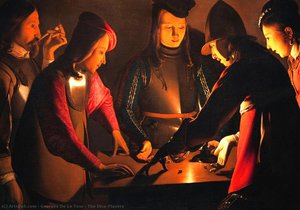
Georges de La Tour's “The Dice Players,” completed around 1650, is more than just a depiction of gambling; it’s an arresting exploration of faith and human vulnerability rendered with the masterful precision characteristic of Tenebrism—a technique that elevates this seemingly simple scene into a profound meditation on spirituality. Painted in stark contrast between light and darkness, the artwork exemplifies the Baroque aesthetic's preoccupation with dramatic emotion and psychological depth.The Anatomy of Darkness: Tenebrism Technique
De La Tour’s signature style is undeniably Tenebrism, derived from Italian “tenebroso,” meaning shadowy or dusky. This method involves plunging the majority of the canvas into impenetrable darkness—almost absolute black—while strategically illuminating select areas with pools of intense light emanating from a single candle. The candlelight casts dramatic shadows across the faces and hands of the players, emphasizing their concentration and highlighting the vulnerability inherent in their pursuit of fortune. Notice how the artist meticulously renders the textures of fabric and skin, capturing subtle nuances that contribute to the overall realism despite the pervasive gloom. This careful attention to detail underscores De La Tour’s commitment to portraying human experience with unflinching honesty.A Scene Steeped in Religious Symbolism
While ostensibly depicting a mundane activity—dice playing—the painting resonates with deeper religious symbolism. The darkened room itself can be interpreted as representing purgatory, the shadowy recesses of the soul awaiting redemption. The candle flame symbolizes divine grace and illuminates the players’ faces, suggesting that even amidst worldly pursuits, faith remains present. Furthermore, the dice themselves are often associated with chance and fate—themes central to Christian theology concerning God's providence. De La Tour subtly invites contemplation on these concepts, elevating the scene beyond mere entertainment into a visual parable.Historical Context: The Quiet Reformation
“The Dice Players” emerged during the turbulent period of the French Reformation (1562-1648), when Catholicism and Protestantism clashed violently across Europe. Despite the outward appearance of piety—the candlelit interior, the solemn expressions of the figures—there’s an underlying tension within the artwork. The players are absorbed in their game, seemingly oblivious to the spiritual implications of their actions. This juxtaposition speaks to the anxieties of the time – a questioning spirit challenging established dogma and prompting reflection on moral responsibility. De La Tour's depiction captures this subtle unease, reflecting the broader societal debates surrounding faith and morality prevalent during his era.Emotional Resonance: Intimacy and Vulnerability
Ultimately, “The Dice Players” succeeds in conveying a powerful emotional resonance. The artist’s masterful use of chiaroscuro creates an atmosphere of palpable intimacy—we are drawn into the players' world, witnessing their intense focus and confronting their vulnerability. There is no grand gesture or triumphant proclamation; instead, De La Tour presents us with a quiet tableau that speaks volumes about human nature. It’s a painting that lingers in the mind long after viewing, prompting reflection on themes of ambition, faith, and the inescapable realities of mortality—a testament to De La Tour's enduring artistic vision.Klausimai ir atsakymai
Ar „The Dice Players“ spalvos atrodo ryškios ar švelnios?
„The Dice Players“ spalvų intensyvumas yra Balanced. Intensyvumas apibūdina, koks spalvų ryškumas yra suvokiamas.
Kur galiu įsigyti „The Dice Players“ – Žoržas Dela Toras spausdinį?
Norėdami užsisakyti „The Dice Players“ – Žoržas Dela Toras spausdinį, tiesiog jį užsisakykite puslapio Kūrinio spausdinimas aukščiausia kokybe skiltyje: aukščiausios kokybės spausdinys ant medžio siuvinėjamų audinių arba archyvinio kanvas tipo popieriaus.
Kur galiu peržiūrėti „The Dice Players“ išsamiai?
Norėdami peržiūrėti „The Dice Players“ – Žoržas Dela Toras reprodukciją, atidarykite kūrinio Peržiūra interjere puslapį.
Quick facts and art quiz
About Žoržas Dela Toras

Žoržas Dela Toras
1593 - 1652, Prancūzija
Autoriaus biografija
Georges de La Tour (1593–1652): French Baroque Master of Dramatic Chiaroscuro & Tenebrism
Georges de La Tour, a name that resonates with the hushed reverence reserved for masters of light and shadow, remains one of the most compelling figures of the French Baroque. Born in 1593 in Vic-sur-Seille, a small town nestled within the Duchy of Lorraine, his life unfolded against a backdrop of religious fervor and political upheaval. While details surrounding his early training remain somewhat elusive—scholars speculate about potential journeys to Italy or apprenticeships with local artists like Jacques Bellange—the seeds of his artistic vision were undoubtedly sown in this environment. He wasn’t born into an artistically established family; his father was a baker, yet the circumstances of his mother's lineage hint at a possible connection to nobility, a subtle influence perhaps reflected in the dignity and quiet grace that permeate his work.
Early Life & Artistic Influences
Georges de La Tour’s formative years were marked by the turbulent political landscape of Lorraine under Habsburg rule. Despite limited formal education—evidence suggests he received instruction from local artisans—his innate talent for observation and representation quickly distinguished him from his peers. Crucially, he encountered the artistic legacy of Caravaggio during his travels, absorbing the revolutionary techniques of tenebrism—the dramatic interplay between light and darkness—that would become central to his distinctive style. However, De La Tour didn’t merely emulate Caravaggio; he skillfully assimilated Dutch Caravaggisti influences, particularly those championed by Hendrick Terbrugghen, forging a synthesis that was both powerfully expressive and remarkably restrained.
The Utrecht School & Artistic Development
De La Tour's artistic development coincided with the flourishing of the Utrecht School, a movement characterized by its meticulous realism and psychological depth. Artists like Terbrugghen prioritized capturing human emotion with unflinching honesty—a commitment that mirrored De La Tour’s own unwavering dedication to portraying the inner life of his subjects. Initially, De La Tour's paintings exhibited a vibrant palette and dynamic composition, reflecting the influence of this Utrecht tradition. Yet as he matured, he gradually refined his aesthetic sensibilities, favoring muted earth tones and simplifying forms—a deliberate choice that underscored his profound spiritual contemplation.
Major Works & Recurring Themes
The hallmark of Georges de La Tour’s oeuvre is undoubtedly his masterful manipulation of candlelight—which he employed not merely as a source of illumination but as a metaphor for divine grace and spiritual awakening. His paintings are frequently set at night, creating an atmosphere of intimacy and quiet contemplation that draws the viewer into the scene and invites them to share in the emotional experience of the figures depicted. The Fortune-Teller, painted around 1630, exemplifies this early style—a lively genre scene rendered with sharp observation and dramatic lighting. However, it is his later religious works that truly showcase De La Tour’s genius. Adoration of the Shepherds, created around 1640, demonstrates his ability to imbue a traditional subject with profound emotional resonance. The figures are not idealized or heroic; they are ordinary people, humbled by the presence of the divine. The Tears of Saint Peter, painted in the 1650s, is particularly poignant—the apostle’s grief rendered with heartbreaking subtlety and realism. Saint Joseph Carpenter, another iconic work, depicts a serene domestic scene, highlighting De La Tour's mastery of capturing the quiet dignity of everyday life.
Legacy & Enduring Appeal
Despite achieving recognition during his lifetime—he was appointed “Painter to the King” by Louis XIII in 1638—Georges de La Tour’s work remained largely obscure after his death in 1652. For centuries, many of his paintings were misattributed to other artists, and his name faded from art historical memory. It wasn't until the early 20th century that a concerted effort was made to rediscover and re-evaluate his oeuvre—led by scholars like Hermann Voss—revealing an artist of extraordinary originality and depth. De La Tour’s innovative use of light and shadow, combined with his psychological insight into his subjects, continues to captivate audiences today. His paintings offer a glimpse into 17th-century life and spirituality, reflecting both the religious fervor and the social realities of his time. He remains celebrated for his ability to imbue everyday scenes with profound meaning and emotional depth—a testament to his enduring legacy as one of the most influential artists of the Baroque period.
Quick facts about Žoržas Dela Toras
- Artistic Movement Or Style: Tenebrismo
- Artists Who Influenced This Artist:
- Karavaggio
- Hendrik Terbrugghen
- Date Of Birth: 13 marto 1593
- Date Of Death: 1652
- Full Name: Georges de La Tour
- Nationality: Prancūzijoje
- Notable Artworks:
- Šešėlyje žiūrantis žmogus
- Kristaus Švietimo adoratorių šventė
- Place Of Birth: Vik-sur-Seille, Prancūzija
Tyrinėkite meno kūrinius, suskirstytus pagal temas, stilius ir savybes.


Žoržas Dela Toras
The Dice Players
() ·
With its frame: · Hand-painted in oil on linen
Total