

 Peržiūrėti realaus dydžio版
 Pasidalinti
 Dalintis
 Išsamiau
 Vadovas

 Atsisiųsti
 Panašūs eksponatai
 Rentgeno spindulių nuotrauka
 Automatinė diorama
 问答
问答 Statistika
LOUIS DAVID (1748 1825)


Admire Jérôme Martin Langlois's masterful depiction of Louis David—a Neoclassical portrait capturing the artist’s wisdom and contemplative gaze, illuminated by dramatic lighting and enriched with textural detail.
 Skaityti daugiau
Jérôme-Martin Langlois (1779-1838): French Neoclassical painter, protégé of Jacques-Louis David. Explore his historical paintings & portraits!
Giclée / Meno spausdinimas
Muziejų lygio „giclée“ arba drobos spausdinimas: greita gamyba ir lankstios apdailos parinktys. ( Pirkti rankų darbo tapybą Perejti prie skaitmeninių vaizdų)




P118B €10

P118H €10

P118W €10

P438Z €10

P508JH €12

P508YH €12

P805H €10

P805Z €10

P919BZ €10

P919G €10

P919XJ €10

P959ZH €10

P968JZ €12

W106C €8

W218G €10

W218JH €8

W218Y €10

W307PJ €10

W316G €10

W316PJ €8

W316Y €10

W398PJ €8

W4111J €10

W500HY €15

W500JH €15

W692G €12

W849H €8

W940BG €15

W953PJ €8




Standartinis dydis
pagal užsakymą
CM
INCH
Pasirinkite iš mūsų nustatytų dydžių, atitinkančių originalaus meno kūrinio proporcijas.
Loading sizes...

plotis
aukštis
Įveskite jums reikiamą plotį ir aukštį, kad atvaizdas derėtų prie jūsų rėmo ar sienos. Spausdiną galima tik sumažinti, bet nepadidinti virš originalaus paveikslėlio dydžio, todėl keičiant proporcijas, dalis vaizdo prarandama. Prieš spausdinimą atsiųsime jums skaitmeninį maketą patvirtinimui. Šioje puslapio nuotraukoje matomas pjūvis nėra tikslus – jį rodo tik maketas.
Pristatymas visame pasaulyje () per 2 weeks, o ne įprastas 4/5 savaičių laikotarpis. (5 lapkritis)

Nemokamas greitasis pristatymas visame pasaulyje

Aukštos kokybės lininis drobė

Pilnas siuntimo draudimas

Muitinės mokesčių grąžinimo garantija

Tikro spalvų atitikimo garantija

100 dienų grąžinimo politika (tik esant įtaigoms)

100% pinigų grąžinimo garantija

Nuolaida dideliems užsakymams
 Stiklo variantas prieinamas tik pasirinkus dydį iki 110 cm

LOUIS DAVID (1748 1825)
Giclée / Meno spausdinimas
Reprodukcijos matmenys
-


Bendroji kaina
€ 63
A Portrait Steeped in Classical Ideals: Jérôme Martin Langlois’s Reverie on Louis David
The artwork, titled “Louis David,” presents a meticulously crafted portrait of the celebrated French artist himself, Jerome Martin Langlois's masterful rendition capturing the essence of Neoclassicism and imbued with subtle Romantic undertones. Executed with oil paints on canvas, this piece stands as a testament to Langlois’s dedication to mastering the stylistic conventions championed by Jacques-Louis David—David, who served as Langlois’s influential mentor—a relationship that profoundly shaped his artistic vision. The painting's formal composition and refined execution immediately convey an atmosphere of dignified contemplation, mirroring the intellectual fervor characteristic of its era.Composition and Technique: Echoes of David’s Studio
Langlois skillfully employs a bust-length format, prioritizing Louis David’s face and upper torso—a deliberate choice reflecting the stylistic preferences prevalent in Neoclassical art. The artist positions his subject facing forward with a slight turn to his right, creating an element of dynamism within the otherwise restrained framework. Held open in David's right hand is a sketchbook brimming with sketches and drawings – a symbolic gesture highlighting intellectual pursuits and artistic talent—a direct nod to David’s own practice. Fine lines delineate facial features with remarkable precision, capturing the subtle nuances of age and experience, while broader strokes sculpt the volume of David’s clothing and jacket. The artist's meticulous layering of paint creates textures that convincingly mimic the surface qualities of fabric and paper, demonstrating a profound understanding of artistic technique.Historical Context and Symbolic Resonance
Painted during the Napoleonic era (circa 1825), “Louis David” embodies the spirit of its time—a period marked by an unwavering commitment to classical ideals and a fervent desire to revive the grandeur of antiquity. The inclusion of the sketchbook serves as more than just a visual detail; it symbolizes the artist’s engagement with scholarly pursuits and his belief in the transformative power of observation. Furthermore, David's solemn gaze and posture convey wisdom gained through years of artistic endeavor—a reflection of the broader cultural preoccupation with virtue and moral contemplation that characterized Neoclassicism. The muted gray-blue background subtly isolates the figure, emphasizing its importance within the composition and enhancing its emotional impact.Color Palette and Lighting: Drama Within Restraint
The artwork’s color palette is deliberately restrained, dominated by dark blues and grays punctuated by flashes of white, red, and flesh tones—a palette reminiscent of David's favored tonal harmonies. Dramatic directional lighting emanating from the upper left casts strong highlights on David’s face and clothing, creating a sense of depth and highlighting his features with meticulous care. This technique underscores the artist’s ability to convey emotion through visual cues—a hallmark of Romanticism that subtly blends into Langlois’s Neoclassical style.Concluding Impression: A Legacy of Artistic Excellence
“Louis David” transcends mere representation; it aspires to capture a moment of profound intellectual and artistic contemplation. Jerome Martin Langlois's masterful execution, guided by the influence of Jacques-Louis David, secures this portrait as an enduring symbol of Neoclassical artistry—a timeless masterpiece that continues to inspire admiration for its elegance, precision, and evocative portrayal of human dignity.Klausimai ir atsakymai
Kaip galiu peržiūrėti „LOUIS DAVID (1748 1825)“ – Jérôme Martin Langlois kaip vaizdų rodyklę?
„LOUIS DAVID (1748 1825)“ diapora prieinama puslapio Slaydšou kūrinio apžvalgos skiltyje.
Ar „LOUIS DAVID (1748 1825)“ – Jérôme Martin Langlois priklauso viešosios teisės domenui?
Autorių teisių statusas kūriniui „LOUIS DAVID (1748 1825)“ – Jérôme Martin Langlois: kūrinys priklauso yra viešosios erdvės dalis – jo autorinė teisė pasibaigusi. Tai nulemia, ar galima laisvai reprodukciuoti šį vaizdą.
Kur galiu rasti „LOUIS DAVID (1748 1825)“ vadovą?
Dėl „LOUIS DAVID (1748 1825)“ – Jérôme Martin Langlois yra prieinama Informacinė medžiaga puslapio: spausdinamas informacinis lapelis apie kūrinį, skirtas studentams ir mokomajamiam procesui klasėje.
Autoriaus biografija
A Parisian Beginnings and the Embrace of Neoclassicism
Jérôme-Martin Langlois, born in Paris in 1779, emerged as a significant voice within the refined world of French Neoclassical painting. His artistic journey began under the tutelage of Jacques-Louis David, the preeminent figurehead of the movement and a master whose influence would indelibly shape Langlois’s aesthetic sensibilities. David quickly recognized a spark of talent in the young artist, welcoming him as one of his favored pupils. This mentorship proved invaluable, providing Langlois with a rigorous foundation in draftsmanship, composition, and the ideals of classical beauty that defined the era. The studio of Jacques-Louis David was not merely a place of technical instruction; it was an immersion into a philosophy of art rooted in order, reason, and the emulation of ancient Greek and Roman models. Langlois absorbed these principles wholeheartedly, setting the stage for his own distinguished career.Collaboration with a Master: Early Commissions and Artistic Growth
The early years of Langlois’s career were marked by close collaboration with David on several ambitious projects. He wasn't simply an assistant; he was a contributing artist whose skills were actively sought after. A notable example is his contribution to the monumental painting, Napoleon Crossing the Alps, now housed in Vienna’s Kunsthistorisches Museum. Langlois skillfully rendered the magnificent horse upon which Napoleon is depicted, demonstrating a remarkable ability to capture both anatomical accuracy and dynamic movement. He further honed his skills assisting David on Leonidas at Thermopylae, a powerful depiction of Spartan valor currently displayed in the Musée du Louvre. These experiences were formative, allowing Langlois to learn from a master while simultaneously establishing his own reputation within artistic circles. His dedication and talent did not go unnoticed; he competed for – and achieved recognition through – prestigious awards, including securing the second prize at the Prix de Rome in 1805, followed by the coveted first prize in 1809. This latter achievement granted him a period of study in Rome during the 1810s, an opportunity to immerse himself directly in the classical art and architecture that inspired his artistic vision. A preparatory drawing for his winning Prix de Rome piece, Priam aux pieds d'Achilles, remains preserved at the Musée Magnin in Dijon, offering a glimpse into his creative process. From 1806 onwards, Langlois consistently exhibited his work at the Salon in Paris until 1837, earning further accolades including second prize in 1817 and first prize in 1819.A Flourishing Career: Commissions, Honors, and Artistic Style
Langlois’s career blossomed with a steady stream of commissions that showcased his growing reputation and artistic maturity. In 1822, he was honored with knighthood in the Legion of Honour, a testament to his contributions to French art and culture. His talent extended beyond historical and mythological subjects; he also excelled in portraiture, capturing the likenesses of prominent figures with dignity and grace. A particularly noteworthy commission came while he was in Brussels in 1824: a portrait of Jacques-Louis David himself, which was exhibited in 1831. This work is not merely a depiction of a man; it’s a poignant tribute from one artist to another, revealing the deep respect and admiration Langlois held for his mentor. He became a nominated member of the Académie des Beaux-Arts, solidifying his position within the artistic establishment. Notable works include L'Enlèvement de Déjanire (Museum of Fine Arts, Angers), Le Peintre David (Musée du Louvre), and portraits of influential figures like Urbain de Maillé, Marquis de Brézé, and François Annibal, Duc d’Estrées (Palace of Versailles). Langlois's artistic style remained firmly rooted in Neoclassicism. His paintings are characterized by their emphasis on order, clarity, and idealized forms. He possessed a meticulous attention to detail and a refined sense of composition, creating works that were both visually striking and intellectually engaging.Legacy and Historical Significance
Jérôme-Martin Langlois passed away in Paris in 1838, leaving behind a body of work that continues to resonate with admirers of Neoclassical art. While perhaps not as widely celebrated as his mentor Jacques-Louis David, Langlois played a crucial role in perpetuating the artistic traditions of the era. His paintings offer valuable insights into the cultural values and aesthetic tastes of early 19th-century France. He wasn’t simply imitating David; he was building upon that foundation, adding his own unique voice to the Neoclassical chorus. His dedication to classical principles, combined with his technical skill and artistic sensitivity, ensured that the ideals of order, reason, and beauty continued to flourish in French painting. The enduring appeal of his works lies not only in their aesthetic qualities but also in their ability to transport viewers back to a time when art was seen as a vehicle for moral instruction and civic virtue. His legacy is one of quiet dedication, skillful execution, and a steadfast commitment to the principles that defined a pivotal moment in art history.
Jérôme Martin Langlois
1779 - 1838 , France
Trumpa informacija
- Artistic Movement Or Style: Neoclassicism
- Artists Who Influenced This Artist: ['Jacques-Louis David']
- Date Of Birth: 1779
- Date Of Death: 1838
- Full Name: Jérôme-Martin Langlois
- Nationality: French
- Notable Artworks:
- Napoleon Crossing the Alps
- L'Enlèvement de Déjanire
- Le Peintre David
- Diana and Endymion
- Place Of Birth: Paris, France
Susiję straipsniai
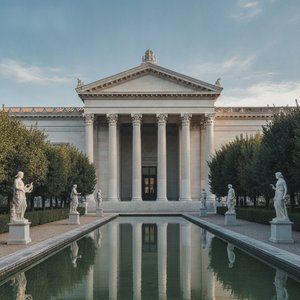
Neoclassicism Unveiled: Discovering the Timeless Elegance and Rational Order of Classical Art
Unveil the timeless elegance of Neoclassicism. Journey through an era defined by reason, order, and the revival of Greco-Roman ideals. Our expert exploration offers a sophisticated look at the transition from Rococo excess to classical precision for the true art enthusiast.