

Paveikslėlyje: · Su rėmu:
 Peržiūrėti realaus dydžio版
 Pasidalinti
 Dalintis
 Išsamiau
 Vadovas

 Atsisiųsti
 Panašūs eksponatai
 Rentgeno spindulių nuotrauka
 Automatinė diorama
 问答
问答 Statistika
- 131.0 x 97.0 cm


€ 240
Rankų darbo aliejinės reprodukcijos
Rankiniu būdu tapytas aliejus ant droblio jūsų pageidaujamame dydį ir rėmuose – tai mūsų menininkų pagal užsakymą sukurtas darbas. ( Perjungti į spausdinamus版作品 Perejti prie skaitmeninių vaizdų)
Šis kūrinys yra saugomas autorinės teisės
Šiame puslapyje rodomas meno kūrinys yra saugomas autorių teisių įstatymais, todėl neturime teisės legaliai kurti ar parduoti jo identiškos reprodukcijos. Ši apsauga užtikrinama remiantis tokiais tarptautiniais susitarimais kaip Bernės konvencija ir pagal nacionalines įstatymų nuostatas, įskaitant tas, kurias nurodo JAV autoriškos teisės įstatymas – 17-asis skyrius.
Kaip pagarbią ir teisėtą alternatyvą, mes siūlome pagal užsakymą rankomis dažytus paveikslus, įkvėptus originalo. Mūsų įgudę ir profesionalūs menininkai kruopščiai tiria originalo stilių, nuotaiką ir meninę esmę, kad sukurtų naują, unikalią kūrinį, kuris sukelia tą paties jausmą – išlikdamas tuo tarciau originaliu, savarankišku kūrybiniu darbu.
Šis metodas visiškai atitinka autorių teises, nes jame nėra saugomo kūrinio kopijavimo ar dubliavimo. Tai yra kūrybinė reinterpretacija – naujas paveikslas, kurį įkvėpė originalas, tačiau kuris nėra jo identiškas.
 Skaityti daugiau
Dydis
·Standartinis dydis
pagal užsakymą
CM
INCH
Pasirinkite iš mūsų nustatytų dydžių, atitinkančių originalaus meno kūrinio proporcijas.
Kraunami dydžiai...

plotis
aukštis
Įveskite jums reikiamą plotį ir aukštį, kad paveikslas atitiktų jūsų rėmą ar sieną. Kadangi šis darbas yra rankinio darbo, siekiant išgauti kitokios formos dydį, paveikslas gali būti šiek tiek didesnis (nuo kraštų bus palikta daugiau erdvės) arba mažesnis – pasirinkite jums patogiausią variantą. Prieš pradedant tapyti, atsiųsime jums skaitmeninį maketą patvirtinimui. Šioje puslapio nuotraukoje matomas vaizdas nėra galutinis rezultatas – jį parodys tik sukurtas maketas.
Baigiamasis etapas
·
Baltas apasutojimas €1

Išblėstantis šonas €1

Išplėstinis €1

P118B €10

P118H €10

P118W €10

P438Z €10

P508JH €12

P508YH €12

P805H €10

P805Z €10

P919BZ €10

P919G €10

P919XJ €10

P959ZH €10

P968JZ €12

W106C €8

W218G €10

W218JH €8

W218Y €10

W307PJ €10

W316G €10

W316PJ €8

W316Y €10

W398PJ €8

W4111J €10

W500HY €15

W500JH €15

W692G €12

W849H €8

W940BG €15

W953PJ €8

H24-GOLD €30

H24-SILVER €30

H36-GOLD €45

H36-SILVER €45
Siunčiama saugiame vamzdelyje, paruošta patys sukomentuoti jūsų rėmeliais.
Virš 105 cm rėmas siunčiamas kaip rinkinys profesionaliam rėmininkui — skaitykite detales.
Papildomos paslaugos
nebūtinaKą apima papildomos paslaugos?
Pavyzdžiai, ką galima pakeisti: pakeisti veidą nuotrauka su klientu; pridėti augintinį (pvz., pakeisti kucingą šuniu); įtraukti paslaptingą žinutę fone; pakeisti fono kraštotvę ar elementus.
Gavus užsakymą, TopImpressionists.com komanda susisieks su klientu el. paštu dėl nurodymų ir pateiks preliminarią maketą.
Gavus užsakymą, TopImpressionists.com komanda susisieks su klientu el. paštu dėl nurodymų ir pateiks preliminarią maketą.
Pristatymas visame pasaulyje () per 3–4 savaites, o ne įprastai – per 5 savaites. (9 lapkritis). Kokybė lieka nepakeičiama.
Apsauginis lakas
Pavadinimo lentelė
Išgraviruotos bronzinės plokštelės detalės
This elegant plaque features the artist's name and the title of the artwork, finely engraved for a timeless presentation.
It is made from bronze with a refined, elegant finish. The text is precisely laser-engraved for a sharp and permanent result. Measuring 9x2 cm, the plaque is compact yet easy to read. It's built to be durable and scratch-resistant, offering a professional, museum-quality look. Mounting is simple thanks to the included adhesive backing.
Skaidrios akrilo plokštelės informacija
The plaque includes essential engraved details such as the artist's name, the title of the artwork, the date it was created, the type of media used-like oil on canvas or watercolor-a brief description of the piece, and a QR code that links to the complete artwork information.
It is crafted from clear acrylic, offering a sleek, modern appearance. The text is UV-engraved in black to ensure strong visual contrast. With a size of 10x15 cm, it ensures optimal readability. It comes equipped with two metal hooks for secure wall mounting. The plaque is designed to be weather-resistant, making it suitable for various environments, and it includes interactive features that work seamlessly with smartphone scanning.
Juodos akrilo plokštelės informacija
This elegant plaque includes engraved information such as the artist's name, the title of the artwork, the date it was created, the type of media used (like oil on canvas or watercolor), a short description of the artwork, and a QR code for quick access to more information.
The plaque itself is made from refined black acrylic with a premium finish. The text is laser-engraved in white for high contrast and readability. Its size is 10x15 cm, designed to be easy to read. It comes with two metal hooks for professional mounting. The design is sleek and fits any interior style. It is also weather-resistant and durable, with built-in digital integration for mobile compatibility.
Stiklo variantas prieinamas tik pasirinkus dydį iki 110 cm
 Stiklo variantas prieinamas tik pasirinkus dydį iki 110 cm
- Nemokamas greitasis pristatymas visame pasaulyje
- Aukštos kokybės lininis drobė
- Pilnas siuntimo draudimas
- Muitinės mokesčių grąžinimo garantija
- Tikro spalvų atitikimo garantija
- 100 dienų grąžinimo politika (tik esant įtaigoms)
- 100% pinigų grąžinimo garantija
- Nuolaida dideliems užsakymams


Kolekcinio objekto aprašas
Experience Miró's 'Circus Horse' (1927), a vibrant Surrealist masterpiece blending dreamlike imagery with Klee-inspired geometry. A captivating oil painting!
Autoriaus biografija
Atraskite Joan Miró spalvingą pasaulį! Surrealistinio meno ir abstrakcijų meistras, kurio kūriniuose atsispindi katalonų kultūra bei vaizdinis poezijos kalbos. Ištykite jo garsius darbus ir pajuskite modernaus meno magiją!
Apie paveisdelį
Joan Miró's "Circus Horse": A Dreamlike Exploration of Form and Color
Joan Miró’s “Circus Horse,” painted in 1927, is a captivating example of his signature dreamlike style, belonging to a suite of approximately seventy works created during that year. This oil painting transports viewers into a whimsical world where familiar forms are abstracted and reimagined, reflecting the influence of both Surrealism and Paul Klee’s narrative geometry. The artwork offers a glimpse into Miró's artistic exploration of the subconscious and his unique approach to composition.
Subject and Composition: A Whimsical Circus Scene
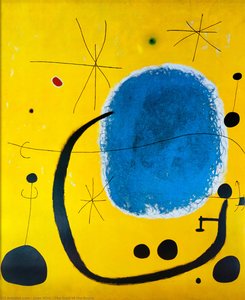
The painting depicts a vibrant circus scene, though far from a realistic portrayal. A bright blue ground serves as the arena, providing a striking backdrop for the central elements. The focal point is a stylized horse, seemingly in motion, rendered with simplified forms and bold colors. Above it, elongated shapes resembling wings or limbs extend upwards, creating a sense of dynamism and flight. A central figure, potentially representing a ringmaster, is suggested by a yellow whip that crisscrosses the canvas in an energetic, meandering line. The composition, while seemingly chaotic at first glance, possesses a remarkable balance, with overlapping elements contributing to a feeling of depth and visual interest. The strong vertical emphasis created by the upward thrust of the wing-like shapes adds to the painting's overall energy.
Style and Technique: Surrealism Meets Narrative Geometry
“Circus Horse” exemplifies Miró’s unique blend of Surrealist aesthetics and Klee-inspired geometric principles. The work is characterized by its abstraction, simplification of forms, and use of symbolic imagery. Miró's technique involves a smooth application of oil paint, likely achieved through brushwork or glazing techniques, resulting in a polished surface. The color palette is dominated by cool tones—deep blues and grays—which contrast with the lighter gray hues of the secondary shapes and the vibrant yellow of the whip. This interplay of colors enhances the painting's visual impact and contributes to its dreamlike quality. As critics noted in 1928, Miró seemed to operate "in the world of magic," a testament to his ability to evoke wonder and imagination through his art.
Historical Context: The Rise of Surrealism and Miró’s Artistic Development
Painted in 1927, “Circus Horse” emerged during a pivotal period in modern art history. The Surrealist movement was gaining momentum, challenging traditional artistic conventions and exploring the realm of dreams and the subconscious. Miró, deeply influenced by this movement, began to develop his own distinctive style, characterized by playful forms, vibrant colors, and symbolic imagery. His earlier influences included Vincent van Gogh and Paul Cézanne, whose expressive use of color and form resonated with Miró’s artistic sensibilities. The "dream" pictures created in 1927 represent a significant phase in Miró's development, showcasing his ability to create whimsical, dreamlike compositions that captivated audiences.
Symbolism and Emotional Impact: A Journey into the Subconscious
The symbolism within “Circus Horse” is open to interpretation, inviting viewers to engage with the artwork on a personal level. The horse, often associated with freedom and movement, takes on an abstracted form, suggesting a sense of liberation from conventional constraints. The whip, while potentially representing control, is rendered in a fluid, meandering line, implying a more playful and imaginative interaction. The bright blue background evokes a sense of vastness and possibility, creating a stage for the unfolding dreamlike narrative. Ultimately, “Circus Horse” invites viewers to embark on a journey into the subconscious, where imagination reigns supreme and familiar forms are transformed into something extraordinary.
Klausimai ir atsakymai
Kokį Žoanas Miro kūrybos etapą atitinka „Circus Horse“ data, nurodyta kaip 1927?
1927 m. data įtraugia „Circus Horse“ į Žoanas Miro kūrybinio plėtojimo Mid-Period laikotarpį.
Kaip galima panaudoti „Circus Horse“ – Žoanas Miro namų interjero dekoracijai?
„Circus Horse“ siūloma naudoti Manifestas, o rekomenduojama erdvė – Popieriaus svetainė.
Į kokį meno kryžminę ir kokį laikotarpį priskiriama „Circus Horse“ – Žoanas Miro?
„Circus Horse“ priklauso Surrealism krypčiai, o jo kūrėjas dirbo Modernizmas laikotarpiu.
Trumpos faktinės datos ir meno viktorina
Apie Žoanas Miro

Žoanas Miro
1893 - 1983, Ispanija
Autoriaus biografija
Katalonų Vizionierius: Žoano Miro Gyvenimas ir Menas
Žoanas Miro i Ferra, gimęs 1893 m. balandžio 20 d. Barselonoje, yra vienas reikšmingiausiu XX amžiaus menininkų. Jo kelionė nebuvo tik stiliumi kaita, bet ir vidinių pasaulių tyrinėjimas, sapnų, atminimų bei katalonų tapatybės perkėlimas ant drobės su unikalia poetiška vizualine kalba. Nuo kuklių pradžių, pažymėtų ligomis ir pradiniu tėvų nepritarimu jo meniniams siekiams, Miro išliko ryžtingas, vedamas įgimto poreikio išreikšti tai neturimą – emocijas, pojūčius bei pasąmonės sroves, kurios slypi už tikrovės paviršiaus. Jo ankstyvieji metai buvo įsipainioję į Barselonos tradicijas, miestą, kupinus architektūriniu stebuklų dėka Antonio Gaudí, kurio organinės formos subtiliai paveikė Miro vėlesnius abstraktumus. Tėvo aukso litavimo profesija įskiepijo apgalvoties meistriškumo vertinimo jausmą, o atšiaurus katalonų kraštovaizdis tapo dažnai pasikartojančiu motyvu ir įkvėpimo šaltiniu per visą jo karjerą.Ankstyvos Įtakos ir Kelias į Siurrealizmą
Miro formalus meninis mokymas prasidėjo La Llotja Barselonoje, kur jis tobulino savo įgūdžius taikant tradicinius metodus. Tačiau būtent susipažinimas su avangardiniais judėjimais, apraizgytais per Paryžių, tikrai sukūrė jo kūrybinę kaitą. Fauvizmo ryškios spalvos ir kubizmo fragmentuotos formos jį giliai paliovė, skatindamos persikelti į Paryžių 1920 m. Šis laikotarpis pasirodė esantis kertinis momentas, nes jis susitiko su tokiais menininkais kaip Pablas Pikaso ir pradėjo eksperimentuoti su vis labiau abstrakčiomis kompozicijomis. Tačiau Miro ne tik tiesiog priėmė šiuos stilius; jis juos sintezavo, sukurdamas kelią į savo išskirtinį estetiką. Jis siekė atskleisti formas iki jų esybės, atsisakydamas reprezentacinių detalių, palankiau simbolinėms formoms ir kvietiančioms spalvoms. Šis tyrimas nuvedė jį į Siurrealistų grupę 1924 m., sutraukdamas jį su tokiais menininkais kaip Maksas Ernstas ir Salvadoras Dalí. Priimdama siurrealistų susidomėjimo pasąmone, Miro išlaikė unikalų pojūtį – jo darbai buvo mažiau apie šokiruojančius vaizdus ar Freudo simbolizmą, o labiau apie žaidžiančių formų ir poetiškos sugestijos pasaulį.Simbolių Kalba: Pagrindiniai Darbai ir Meninės Naujovės
Per 1920-uosius ir 1930-uosius Miro išvystė savo unikalų vizualinį žodyną – pasaulį, apibūdinamą biomorfinėmis formomis, plaukiančiomis figūromis ir ryškiomis spalvomis. „Ūkis“ (1922 m.), dažnai laikomas jo kūrinio pagrindiniu akmeniu, puikiai iliustruoja šį perėjimą. Tai ne tik kaimo gyvenimo vaizdas, bet ir katalonų tapatybės sukeliamas pojūtis bei simbolinis natūralaus pasaulio atvaizdavimas. Jo bendradarbiavimo dvasia paskatino naujų technikų kūrimą, tokių kaip grattage*, kurią jis sukūrė kartu su Maksu Ernstu 1926 m. dizainams, skirtiems Sergejui Diaghilevo baletui, kur tekstūros buvo atskleidžiamos nubraukus dažus per drobę. Serija Olandiški interjerai (1928 m.)* parodė jo gebėjimą interpretuoti Senosios Meistrų kūrinį visiškai moderniu požiūriu, paversdamas buitinius vaizdus svajoniškais abstraktumais. „Tapyba“ (1933 m.), su ryškiomis spalvomis ir supaprastintomis formomis, apibendrina Miro tyrimą pasąmonės ir jo atmetimą įprastų meninių ribų. Be tapybos, Miro drąsiai eksperimentavo su skulptūra, keramika ir grafika, išplėsdamas savo kūrybinius horizontus ir parodydamas nepaprastą universalumą.Palikimas ir Nuolatinis Įtaka
Žoano Miro įtaka XX amžiaus menui yra neatsiejama. Jis nebuvo tik tapytojas; jis buvo vizionierius, kuris iššūkį metė pačiai meno raiškos apibrėžčiai. Jo darbai atidarė kelią abstraktaus ekspresionizmo atsiradimui ir toliau įkvepia menininkus visose disciplinuose. Jis įkūrė du fondus – Fundació Joan Miró Barselonoje (1975 m.) ir Fundació Pilar i Joan Miró Palmos de Maljorkos saloje (1981 m.), užtikrindamas, kad jo palikimas išliktų, suteikdamas erdvių meniniam tyrinėjimui ir edukacijai. Per visą savo ilgą karjerą jis liko įsipareigojęs peržengti ribas, sužadinti tradicijas ir tyrinėti žmogaus vaizduotės gelmes. Miro kūrinys yra liudijimas abstrakcijos, simbolizmo ir poetiškos raiškos galiai – ryški gyvenimo, sapnų ir katalonų kultūros atspindžio šventė. Jo darbai toliau rezonuoja su publikomis visame pasaulyje, kviešdami į žaidimų spalvų ir formų šokdyje, kuriame išnyksta tikrovės ir fantazijos ribos.Trumpa informacija apie Žoanas Miro
- Artistic Movement Or Style: Siurrealizmas, Abstrakcija
- Artists Or Movements Influenced By This Artist:
- Siurrealizmas
- Abstrakcija
- Artists Who Influenced This Artist:
- Van Gogas
- Sezanas
- Date Of Birth: 1893 m. balandžio 20 d.
- Date Of Death: 1983 m. gruodžio 25 d.
- Full Name: Žoanas Miro i Ferà
- Nationality: Ispanas
- Notable Artworks:
- Laūkynas
- Olandiški interjerai
- Tapyba
- Place Of Birth: Barselona, Ispanija
Tyrinėkite meno kūrinius, suskirstytus pagal temas, stilius ir savybes.



Žoanas Miro
Circus Horse
() ·
Su rėmu: · Rankiniu būdu tapyta aliejumi ant lineno
Viso suma