Autoriaus biografija
A Life Dedicated to Vilnius: The Architectural Legacy of Juozas Kamarauskas
Juozas Kamarauskas, born in 1874 in the small Lithuanian village of Skauradai near Troškūnai, was more than just an architect and artist; he was a chronicler of a vanishing world. His life unfolded against the backdrop of a Lithuania grappling with its identity under Russian imperial rule, a period that instilled within him a profound sense of national heritage and a determination to preserve it through art. Born into a farming family, Kamarauskas’s early connection to the land undoubtedly shaped his later fascination with the built environment – not as abstract structures, but as tangible embodiments of history and culture. He began his artistic journey at the Vilnius Drawing School under Ivan Trutnev, laying the foundation for his meticulous draftsmanship and realistic depiction of form. This initial training proved pivotal, leading him to St. Petersburg’s Central Baron A. Stieglitz School for Technical Drawing and later the Imperial Academy of Arts, where he honed skills that would become hallmarks of his unique artistic vision.
From Engineer to Artistic Documentarian
Kamarauskas's professional life initially took a practical turn as an engineer working on railway projects throughout Lithuania and Russia. However, this seemingly unrelated path proved crucial in developing his technical precision and understanding of spatial relationships – skills that would later be instrumental in his exhaustive documentation of Vilnius’s architecture. Around 1906, he embarked on a monumental undertaking: the systematic inventory of over 3,000 buildings in Vilnius. This wasn't merely an architectural survey; it was an act of cultural preservation, driven by a deep-seated fear that the city’s unique character was being eroded by modernization and political shifts. He created detailed drawings, colored panoramic plans distinguishing old from new structures, and street views capturing the urban evolution before World War I irrevocably altered the landscape. His work transcended simple representation; it was an attempt to capture the soul of Vilnius, its layered history etched into every facade and cobblestone.
The Watercolors of Memory: Reconstructing a Lost Past
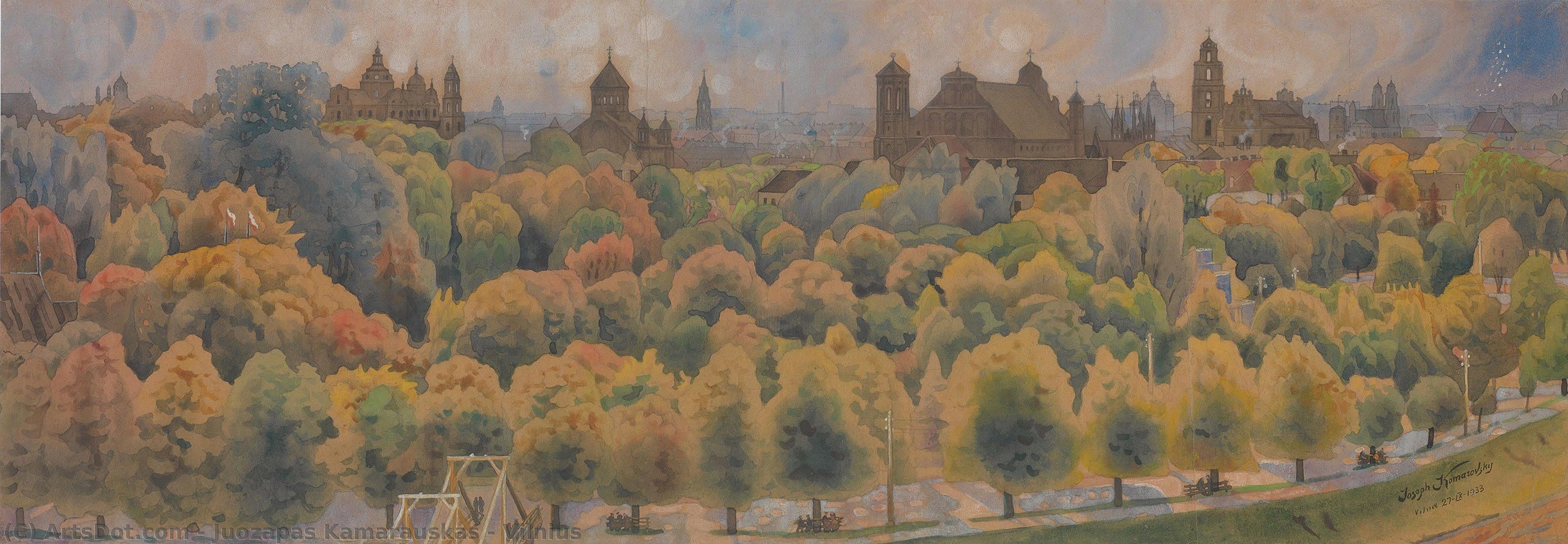
While his architectural drawings were meticulously accurate records, Kamarauskas’s watercolors reveal a more emotive side to his artistic practice. He didn't limit himself to documenting what *was*; he also sought to reconstruct what *had been*. Driven by old images and his own vivid imagination, he created stunning depictions of Vilnius as it once stood – the rulers’ castles and palaces, the imposing city walls with their towers, all brought back to life through delicate washes of color and precise detail. His most famous watercolor, “Vilnius” (1933), is a testament to this passion. It's not simply a picturesque view; it’s a carefully researched reconstruction of the Bernardine Gardens, complete with Polish flags reflecting the interwar political context, bustling paths, swings, and benches – a vibrant snapshot of life interwoven with historical memory. The sea of autumnal trees adds a layer of romanticism, while the precise rendering of buildings speaks to his unwavering commitment to accuracy.
Influences and Artistic Style
Kamarauskas’s artistic style was unique, blending technical precision with an almost nostalgic sensibility. While influenced by his training in St. Petersburg, he developed a distinctly Lithuanian voice, characterized by meticulous detail, realistic depiction, and a deep respect for historical context. He wasn't concerned with avant-garde experimentation; his focus lay on preserving the past rather than forging new artistic frontiers. His work shares affinities with topographical painting traditions but distinguishes itself through its sheer scale and dedication to documenting an entire city. Vladas Drėma’s seminal work, *Dingęs Vilnius* (Vanished Vilnius), owes a significant debt to Kamarauskas's meticulous records, demonstrating the lasting impact of his artistic endeavors on subsequent generations of Lithuanian scholars and artists.
Historical Significance and Enduring Legacy
Juozas Kamarauskas’s contribution to Lithuanian art history is immeasurable. He left behind a collection exceeding 4,000 works – drawings, watercolors, architectural reconstructions – that serve as an invaluable visual archive of Vilnius before the devastation of World War II and subsequent Soviet alterations. He wasn't merely an artist; he was a cultural guardian, safeguarding the memory of a city facing profound change. His work continues to inspire artists, architects, and historians today, offering a poignant glimpse into Lithuania’s rich past and reminding us of the importance of preserving our shared heritage. He died in 1946, leaving behind a legacy that ensures Vilnius's history will continue to be remembered and celebrated for generations to come.


 Peržiūrėti realybėje
 Pirkti spaudinį
 Pasidalinti
 Dalintis
 Išsamiau

 Atsisiųsti
 Panašūs eksponatai
 Rentgeno nuotrauka
 Automatinė diorama


 Skaityti daugiau






































 Stiklo variantas prieinamas tik pasirinkus dydį iki 110 cm



