

Paveikslėlyje: · Su rėmu:
 Peržiūrėti realaus dydžio版
 Pasidalinti
 Dalintis
 Išsamiau
 Vadovas

 Atsisiųsti
 Panašūs eksponatai
 Rentgeno spindulių nuotrauka
 Automatinė diorama
 问答
问答 Statistika

€ 485
Rankų darbo aliejinės reprodukcijos
Rankiniu būdu tapytas aliejus ant droblio jūsų pageidaujamame dydį ir rėmuose – tai mūsų menininkų pagal užsakymą sukurtas darbas. ( Perjungti į spausdinamus版作品 Perejti prie skaitmeninių vaizdų)
Dydis
·Standartinis dydis
pagal užsakymą
CM
INCH
Pasirinkite iš mūsų nustatytų dydžių, atitinkančių originalaus meno kūrinio proporcijas.
Kraunami dydžiai...

plotis
aukštis
Įveskite jums reikiamą plotį ir aukštį, kad paveikslas atitiktų jūsų rėmą ar sieną. Kadangi šis darbas yra rankinio darbo, siekiant išgauti kitokios formos dydį, paveikslas gali būti šiek tiek didesnis (nuo kraštų bus palikta daugiau erdvės) arba mažesnis – pasirinkite jums patogiausią variantą. Prieš pradedant tapyti, atsiųsime jums skaitmeninį maketą patvirtinimui. Šioje puslapio nuotraukoje matomas vaizdas nėra galutinis rezultatas – jį parodys tik sukurtas maketas.
 Skaityti daugiau
Baigiamasis etapas
·
Baltas apasutojimas €1

Išblėstantis šonas €1

Išplėstinis €1

P118B €10

P118H €10

P118W €10

P438Z €10

P508JH €12

P508YH €12

P805H €10

P805Z €10

P919BZ €10

P919G €10

P919XJ €10

P959ZH €10

P968JZ €12

W106C €8

W218G €10

W218JH €8

W218Y €10

W307PJ €10

W316G €10

W316PJ €8

W316Y €10

W398PJ €8

W4111J €10

W500HY €15

W500JH €15

W692G €12

W849H €8

W940BG €15

W953PJ €8

H24-GOLD €30

H24-SILVER €30

H36-GOLD €45

H36-SILVER €45
Siunčiama saugiame vamzdelyje, paruošta patys sukomentuoti jūsų rėmeliais.
Virš 105 cm rėmas siunčiamas kaip rinkinys profesionaliam rėmininkui — skaitykite detales.
Papildomos paslaugos
nebūtinaKą apima papildomos paslaugos?
Pavyzdžiai, ką galima pakeisti: pakeisti veidą nuotrauka su klientu; pridėti augintinį (pvz., pakeisti kucingą šuniu); įtraukti paslaptingą žinutę fone; pakeisti fono kraštotvę ar elementus.
Gavus užsakymą, TopImpressionists.com komanda susisieks su klientu el. paštu dėl nurodymų ir pateiks preliminarią maketą.
Gavus užsakymą, TopImpressionists.com komanda susisieks su klientu el. paštu dėl nurodymų ir pateiks preliminarią maketą.
Pristatymas visame pasaulyje () per 3–4 savaites, o ne įprastai – per 5 savaites. (6 lapkritis). Kokybė lieka nepakeičiama.
Apsauginis lakas
Pavadinimo lentelė
Išgraviruotos bronzinės plokštelės detalės
This elegant plaque features the artist's name and the title of the artwork, finely engraved for a timeless presentation.
It is made from bronze with a refined, elegant finish. The text is precisely laser-engraved for a sharp and permanent result. Measuring 9x2 cm, the plaque is compact yet easy to read. It's built to be durable and scratch-resistant, offering a professional, museum-quality look. Mounting is simple thanks to the included adhesive backing.
Skaidrios akrilo plokštelės informacija
The plaque includes essential engraved details such as the artist's name, the title of the artwork, the date it was created, the type of media used-like oil on canvas or watercolor-a brief description of the piece, and a QR code that links to the complete artwork information.
It is crafted from clear acrylic, offering a sleek, modern appearance. The text is UV-engraved in black to ensure strong visual contrast. With a size of 10x15 cm, it ensures optimal readability. It comes equipped with two metal hooks for secure wall mounting. The plaque is designed to be weather-resistant, making it suitable for various environments, and it includes interactive features that work seamlessly with smartphone scanning.
Juodos akrilo plokštelės informacija
This elegant plaque includes engraved information such as the artist's name, the title of the artwork, the date it was created, the type of media used (like oil on canvas or watercolor), a short description of the artwork, and a QR code for quick access to more information.
The plaque itself is made from refined black acrylic with a premium finish. The text is laser-engraved in white for high contrast and readability. Its size is 10x15 cm, designed to be easy to read. It comes with two metal hooks for professional mounting. The design is sleek and fits any interior style. It is also weather-resistant and durable, with built-in digital integration for mobile compatibility.
Stiklo variantas prieinamas tik pasirinkus dydį iki 110 cm
 Stiklo variantas prieinamas tik pasirinkus dydį iki 110 cm
- Nemokamas greitasis pristatymas visame pasaulyje
- Aukštos kokybės lininis drobė
- Pilnas siuntimo draudimas
- Muitinės mokesčių grąžinimo garantija
- Tikro spalvų atitikimo garantija
- 100 dienų grąžinimo politika (tik esant įtaigoms)
- 100% pinigų grąžinimo garantija
- Nuolaida dideliems užsakymams


Kolekcinio objekto aprašas
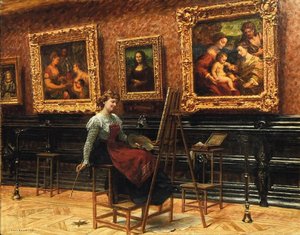
Explore 'A la gloire de Rubens' by Louis Beroud – a vibrant Baroque masterpiece inspired by Rubens! Capturing opulent revelry & sensual energy, this oil painting offers a glimpse into 19th-century Parisian art.
Autoriaus biografija
Atraskite Louis Beroud (1852-1930), prancūzų paveislininko, garsaus savo detalizuotais Paryžiaus interjerų ir lankytinų vietų vaizdais, įskaitant Le Louvre ir Opera Garnier.
Apie paveisdelį
À la gloire de Rubens – A Celebration of Baroque Grandeur
Louis Béroud’s “À la gloire de Rubens” is more than just a depiction of a painting; it's an embodiment of the artistic spirit of its time—the fervent embrace of academic tradition alongside a keen observation of modern life that characterized Parisian art in the early 20th century. Painted in 1905, this monumental canvas captures the atmosphere of the Louvre Museum during a period marked by significant cultural renewal and intellectual curiosity. The artwork’s subject matter is deceptively simple: a young woman diligently sketching “The Coronation” by Peter Paul Rubens from his celebrated Marie de Medici cycle—a masterpiece that embodies the Baroque ideal of dramatic grandeur and emotional intensity.- Composition & Style: Béroud adheres to the stylistic conventions of the École de Beaux-Arts, prioritizing clarity of form and meticulous detail. The scene unfolds within a richly ornamented interior space reminiscent of Rubens’s own studio, emphasizing architectural perspective and creating a sense of spatial depth. However, unlike Rubens's canvases which aim for idealized beauty, Béroud presents a realistic portrayal of artistic practice—a testament to the artist’s commitment to capturing the essence of his subject matter.
- Technique: Employing oil paint on canvas with visible brushstrokes, Béroud utilizes impasto – thick application of pigment – particularly noticeable in areas depicting drapery and skin tones. This technique lends texture and luminosity to the painting, mirroring the dramatic chiaroscuro employed by Rubens himself. The artist’s careful attention to light and shadow contributes significantly to the overall theatrical quality of the composition.
- Historical Context: Béroud's work emerged during a period of artistic debate following Impressionism’s dominance. Artists like Béroud sought to reaffirm classical principles while acknowledging the influence of contemporary life—a dynamic tension that reflects broader cultural shifts occurring in France at the time. The painting’s inclusion within the Louvre’s collection underscores its significance as an exemplar of academic art and a celebration of Rubens's legacy.
- Symbolism: The central figure, sketching “The Coronation,” symbolizes the dedication to artistic craft and the pursuit of excellence—values deeply ingrained in the Beaux-Arts tradition. The inclusion of Rubens’s monumental painting serves as a visual reminder of the Baroque aesthetic’s ambition to inspire awe and convey profound emotion.
- Emotional Impact: “À la gloire de Rubens” evokes a feeling of reverence for artistic heritage combined with an appreciation for meticulous observation. It invites viewers to contemplate the role of art in capturing beauty, conveying emotion, and preserving cultural memory—themes that resonate powerfully across generations.
Detailed Description & Artistic Considerations
The painting’s palette is dominated by muted earth tones – ochre, umber, Sienna – reflecting the subdued lighting of the Louvre’s galleries. Béroud skillfully renders textures with remarkable precision, capturing the folds of fabric and the subtle nuances of skin tone. The artist's meticulous brushwork contributes to a palpable sense of movement—suggesting the dynamism inherent in artistic creation itself. Careful attention is paid to architectural elements – moldings, arches – reinforcing the spatial illusion and enhancing the grandeur of the setting. Béroud’s masterful technique elevates the depiction beyond mere representation, transforming it into an evocative meditation on art history and artistic practice.Provenance & Acquisition
“À la gloire de Rubens” entered the Louvre's collection in 1993 as a bequest from Micheline Héblot (1930-1990), honoring her parents’ memory. The painting was originally exhibited at the Salon of Société des Artistes français in 1905 and subsequently reproduced as prints during that era. Its inclusion in Musée Carnavalet's permanent collection provides invaluable insight into Parisian artistic culture at the turn of the century.Further Research & Artistic Influences
Louis Béroud’s artistic trajectory was profoundly shaped by his training at the École Supérieure des Beaux-Arts, where he absorbed the precepts of classical art and technique. His unwavering devotion to realism combined with an artist's sensitivity distinguishes him as a pivotal figure in late 19th-century French painting—a legacy that continues to inspire artists today. References: Musée Carnavalet; Louvre éditions / Somogy, 2008, p. 149, coul. n°178; Bresc-Bautier, Geneviève ; Foucart, Jacques, « Le tableau du mois n° 9 : trois nouveaux tableaux pour l’histoire du Louvre : Louis Béroud, Henri Coroënne », Tableau du mois, 9, du 7 septembre au 3 octobre 1994, 1994, 1-4, p. 1-4, n&b, p. 1, B; Musée du Louvre, Département des Peintures; Bresc-Bautier, Geneviève ; Foucart, Jacques, « Le tableau du mois n° 9 : trois nouveaux tableaux pour l’histoire du Louvre : Louis Béroud, Henri Coroënne », Tableau du mois, 9, du 7 septembre au 3 octobre 1994, 1994, 1-4, p. 1-4, n&b, p. 1, B; Musée Carnavalet; Louvre éditions / Somogy, 2008, p. 149, coul. n°178; Musée du Louvre, Département des Peintures; Bresc-Bautier, Geneviève ; Foucart, Jacques, « Le tableau du mois n° 9 : trois nouveaux tableaux pour l’histoire du Louvre : Louis Béroud, Henri Coroënne », Tableau du mois, 9, du 7 septembre au 3 octobre 1994, 1994, 1-4, p. 1-4, n&b, p. 1, B; Musée Carnavalet; Louvre éditions / Somogy, 2008, p. 149, coul. n°178Klausimai ir atsakymai
Į kokį kambarį rekomenduojamas „A la gloire de Rubens“ – Lui Berudas?
Rekomenduojama erdvė kūriniui „A la gloire de Rubens“ – Lui Berudas yra Living Room. Šią rekomendaciją, žinoma, galima pritaikyti prie jūsų interjero.
Kur ir kokiam tikslui rekomenduojamas „A la gloire de Rubens“?
Rekomenduojamas naudojimas (Accent) ir erdvė (Living Room) – tai dvi rekomendacijos, nurodytos kūriniui „A la gloire de Rubens“ – Lui Berudas.
Kam rekomenduojamas naudojimui „A la gloire de Rubens“ spausdinys?
Rekomenduojamas „A la gloire de Rubens“ spausdinio naudojimas yra Accent.
Trumpos faktinės datos ir meno viktorina
Apie Lui Berudas
Lui Berudas
1852 - 1930, Prancūzija
Autoriaus biografija
Louis Beroud: Parisietiškas vizionierius, įtrapęs savo laikotakių dvasią
Louis Beroud (1852–1930) iškyla kaip iškilminga XIX amžiaus pabaigos ir XX amžiaus pradžios Prancūzijos meno veikėja, šlovėje dėl savo kruopštaus Paryžiaus interjerų ir lankytinų vietų – ypač Luvro muziejaus bei Opera Garnier – vaizdinimo. Gimęs Liūone, Prancūzijoje, Beroud kūrybinis kelias išskleidė savo pradinę plėstrą mažėjančio impresionizmo įtakos fone, taip tvirtai įtvirtindamas jį akademistų tradicijoje, tačiau kartu demonstruodamas subtilų modernaus gyvenimo suvokimą. Jo drobės kviečia į pasaulį, pasenusį prabanga, detalėmis ir psichologiniu pastebėjimu – tai yra neabejingas jo ištikimybės realizmui bei meninystės jautrumo įrodymas.- Anslingasis gyvenimas ir meninė mokslė:* Beroud savo pirmąjį meno išsilavinimą gavo Paryzjuje, École Supérieure des Beaux-Arts mokykloje, kur tobulino savo įgūdžius po įtakingų mokytojų, gynėjų klasikinio kompozicijos ir technikos principus. Šis formavimo laikotarpis jį įtvirtino gilią pagarbą tradicijai, kartu puoselėdamas tyrinėją dvasią, kuri vėliau paskatino jį tyrinėti įvairias temas ir stilius.
- Žinomos kūriniai ir meninė stilistika:* Beroud kūrybos veikalas apima stulbinančią temų įvairovę – nuo monumentalios architektūros vaizdinio, tokių kaip jo garsieji Luvro ir Opera Garnier pavaizdujimai, iki jautrių portretų, įtrapusių Paryžiaus gyvenimo esmę. Jo paveikslams būdingas itin kruopštus dėmesys detalėms, meistriškas šviesos ir šešėlio naudojimas bei gebėjimas išskirtiniu tikslumu perteikti atmosferą. Jis meistriškai sujungė akademinį realizmą su išraiškingais traukės, kurdamas paveikslus, kurie rezonuoja tiek intelektiniu griežtumu, tiek emociniu gyliu.
Incidentas Luvre: Surrealistinio humoro akimirka
Galbūt Beroud didžiausią ilgalaikę šlovę jam suteikė nepamirštama istorija jo lankomumo Luvro muziejuje 1911 m. vasarį. Siekdamas rasti įkvėpimo paveikslukui, skirtam pažymėti muziejaus šimtmetį, Beroud atvyko piešti „Mona Lisa au Louvre“, tačiau rado tik tuštumą – Leonardo da Vinci ikoniškas portretas buvo išnykęs, o jo vietoje palikti keturi geležiniai varžtai, laikantys paveikslą prie sienos. Ši keista aplinkybė paskatino tyrimą dėl šedevro pavagio ir sudominė viso Paryžiaus visuomenę. Šis įvykis tapo simboliu nerimo dėl meno autentiškumo ir modernumo įsivėmimo į senovines institucijas.- Muzieciniai užsakymas ir meninė pripažinimas:* Beroud reputacija kaip paveikslūsto stiprėjo dėkingas daugybei užsakymų iš žinomų kultūros organizacijų, įskaitant patį Luvrą. Šie projektai leido jam parodyti savo talentą didiniu mastu ir sutvirtino jo vietą kaip vieno svarbiausių savo laikotarpio Prancūzijos menininkų.
- Įtaka ir palikimas:* Beroud meninė stilistika – pasižyminti kruopščiu realizmu ir psichologiniu įžvalgumu – paveikė būsimas paveikslūstų kartas, ypač tuos, kurie siekė įamžinti miesto gyvenimo sudėtingumą. Jo darbai ir toliau vertinami dėl jų techninio meistriškumo bei evokuojančio Paryžiaus visuomenės vaizdo Belle Époque laikotarpiu, užtvirtindami jo palikimą kaip pagrindinės prancūziškos meno istorijos figūros.
Paryžiaus erdvės tyrimas: nuo grandioziškų salų iki tylių kampelių
Beroud meninė dėmesio centras sukauptas kruopščiai dokumentuojant Paryžiaus aplinką – tiek monumentalią, tiek buitinę. Jis su kvapaudinčiu tikslumu įamžino tokių architektūriškų erdvių didybę kaip Opera Garnier ir Louvre, taikydamas technikas, kurios atitiko to meto akademistų mėgstamas metodus. Simultaniškai jis tyrinėjo kasdienio gyvenimo subtilybes per jautrius portretus ir scenas, vaizduojančias paprastus paryjiečius jų kasdienėse rutinėse. Šios drobės suteikia neįvertinjamą įžvalgą į Belle Époque socialinį ir kultūrinį peizažą – laikotarpį, pažymėtą sparčia industrializacija, menine inovacija ir augančia modernumo fascinacija.Žinomos paveikslai ir muziejų parodos
Tarp garsiausių Beroud kūrybos veikalų yra „Avenue de la Gare in Nice“ bei „Le dôme central de la galerie des machines à l'exposition universelle de 1889“, kurie demonstruoja jo įsipareigojimą įamžinti savo laikotakio dvasią. Jo paveikslai galima rasti prestižinguose muziekuose visoje Prancūzijoje, įskaitant Luvro muziejų ir Saint Louis Art Museum, kur jie ir toliau įkvepia žiūrėtojus savo menine vertė ir istorine reikšme.Trumpa informacija apie Lui Berudas
- Artistic Movement Or Style: Akademinis realizmas
- Artists Or Movements Influenced By This Artist: ['Art deco']
- Artists Who Influenced This Artist: ['Gustave Moreau']
- Date Of Birth: 1852 m., Lyonas, Prancūzija
- Date Of Death: 1930 m.
- Full Name: Louis Beroud
- Nationality: Prancūzų
- Notable Artworks:
- Avenue de la Gare Nice mieste
- Le dôme central de la galerie des machines à l'exposition universelle de 1889
- Barono Schlichting biuras
- Place Of Birth: Lyonas, Prancūzija

Lui Berudas
A la gloire de Rubens
() ·
Su rėmu: · Rankiniu būdu tapyta aliejumi ant lineno
Viso suma