

Shown: · With its frame:
 Peržiūrėti realaus dydžio版
 Pasidalinti
 Dalintis
 Išsamiau
 Vadovas

 Atsisiųsti
 Panašūs eksponatai
 Rentgeno spindulių nuotrauka
 Automatinė diorama
 Q&A
Q&A Statistika
Pansy Waltz


€ 237
Rankų darbo aliejinės reprodukcijos
Rankiniu būdu tapytas aliejus ant droblio jūsų pageidaujamame dydį ir rėmuose – tai mūsų menininkų pagal užsakymą sukurtas darbas. ( Perjungti į spausdinamus版作品 Perejti prie skaitmeninių vaizdų)
Size
·Standartinis dydis
pagal užsakymą
CM
INCH
Pasirinkite iš mūsų nustatytų dydžių, atitinkančių originalaus meno kūrinio proporcijas.
Loading sizes...

plotis
aukštis
Įveskite jums reikiamą plotį ir aukštį, kad paveikslas atitiktų jūsų rėmą ar sieną. Kadangi šis darbas yra rankinio darbo, siekiant išgauti kitokios formos dydį, paveikslas gali būti šiek tiek didesnis (nuo kraštų bus palikta daugiau erdvės) arba mažesnis – pasirinkite jums patogiausią variantą. Prieš pradedant tapyti, atsiųsime jums skaitmeninį maketą patvirtinimui. Šioje puslapio nuotraukoje matomas vaizdas nėra galutinis rezultatas – jį parodys tik sukurtas maketas.
 Skaityti daugiau
Finish
·
White €1

Blurside €1

Extended €1

P118B €10

P118H €10

P118W €10

P438Z €10

P508JH €12

P508YH €12

P805H €10

P805Z €10

P919BZ €10

P919G €10

P919XJ €10

P959ZH €10

P968JZ €12

W106C €8

W218G €10

W218JH €8

W218Y €10

W307PJ €10

W316G €10

W316PJ €8

W316Y €10

W398PJ €8

W4111J €10

W500HY €15

W500JH €15

W692G €12

W849H €8

W940BG €15

W953PJ €8

H24-GOLD €30

H24-SILVER €30

H36-GOLD €45

H36-SILVER €45
Shipped in a protective tube, ready for your own framer.
Above 105 cm the frame is shipped as a kit for a professional framer — read the details.
Extras
optionalWhat do the extras include?
Examples of what can be changed: Replace face with customer photo; Add pet (e.g., replace cat with dog); Include hidden message in background; Change background landscape or elements.
After order, TopImpressionists.com team will email client for instructions and provide a mockup preview
After order, TopImpressionists.com team will email client for instructions and provide a mockup preview
Pristatymas visame pasaulyje () per 3–4 savaites, o ne įprastai – per 5 savaites. (29 spalis). Kokybė lieka nepakeičiama.
Apsauginis lakas
Pavadinimo lentelė
Išgraviruotos bronzinės plokštelės detalės
This elegant plaque features the artist's name and the title of the artwork, finely engraved for a timeless presentation.
It is made from bronze with a refined, elegant finish. The text is precisely laser-engraved for a sharp and permanent result. Measuring 9x2 cm, the plaque is compact yet easy to read. It's built to be durable and scratch-resistant, offering a professional, museum-quality look. Mounting is simple thanks to the included adhesive backing.
Skaidrios akrilo plokštelės informacija
The plaque includes essential engraved details such as the artist's name, the title of the artwork, the date it was created, the type of media used-like oil on canvas or watercolor-a brief description of the piece, and a QR code that links to the complete artwork information.
It is crafted from clear acrylic, offering a sleek, modern appearance. The text is UV-engraved in black to ensure strong visual contrast. With a size of 10x15 cm, it ensures optimal readability. It comes equipped with two metal hooks for secure wall mounting. The plaque is designed to be weather-resistant, making it suitable for various environments, and it includes interactive features that work seamlessly with smartphone scanning.
Juodos akrilo plokštelės informacija
This elegant plaque includes engraved information such as the artist's name, the title of the artwork, the date it was created, the type of media used (like oil on canvas or watercolor), a short description of the artwork, and a QR code for quick access to more information.
The plaque itself is made from refined black acrylic with a premium finish. The text is laser-engraved in white for high contrast and readability. Its size is 10x15 cm, designed to be easy to read. It comes with two metal hooks for professional mounting. The design is sleek and fits any interior style. It is also weather-resistant and durable, with built-in digital integration for mobile compatibility.
Stiklo variantas prieinamas tik pasirinkus dydį iki 110 cm
 Stiklo variantas prieinamas tik pasirinkus dydį iki 110 cm
- Nemokamas greitasis pristatymas visame pasaulyje
- Aukštos kokybės lininis drobė
- Pilnas siuntimo draudimas
- Muitinės mokesčių grąžinimo garantija
- Tikro spalvų atitikimo garantija
- 100 dienų grąžinimo politika (tik esant įtaigoms)
- 100% pinigų grąžinimo garantija
- Nuolaida dideliems užsakymams


Kolekcinio objekto aprašas
Paul de Longpre’s ‘Pansy Waltz’ watercolor captures serene beauty & nostalgic charm. Explore this realistic yet romantic floral still life – a timeless piece of 19th-century art.
Autoriaus biografija
Paul de Longpré (1855-1911) was a celebrated French & American flower painter renowned for his delicate watercolors. Discover the artist behind 'Le Roi de Fleur,' a pioneer of California art and Hollywood history, known for botanical accuracy & vibra
About the painting
Quick facts and art quiz
About Paul de Longpré

Paul de Longpré
1855 - 1911, France
Autoriaus biografija
A Pioneer of California Impressionism
Paul de Longpré (1855-1911) stands as a singular figure in the annals of American art history—a French expatriate who irrevocably shaped the aesthetic landscape of Hollywood and championed botanical accuracy with an unparalleled sensitivity. Born in Lyon, France, he embarked on an artistic journey entirely independent of formal training, honing his skills through observation and tireless dedication. From the tender age of twelve, he established himself as a successful painter of fans—a craft that demanded meticulous detail and a profound understanding of color and texture—laying the groundwork for his later mastery of watercolor.
His breakthrough came in 1876 when he debuted at the Paris Salon, attracting immediate attention and marking the commencement of a distinguished artistic career. However, fortune proved fickle; a disastrous investment in Parisian banking plunged him into financial hardship, prompting him to relocate to New York City in 1890. Despite facing adversity, de Longpré persevered, securing considerable acclaim for his floral paintings at an exhibition held in 1896—a pivotal moment that cemented his reputation as a visionary artist. His ability to capture the ephemeral beauty of nature through delicate washes and precise linework allowed his work to transcend mere illustration, reaching a level of fine art that resonated deeply with the public.
The Hollywood Estate and Botanical Mastery
Driven by a desire to foster cultural enrichment within the burgeoning city of Hollywood, philanthropist H.H. Wilcox generously bestowed upon him three acres of land on Cahuenga Canyon – a location that would become synonymous with California’s artistic spirit. Collaborating with architect Louis Bourgeois, de Longpré envisioned a magnificent residence embodying Mission Revival style—a deliberate homage to Spanish colonial architecture—complete with an expansive flower garden designed to inspire creativity and serve as a backdrop for his artwork. The gallery within the home was specifically conceived to showcase his botanical wonders, turning his private sanctuary into a major cultural landmark.
This estate became more than just a residence; it was a living laboratory of color. De Longpré planted thousands of rose bushes, creating a lush, immersive environment that fed his obsession with perfection. He famously painted only the most flawless specimens, seeking to unite scientific botanical knowledge with an emotive, artistic touch. His works, such as Double Peach Blossoms and White Fringed Poppies, achieved immense popularity through widespread reproductions in magazines and seed packages, making him a household name across the United States. Through his brush, the delicate essence of a petal or the subtle gradient of a bloom was immortalized, bridging the gap between the natural world and the human soul.
Legacy of a Floral Visionary
The historical significance of Paul de Longpré lies in his unique ability to blend the precision of a naturalist with the romanticism of an Impressionist. While his technical skill allowed for the mass reproduction of his art, the emotional depth of his watercolors remained intact, capturing a sense of fleeting beauty that continues to captivate collectors today. His influence can be seen in the way he helped establish Southern California as a legitimate center for fine art, moving the focus away from purely European traditions toward a new, vibrant American aesthetic.
Today, his legacy is preserved in prestigious institutions such as the Los Angeles County Museum of Art and the Irvine Museum. He remains remembered not just as a painter of flowers, but as an architect of culture who transformed a dusty canyon into a blooming paradise of artistic inspiration. His life serves as a testament to the power of resilience and the enduring allure of the natural world.
Trumpa informacija
- Full Name: Paul de Longpré
- Nationality: French
- Date Of Birth: 1855
- Date Of Death: 1911
- Place Of Birth: Lyon, France
- Notable Artworks:
- Le Roi de Fleur
- Landscape at Feu de Broussailles
- Pansy Waltz
- Artistic Movement Or Style: Flower Painting
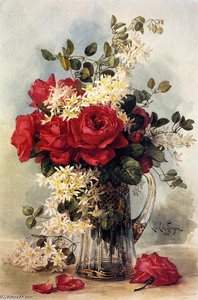


Pansy Waltz
·