

Shown: · With its frame:
 Peržiūrėti realaus dydžio版
 Pasidalinti
 Dalintis
 Išsamiau
 Vadovas

 Atsisiųsti
 Panašūs eksponatai
 Rentgeno spindulių nuotrauka
 Automatinė diorama
 Q&A
Q&A Statistika
- 105.0 x 108.0 cm


€ 239
Rankų darbo aliejinės reprodukcijos
Rankiniu būdu tapytas aliejus ant droblio jūsų pageidaujamame dydį ir rėmuose – tai mūsų menininkų pagal užsakymą sukurtas darbas. ( Perjungti į spausdinamus版作品 Perejti prie skaitmeninių vaizdų)
Size
·Standartinis dydis
pagal užsakymą
CM
INCH
Pasirinkite iš mūsų nustatytų dydžių, atitinkančių originalaus meno kūrinio proporcijas.
Loading sizes...

plotis
aukštis
Įveskite jums reikiamą plotį ir aukštį, kad paveikslas atitiktų jūsų rėmą ar sieną. Kadangi šis darbas yra rankinio darbo, siekiant išgauti kitokios formos dydį, paveikslas gali būti šiek tiek didesnis (nuo kraštų bus palikta daugiau erdvės) arba mažesnis – pasirinkite jums patogiausią variantą. Prieš pradedant tapyti, atsiųsime jums skaitmeninį maketą patvirtinimui. Šioje puslapio nuotraukoje matomas vaizdas nėra galutinis rezultatas – jį parodys tik sukurtas maketas.
 Skaityti daugiau
Finish
·
White €1

Blurside €1

Extended €1

P118B €10

P118H €10

P118W €10

P438Z €10

P508JH €12

P508YH €12

P805H €10

P805Z €10

P919BZ €10

P919G €10

P919XJ €10

P959ZH €10

P968JZ €12

W106C €8

W218G €10

W218JH €8

W218Y €10

W307PJ €10

W316G €10

W316PJ €8

W316Y €10

W398PJ €8

W4111J €10

W500HY €15

W500JH €15

W692G €12

W849H €8

W940BG €15

W953PJ €8

H24-GOLD €30

H24-SILVER €30

H36-GOLD €45

H36-SILVER €45
Shipped in a protective tube, ready for your own framer.
Above 105 cm the frame is shipped as a kit for a professional framer — read the details.
Extras
optionalWhat do the extras include?
Examples of what can be changed: Replace face with customer photo; Add pet (e.g., replace cat with dog); Include hidden message in background; Change background landscape or elements.
After order, TopImpressionists.com team will email client for instructions and provide a mockup preview
After order, TopImpressionists.com team will email client for instructions and provide a mockup preview
Pristatymas visame pasaulyje () per 3–4 savaites, o ne įprastai – per 5 savaites. (2 lapkritis). Kokybė lieka nepakeičiama.
Apsauginis lakas
Pavadinimo lentelė
Išgraviruotos bronzinės plokštelės detalės
This elegant plaque features the artist's name and the title of the artwork, finely engraved for a timeless presentation.
It is made from bronze with a refined, elegant finish. The text is precisely laser-engraved for a sharp and permanent result. Measuring 9x2 cm, the plaque is compact yet easy to read. It's built to be durable and scratch-resistant, offering a professional, museum-quality look. Mounting is simple thanks to the included adhesive backing.
Skaidrios akrilo plokštelės informacija
The plaque includes essential engraved details such as the artist's name, the title of the artwork, the date it was created, the type of media used-like oil on canvas or watercolor-a brief description of the piece, and a QR code that links to the complete artwork information.
It is crafted from clear acrylic, offering a sleek, modern appearance. The text is UV-engraved in black to ensure strong visual contrast. With a size of 10x15 cm, it ensures optimal readability. It comes equipped with two metal hooks for secure wall mounting. The plaque is designed to be weather-resistant, making it suitable for various environments, and it includes interactive features that work seamlessly with smartphone scanning.
Juodos akrilo plokštelės informacija
This elegant plaque includes engraved information such as the artist's name, the title of the artwork, the date it was created, the type of media used (like oil on canvas or watercolor), a short description of the artwork, and a QR code for quick access to more information.
The plaque itself is made from refined black acrylic with a premium finish. The text is laser-engraved in white for high contrast and readability. Its size is 10x15 cm, designed to be easy to read. It comes with two metal hooks for professional mounting. The design is sleek and fits any interior style. It is also weather-resistant and durable, with built-in digital integration for mobile compatibility.
Stiklo variantas prieinamas tik pasirinkus dydį iki 110 cm
 Stiklo variantas prieinamas tik pasirinkus dydį iki 110 cm
- Nemokamas greitasis pristatymas visame pasaulyje
- Aukštos kokybės lininis drobė
- Pilnas siuntimo draudimas
- Muitinės mokesčių grąžinimo garantija
- Tikro spalvų atitikimo garantija
- 100 dienų grąžinimo politika (tik esant įtaigoms)
- 100% pinigų grąžinimo garantija
- Nuolaida dideliems užsakymams


Kolekcinio objekto aprašas
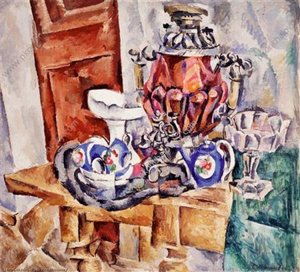
Experience Konchalovsky's 'Still Life with a Coffeepot,' a vibrant 1919 Fauvist masterpiece! Bold colors & Cubist influences create a harmonious, balanced scene.
Autoriaus biografija
Rusų dailininkas Pyotr Konchalovskis (1876–1956) – impresionizmo, fovizmo ir socialistinio realizmo stiliumi kūręs menininkas. Apžvelkite jo peizažus, portretus bei ikoninius darbus, atspindinčius Rusijos istoriją.
About the painting
Still Life with a Coffeepot: A Fauvist Celebration of Everyday Objects
Pyotr Konchalovsky’s Still Life with a Coffeepot, painted in 1919, is a vibrant and captivating example of the Fauvist movement. Measuring 105 x 108 cm, this artwork transcends a simple depiction of domestic items; it's an exploration of color, form, and the expressive potential of paint itself.
Composition and Subject Matter
The painting presents a carefully arranged still life set upon a table draped with a warm yellow cloth. The scene is populated with familiar objects: a blue vase brimming with flowers, a small white bowl holding green fruits (likely limes), and the titular yellow teapot. These elements are not rendered with photographic realism but rather simplified and stylized to emphasize their inherent shapes and colors. The background, painted in varying shades of blue, provides a cool counterpoint to the warmer tones dominating the foreground, creating visual balance and depth. The arrangement isn't haphazard; it demonstrates Konchalovsky’s skill in orchestrating a harmonious composition that guides the viewer's eye across the canvas.
Fauvist Style and Influences
Konchalovsky was deeply influenced by French Impressionism and, most notably, Fauvism. The term "Fauve" (meaning “wild beast”) was applied to artists who utilized bold, non-naturalistic colors and expressive brushstrokes. Still Life with a Coffeepot exemplifies these characteristics. The colors are not used to accurately represent the objects but rather to evoke emotion and create visual impact. The visible brushwork adds texture and dynamism to the painting, further distancing it from traditional realism. One can also detect echoes of Paul Cézanne’s influence in Konchalovsky's approach to form and structure, particularly in the way he simplifies shapes and explores spatial relationships.
Historical Context and Artistic Significance
Created in 1919, shortly after the Russian Revolution, this painting reflects a period of significant social and artistic upheaval. Konchalovsky was a member of the Jack of Diamonds group, a collective of artists who actively challenged traditional representational art forms. This group sought to introduce modern European trends – particularly Fauvism and Cubism – into the Russian art scene. Still Life with a Coffeepot stands as a testament to this artistic rebellion, showcasing Konchalovsky’s contribution to the development of Fauvism within the context of Russian art. It represents a move away from academic conventions towards a more expressive and subjective approach to painting.
Emotional Impact and Lasting Appeal
Beyond its historical significance, Still Life with a Coffeepot possesses an undeniable emotional appeal. The vibrant colors and dynamic brushstrokes create a sense of energy and vitality. While the subject matter is commonplace – everyday objects found in a home – Konchalovsky elevates it to something extraordinary through his artistic vision. The painting evokes feelings of warmth, comfort, and perhaps even a touch of nostalgia. It’s a celebration of the beauty that can be found in the ordinary, rendered with an exuberance that continues to captivate viewers today.
Klausimai ir atsakymai
Kaip „Still Life with a Coffeepot“ tema susiję su įprastomis Petras Končalovskis tematikos temos?
Tarp užfiksuotų Petras Končalovskis temų – french impressionism, fauvism influence, paul cezanne’s style, everyday objects depicted artfully, russian art development, breaking from traditional art, contribution to fauvism – kūrinys „Still Life with a Coffeepot“ akcentuoja still life, coffeepot, flowers, tableware, fauvism, composition, warm colors, blue vase.
Kokia spausdinimo konfigūracija rekomenduojama kūriniui „Still Life with a Coffeepot“ – Petras Končalovskis?
Medium dydis, Square orientacija: tai rekomenduojamas spausdinimo nustatymas kūriniui „Still Life with a Coffeepot“ – Petras Končalovskis.
Ar galima atsisiųsti „Still Life with a Coffeepot“ vaizdą?
Kūrinio „Still Life with a Coffeepot“ – Petras Končalovskis vaizdą galite atsisiųsti puslapio Atsisiųsti skaitmeninį vaizdą skiltyje: aukštos raiškos skaitmeninio vaizdo atsisiuntimas.
Quick facts and art quiz
About Petras Končalovskis

Petras Končalovskis
1876 - 1956, Rusija
Autoriaus biografija
Pyotr Končalovskis: Rusų meno kelionė per epochas
Pyotras Petrovičius Končalovskis (1876–1956) – neeilinis rusų tapytojas, kurio kūryba atspindi turbulenciją ir nuolatines transformacijas patyrusios Rusijos istorijos vingrius keliuos. Gimęs Slaviankos kaime netoli Charkivo, Končalovskis nuo vaikystės buvo apipavaldas intelektualaus ir kūrybingo pasaulio – jo tėvas, vertėjas ir meno leidėjas Petras Petrovičius Končalovskis, savo namus Maskvoje paversdavo bohemišku centru, kur susitikdavo tokie žymūs dailininkai kaip Valentinas Serovas, Michailas Vrubelis ir Vasilijus Surikovas. Ši ankstyva ekspozicija nebuvo tik stebėjimo dalykas; ji įskiepijo jaunajam Piotrui gilią meno vertinimo meilę ir padėjo pagrindą jo ateinančiai karjerai. Savaitgaliai, praleidžiami apžiūrinėjant Tretiakovo galerijos lobius, formavo jo estetinį suvokimą, įkvėpdami jame Rusijos meistrų galią.Meno mokyklos ir Paryžiaus įtaka
Formali Končalovskio išsilavinimas prasidėjo Maskvos tapybos, skulptūros ir architektūros mokykloje, tačiau esminis posūkio momentas įvyko 1896–1898 metais, kai jis vyko į Paryžių studijuoti Akademijoje Julian. Ši panardimo į Prancūzijos meno pasaulį patirtis buvo transformuojanti. Jis susipažino su Paulio Sezano ir Vincento van Gogo darbais – menininkais, kurie iššūkė tradicinius atvaizdų principus ir tyrė naujus formų bei spalvų suvokimo būdus. Vėlesnė kelionė į Arlį suteikė jam gilesnio Van Gogo meno supratimo – tikrąjį piligriminę į ekspresyvumo širdį. Grįžęs į Rusiją, Končalovskis tęsė studijas Sankt Peterburgo Imperatoriškosios dailės akademijos, tačiau būtent po grįžimo jis pradėjo formuoti savo savitą stilių. Jis tapo svarbiu figūra rusų avangardo judėjime, 1910 metais įkūręs reikšmingą „Bumbulinio validžio“ (Knave of Diamonds) draugiją. Ši grupė atmetė akademines tradicijas ir skatino eksperimentus, semdasi įkvėpimo ne tik iš Vakarų Europos modernizmo, bet ir iš Rusijos tautinio meno – ikonų, tavernos ženklų bei spalvingų liaudies spaudinių (*lubok*).Evoliuojantis stilius ir ideologiniai poslinkiai
Končalovskio meninis stilius nuolat kito visą jo karjerą, atspindėdamas tiek asmenines paieškas, tiek besikeičiančią Rusijos politinę atmosferą. Pradžioje paveiktas Fauvizmo ir Sezano, jo ankstyvieji darbai pasižymėjo ryškiomis spalvomis, supaprastintomis formomis ir dėmesiu struktūrai. Tokie kūriniai kaip „Nusidėvėjimas su kava“ iliustruoja šį laikotarpį, demonstruodami sodrią paletę ir dinamišką kompoziciją. Pirmojo pasaulinio karo metais tarnavęs Rusijos kariuomenėje, Končalovskis ėmėsi naujų temų. Sovietmečiu įsigalinus Socialistiniam realizmui, menas turėjo atitikti ideologinius tikslus, šlovinant socialistines vertybes ir vaizduojant žymius veikėjus. Nors tai buvo atsiskyrimas nuo ankstesniojo avangardo, Končalovskis prisitaikė, įvaldydamas ceremonijose portretų kūrimą. Nepaisant šių pokyčių, jis išlaikė savitą meninį balsą, netgi savo politiškai orientuotuose darbuose įnešdamas solidumo ir monumentaliumo pojūtį. Jo kūrybos apimtis – daugiau kaip 5000 darbų – yra liudijimas jo nepailstančio atsidavimo ir neatsiejamo ryšio su tapybos menu.Palikimas ir istorinė reikšmė
Pyotro Končalovskio indėlis į Rusijos dailę neprilygdomas. Jis užpildė tarpą tarp ankstyvojo modernizmo ir Socialistinio realizmo, orientuodamasis per sudėtingus politinius sūkius ir išlikdamas reikšminga menine jėga. 1922 metais surengta jo pirmosios solinės parodos Tretiakovo galerijoje įtvirtino jo reputaciją kaip vieno Rusijos lyderių dailininkų. Be savo darbų, Končalovskis skatino šeimą, giliai įsitraukusią į meno pasaulį; sūnus Michailas Petrovičius Končalovskis tapo žinomu filmų režisieriumi, o duktė Natalija Končalovskaja – talentinga dailininke. Jo paveikslai yra ne tik estetiškai patrauklūs objektai, bet ir istorijos dokumentai, atspindintys laiką, kuriame jie buvo sukūrti. Jie suteikia vertingų įžvalgų apie Rusijos meno raidos eigą ir menininkams iškylančias problemas greitai besikeičiančioje visuomenėje. Končalovskio gebėjimas prisitaikyti, išlaikant savitą stilių, padėjo jam užimti svarbią vietą Rusijos meno istorijoje, paliekantį palikimą, kuris ir toliau įkvepia bei žavi publiką šiandien. Jo darbai yra liudijimas meninio pasireiškimo atsparumo politiniam sukrėtimui, o jo įtaka vis dar pastebima šiuolaikinėje Rusijos dailėje.Quick facts about Petras Končalovskis
- Artistic Movement Or Style: Avantgardė, Fauvizmas, Realizmas
- Artists Or Movements Influenced By This Artist: ['Rusijos Avantgardė']
- Artists Who Influenced This Artist:
- Paul Cézanne
- Vincent van Gogh
- Date Of Birth: Vasario 21, 1876
- Date Of Death: 1956
- Full Name: Pyotr Petrovich Konchalovsky
- Nationality: Rusijoje
- Notable Artworks:
- Landšaftai
- Šiltai su kavos puodė
- Place Of Birth: Kharkiv, Rusija
panašūs kūriniai




Petras Končalovskis
Still Life with a Coffeepot
() ·
With its frame: · Hand-painted in oil on linen
Total