A Descent into Dreams: Salvador Dalí’s “The Two on the Cross”
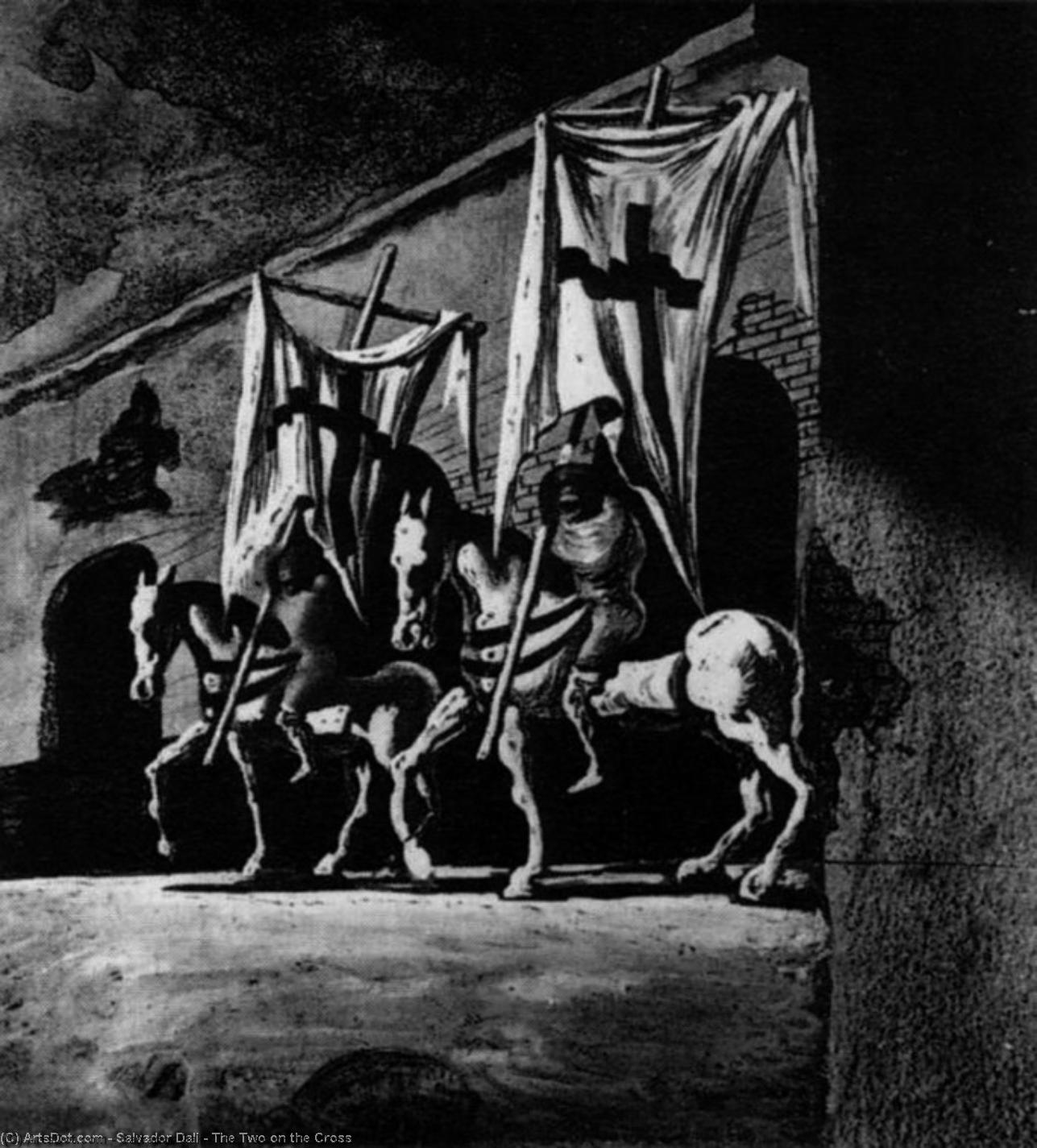
Salvador Dalí's "The Two on the Cross," created in 1942, is not merely an etching; it’s a plunge into the artist’s meticulously constructed subconscious. This monochrome masterpiece, rendered with the stark precision of an engraving, immediately commands attention with its unsettling atmosphere and profoundly symbolic imagery. The work transcends simple representation, offering instead a glimpse into Dalí's preoccupation with themes of duality, loss, and the fractured nature of reality – all hallmarks of his signature surrealist style. Born in Figueres, Spain, in 1904, Dalí’s early life was marked by tragedy—the death of his older brother just months after his birth profoundly shaped his artistic vision, imbuing it with a persistent sense of absence and the haunting echo of what might have been.
Visual Anatomy: Technique and Composition
The technical mastery evident in “The Two on the Cross” lies primarily within its etching technique. Dalí’s deliberate use of hatching and cross-hatching creates a remarkable illusion of texture, imbuing the seemingly flat surface with a palpable sense of volume and depth. The stark contrast between light and shadow is expertly controlled, drawing the viewer's eye to the central figures while simultaneously enveloping the scene in an aura of mystery. The composition itself is carefully orchestrated; the two riders, positioned slightly off-center, are framed by the dramatically draped fabric adorned with crosses – a potent visual reminder of religious iconography. The blurred foreground, rendered in shades of gray, serves not as a simple background element but rather as a deliberate device to heighten the sense of distance and contribute to the overall feeling of unease. The geometric precision of the brickwork wall provides a grounding counterpoint to the flowing forms of the horses and riders, further emphasizing the work’s inherent tension.
Symbolism and Emotional Resonance
Beyond its technical brilliance, “The Two on the Cross” is rich in symbolic meaning. The crosses themselves are undeniably religious symbols, immediately evoking notions of sacrifice, suffering, and perhaps even redemption. However, within Dalí’s surrealist framework, these symbols are rarely straightforward. The two riders, mounted on horseback, can be interpreted as figures representing power, movement, or even a distorted historical narrative – perhaps alluding to the Spanish Civil War that was raging during this period of Dalí's life. The ambiguous architectural setting—a vaguely Gothic structure—adds to the work’s unsettling atmosphere, suggesting a world both familiar and profoundly strange. The overall effect is deeply melancholic, prompting contemplation on themes of mortality, faith, and the fragility of human existence. It’s a piece that lingers in the mind long after viewing, provoking questions rather than offering easy answers.
Dalí's Surrealist Universe: Context and Influence
“The Two on the Cross” firmly establishes Dalí within the context of his broader surrealist project. Influenced by the theories of Sigmund Freud, Dalí sought to unlock the hidden depths of the unconscious mind through art. His work frequently employed dreamlike imagery, distorted perspectives, and unexpected juxtapositions – techniques that challenged conventional notions of reality and invited viewers to engage in a process of imaginative interpretation. This piece echoes similar themes explored in other works from this period, such as “The Persistence of Memory,” demonstrating Dalí’s consistent exploration of the subconscious through meticulously rendered visuals. The unfinished stereoscopic work "Sebastian de Morra with Catastrophic Signs" (1982) further exemplifies his fascination with blending realism and fantasy to create unsettling and thought-provoking imagery.
TopImpressionists offers exceptional, hand-painted reproductions of “The Two on the Cross,” allowing you to bring this iconic surrealist masterpiece into your home or office. Each reproduction is created by skilled artists using archival-quality materials, ensuring that the beauty and detail of Dalí’s original work are faithfully preserved for generations to come.


 Peržiūrėti realybėje
 Perejti prie rankinio darbo paveikslėlio
 Pasidalinti
 Dalintis
 Išsamiau

 Atsisiųsti
 Panašūs eksponatai
 Rentgeno nuotrauka
 Automatinė diorama

 Skaityti daugiau






































 Stiklo variantas prieinamas tik pasirinkus dydį iki 110 cm



