

Paveikslėlyje: · Su rėmu:
 Peržiūrėti realaus dydžio版
 Pasidalinti
 Dalintis
 Išsamiau
 Vadovas

 Atsisiųsti
 Panašūs eksponatai
 Rentgeno spindulių nuotrauka
 Automatinė diorama
 问答
问答 Statistika

€ 285
Rankų darbo aliejinės reprodukcijos
Rankiniu būdu tapytas aliejus ant droblio jūsų pageidaujamame dydį ir rėmuose – tai mūsų menininkų pagal užsakymą sukurtas darbas. ( Perjungti į spausdinamus版作品 Perejti prie skaitmeninių vaizdų)
Dydis
·Standartinis dydis
pagal užsakymą
CM
INCH
Pasirinkite iš mūsų nustatytų dydžių, atitinkančių originalaus meno kūrinio proporcijas.
Kraunami dydžiai...

plotis
aukštis
Įveskite jums reikiamą plotį ir aukštį, kad paveikslas atitiktų jūsų rėmą ar sieną. Kadangi šis darbas yra rankinio darbo, siekiant išgauti kitokios formos dydį, paveikslas gali būti šiek tiek didesnis (nuo kraštų bus palikta daugiau erdvės) arba mažesnis – pasirinkite jums patogiausią variantą. Prieš pradedant tapyti, atsiųsime jums skaitmeninį maketą patvirtinimui. Šioje puslapio nuotraukoje matomas vaizdas nėra galutinis rezultatas – jį parodys tik sukurtas maketas.
 Skaityti daugiau
Baigiamasis etapas
·
Baltas apasutojimas €1

Išblėstantis šonas €1

Išplėstinis €1

P118B €10

P118H €10

P118W €10

P438Z €10

P508JH €12

P508YH €12

P805H €10

P805Z €10

P919BZ €10

P919G €10

P919XJ €10

P959ZH €10

P968JZ €12

W106C €8

W218G €10

W218JH €8

W218Y €10

W307PJ €10

W316G €10

W316PJ €8

W316Y €10

W398PJ €8

W4111J €10

W500HY €15

W500JH €15

W692G €12

W849H €8

W940BG €15

W953PJ €8

H24-GOLD €30

H24-SILVER €30

H36-GOLD €45

H36-SILVER €45
Siunčiama saugiame vamzdelyje, paruošta patys sukomentuoti jūsų rėmeliais.
Virš 105 cm rėmas siunčiamas kaip rinkinys profesionaliam rėmininkui — skaitykite detales.
Papildomos paslaugos
nebūtinaKą apima papildomos paslaugos?
Pavyzdžiai, ką galima pakeisti: pakeisti veidą nuotrauka su klientu; pridėti augintinį (pvz., pakeisti kucingą šuniu); įtraukti paslaptingą žinutę fone; pakeisti fono kraštotvę ar elementus.
Gavus užsakymą, TopImpressionists.com komanda susisieks su klientu el. paštu dėl nurodymų ir pateiks preliminarią maketą.
Gavus užsakymą, TopImpressionists.com komanda susisieks su klientu el. paštu dėl nurodymų ir pateiks preliminarią maketą.
Pristatymas visame pasaulyje () per 3–4 savaites, o ne įprastai – per 5 savaites. (7 lapkritis). Kokybė lieka nepakeičiama.
Apsauginis lakas
Pavadinimo lentelė
Išgraviruotos bronzinės plokštelės detalės
This elegant plaque features the artist's name and the title of the artwork, finely engraved for a timeless presentation.
It is made from bronze with a refined, elegant finish. The text is precisely laser-engraved for a sharp and permanent result. Measuring 9x2 cm, the plaque is compact yet easy to read. It's built to be durable and scratch-resistant, offering a professional, museum-quality look. Mounting is simple thanks to the included adhesive backing.
Skaidrios akrilo plokštelės informacija
The plaque includes essential engraved details such as the artist's name, the title of the artwork, the date it was created, the type of media used-like oil on canvas or watercolor-a brief description of the piece, and a QR code that links to the complete artwork information.
It is crafted from clear acrylic, offering a sleek, modern appearance. The text is UV-engraved in black to ensure strong visual contrast. With a size of 10x15 cm, it ensures optimal readability. It comes equipped with two metal hooks for secure wall mounting. The plaque is designed to be weather-resistant, making it suitable for various environments, and it includes interactive features that work seamlessly with smartphone scanning.
Juodos akrilo plokštelės informacija
This elegant plaque includes engraved information such as the artist's name, the title of the artwork, the date it was created, the type of media used (like oil on canvas or watercolor), a short description of the artwork, and a QR code for quick access to more information.
The plaque itself is made from refined black acrylic with a premium finish. The text is laser-engraved in white for high contrast and readability. Its size is 10x15 cm, designed to be easy to read. It comes with two metal hooks for professional mounting. The design is sleek and fits any interior style. It is also weather-resistant and durable, with built-in digital integration for mobile compatibility.
Stiklo variantas prieinamas tik pasirinkus dydį iki 110 cm
 Stiklo variantas prieinamas tik pasirinkus dydį iki 110 cm
- Nemokamas greitasis pristatymas visame pasaulyje
- Aukštos kokybės lininis drobė
- Pilnas siuntimo draudimas
- Muitinės mokesčių grąžinimo garantija
- Tikro spalvų atitikimo garantija
- 100 dienų grąžinimo politika (tik esant įtaigoms)
- 100% pinigų grąžinimo garantija
- Nuolaida dideliems užsakymams


Kolekcinio objekto aprašas
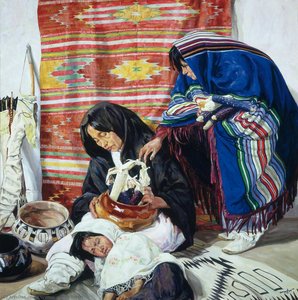
Explore Walter Ufer’s ‘Sleep,’ a poignant oil painting of Native American women in Taos. Discover realism, rich detail & cultural symbolism – a unique 20th-century artwork.
Autoriaus biografija
Vokietijos kilmės amerikietis Walter Ufer (1876-1936) garsėjo įtraukiančiais amerikiečių indėnų gyvenimo paveikslais Taose, Naujojo Meksikoje. „Taos dešimties“ narys, žinomas dėl žanrinio slengio ir ryškių peizažų.
Apie paveisdelį
The Weight of Tradition: An Encounter with Walter Ufer’s “Sleep”
Walter Ufer's "Sleep," painted in 1923, isn’t merely a depiction of three Native American women; it’s an immersion into a world steeped in ritual and profound reverence. The painting immediately draws the viewer in with its rich tapestry of color – predominantly warm reds, oranges, and browns that evoke the earth itself, grounded by cooler blues and greens woven through the textiles and pottery. This palette isn't simply decorative; it speaks to the cultural heritage of the subjects, hinting at a deep connection to the land and ancestral traditions. The composition is carefully orchestrated, centering on the kneeling woman as a focal point, yet subtly inviting us into the periphery of the scene, suggesting an active participation in this sacred space.
Ufer’s masterful technique reveals layers of painstaking detail. He employs a layered oil painting approach, building up texture with deliberate brushstrokes that create a palpable sense of roughness on the clothing – perhaps representing the wear and tear of daily life intertwined with ceremonial garb – while simultaneously rendering the pottery with smooth, almost polished surfaces. This juxtaposition speaks to the duality inherent in Native American culture: the balance between practicality and spirituality, the tangible and the intangible. The lighting, soft and diffused, isn’t dramatic; it's deliberately muted, casting subtle shadows that lend a sense of solemnity and depth to the figures and objects, as if illuminating a secret whispered within a sacred space.
A Window into Taos: Contextualizing Ufer’s Vision
To fully appreciate “Sleep,” it's crucial to understand its historical context. Painted in 1923, during his time in Taos Pueblo, New Mexico, the artwork represents a pivotal moment in Walter Ufer’s career and his deep engagement with Native American culture. He was part of the "Taos Ten," a group of artists who sought to document and celebrate the lives and traditions of the region's indigenous communities. This wasn’t simply an act of observation; it was a deliberate attempt at understanding and portraying these cultures with respect and authenticity, a rare undertaking for American art at the time.
Ufer’s background as a German-born artist profoundly shaped his approach. His training in Europe instilled a meticulous attention to detail and a sophisticated understanding of composition – elements he skillfully translated into his depictions of Native American life. However, it was his immersion within the Taos community that truly informed his work, allowing him to capture not just appearances but also the spirit and essence of these traditions. The painting’s realism is tempered by an underlying sense of mystery, inviting viewers to contemplate the deeper meanings embedded within the scene.
Symbolism Woven into the Fabric
The details within “Sleep” are laden with symbolic significance. The intricately patterned rug serves as a visual anchor, framing the central figures and providing a rich backdrop that speaks to the importance of storytelling and communal life within Native American culture. The pottery, often adorned with geometric designs and natural motifs, represents both artistic skill and spiritual connection – a tangible link to ancestors and the earth. The women themselves, engaged in what appears to be a ritualistic activity, are not simply subjects; they embody generations of tradition, wisdom, and connection to the divine.
The act depicted—kneeling in reverence—suggests healing or a profound spiritual ceremony. The quiet dignity of the figures, coupled with the muted colors and soft lighting, evokes a sense of solemnity and timelessness. It’s an image that transcends mere representation, offering a glimpse into a world governed by ancient beliefs and deeply rooted traditions.
A Legacy of Authenticity: Reproductions and Beyond
Walter Ufer's "Sleep" remains a powerful testament to the beauty and complexity of Native American culture. TopImpressionists offers high-quality, hand-painted reproductions that faithfully capture the painting’s rich detail and evocative atmosphere. These reproductions are more than just images; they are windows into another world—a world of sacred rituals, profound traditions, and enduring wisdom. Investing in a reproduction is an investment in preserving this important piece of American art history and honoring the legacy of Walter Ufer's insightful portrayal.
Klausimai ir atsakymai
Kas yra „Sleep“ autorius ir kokio stiliaus/krypties šis kūrinys?
„Sleep“ kūrybinį darbu pasižymi Walteris Uferis, taikantis Contemporary Realism stilių. Autorius ir stilius nurodo šio kūrinio tradiciją.
Ar „Sleep“ spalvos atrodo ryškios ar švelnios?
„Sleep“ spalvų intensyvumas yra Balanced. Intensyvumas apibūdina, koks spalvų ryškumas yra suvokiamas.
Kur galima pamatyti „Sleep“ – Walteris Uferis originalą?
Originalų kūrinį „Sleep“ galite pamatyti National Cowboy - Western Heritage Museum, Oklahoma Sity, Jungtinės Valgos.
Trumpos faktinės datos ir meno viktorina
Apie Walteris Uferis

Walteris Uferis
1876 - 1936, Vokietija
Autoriaus biografija
Pietų vakaro siela: Walterio Uferio gyvenimas ir palikimas
Walteris Uferis yra viena esminių amerikiečių impresionizmo figūrų – tapystojas, kurio meno traukai pavyko ne tik įamžinti šviesą, bet ir įčiupti patį kultūros pulsuojantį širdį. 1876 m. gimęs Vokietijos Hückesvageno mieste, Uferio kelionė į aukštas Naujosios Meksikos dykumus buvo grįžta griežtos Europos mokslos ir gilaus smalsumo apie žmogaus būtį. Jo ankstyvoji vaikystė formavosi Kentucky valstijos Luisvilo mieste, gyvybingoje vokiečių diasporoje, kur jis pirmą kartą pradėjo pajusti savo paveldos turtingą tekstūrą. Šis pagrindinis laikotarpis, paliktas studijuojant litografiją ir grafikos meną, suteikė jam techninį tikslumą, kuris vėliau leistų jam nepanašiu meistriškumu valdyti šviesos ir šešėlio sudėtingumas.
Jo siekis pasiekti meninę aukštę nukreipė jį į transformatyvią odisėją per Europą. Kaip keliaujantis meistras, Uferis pasinerė į įvairias kontinento meno tradicijas, tobulindamas savo techniką prestižinguose Hamburgo ir Drakšendo akademijų mokyklose. Šis intensyvus intelektualinis ir kūrybinis plėtojimas pasiekė kulminaciją Munoje, kur jis skyrė save intensyviai studijų darbui. Kai 1911 m. jis pagaliau grįžo į Jungtines Valstijas, su sau nešė sofistikuotą europietišką jautrumą, paruoštą galingam susitikimui su grubia, saulės apšviesta Amerikos Vakarų peizažais.
Taoso dešimties vizionierius
1914 metai tapo tvirtu lūžio tašku Uferio gyvenime ir visos amerikiečių meno trajektorijoje. Įėjęs į Taoso Pueblo, Naująją Meksiką, jis pasapagavo dalį neįtikėtinos meninės revoliucijos. Prisijungęs prie įtakingos grupės, žinomos kaip "Taoso dešimtis," Uferis tapo pagrindine figūra kolektyve, siekiančiame išeiti už paprastų peizažų ribų ir pateikti autentišką, iš გlebą, indėnų gyvenimo vaizdą. Skirtingai nei daugelis jo samtvorių, kurie Pietvakario regėjo per romantišką ar kolonistų akimirką, Uferis prie savo temų priėmė su giliu pagarba ir žvelgdamas į kasdienybės orumą.
Jo kūriniai tapo tiltu tarp europinių impresionistinių technikų ir grynos, dvasinės Pueblo žmonių energijos. Jis nebuvo tik stebėtojas, bet ritualų, peizažų ir ramių bendruomenės gyvenimo ritmų kronika. Svarbiausia šio kūrybinio evoliucijos elementu buvo jo ryšys su Jimu Mirabalu – Taoso indenu, kuris tapo tiek Uferio įkvėpimo šaltiniu, tiek bendradarbiu. Per šį ryšį Uferis įgijo gilią supratimą apie regioną apibrėžiančius kultūros niuansus, leidžiančius jo drobėms įteigti gyvos tiesos pojūtį, kuris pasiekė toli už Naujosios Meksikos ribų.
Technika, simbolika ir istorinė reikšmė
Uferio kūrybos ešėtrė pasižymi meistrišku spalvų valdymu ir drąsia, išraiškoma dažų taikymo technika. Jo stilius, nors ir įtvirtintas amerikiečių impresionizmo principuose, dažnai linko link tvirtesnio ir tekstūruoto požiūrius, kurie įamžino desertės saulės karštį ir žemės svorį. Jis šviesą naudojo ne tik formoms apšviesti, bet ir jausmams suėdinti – kurdamas scenas, kuriose atmosfera atrodo prisunkta istorijos ir tradicijų.
Istorinė Walterio Uferio reikšmė slypi jo gebėjime žanrinę tapybą pakelti į gilią socialinę ir kultūrinę išsakymą. Jo pasiekimai apima:
- Autentiškas vaizdavimas: atsisakymas nuo „vaizdingų“ amerikiečių indėnų gyvenimo stereotipų, siekiant pateikti subtilesnį ir humanizuoti Taoso žmonių portretą.
- Meninė sintezė: sėkmingas Vokietijos oficialaus akademinio mokymo su dinantiška, nekontroliuojama Amerikos Pietvakario dvasia sujungimas.
- Taoso dešimties palikimas: leido Taosui tapti pagrindiniu amerikiečių modernizmo tiksliniu taikiniu ir gyvybiška indėnų kultūros meno centru.
Šiandien Uferio paveikslai išlieka neįtikėtinais įrodymais apie intensyvų kultūrų susilankymą. Jo gebėjimas sukurti sintezę tarp techninio savo Europos išsilavinimo griežtumo ir dvasinės Pueblo kultūros gylio užtikrina, kad jo darbai ir toliau sužavėtų, kvėdami šiuolaikinius žiūrėtojus prisijungti prie amžino Taoso slėgio dvasią per jo įkvėpipusią ir meistrišką žvilgsnį.
Trumpa informacija apie Walteris Uferis
- Artinis Stilius Ar Kryptis: Taoso impresionizmas
- Gimimo Data: 1876
- Gimimo Vieta: Hückeswagen, Vokietija
- Menininkai, Kurie Paveikė Šį Menininko Kūrybą: ['']
- Mirties Data: 1936
- Tautybė: Vokietijos kilmės amerikietis
- Vardas, Pavardė: Walter Ufer
- Šio Meno Kūrėjo Paveikšti Menininkai Ar Kryptys: ['']
- Žinomos Kūrybinės Darbai:
- Ją dukra
- Dvi pustynės


Walteris Uferis
Sleep
() ·
Su rėmu: · Rankiniu būdu tapyta aliejumi ant lineno
Viso suma