

Paveikslėlyje: · Su rėmu:
 Peržiūrėti realaus dydžio版
 Pasidalinti
 Dalintis
 Išsamiau
 Vadovas

 Atsisiųsti
 Panašūs eksponatai
 Rentgeno spindulių nuotrauka
 Automatinė diorama
 问答
问答 Statistika


€ 240
Rankų darbo aliejinės reprodukcijos
Rankiniu būdu tapytas aliejus ant droblio jūsų pageidaujamame dydį ir rėmuose – tai mūsų menininkų pagal užsakymą sukurtas darbas. ( Perjungti į spausdinamus版作品 Perejti prie skaitmeninių vaizdų)
Dydis
·Standartinis dydis
pagal užsakymą
CM
INCH
Pasirinkite iš mūsų nustatytų dydžių, atitinkančių originalaus meno kūrinio proporcijas.
Kraunami dydžiai...

plotis
aukštis
Įveskite jums reikiamą plotį ir aukštį, kad paveikslas atitiktų jūsų rėmą ar sieną. Kadangi šis darbas yra rankinio darbo, siekiant išgauti kitokios formos dydį, paveikslas gali būti šiek tiek didesnis (nuo kraštų bus palikta daugiau erdvės) arba mažesnis – pasirinkite jums patogiausią variantą. Prieš pradedant tapyti, atsiųsime jums skaitmeninį maketą patvirtinimui. Šioje puslapio nuotraukoje matomas vaizdas nėra galutinis rezultatas – jį parodys tik sukurtas maketas.
 Skaityti daugiau
Baigiamasis etapas
·
Baltas apasutojimas €1

Išblėstantis šonas €1

Išplėstinis €1

P118B €10

P118H €10

P118W €10

P438Z €10

P508JH €12

P508YH €12

P805H €10

P805Z €10

P919BZ €10

P919G €10

P919XJ €10

P959ZH €10

P968JZ €12

W106C €8

W218G €10

W218JH €8

W218Y €10

W307PJ €10

W316G €10

W316PJ €8

W316Y €10

W398PJ €8

W4111J €10

W500HY €15

W500JH €15

W692G €12

W849H €8

W940BG €15

W953PJ €8

H24-GOLD €30

H24-SILVER €30

H36-GOLD €45

H36-SILVER €45
Siunčiama saugiame vamzdelyje, paruošta patys sukomentuoti jūsų rėmeliais.
Virš 105 cm rėmas siunčiamas kaip rinkinys profesionaliam rėmininkui — skaitykite detales.
Papildomos paslaugos
nebūtinaKą apima papildomos paslaugos?
Pavyzdžiai, ką galima pakeisti: pakeisti veidą nuotrauka su klientu; pridėti augintinį (pvz., pakeisti kucingą šuniu); įtraukti paslaptingą žinutę fone; pakeisti fono kraštotvę ar elementus.
Gavus užsakymą, TopImpressionists.com komanda susisieks su klientu el. paštu dėl nurodymų ir pateiks preliminarią maketą.
Gavus užsakymą, TopImpressionists.com komanda susisieks su klientu el. paštu dėl nurodymų ir pateiks preliminarią maketą.
Pristatymas visame pasaulyje () per 3–4 savaites, o ne įprastai – per 5 savaites. (6 lapkritis). Kokybė lieka nepakeičiama.
Apsauginis lakas
Pavadinimo lentelė
Išgraviruotos bronzinės plokštelės detalės
This elegant plaque features the artist's name and the title of the artwork, finely engraved for a timeless presentation.
It is made from bronze with a refined, elegant finish. The text is precisely laser-engraved for a sharp and permanent result. Measuring 9x2 cm, the plaque is compact yet easy to read. It's built to be durable and scratch-resistant, offering a professional, museum-quality look. Mounting is simple thanks to the included adhesive backing.
Skaidrios akrilo plokštelės informacija
The plaque includes essential engraved details such as the artist's name, the title of the artwork, the date it was created, the type of media used-like oil on canvas or watercolor-a brief description of the piece, and a QR code that links to the complete artwork information.
It is crafted from clear acrylic, offering a sleek, modern appearance. The text is UV-engraved in black to ensure strong visual contrast. With a size of 10x15 cm, it ensures optimal readability. It comes equipped with two metal hooks for secure wall mounting. The plaque is designed to be weather-resistant, making it suitable for various environments, and it includes interactive features that work seamlessly with smartphone scanning.
Juodos akrilo plokštelės informacija
This elegant plaque includes engraved information such as the artist's name, the title of the artwork, the date it was created, the type of media used (like oil on canvas or watercolor), a short description of the artwork, and a QR code for quick access to more information.
The plaque itself is made from refined black acrylic with a premium finish. The text is laser-engraved in white for high contrast and readability. Its size is 10x15 cm, designed to be easy to read. It comes with two metal hooks for professional mounting. The design is sleek and fits any interior style. It is also weather-resistant and durable, with built-in digital integration for mobile compatibility.
Stiklo variantas prieinamas tik pasirinkus dydį iki 110 cm
 Stiklo variantas prieinamas tik pasirinkus dydį iki 110 cm
- Nemokamas greitasis pristatymas visame pasaulyje
- Aukštos kokybės lininis drobė
- Pilnas siuntimo draudimas
- Muitinės mokesčių grąžinimo garantija
- Tikro spalvų atitikimo garantija
- 100 dienų grąžinimo politika (tik esant įtaigoms)
- 100% pinigų grąžinimo garantija
- Nuolaida dideliems užsakymams


Kolekcinio objekto aprašas
Kandinsky’s artistic journey began with a transformative encounter with Monet’s Haystacks, sparking his fascination with color symbolism and influencing his exploration of musical composition. His Bauhaus teaching experience solidified his commitment to geometric abstraction and experimental art forms.
Autoriaus biografija
Vasilijus Kandinskis – revoliucija dailės pasaulyje! Žiūrėkite į spalvingą abstrakciją „Kompozicija IX“ ir atraskite meno dvasią bei Bauhaus istoriją.
Apie paveisdelį
Division -Unit: A Symphony of Color and Spirit
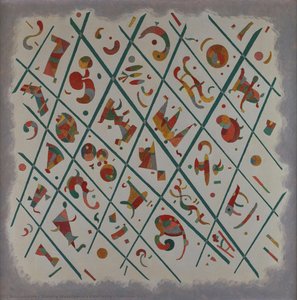
Wassily Kandinsky’s “Division - Unite,” created in 1934 during his formative Parisian period, stands as an emblem of abstract expressionism and a testament to the artist's relentless pursuit of spiritual resonance within visual art. Born in Moscow in 1866, Kandinsky embarked on a transformative artistic odyssey fueled by encounters with Impressionist painting—particularly Claude Monet’s “Haystacks”—and profoundly moved by Wagner’s opera "Lohengrin." These experiences instilled within him an unwavering conviction that art could transcend mere representation and communicate directly with the soul. This conviction would become the cornerstone of his groundbreaking approach to abstraction, forever altering the landscape of modern artistic endeavor. Early influences extended beyond purely visual stimuli; Kandinsky absorbed the vibrant hues and symbolic narratives of Russian folk art, gleaned from expeditions into the Vologda region. He meticulously documented these observations, recognizing their capacity to evoke emotional responses akin to musical harmonies—a concept he would champion throughout his career. This intellectual framework underpinned his artistic explorations, guiding him toward a deliberate rejection of conventional pictorial conventions in favor of forms that prioritized color and composition as primary expressive vehicles. The painting itself presents a striking visual experience: a square grid serves as the foundational structure for an astonishing array of organic shapes—circles, squares, triangles—interwoven with scattered letters. These elements are not uniformly distributed; rather, they cluster and overlap, generating a palpable sense of controlled chaos that belies Kandinsky’s meticulous planning. Diagonal lines intersect the grid, injecting dynamism into the composition and reinforcing the feeling of movement. The color palette is extraordinarily rich and diverse, encompassing reds, greens, blues, yellows, oranges, and purples—applied in both solid blocks and blended areas to create subtle gradations that heighten visual interest. Dominating the background is a pale grey or off-white hue, allowing the vibrant colors of the shapes to command attention and radiate luminosity. Kandinsky’s technique reflects his unwavering commitment to capturing inner experience. Executed primarily with oil paints on canvas—likely stretched taut—the application appears remarkably smooth, minimizing visible brushstrokes and prioritizing tonal harmony. This deliberate restraint underscores Kandinsky's belief that color alone could convey profound emotional significance. The resulting surface possesses a subtle textural quality, suggestive of the paper-like texture of his preparatory sketches, hinting at the artist’s ongoing engagement with traditional drawing methods alongside his pioneering explorations of abstraction. “Division - Unite” embodies Kandinsky’s mature abstract style—characterized by its rejection of representational imagery and its masterful manipulation of color relationships to evoke spiritual contemplation. It aligns seamlessly with the tenets of Abstract Expressionism, a movement that championed spontaneous gesture and emotional intensity as paramount considerations in artistic creation. More than just a visual spectacle, this artwork invites viewers into a realm where form and color coalesce to communicate unspoken truths—a legacy that continues to inspire artists and collectors alike.Composition & Structure
The square grid serves as the central organizing principle of “Division - Unite,” providing a framework for the arrangement of disparate elements while simultaneously fostering a sense of controlled dynamism. Unlike traditional perspectival representations, Kandinsky eschews depth illusion, opting instead for a flattened surface that emphasizes color and form as independent expressive forces. Diagonal lines intersect the grid, injecting movement into the composition and disrupting any potential static equilibrium. This deliberate disruption mirrors Kandinsky’s philosophical conviction that art should transcend rational thought and tap into primal instincts—a core tenet of his spiritual worldview.Color Palette & Harmony
Kandinsky's masterful use of color is arguably the painting's most striking feature. The palette encompasses a spectrum of hues—reds, greens, blues, yellows, oranges, and purples—each carefully positioned to create visual harmony and convey specific emotional resonances. Solid blocks of color coexist with blended areas, generating subtle gradations that enrich the overall tonal range. The dominant off-white background serves as a counterpoint to the vibrant shapes, maximizing their luminosity and enhancing their impact on the viewer’s eye. Kandinsky's meticulous attention to color theory—informed by Goethean aesthetics—demonstrates his profound understanding of how color can stimulate sensory perception and evoke psychological responses.Technique & Materials
The painting was crafted using oil paints on canvas, a medium favored by Kandinsky for its ability to achieve exceptional tonal fidelity and textural nuance. The application technique prioritizes smoothness and tonal consistency, minimizing visible brushstrokes and emphasizing the artist’s commitment to capturing inner experience through visual form. This deliberate restraint underscores Kandinsky's belief that color alone could convey profound emotional significance—a conviction that underpinned his entire artistic practice.Symbolic Significance & Emotional Impact
“Division - Unite” transcends mere aesthetic beauty; it embodies Kandinsky’s aspiration to communicate spiritual truths through abstraction. The scattered letters within the composition serve as visual anchors, grounding the organic shapes in a realm of intellectual contemplation—a reflection of Kandinsky's engagement with philosophical ideas and his belief that art could illuminate hidden dimensions of human consciousness. Ultimately, this painting invites viewers into a meditative state—a testament to Kandinsky’s enduring legacy as one of the foremost pioneers of abstract expressionism and a visionary artist who dared to explore the uncharted territories of visual perception.Historical Context
Created in 1934, “Division - Unite” emerged during Kandinsky's Parisian period—a time marked by profound intellectual ferment and artistic experimentation. The painting reflects the influence of Bauhaus, where Kandinsky taught from 1922 to 1933, and embodies the broader ethos of Abstract Expressionism—a movement that championed spontaneity and emotional intensity as paramount considerations in artistic creation. It stands as a pivotal work within Kandinsky’s oeuvre, solidifying his reputation as one of the most innovative and influential artists of the 20th century.Size & Dimensions
Unknown Date: 1934Klausimai ir atsakymai
Kokia yra „Division -Unit“ paletės ryškumas?
„Division -Unit“ – Vasilijus Kandinskis kūrinys pasižymi Blėskios nasyginimu.
Ar „Division -Unit“ – Vasilijus Kandinskis priklauso viešosios teisės domenui?
„Division -Unit“ – Vasilijus Kandinskis yra yra viešosios erdvės dalis – jo autorinė teisė pasibaigusi. Šis statusas nustato, kaip galima reprodukcijaus šio kūrinio vaizdą.
Kokia „Division -Unit“ – Vasilijus Kandinskis švytėjimo (luminance) intensyvumas?
„Division -Unit“ spalvos pasižymi Švelni apšvietimo intensyvumas šviesos intensyvumu.
Trumpos faktinės datos ir meno viktorina
Apie Vasilijus Kandinskis

Vasilijus Kandinskis
1866 - 1944, Rusija
Autoriaus biografija
A Life Immersed in Color and Spirit
Wassily Wassilyevich Kandinsky, born December 4, 1866, in Moscow, Russia, was a revolutionary figure who irrevocably altered the course of modern art. His journey wasn’t one of immediate artistic calling; initially destined for a career in law and economics at the University of Moscow, it was a profound encounter with Impressionist painting – specifically Claude Monet's “Haystacks” – and a deeply moving experience witnessing Wagner’s opera "Lohengrin" that ignited within him an irrepressible desire to pursue art. This pivotal moment, occurring around age thirty, marked not merely a career change but a complete transformation of perspective, setting him on a path toward pioneering abstraction. He soon relocated to Munich, enrolling at the prestigious Academy of Fine Arts and studying under Franz von Stuck, though even within formal training, Kandinsky’s spirit yearned for exploration beyond conventional boundaries. Early influences included Russian folk art, gleaned from an ethnographic expedition to the Vologda region in 1889, which instilled a fascination with vibrant color palettes and symbolic imagery. This foundation would prove crucial as he began to develop his unique artistic language. These early explorations weren’t simply about aesthetic preference; they were rooted in a deep cultural connection and a burgeoning understanding of how art could communicate beyond the literal. He experimented with landscapes and portraits, demonstrating considerable skill but always feeling constrained by representational limitations.The Dawn of Abstraction: From Expressionism to Inner Necessity
Kandinsky’s early works reveal a strong expressionistic bent, characterized by bold colors and emotional intensity – pieces like “Papeln (Poplars)” from 1902 exemplify this period. However, he wasn't content with merely representing the external world; he sought to express inner realities, spiritual truths that transcended mere visual depiction. This quest led him gradually away from representational art and toward a revolutionary exploration of color, form, and their emotional resonance. He believed that colors possessed inherent psychological effects, capable of evoking specific feelings and sensations in the viewer. This conviction was deeply intertwined with his burgeoning interest in Theosophy, a spiritual movement emphasizing esoteric knowledge and universal brotherhood. As he delved deeper into these ideas, Kandinsky’s paintings became increasingly non-objective, shedding recognizable forms in favor of abstract compositions driven by an “inner necessity.” This wasn't simply about abandoning representation; it was about discovering a new visual language capable of expressing the intangible realms of emotion and spirituality. He sought to create a visual equivalent of music, where color and form harmonized to evoke profound emotional responses. He began to experiment with landscapes and portraits, demonstrating considerable skill but always feeling constrained by representational limitations. His conviction that colors possessed inherent psychological effects, capable of evoking specific feelings and sensations in the viewer. This conviction was deeply intertwined with his burgeoning interest in Theosophy, a spiritual movement emphasizing esoteric knowledge and universal brotherhood. As he delved deeper into these ideas, Kandinsky’s paintings became increasingly non-objective, shedding recognizable forms in favor of abstract compositions driven by an “inner necessity.” This wasn't simply about abandoning representation; it was about discovering a new visual language capable of expressing the intangible realms of emotion and spirituality. He sought to create a visual equivalent of music, where color and form harmonized to evoke profound emotional responses.Geometric Harmony and Spiritual Resonance
The period following his involvement with the influential artist group Der Blaue Reiter (The Blue Rider), which he co-founded in Munich in 1911, saw a further evolution in Kandinsky’s style. While earlier works often featured fluid, organic shapes, he began to explore geometric abstraction, focusing on the interplay of circles, triangles, and squares. “Several Circles” (140 x 140 cm) stands as a prime example of this phase – a dynamic composition where color and form interact in a harmonious yet energetic dance. He believed that colors possessed inherent psychological effects, capable of evoking specific feelings and sensations in the viewer. This conviction was deeply intertwined with his burgeoning interest in Theosophy, a spiritual movement emphasizing esoteric knowledge and universal brotherhood. As he delved deeper into these ideas, Kandinsky’s paintings became increasingly non-objective, shedding recognizable forms in favor of abstract compositions driven by an “inner necessity.” This wasn't simply about abandoning representation; it was about discovering a new visual language capable of expressing the intangible realms of emotion and spirituality. He sought to create a visual equivalent of music, where color and form harmonized to evoke profound emotional responses. He experimented with landscapes and portraits, demonstrating considerable skill but always feeling constrained by representational limitations. His conviction that colors possessed inherent psychological effects, capable of evoking specific feelings and sensations in the viewer. This conviction was deeply intertwined with his burgeoning interest in Theosophy, a spiritual movement emphasizing esoteric knowledge and universal brotherhood. As he delved deeper into these ideas, Kandinsky’s paintings became increasingly non-objective, shedding recognizable forms in favor of abstract compositions driven by an “inner necessity.” This wasn't simply about abandoning representation; it was about discovering a new visual language capable of expressing the intangible realms of emotion and spirituality. He sought to create a visual equivalent of music, where color and form harmonized to evoke profound emotional responses.Bauhaus Influence and Lasting Legacy
The outbreak of World War I forced Kandinsky's return to Russia in 1914, but following the Russian Revolution, he found himself increasingly at odds with the prevailing artistic climate. In 1920, he accepted a teaching position at the Bauhaus school in Germany, where he profoundly influenced generations of artists with his theories on color, form, and abstraction. The Bauhaus provided an ideal environment for Kandinsky to further develop his ideas and explore new creative avenues. He experimented with landscapes and portraits, demonstrating considerable skill but always feeling constrained by representational limitations. His conviction that colors possessed inherent psychological effects, capable of evoking specific feelings and sensations in the viewer. This conviction was deeply intertwined with his burgeoning interest in Theosophy, a spiritual movement emphasizing esoteric knowledge and universal brotherhood. As he delved deeper into these ideas, Kandinsky’s paintings became increasingly non-objective, shedding recognizable forms in favor of abstract compositions driven by an “inner necessity.” This wasn't simply about abandoning representation; it was about discovering a new visual language capable of expressing the intangible realms of emotion and spirituality. He sought to create a visual equivalent of music, where color and form harmonized to evoke profound emotional responses. He experimented with landscapes and portraits, demonstrating considerable skill but always feeling constrained by representational limitations. His conviction that colors possessed inherent psychological effects, capable of evoking specific feelings and sensations in the viewer. This conviction was deeply intertwined with his burgeoning interest in Theosophy, a spiritual movement emphasizing esoteric knowledge and universal brotherhood. As he delved deeper into these ideas, Kandinsky’s paintings became increasingly non-objective, shedding recognizable forms in favor of abstract compositions driven by an “inner necessity.” This wasn't simply about abandoning representation; it was about discovering a new visual language capable of expressing the intangible realms of emotion and spirituality. He sought to create a visual equivalent of music, where color and form harmonized to evoke profound emotional responses. Kandinsky’s exploration of color, form, and spirituality continues to inspire artists today, solidifying his place as one of the most important figures in 20th-century art history. He didn't just paint pictures; he painted emotions, ideas, and the very essence of the human spirit.Trumpa informacija apie Vasilijus Kandinskis
- Artistic Movement Or Style: Abstrakti meno
- Artists Or Movements Influenced By This Artist: ['Abstrakti ekspresionizmas']
- Artists Who Influenced This Artist:
- Claude Monet
- Richard Wagner
- Date Of Birth: 1866
- Full Name: Wassily Wassilyevich Kandinsky
- Nationality: Rusijoje
- Notable Artworks: ['Murnau su aromatu']
- Place Of Birth: Maskova, Rusija
Tyrinėkite meno kūrinius, suskirstytus pagal temas, stilius ir savybes.


Vasilijus Kandinskis
Division -Unit
() ·
Su rėmu: · Rankiniu būdu tapyta aliejumi ant lineno
Viso suma