


 Peržiūrėti realaus dydžio版
 Siųsti
 Dalintis
 Išsamiau
 Vadovas

 Atsisiųsti
 Panašūs eksponatai
 Rentgeno spindulių nuotrauka
 Diaporama
 Statistika
Tivoli

Admire 'Tivoli' by William Payne – a stunning Romantic landscape painting of Tivoli Gardens. Explore this realistic watercolor’s serene beauty & historical detail. Hand-painted reproduction available.
William Payne (1760-1830) was a pioneering English watercolourist known for inventing Payne's Grey & innovative techniques in sunlight/atmosphere. He revolutionized landscape painting, moving beyond topography to poetic scenery and became London’s mo
 Rodyti daugiau
Rankų darbo aliejinės reprodukcijos
Rankiniu būdu tapytas aliejus ant droblio jūsų pageidaujamame dydį ir rėmuose – mūsų menininkų darbas pagal užsakymą. ( Perjungti į spausdinimą Perejti prie skaitmeninių vaizdų)




P118B €10

P118H €10

P118W €10

P438Z €10

P508JH €12

P508YH €12

P805H €10

P805Z €10

P919BZ €10

P919G €10

P919XJ €10

P959ZH €10

P968JZ €12

W106C €8

W218G €10

W218JH €8

W218Y €10

W307PJ €10

W316G €10

W316PJ €8

W316Y €10

W398PJ €8

W4111J €10

W500HY €15

W500JH €15

W692G €12

W849H €8

W940BG €15

W953PJ €8




Standartinis
individualaus dydžio
CM
INCH
Pasirinkite iš mūsų nustatytų dydžių, atitinkančių originalaus meno kūrinio proporcijas.
Loading sizes...

plotis
aukštis
Įveskite jums reikiamą plotį ir aukštį, kad paveikslas atitiktų jūsų rėmą ar sieną. Kadangi šis darbas yra rankinio darbo, siekiant išgauti kitokio formos dydį, paveikslas gali būti šiek tiek didesnis (nuo kraštų bus palikta daugiau erdvės) arba mažesnis – pasirinkite jums patogiausią variantą. Prieš pradedant tapyti, atsiųsime jums skaitmeninį maketą patvirtinimui. Šioje puslapio nuotraukoje matomas vaizdas nėra galutinis rezultatas – jį parodys tik sukurtas maketas.
Ką galima pakeisti (pavyzdžiai): Pakeisti veidą į kliento nuotrauką; Pridėti augintinį (pvz., pakeisti katę šunimi); Įtraukti paslėptą žinutę fone; Pakeisti fono kraštovaizdį ar elementus.
Gavus užsakymą, TopImpressionists.com komanda susisieks su klientu el. paštu dėl instrukcijų ir pateiks maketo pavyzdį
Gavus užsakymą, TopImpressionists.com komanda susisieks su klientu el. paštu dėl instrukcijų ir pateiks maketo pavyzdį
Pristatymas visame pasaulyje () per 3–4 savaites, o ne įprastai – per 5 savaites. (25 spalis). Kokybė lieka nepakeičiama.

Nemokamas greitasis pristatymas visame pasaulyje

Aukštos kokybės lininis drobė

Pilnas siuntimo draudimas

Muitinės mokesčių grąžinimo garantija

Tikro spalvų atitikimo garantija

100 dienų grąžinimo politika (tik esant įtaigoms)

100% pinigų grąžinimo garantija

Nuolaida dideliems užsakymams
 Stiklo variantas prieinamas tik pasirinkus dydį iki 110 cm

Tivoli
Reprodukcijos technika
Reprodukcijos dydis
-


Visų pasirinktų variantų kaina
€ 236
Autoriaus biografija
The Architect of Atmosphere: The Life and Legacy of William Payne
In the quiet annals of art history, certain names resonate not through the sheer volume of their fame, but through the profound chemical and technical shifts they introduced to the canvas. William Payne (1760–1830) was such a figure—a man whose hands did more than merely guide a brush; they redefined the very vocabulary of watercolor. Born in Devon, England, Payne’s journey began far from the prestigious drawing rooms of London. His early professional life was rooted in the precision of engineering and draughtsmanship, serving as a skilled hand within the Board of Ordnance at the Tower of London. This rigorous training in mathematics and perspective provided him with a structural foundation that would later allow him to master the more ephemeral elements of the natural world.
As he transitioned from the meticulous duties of a draughtsman to the expressive freedom of a landscape painter, Payne sought to move beyond the era's obsession with mere topography. While many of his contemporaries were content to produce literal, almost clinical records of landmarks, Payne looked toward the Picturesque. Influenced by the aesthetic theories of William Gilpin, he began to view the landscape not as a collection of static objects, but as a living, breathing entity shaped by light, moisture, and shadow. His move to London in 1790 marked the beginning of his ascent as the city's most fashionable drawing master, where he taught a new generation how to capture the emotional essence of a scene rather than just its physical boundaries.
The Alchemy of Grey and the Mastery of Light
The true genius of Payne lay in his experimental spirit, particularly his ability to manipulate pigments to mimic the elusive qualities of the English sky. His most enduring contribution to the artist's palette remains the invention of Payne’s Grey. This subtle, neutral tint—a sophisticated marriage of indigo, raw sienna, and lake—offered watercolorists a way to render deep shadows and stormy atmospheres without the muddying effect of traditional blacks. Through this single innovation, he provided a tool that could capture the nuanced transition from twilight to dusk, or the heavy, moisture-laden clouds of a coastal storm.
Beyond his palette, Payne revolutionized the physical application of watercolor. He abandoned the rigid reliance on pen outlines, favoring instead a method of building depth through layers of translucent washes. His techniques were nothing short of revolutionary for the time:
- Splitting the brush to create the delicate, irregular forms of foliage and organic textures.
- Dragging tints across the paper to simulate the ruggedness of foreground terrain.
- The use of bread and rag to lift pigment from a wet surface, effectively "carving" highlights and luminous light out of the darkness.
These methods allowed him to achieve a sense of atmospheric perspective that was previously difficult to sustain in the medium. His work possessed a tactile quality, where the viewer could almost feel the dampness of the Devonshire air or the warmth of sunlight breaking through a canopy.
A Lasting Impression on the Romantic Landscape
Though his name may not carry the immediate weight of a Turner or a Constable in popular consciousness, Payne’s influence was foundational to the development of the Romantic landscape movement. By shifting the focus from the topographical to the poetic, he paved the way for an art form that prioritized feeling and atmosphere over factual accuracy. His success as a teacher ensured that his "tricky" and innovative methods were disseminated throughout the British art scene, influencing notable pupils such as John Glover.
Ultimately, William Payne stands as a bridge between the disciplined draughtsmanship of the eighteenth century and the expressive, emotive watercolor traditions of the nineteenth. He transformed a medium once used for mere documentation into a powerful vehicle for poetic expression. Every time a modern artist reaches for that deep, moody blue-grey to depict a twilight sky, they are participating in a visual legacy that began with the inquisitive mind and steady hand of this Devon-born innovator.

William Payne
1760 - 1830 , United Kingdom
Trumpa informacija apie kūrėją
- Full Name: William Payne
- Nationality: English
- Date Of Birth: 1760
- Date Of Death: 1830
- Place Of Birth: Devon, United Kingdom
- Notable Artworks:
- Upon the Yealm, Devon
- View Near Cardigan, South Wales
- Travellers Gossiping At The Wayside
- Artistic Movement Or Style: Romantic Landscape Painting
Susiję straipsniai
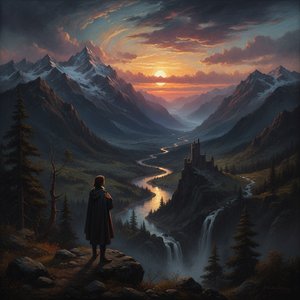
Capturing the Soul: The Emotional Majesty and Sublime Power of Romantic Landscape Painting
Explore the profound emotional depth of Romantic landscape painting. Discover how masters like Turner and Friedrich captured the sublime power of nature through intuition and imagination in this expert art history retrospective.

Capturing Light: The Ethereal Beauty and Timeless Legacy of Watercolor Landscapes
Embark on a visual journey through the ethereal beauty of watercolor landscapes. Discover how Impressionist masters captured light and emotion, and learn to bring this timeless, luminous elegance into your home with expert art curation and hand-painted reproductions.