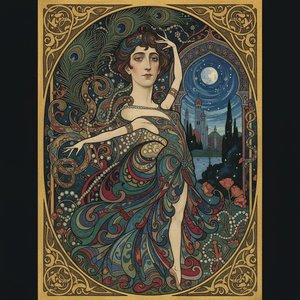
The Life and Artistic Journey of Lionel Royer
Born in Château-du-Loir, France, Lionel Royer was a painter who demonstrated early talent during the Franco-Prussian War. After volunteering for the conflict before his eighteenth birthday, he participated in the Battle of Loigny-Poupry. His artistic potential was recognized by General Athanase Charette de la Contrie, who financed his studies at the École nationale supérieure des Beaux-Arts in Paris. Under the guidance of teachers Alexandre Cabanel and William-Adolphe Bouguereau, Royer developed his craft, eventually obtaining the Prix de Rome in 1882.
Royer became a noted portraitist and a painter of historical scenes. His notable works include Vercingetorix Throwing down His Weapons at the feet of Julius Caesar. He is also recognized for his decorations in the Basilica of Bois-Chenu in Domrémy, which are dedicated to Joan of Arc. Additionally, he contributed drawings to illustrated newspaper supplements, depicting figures such as Alfred Dreyfus and Auguste Comte.
Historical and Religious Works
Royer's oeuvre is deeply connected to historical and religious themes. In memory of his service in the battle of Loigny, he donated two paintings to the rebuilt church of that village: one depicting a mass attended by volunteers before the battle, and another showing the nocturnal agony of the wounded General de Sonis. He also gifted ten watercolors depicting the Life of Joan of Arc to the Société historique et archéologique du Maine.
His work in the Basilica of Domrémy involved the creation of Johannic iconography, including the window entitled Dépôt de l’épée de Fierbois par un ange. Royer died in Neuilly-sur-Seine.
Klausimai ir atsakymai
Kur galima rasti Lionel Royer kūrybą, sugrupuotą pagal spalvas?
Lionel Royer kūrybą pagal spalvas galite tyrinėti puslapio Spalvų indeksas svetainėje.
Ar yra apžvalga visų temų, kurias vaizdavo Lionel Royer?
Tematų katalogas puslapio tematikos žemėlapyje Lionel Royer kūriniai suskirstyti pagal temas.
Iš kokios šalies yra Lionel Royer?
Lionel Royer gimė France.
Kaip galiu stebėti Lionel Royer kūrybos eigą metmet metams?
Lionel Royer kūrybos laiko linija Kūrybos chronologija pateikia Lionel Royer darbus chronologine tvarka, metus po metų.