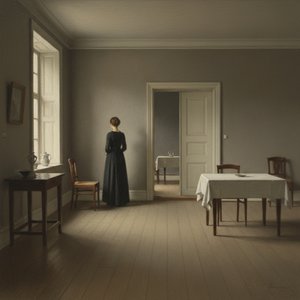
A Life in Light and Shadow
Born in Gothenburg, Sweden, in 1866, Otto Holmström lived a life that mirrored the quiet, often difficult realities of the Swedish art scene at the turn of the century. He was a man of deep observation, a painter who found his purpose in the subtle details of the world around him. His early years were shaped by the guidance of Carl Larsson, a connection that likely helped refine his eye for composition and form. Despite his talent, his later years were marked by hardship. By 1914, while working in a studio in Stockholm, he faced significant poverty and declining health. He passed away in Stockholm in 1915, leaving behind a body of work that captured the essence of Swedish life and landscape.
The Quiet Observer of Landscapes
Holmström’s work was never about grand, sweeping gestures. Instead, he focused on the intimacy of specific places and the way light interacts with the built environment. He was a master of the small, focused moment, often working in watercolor or through precise drawings. His subjects were varied, yet they shared a certain stillness that invites a closer look. He sought to document the character of the places he visited, from the coastal air to the quiet corners of a room.
His repertoire included several distinct themes:
- Landscape depictions, particularly those capturing the atmosphere of Visby.
- Street scenes from Bruges, capturing the architecture and life of the city.
- Harbor scenes and views of the archipelago.
- Interior scenes rendered with a sense of quietude.
A Lasting Presence in Swedish Art
Though he lived much of his life in relative obscurity and struggled with illness, Holmström’s contribution to Swedish art is preserved in significant collections. His ability to translate the texture of a street or the mood of a harbor into a visual form earned him a place in the permanent records of his country. His works are held by the Nationalmuseum and the Gothenburg Museum of Art, ensuring that his perspective on the Swedish landscape and urban life remains available to those who seek it. He is buried in the Västra Cemetery in Gothenburg, the city where his story began.
Klausimai ir atsakymai
Kuriame istoriniame laikotarpyje kūrė Otto Holmström?
Otto Holmström kūrė 19th Century laikotarpiu. Šis laikotarpis leidžia įvertinti kūrybinę veiklą istoriniame kontekste.
Kokias nuota išreiškia Otto Holmström kūryba?
Otto Holmström kūrybą pagal nuotaikas galite peržiūrėti joje, kurioje kūriniai sugrupuoti pagal jų atspindžiamas nuotaikas: Nuotaudų kambarys
Ar galiu peržiūrėti Otto Holmström darbus pagal spalvų paletę?
Otto Holmström kūrybą spalvų paletėms sugrupuota galite rasti puslapyje Pagrinti pagal spalvų paletę.
Ar galima pasimatričiuoti 3D virtualiame Otto Holmström kūrybos muzieje?
Otto Holmström kūrybą galite apžiūrėti 3D galerijoje, apsilankę puslapyje 3D galerija.