
 Voorvertoning
 Verstuur
 Delen
Delen
 Details bekijken
 Gids
Gids

 Download
 Vergelijkbare items
 Röntgenonderzoek
 Diavoorstelling
 Vraag & antwoord
 Statistieken
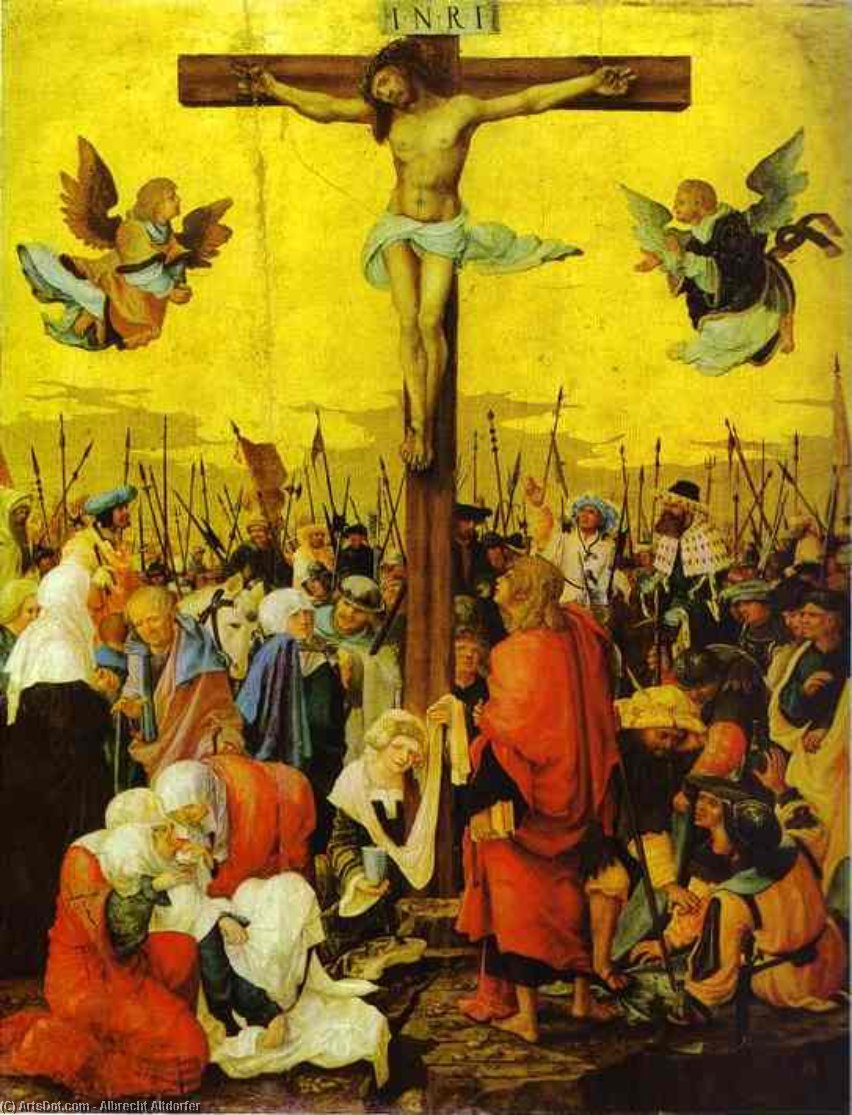
Crucifixion

- 29.0 x 21.0 cm


Albrecht Altdorfer's "Crucifixion" (1526) is a dramatic, evocative depiction of Christ’s suffering, showcasing the artist's pioneering landscape style and masterful use of color within the Northern Renaissance.
 Lees meer
Albrecht Altdorfer (1480-1538): Pionier van de Duitse Renaissance landschapspinturen & sleutelfiguur van de Donau School. Ontdek zijn gravures, religieuze werken & innovatieve kunst.
Ontvang een bestand dat klaar is voor drukwerk en de kwaliteit van het online voorbeeld ver overstijgt. Elke digitale afbeelding die wij verkopen, is afkomstig van een high-resolution master uit onze database — meestal tussen de 5.000 en 15.000 pixels breed — zodat u met vertrouwen groot kunt afdrukken, nauwkeurig kunt bijsnijden of fijne details kunt reproduceren.
Geen enkel bestand verlaat ons atelier onbewerkt. Een digitaal expert controleert de kleuren aan de hand van het originele schilderij en corrigeert deze indien nodig, om vervolgens de helderheid en details te verbeteren met professionele retoucheertechnieken — waarbij de penseelstreek en stijl van de kunstenaar altijd strikt worden gerespecteerd. Het resultaat is een afbeelding die oogt als het schilderij zelf, en niet als een gescande foto met een filter.
U keurt de afbeelding goed voordat de bestelling wordt afgerond: onze expert stuurt u binnen 72 uur een e-mail ter beoordeling. Niet tevreden? Vraag om aanpassingen of correcties, of vraag een terugbetaling aan als de kwaliteit niet aan de verwachtingen voldoet.
Dit is de kwaliteit waarop uitgevers, designstudio's, galeries en drukkerijen vertrouwen.
Digitale afbeeldingen
Download een bestand met hoge resolutie voor persoonlijke weergave, afdrukken en creatieve projecten. ( Schakel over naar print Bestel handgeschilderde reproductie)
Inbegrepen bij elke bestelling van een digitale afbeelding
Professionele digitale levering, gegarandeerd
Wanneer u kiest voor TopImpressionists.com, ontvangt u niet alleen een afbeelding – u krijgt een professioneel verbeterd digitaal kunstwerk, met precisie vervaardigd en voorzien van een tevredenheidsgarantie. Dit is alles wat automatisch bij uw bestelling is inbegrepen:

Snelle levering per e-mail
Uw hoogwaardige digitale afbeeldingsbestand wordt binnen 72 uur na bestelling naar u gemaild – klaar voor direct gebruik.

AI-verbeterd digitaal bestand
Uw kunstwerk wordt professioneel geoptimaliseerd met behulp van geavanceerde AI-tools en handmatige bewerkingen, waardoor maximale details, helderheid en kleurnauwkeurigheid worden gegarandeerd.

Gratis levenslange herlevering van digitale bestanden
Je bestand per ongeluk verwijderd of kwijtgeraakt? Geen zorgen – we sturen het u op elk gewenst moment gratis opnieuw toe.

Geen invoerkosten – nooit
Geniet direct van uw kunstwerk zonder invoerrechten, belastingen of verzendkosten – digitale downloads zijn altijd belastingvrij.

Garantie op kleurgetrouwheid
Met behulp van professionele hulpmiddelen en kleurbeheer zorgen wij ervoor dat uw digitale afbeelding de originele kleuren zo nauwkeurig mogelijk weergeeft.

100 dagen tevredenheidsgarantie
Mocht u niet tevreden zijn met uw digitale afbeelding, dan passen wij deze aan of storten wij 100% terug binnen 100 dagen – zonder vragen te stellen.

100% Geld-terug-garantie
Niet tevreden? Ontvang een volledige terugbetaling binnen 100 dagen na ontvangst van uw digitale bestand – zonder vragen te stellen.

Korting bij grote bestellingen
Koop 3 afbeeldingen, bespaar 10% - Koop 5, bespaar 15% - Koop 10+, bespaar 20%. Ideaal voor creatieve projecten, galerieën en bureaus.
The Weight of Sorrow: Albrecht Altdorfer’s “Crucifixion”
Albrecht Altdorfer's "Crucifixion," painted in 1526, isn’t merely a depiction of a pivotal religious event; it’s a visceral experience. Emerging from the burgeoning German Renaissance, Altdorfer wasn’t simply replicating biblical narratives; he was forging a new visual language, one deeply rooted in the natural world yet imbued with profound spiritual intensity. This particular rendition transcends simple illustration, becoming a landscape saturated with grief and a haunting meditation on sacrifice. The painting immediately commands attention not through grand scale – it's remarkably intimate, measuring just 29 x 21 cm – but through its masterful manipulation of light, color, and composition to evoke an overwhelming sense of sorrow.
The scene unfolds against a dramatically rendered landscape—a brooding, almost primeval forest. The trees, rendered in thick, layered brushstrokes of deep greens, browns, and purples, seem to writhe with the weight of the event. This isn’t a picturesque vista; it's a wilderness imbued with an unsettling energy. Altdorfer deliberately eschews traditional depictions of serene backgrounds, instead presenting a landscape actively participating in the drama. The distant mountains, shrouded in mist and shadow, amplify the feeling of isolation and despair. Notice how the artist uses atmospheric perspective – lighter hues for objects further away – to create a sense of depth and distance, drawing the viewer’s eye into the heart of the scene.
A Pioneer of Landscape
Albrecht Altdorfer stands as a pivotal figure in art history, largely credited with establishing landscape painting as an independent artistic subject within Europe. Prior to his work, landscapes were typically relegated to mere backgrounds for religious or mythological scenes. However, Altdorfer recognized the power of the natural world to convey emotion and meaning. His meticulous observation of nature—evident in the detailed rendering of foliage, rocks, and atmospheric conditions—transformed the landscape from a passive backdrop into an active participant in the narrative. This shift was revolutionary, paving the way for later generations of landscape artists like Albert Bierstadt and Frederic Church.
His background as a town architect and council member further informs his artistic approach. Altdorfer possessed a keen eye for spatial relationships and a deep understanding of how to create a sense of harmony and balance within a composition. This skill is brilliantly demonstrated in “Crucifixion,” where the human figure—Jesus—is carefully positioned within the landscape, creating a dynamic interplay between the earthly realm and the divine.
Symbolism and Emotional Resonance
Beyond its technical brilliance, "Crucifixion" resonates deeply with viewers through its potent symbolism. The stark simplicity of Jesus’s pose – arms outstretched, head bowed – is profoundly moving. Altdorfer avoids any overtly dramatic or theatrical elements, opting instead for a quiet, understated portrayal of suffering. The figures surrounding the cross—angels and soldiers—are rendered in muted tones, emphasizing the central tragedy. Even the light itself seems to weep, casting long shadows across the landscape.
The choice of a dark, foreboding forest as the setting is particularly significant. Forests have historically been associated with death, mourning, and the unknown. In this context, it serves as a powerful metaphor for the spiritual darkness surrounding Jesus’s sacrifice. The painting isn't simply depicting an event; it’s exploring the profound emotional consequences of that event—the grief, despair, and sense of loss experienced by those who witnessed it.
A Timeless Masterpiece
“Crucifixion” is more than just a religious painting; it’s a testament to Altdorfer's artistic genius and his ability to capture the essence of human emotion. The meticulous detail, masterful use of color and light, and profound symbolism combine to create an unforgettable image that continues to resonate with viewers centuries after its creation. Reproductions, like this one, offer a remarkable opportunity to experience the power and beauty of this iconic work, bringing its haunting message into our own spaces.
Veelgestelde vragen
Wat voor soort kunstwerk is "Crucifixion" door Albrecht Altdorfer?
"Crucifixion" is een WallArt-werk.
Wat deelt "Crucifixion" met het overige oeuvre van Albrecht Altdorfer?
"Crucifixion" deelt met andere werken van Albrecht Altdorfer de German Renaissance Landscape-stijl en de terugkerende thema's: danube school landscape influence, medieval religious symbolism strong, early renaissance artistic trends, german cultural identity depicted, altdorfer's innovative landscape role.
Wordt "Crucifixion" bewaard in het land van de maker?
Nee - het kunstwerk wordt in het buitenland bewaard. Het geboorteland van Albrecht Altdorfer is Duitsland, en het museum waar het origineel van "Crucifixion" zich bevindt, ligt in Germany.
Kunstenaarsbiografie
Albrecht Altdorfer: De Pionier van het Noordelijke Renaissance Landschap
Albrecht Altdorfer, geboren rond 1480 in Regensburg, Duitsland, staat als een cruciale figuur tussen de late Gotiek en de opkomende Duitse Renaissance. Hij was niet zomaar een kunstenaar *van* zijn tijd; hij veranderde actief de artistieke koers ervan, met name in het domein van het landschapsschilderij. Komend uit een familie die diep geworteld was in artistieke traditie – zijn vader, Ulrich Altdorfer, was schilder en miniaturist – onderscheidde de jongere Altdorfer zich snel niet als een volger, maar als een innovator. Regensburg, een vrije keurvorstelstad strategisch gelegen aan de Donau, bood een levendige culturele achtergrond voor zijn vroege jaren. Deze locatie vormde diepgaand zijn artistieke gevoeligheid, waardoor een verbinding met de natuur ontstond die centraal zou staan in zijn oeuvre. Naast zijn kunstenaarschap was Altdorfer een man van burgerlijke plicht, zowel architect als gemeinderlid – een getuigenis van zijn veelzijdige talenten. Echter, door zijn kunst – met name zijn vroege gravures en tekeningen uit ongeveer 1506, zoals *Stygmata of St. Francis* en *St. Jerome* – onthulde hij aanvankelijk al een unieke artistieke stem, die hints gaf naar de emotionele intensiteit en nauwkeurigheid die kenmerkend zouden worden voor zijn volwassen stijl.De Donau School en een Revolutionaire Visie
Altdorfer wordt voornamelijk erkend als een toonaangevende figuur van de Donau School, een invloedrijke groep kunstenaars actief in zuidelijk Duitsland in het vroege 16e eeuw. Deze artistieke kring deelde een gemeenschappelijke fascinatie met het verkennen van het expressieve potentieel van het landschap, waardoor dit werd verheven tot een centraal onderwerp op zichzelf. Voordat Altdorfer, diende het landschap voornamelijk als achtergrond voor religieuze of historische narratieven; hij durfde de natuur te portretteren *voor zichzelf*, doordrenkt van sfeer en emotionele resonans. Een transformatieve reis langs de Donau en in de Alpen rond 1511 bleek cruciaal voor zijn artistieke ontwikkeling. De dramatische vergezichten, dichte bossen en imposante bergen ontketenden binnen hem een passie voor het weergeven van de natuur met ongekende nauwkeurigheid en gevoel. Hij werd, naar verluidt, de eerste moderne landschapsschilder, niet alleen wat hij zag reproduceerde, maar ook een emotionele reactie – een gevoel van bewondering, mysterie en zelfs spirituele verbinding. Dit was geen geografische nauwkeurigheid alleen; het ging om het vastleggen van de *ervaring* van het zijn in een landschap. Zijn werk, zoals “The Large Spruce”, illustreert deze verschuiving, waarbij een serene en ingewikkelde weergave van de schoonheid van de natuur wordt aangeboden.Meesterwerken en Artistieke Invloeden
Doorheen zijn carrière produceerde Altdorfer een divers oeuvre bestaande uit schilderijen, gravures, tekeningen en architecturale ontwerpen. Onder zijn meest gerespecteerde prestaties behoort *The Battle of Alexander at Issus* (1529), besteld door hertog Willem IV van Beieren. Deze monumentale schilderkunst toont niet alleen zijn meesterschap in compositie en detail, maar ook zijn innovatieve gebruik van het landschap om de dramatische spanning van het slagveld te versterken. De wervelende wolken, stekelige bergen en chaotische menigte van soldaten creëren een gevoel van overweldigende energie en spektakel. Zijn samenwerking met keizer Maximiliaan I in Innsbruck vanaf 1513 breidde zijn artistieke horizon verder uit en bood mogelijkheden voor grootschalige projecten. Altdorfer’s stijl werd niet in isolatie gevormd; hij absorbeerde invloeden van verschillende bronnen. De poëtische lyriek van Giorgione, de expressieve figuren van Lucas Cranach de Oude en het nauwkeurige detail van Albrecht Dürer lieten allemaal hun sporen achter op zijn werk. Echter, hij synthetiseerde deze invloeden tot een uniek persoonlijk visioen, gekenmerkt door zijn emotionele intensiteit, dramatische verlichting en evocatieve landschappen. Zijn gravures, zoals “Mucius Scaevola Burning His Hand”, demonstreren zijn vaardigheid in dit medium, waarbij delicate lijnen en ingewikkelde details worden getoond, vaak een gevoel van beweging en drama overbrengend.De Evolutie van de Stijl
In de vroege jaren 1500 ontwikkelde Altdorfer zijn stijl door middel van gravures en tekeningen, waarbij hij zich concentreerde op het vastleggen van details en het creëren van composities met een hoge mate van precisie. Deze werken dienden als oefening voor zijn latere schilderijen, waarin hij de emotionele expressie en dramatische verlichting verder zou ontwikkelen. De invloed van de Renaissance-kunstenaars, zoals Dürer en Cranach, is duidelijk zichtbaar in zijn werk, maar Altdorfer wist deze invloeden te integreren in een unieke stijl die hem onderscheidt van zijn tijdgenoten.Belangrijke Prestaties
Doorheen zijn carrière produceerde Altdorfer een divers oeuvre bestaande uit schilderijen, gravures, tekeningen en architecturale ontwerpen. Onder zijn meest gerespecteerde prestaties behoort *The Battle of Alexander at Issus* (1529), besteld door hertog Willem IV van Beieren. Deze monumentale schilderkunst toont niet alleen zijn meesterschap in compositie en detail, maar ook zijn innovatieve gebruik van het landschap om de dramatische spanning van het slagveld te versterken. De wervelende wolken, stekelige bergen en chaotische menigte van soldaten creëren een gevoel van overweldigende energie en spektakel. Zijn samenwerking met keizer Maximiliaan I in Innsbruck vanaf 1513 breidde zijn artistieke horizon verder uit en bood mogelijkheden voor grootschalige projecten. Altdorfer’s stijl werd niet in isolatie gevormd; hij absorbeerde invloeden van verschillende bronnen. De poëtische lyriek van Giorgione, de expressieve figuren van Lucas Cranach de Oude en het nauwkeurige detail van Albrecht Dürer lieten allemaal hun sporen achter op zijn werk. Echter, hij synthetiseerde deze invloeden tot een uniek persoonlijk visioen, gekenmerkt door zijn emotionele intensiteit, dramatische verlichting en evocatieve landschappen. Zijn gravures, zoals “Venus after the Bath”, demonstreren zijn vaardigheid in dit medium, waarbij delicate lijnen en ingewikkelde details worden getoond, vaak een gevoel van beweging en drama overbrengend.Erfgoed en Duurzaam Impact
Albrecht Altdorfer’s artistieke nalatenschap strekt zich verder uit dan de 55 panelen, 120 tekeningen en vele gravures die hij creëerde tijdens zijn leven. Hij heeft fundamenteel de manier veranderd waarop kunstenaars naar landschapsschilderij keken, waardoor toekomstige generaties werden ingelegd om de expressieve mogelijkheden ervan te verkennen. Zijn invloed is zichtbaar in het werk van latere Duitse romantische schilders die op hun beurt probeerden de sublime schoonheid en emotionele kracht van de natuur vast te leggen. Vandaag de dag worden Altdorfer’s kunstwerken vertegenwoordigd in belangrijke museumcollecties wereldwijd, waaronder de Museum Ostdeutsche Galerie in Duitsland – waar zijn *Madonna (Beautiful Maria of Regensburg)* wordt tentoongesteld – en de Kunstsammlungen und Museen Augsburg in Oostenrijk. Zijn innovatieve geest, technische vaardigheid en diepe verbinding met de natuur blijven kunstenaars inspireren en publiek verbluffen eeuwen na zijn dood in 1538. Hij blijft een torenfiguur van de Duitse Renaissance, een ware pionier die durfde te zien landschap niet alleen als achtergrond, maar als een krachtige kracht die diepe emoties en spirituele betekenis kan oproepen. Zijn werk is een getuigenis van de blijvende kracht van kunst om onze perceptie van de wereld om ons heen te transformeren – een nalatenschap die nog steeds resoneert met kijkers vandaag de dag.
Albrecht Altdorfer
1480 - 1538 , Duitsland
Belangrijkste feiten
- Artistic Movement Or Style: Donau-school, Renaissance
- Artists Or Movements Influenced By This Artist: ['Romantici Duits']
- Artists Who Influenced This Artist:
- Giorgione
- Cranach
- Dürer
- Date Of Birth: c. 1480
- Date Of Death: 1538
- Full Name: Albrecht Altdorfer
- Nationality: Duits
- Notable Artworks:
- Slag bij Alexander
- Grote spar
- St. George
- Place Of Birth: Regensburg, Duitsland