

Getoond: · Inclusief lijst:
 Voorvertoning
 Verstuur
 Delen
Delen
 Details bekijken
 Gids
Gids

 Download
 Vergelijkbare items
 Röntgenonderzoek
 Diavoorstelling
 Vraag & antwoord
 Statistieken


€ 240
Handgemaakte olieverfreproductie
Met de hand geschilderd in olieverf op canvas in uw gewenste maat en lijst, op bestelling gemaakt door onze kunstenaars. ( Schakel over naar print Schakel over naar digitale afbeeldingen)
Formaat
·Standaardformaat
op maat gemaakt
CM
INCH
Kies uit onze vooraf ingestelde maten die overeenkomen met de originele verhoudingen van het kunstwerk.
Afmetingen laden...

breedte
hoogte
Voer de breedte en hoogte in die u nodig heeft, passend bij uw lijst of uw muur. Omdat dit handgeschilderd is, kan de kunstenaar bij een afmeting met een andere beeldverhouding iets meer rondom het schilderij schilderen of juist iets meer weglaten — u kiest zelf. Wij sturen u een digitaal mockup ter goedkeuring voordat het schilderwerk begint. De afbeelding die op deze pagina wordt getoond, is niet het uiteindelijke resultaat — alleen de mockup geeft dit weer.
 Lees meer over
Afronden
·
Wit €1

Vervagende randen €1

Doorlopende rand €1

P118B €10

P118H €10

P118W €10

P438Z €10

P508JH €12

P508YH €12

P805H €10

P805Z €10

P919BZ €10

P919G €10

P919XJ €10

P959ZH €10

P968JZ €12

W106C €8

W218G €10

W218JH €8

W218Y €10

W307PJ €10

W316G €10

W316PJ €8

W316Y €10

W398PJ €8

W4111J €10

W500HY €15

W500JH €15

W692G €12

W849H €8

W940BG €15

W953PJ €8

H24-GOLD €30

H24-SILVER €30

H36-GOLD €45

H36-SILVER €45
Verzonden in een beschermende koker, klaar om door uw eigen frameur te worden ingelijst.
Extra's
optioneelWat zijn de extra's precies?
Voorbeelden van wat aangepast kan worden: Vervang het gezicht door een foto van de klant; Voeg een huisdier toe (bijv. vervang de kat door een hond); Voeg een verborgen boodschap toe aan de achtergrond; Wijzig het landschap of de elementen in de achtergrond.
Na de bestelling zal het team van TopImpressionists.com per e-mail contact opnemen met de klant voor instructies en een mockup-voorbeeld verstrekken
Na de bestelling zal het team van TopImpressionists.com per e-mail contact opnemen met de klant voor instructies en een mockup-voorbeeld verstrekken
Wereldwijde levering () binnen 3 tot 4 weken in plaats van de standaard 5 weken. (8 november). Zonder concessies aan de kwaliteit.
Beschermende vernislaag
Naamplaatje
Details van de gegraveerde bronzen plaat
This elegant plaque features the artist's name and the title of the artwork, finely engraved for a timeless presentation.
It is made from bronze with a refined, elegant finish. The text is precisely laser-engraved for a sharp and permanent result. Measuring 9x2 cm, the plaque is compact yet easy to read. It's built to be durable and scratch-resistant, offering a professional, museum-quality look. Mounting is simple thanks to the included adhesive backing.
Details transparante acrylplaat
The plaque includes essential engraved details such as the artist's name, the title of the artwork, the date it was created, the type of media used-like oil on canvas or watercolor-a brief description of the piece, and a QR code that links to the complete artwork information.
It is crafted from clear acrylic, offering a sleek, modern appearance. The text is UV-engraved in black to ensure strong visual contrast. With a size of 10x15 cm, it ensures optimal readability. It comes equipped with two metal hooks for secure wall mounting. The plaque is designed to be weather-resistant, making it suitable for various environments, and it includes interactive features that work seamlessly with smartphone scanning.
Details zwarte acrylplaat
This elegant plaque includes engraved information such as the artist's name, the title of the artwork, the date it was created, the type of media used (like oil on canvas or watercolor), a short description of the artwork, and a QR code for quick access to more information.
The plaque itself is made from refined black acrylic with a premium finish. The text is laser-engraved in white for high contrast and readability. Its size is 10x15 cm, designed to be easy to read. It comes with two metal hooks for professional mounting. The design is sleek and fits any interior style. It is also weather-resistant and durable, with built-in digital integration for mobile compatibility.
De optie voor glas is alleen beschikbaar bij een formaat kleiner dan 110 cm.
 De optie voor glas is alleen beschikbaar bij een formaat kleiner dan 110 cm.
- Gratis wereldwijde expressverzending
- Hoogwaardig linnen canvas
- Volledige verzendverzekering
- Garantie op terugbetaling van invoerrechten
- Garantie op exacte kleurweergave
- Retourbeleid van 100 dagen (alleen bij defecten)
- 100% Geld-terug-garantie
- Korting bij meerdere afnames


Beschrijving verzamelobject
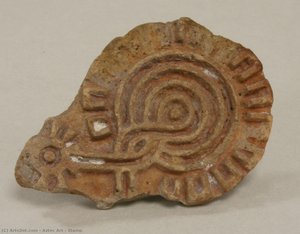
Hand-painted reproduction of 'Stamp' by Aztec Empire (1521). Explore this captivating piece from ancient Mexico – a unique symbol of Aztec artistry and culture. #AztecArt
Biografie kunstenaar
Ontdek de prachtige kunst van het Azteekse Rijk! Bewonder complexe sculpturen, levendige codices & symbolische mozaïeken die hun rijke cultuur en religieuze overtuigingen weerspiegelen. #AztecArt #Mexico
Over het schilderij
The Echoes of Stone: Unveiling the ‘Stamp’
Within the realm of ancient Mesoamerica lies a deceptively simple object – a terracotta stamp, often referred to as a “stamp” in modern parlance. Yet, this unassuming artifact is far more than just a tool for marking textiles; it's a potent symbol of Aztec identity, religious belief, and the sophisticated artistry that flourished within their empire. This particular reproduction captures the essence of these ancient practices, offering a tangible connection to a civilization that once dominated central Mexico.

The piece itself is a testament to the skill of Aztec artisans. Crafted from fired clay – likely terracotta, judging by its texture and color – it’s a compact rectangle adorned with an intricate design. The dominant motif consists of three stylized figures, rendered in a manner that speaks volumes about Aztec cosmology and artistic conventions. These aren't realistic depictions; rather, they are abstracted representations, echoing the geometric patterns so prevalent throughout Mesoamerican art. Notice the parallel lines radiating outwards from the central figure’s crown – a deliberate element reminiscent of the shock of hair worn by the Mexican spider monkey, a creature deeply intertwined with Aztec mythology and associated with music, dance, and even the wind deity Ehecatl.
A Legacy Forged in Clay: Historical Context
To truly appreciate this stamp, one must understand its place within the broader context of Aztec society. The Aztecs, or Mexica as they called themselves, were a remarkably innovative people who built a vast empire on a foundation of military prowess and intricate social structures. Their art wasn’t merely decorative; it served as a powerful means of communication – conveying religious beliefs, political authority, and historical narratives. Ceramic stamps like this one were employed for a variety of purposes, from embellishing clothing and textiles to marking bark paper (amate), a crucial medium for writing and record-keeping. The practice dates back millennia, with roots in earlier Mesoamerican civilizations like the Olmecs and Maya, demonstrating a continuous artistic tradition.
The stamp’s creation aligns perfectly with the Aztec era of roughly 1300 to 1521 AD. During this time, the Aztecs were at their peak, controlling much of central Mexico through a complex system of alliances and tribute. The use of stamps was closely associated with elite culture, primarily crafted by scribes who held positions of high status within the empire. These objects were considered valuable possessions, often interred with the deceased – suggesting they held significant spiritual importance.
Symbolism and Meaning: Decoding the Design
The specific imagery on this stamp is rich in symbolic meaning. The stylized figures likely represent deities or cosmological concepts central to Aztec belief. While a definitive interpretation remains elusive, their abstracted forms align with the broader artistic conventions of the period – prioritizing geometric patterns and symbolic representation over realistic depiction. The spider monkey itself carries significant weight; as mentioned earlier, it was closely linked to Ehecatl, the wind deity, suggesting a connection between earthly existence and the celestial realm.
Furthermore, the stamp’s function as a tool for marking textiles speaks to the Aztec emphasis on ornamentation and visual display. Clothing and other fabrics were often adorned with intricate designs, reflecting social status, religious affiliation, and personal identity. The ‘stamp’ served as a means of adding these decorative elements efficiently and consistently.
A Timeless Masterpiece: Reproduction and Beyond
This hand-painted reproduction captures the spirit and artistry of this remarkable artifact. It offers a beautiful way to bring a piece of Aztec history into your home or studio, serving as a conversation starter and a reminder of the ingenuity and cultural richness of this ancient civilization. Consider it not just an image, but a portal – a window into the world of the Aztecs, where art, symbolism, and daily life were inextricably intertwined.
Veelgestelde vragen
Welke afmeting voor de reproductie wordt aanbevolen voor "Stamp" door Azteekse Rijk?
De aanbevolen afmeting voor de print van "Stamp" door Azteekse Rijk is Medium.
Hoe harmonieren de kleuren van "Stamp" met elkaar?
"Stamp" door Azteekse Rijk vertoont een Unified Palette kleurharmonie.
Waar kan ik de afbeelding van "Stamp" door Azteekse Rijk downloaden?
Er is een download beschikbaar voor "Stamp": de Downloaden pagina van het kunstwerk biedt de mogelijkheid om een digitale afbeelding in hoge resolutie om te downloaden.
Snelle feiten en kunstquiz
Over Azteekse Rijk

Azteekse Rijk
1300 - 1521, Mexico
Biografie kunstenaar
De Echo's van Steen: Een Verkenning van de Kunst en Erfenis van het Azteekse Rijk
De naam “Azteek” – afgeleid van het Nahuatl-woord ātl-ce-tlācati–tlān, wat "volk van vele vormen" betekent – roept beelden op van een uitgestrekt, complex rijk dat Mesoëmerica eeuwenlang domineerde. Meer dan alleen krijgers en veroveraars, waren de Azteken diepgaande kunstenaars die een verfijnde schoonheid weefden in elk aspect van hun leven – van monumentale architectuur tot delicaat verenwerk, van heilige rituelen tot alledaagse objecten. Hun kunst was niet louter decoratief; het was een levendige taal die religieuze overtuigingen, politieke macht, historische verhalen en sociale hiërarchieën communiceerde binnen een samenleving die zowel rigide gestructureerd als opmerkelijk innovatief was.
De artistieke tradities van de Azteken, die in de vroege 14e eeuw ontstonden in Tenochtitlan, het hart van het Azteekse Rijk, waren diep geworteld in de nalatenschap van eerdere Meso-Amerikaanse beschavingen. De Olmeken, met hun kolossale hoofden en geavanceerde kalendersystemen, de Teotihuacanos, beroemd om hun massieve piramides en stadsplanning, en de Tolteken, meesters in metaalbewerking en beeldhouwkunst, droegen allemaal bij aan het rijke artistieke weefsel dat de Azteken erfden. De Azteken waren echter geen eenvoudige imitators; zij versmolten deze invloeden met hun eigen unieke esthetische gevoel, waardoor een kenmerkende stijl ontstond die werd gekenmerkt door gewaagde kleuren, complexe geometrische patronen en symbolische representaties.
Een Palet van Macht: Materialen en Technieken
De Azteekse kunst was opmerkelijk divers en maakte gebruik van een verbazingwekkend scala aan materialen en technieken. Steenhouwen nam een prominente plaats in, belichaamd door monumentale sculpturen die godheden, heersers en mythische wezens uitbeelden. De massieve Zonnesteen (Kalendersteen), ontdekt in 1946, staat als een testament van hun meesterschap over dit medium – een complex, gelaagd stenen reliëf dat kalenderinformatie combineerde met kosmologische symboliek. Bekwame ambachtslieden werkten ook met hout, klei, veren – in het bijzonder de levendige quetzal-veren – jade, turquoise, obsidiaan en goud, wat zowel rijkdom als status weerspiegelde.
Het verenwerk was misschien wel het meest visueel aangrijpende aspect van de Azteekse kunst. Verfijnd vervaardigde hoofdtoooien, mantels, schilden en andere decoratieve voorwerpen werden gemaakt met behulp van duizenden zorgvuldig gerangschikte veren – een proces dat enorme vaardigheid en geduld vereiste. Deze objecten waren niet alleen mooi; ze dienden als krachtige symbolen van autoriteit, religieuze devotie en sociale rang. De kleuren zelf hadden specifieke betekenissen: blauw vertegenwoordigde de hemel, groen symboliseerde vruchtbaarheid, rood stond voor oorlog en geel representeerde de zon.
Bovendien waren Azteekse kunstenaars meesters in de mozaïekkunst, waarbij ze prachtige decoratieve panelen creëerden met behulp van kleine, precies gesneden stenen tegels. Deze mozaïeken versierden tempels, paleizen en particuliere woningen, wat een laag van visuele rijkdom toevoegde aan de gebouwde omgeving. Hun aardewerk was even indrukwekkend, met complexe geometrische ontwerpen en afbeeldingen van dieren en godheden.
De Taal van Symbolen: Thema's en Motieven
De Azteekse kunst is doordrenkt van symboliek, waarbij elk beeld lagen van betekenis bevat die een zorgvuldige interpretatie vereisten door priesters, schrijvers en heersers. De centrale godheid, Huitzilopochtli, de god van de oorlog en de zon, werd vaak afgebeeld in uitgebreide hoofdtoooien versierd met veren en edelstenen. Quetzalcoatl, de gevederde slangengod die geassocieerd wordt met kennis, wijsheid en schepping, nam een prominente plaats in hun pantheon in en verscheen in talrijke artistieke representaties.
Het kalendersysteem – een opmerkelijk geavanceerde combinatie van zonne- en rituele cycli – was een ander terugkerend motief. Beelden van kalenders, hiërogliefen en astronomische symbolen werden verwerkt in sculpturen, mozaïeken en codices (geïllustreerde boeken), wat het diepe begrip van de Azteken voor tijd en kosmologie weerspiegelde. Voorstellingen van maïs, het basisvoedsel van hun dieet, symboliseerden levensonderhoud en vruchtbaarheid. Dierlijke beeldspraak – in het bijzonder jaguars, adelaars, slangen en kolibries – droeg een symbolische betekenis met zich mee die gerelateerd was aan macht, moed en goddelijkheid.
Een Erfenis in Fragmenten: Kunst en Historisch Belang
De plotselinge ineenstorting van het Azteekse Rijk in de handen van Spaanse conquistadores in 1521 leidde tot een verwoestend verlies voor de Meso-Amerikaanse cultuur. Tragisch genoeg werd een groot deel van hun artistieke erfgoed vernietigd tijdens de verovering – tempels werden platgebrand, sculpturen verbrijzeld en codices verbrand. Ondanks deze verliezen overleven fragmenten van de Azteekse kunst vandaag de dag nog steeds, wat onschatbare inzichten biedt in deze bijzondere beschaving.
Opmerkelijke voorbeelden zijn de Zonnesteen, een monumentaal beeldhouwwerk dat de geavanceerde kennis van de Azteken op het gebied van astronomie en wiskunde toont; verfijnde veren hoofdtoooien en mantels die in musea over de hele wereld bewaard zijn gebleven; en de overgebleven codices – handgeschreven boeken met historische verslagen, religieuze overtuigingen en kalenderinformatie. De Colección Andrés Blaisten in Mexico herbergt een belangrijke collectie Latijns-Amerikaanse kunst, waaronder voorbeelden die de Azteekse artistieke tradities verhelderen.
De invloed van de artistieke erfenis van het Azteekse Rijk is nog steeds zichtbaar in de hedendaagse tijd en inspireert zowel moderne kunstenaars als ontwerpers. Hun innovatieve technieken, symbolische beeldspraak en diepe verbondenheid met de natuur blijven resoneren bij een wereldwijd publiek. Het verkennen van de kunst van de Azteken is niet louter een oefening in historische waardering; het is een reis naar het hart van een complexe en fascinerende beschaving – een testament tot menselijke creativiteit, vindingrijkheid en spirituele diepgang.
Om meer kunstwerken uit het Azteekse Rijk en andere opmerkelijke kunstenaars te ontdekken, bezoek TopImpressionists.com.
Snelle feiten over Azteekse Rijk
- Artistic Movement Or Style: Meso-Amerikaanse kunst
- Artists Or Movements Influenced By This Artist: ['Moderne kunst']
- Artists Who Influenced This Artist:
- Olmeks
- Teotihuacan
- Tolteken
- Date Of Birth: 1300 (Tenochtitlan)
- Date Of Death: 1521
- Full Name: Azteekse Rijk
- Nationality: Mexicaans
- Notable Artworks:
- Azteekse kalender
- Zonnepiramide
- Mexicaatse verenarbeid
- Place Of Birth: Tenochtitlan, Mexico
Ontdek kunstwerken georganiseerd op thema, stijl en kenmerk.


Azteekse Rijk
Stamp
() ·
Inclusief lijst: · Met de hand geschilderd in olieverf op linnen
Totaal