

 Voorvertoning
 Verstuur
 Delen
Delen
 Details bekijken
 Gids
Gids

 Download
 Vergelijkbare items
 Röntgenonderzoek
 Diavoorstelling
 Q&A
Q&A Statistieken
two men contemplating the moon


Friedrich’s evocative monochrome landscape captures a moment of profound contemplation beneath the luminous glow of multiple moons, embodying Romantic idealism and showcasing his masterful depiction of solitude and spiritual yearning – explore this iconic masterpiece.
 Lees meer
Caspar David Friedrich (1774-1840): Duitse Romantiek kunstenaar die prachtige landschappen schilderde & symbolische kunst verkende, geïnspireerd door natuur en spiritualiteit. Een pionier van zijn tijd.
Giclée / Kunstafdrukken
Giclée- of canvasafdruk van museumkwaliteit met een snelle productie en flexibele afwerkingsmogelijkheden. ( Bestel handgeschilderde reproductie Schakel over naar digitale afbeeldingen)




P118B €10

P118H €10

P118W €10

P438Z €10

P508JH €12

P508YH €12

P805H €10

P805Z €10

P919BZ €10

P919G €10

P919XJ €10

P959ZH €10

P968JZ €12

W106C €8

W218G €10

W218JH €8

W218Y €10

W307PJ €10

W316G €10

W316PJ €8

W316Y €10

W398PJ €8

W4111J €10

W500HY €15

W500JH €15

W692G €12

W849H €8

W940BG €15

W953PJ €8




Standaardformaat
op maat gemaakt
CM
INCH
Kies uit onze vooraf ingestelde maten die overeenkomen met de originele verhoudingen van het kunstwerk.
Loading sizes...

breedte
hoogte
Voer de gewenste breedte en hoogte in, passend bij uw lijst of muur. Een afdruk kan alleen worden ingekort en nooit groter worden gemaakt dan het origineel; een formaat met andere verhoudingen zal daarom een deel van de afbeelding verliezen. Wij sturen u een digitaal mockup ter goedkeuring voordat we tot drukwerk overgaan. De afbeelding op deze pagina toont niet de werkelijke uitsnede — dit is alleen te zien op het mockup.
Wereldwijde levering () binnen 2 weken in plaats van de standaard 4/5 weken. (31 oktober)

Gratis wereldwijde expressverzending

Hoogwaardig linnen canvas

Volledige verzendverzekering

Garantie op terugbetaling van invoerrechten

Garantie op exacte kleurweergave

Retourbeleid van 100 dagen (alleen bij defecten)

100% Geld-terug-garantie

Korting bij meerdere afnames
 De optie voor glas is alleen beschikbaar bij een formaat kleiner dan 110 cm.

two men contemplating the moon
Giclée / Kunstafdrukken
Afmetingen reproductie
-


Eindtotaal
€ 62
A Celestial Meditation: The Soul of Romanticism
In the quiet, silvered depths of Caspar David Friedrich’s “Two Men Contemplating the Moon,” we encounter more than a mere landscape; we enter a profound psychological space. Executed during the height of the Romantic era, between 1835 and 1840, this monochrome masterpiece serves as a poignant window into the human condition. The scene presents two solitary figures positioned beneath the skeletal silhouette of a tree, their gazes fixed upon a luminous night sky. Yet, Friedrich transcends simple observation by populating the heavens with multiple moons, creating a dreamlike, surrealist atmosphere that defies the rational laws of our world. This deliberate departure from reality invites the viewer to step away from the mundane and enter a realm of pure, unadulterated feeling.
The technical mastery of this work lies in its restrained, atmospheric brilliance. Eschewing the vibrant palettes of his contemporaries, Friedrich utilizes a sophisticated range of tonal gradations in shades of gray to sculpt light from darkness. Through a masterful application of sfumato and subtle blending, he achieves an illusion of infinite depth, where the boundaries between the earth and the cosmos seem to dissolve. The presence of three small birds, scattered delicately throughout the composition, adds a layer of fragile life to the stillness, acting as tiny anchors of movement within the vast, silent expanse. For the discerning collector or interior designer, this painting offers a sophisticated focal point—a piece that does not demand attention through noise, but commands it through a quiet, magnetic intensity.
Symbolism and the Sublime
To gaze upon this work is to engage with the very heart of German Romanticism. Friedrich’s life, marked by early personal tragedies and a deep-seated spiritual inquiry, is etched into every brushstroke. The tree, standing resilient against the nocturnal void, serves as a powerful symbol of rootedness and the enduring connection between the terrestrial and the divine. As the two men stand in contemplative silence, they become proxies for the viewer, embodying the sublime—that overwhelming sensation of awe mixed with a touch of melancholy when faced with the infinite grandeur of nature. This tension between the smallness of humanity and the vastness of the universe is what gives the painting its enduring emotional resonance.
Historically, this piece stands as a defiant reaction against the rigid rationalism of the Enlightenment. While the era sought to categorize and explain the world through logic, Friedrich sought to experience it through intuition and spirit. The multiple moons suggest a fractured or expanded reality, hinting at the layers of existence that lie beyond human perception. For those seeking to adorn a space with art that inspires deep thought and provides a sanctuary for reflection, this reproduction offers an unparalleled opportunity. It is not merely a decoration; it is an invitation to pause, to breathe, and to lose oneself in the eternal dance of light and shadow.
Veelgestelde vragen
Waarvoor wordt een afdruk van "two men contemplating the moon" aanbevolen?
Een reproductie van "two men contemplating the moon" door Caspar David Friedrich wordt aanbevolen voor Mood. Dit advies is gebaseerd op het onderwerp, de sfeer en de kleuren van het werk.
Is "two men contemplating the moon" door Caspar David Friedrich een schilderij, een tekening of een prent?
"two men contemplating the moon" door Caspar David Friedrich wordt geclassificeerd als WallArt. Deze categorie beschrijft het type kunstwerk dat het origineel is.
Hoe populair is "two men contemplating the moon" binnen Romantic Landscape Painting?
"two men contemplating the moon" door Caspar David Friedrich wordt geclassificeerd als Iconic en behoort tot de Romantic Landscape Painting-stroming.
Biografie kunstenaar
A Solitary Vision: The Life and Art of Caspar David Friedrich
Born in the Baltic port city of Greifswald in 1774, Caspar David Friedrich’s life was steeped in a melancholic atmosphere that would profoundly shape his artistic vision. His early years were marked by loss – the deaths of his mother and siblings cast a long shadow, fostering a sensitivity to mortality and transience that became central themes in his work. Initially educated by his older brother Christian in drawing, Friedrich’s formal training began at the University of Leipzig, where he pursued both art and theology, though neither degree was completed. This dual interest – a fascination with the visual world alongside a deep spiritual questioning – would prove crucial to his development as an artist. Further studies in Copenhagen honed his technical skills, exposing him to landscape painting traditions that would serve as a foundation for his unique style, yet it was not imitation he sought but rather expression—a means of conveying inner emotional states through the language of nature.The Birth of Romantic Landscape
Friedrich’s artistic journey wasn't merely about depicting scenery; it was about imbuing landscapes with profound symbolic meaning. He moved away from the meticulous detail favored by earlier artists, embracing a more personal and expressive approach. His paintings are characterized by an emphasis on the sublime – evoking feelings of awe, terror, and spiritual connection in the face of nature’s grandeur. The use of *Rückenfiguren*, figures seen from behind, became a signature element, inviting viewers to step into the scene and share in the contemplative experience. Natural elements like ancient trees, towering mountains, swirling fog, and crumbling ruins weren't simply picturesque details; they were potent symbols representing life’s cycles, spiritual longing, and the weight of history. His palette, often muted with blues, grays, and browns, further enhanced the mood of introspection and solemnity that pervades his work. He pioneered a way to depict landscapes not as mere views but as reflections of the human soul—a revolutionary concept for its time.Iconic Works and Enduring Themes
Several paintings stand out as defining examples of Friedrich’s artistic achievement. “Abbey in the Oakwood” (1809-1810), a haunting image of a ruined churchyard enveloped by bare trees, speaks powerfully to themes of mortality and spiritual decay. The composition is deliberately sparse, emphasizing the desolate beauty of ruin and prompting reflection on the passage of time. “Wanderer Above the Sea of Fog” (c. 1818), arguably his most recognizable work, depicts a solitary man gazing out over a misty mountain landscape. This iconic image embodies the Romantic ideal of the individual confronting the vastness and mystery of existence—a figure dwarfed by nature yet simultaneously connected to it on a spiritual level. The Rückenfigur technique powerfully conveys this sense of contemplation and vulnerability. “Chalk Cliffs on Rügen” (1818) demonstrates Friedrich’s mastery of atmospheric effects, capturing the ethereal quality of dawn light filtering through fog-laden cliffs. It subtly evokes German national identity—a growing concern in the fragmented political landscape of early 19th-century Germany. Finally, “The Sea of Ice” (1824) presents a dramatic depiction of an Arctic wasteland, representing nature’s immense power and indifference to human fate. The painting's chilling realism underscores Friedrich’s fascination with confronting the sublime—the awe-inspiring beauty that simultaneously inspires terror and reverence.Influences and Artistic Style
Friedrich drew inspiration from diverse sources, including Dutch Golden Age landscape painters like Jacob van Ruisdael, whose masterful use of light and atmosphere profoundly impacted his artistic sensibilities. He was also deeply influenced by the philosophical writings of Immanuel Kant, particularly Kant’s concept of transcendental idealism—the idea that our experience is shaped by innate mental structures rather than solely by sensory input. This intellectual framework informed Friedrich's belief in the importance of subjective perception and emotional expression as pathways to spiritual understanding. His artistic style is characterized by a deliberate simplification of form, prioritizing mood and symbolism over precise detail. He eschewed academic conventions, favoring instead a painterly technique that conveyed emotion through tonal gradations and textural variations—a radical departure from prevailing artistic trends.Legacy and Rediscovery
Friedrich’s art achieved considerable renown during his lifetime, though it remained largely unrecognized for decades after his death in Dresden in 1840. However, he experienced a significant revival in the late 20th century, becoming widely celebrated as one of the most important figures in German Romanticism. His emphasis on subjective experience and emotional expression paved the way for later movements like Symbolism and Surrealism, influencing generations of artists who sought to explore the inner world through visual means. He didn’t simply paint what he saw; he painted what he *felt*, and it is this profound honesty that continues to captivate and inspire audiences today. His work stands as a testament to the enduring power of art to confront existential questions—to contemplate our relationship with nature, with God, and with ourselves—a timeless contribution to Western artistic heritage.
Caspar David Friedrich
1774 - 1840 , Duitsland
Belangrijkste feiten
- Artistic Movement Or Style: Romantiek
- Artists Or Movements Influenced By This Artist:
- Symbolisten
- Surrealisten
- Artists Who Influenced This Artist:
- Nederlandse Meesters
- J.C. Dahl
- Date Of Birth: 5 september 1774
- Full Name: Caspar David Friedrich
- Nationality: Duits
- Notable Artworks:
- Abtei im Eichwald
- Wanderer über dem Nebelmeer
- Kreideklippen auf Rügens
- Das Eissee
- Place Of Birth: Greifswald, Duitsland
Gerelateerde artikelen
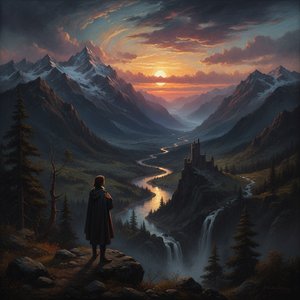
Capturing the Soul: The Emotional Majesty and Sublime Power of Romantic Landscape Painting
Explore the profound emotional depth of Romantic landscape painting. Discover how masters like Turner and Friedrich captured the sublime power of nature through intuition and imagination in this expert art history retrospective.

Capturing the Soul: The Emotional Magic and Sublime Grandeur of Romantic Landscape Painting
Explore the profound emotional depth of Romantic landscape painting. Discover how masters like Friedrich and Turner captured the sublime through light, shadow, and nature's power in this expert art history retrospective for discerning collectors.
Ontdek kunstwerken georganiseerd op thema, stijl en kenmerk.


