

Shown: · With its frame:
 Voorvertoning
 Verstuur
 Delen
Delen
 Details bekijken
 Gids
Gids

 Download
 Vergelijkbare items
 Röntgenonderzoek
 Diavoorstelling
 Q&A
Q&A Statistieken
 Acrylic On Canvas
- WallArt
- Early Renaissance
 1268
1268- Renaissance
 45.0 x 28.0 cm
 San Domenico
€ 259
Handgemaakte olieverfreproductie
Met de hand geschilderd in olieverf op canvas in uw gewenste maat en lijst, op bestelling gemaakt door onze kunstenaars. ( Schakel over naar print Schakel over naar digitale afbeeldingen)
Size
·Standaardformaat
op maat gemaakt
CM
INCH
Kies uit onze vooraf ingestelde maten die overeenkomen met de originele verhoudingen van het kunstwerk.
Loading sizes...

breedte
hoogte
Voer de breedte en hoogte in die u nodig heeft, passend bij uw lijst of uw muur. Omdat dit handgeschilderd is, kan de kunstenaar bij een afmeting met een andere beeldverhouding iets meer rondom het schilderij schilderen of juist iets meer weglaten — u kiest zelf. Wij sturen u een digitaal mockup ter goedkeuring voordat het schilderwerk begint. De afbeelding die op deze pagina wordt getoond, is niet het uiteindelijke resultaat — alleen de mockup geeft dit weer.
 Lees meer over
Finish
·
White €1

Blurside €1

Extended €1

P118B €10

P118H €10

P118W €10

P438Z €10

P508JH €12

P508YH €12

P805H €10

P805Z €10

P919BZ €10

P919G €10

P919XJ €10

P959ZH €10

P968JZ €12

W106C €8

W218G €10

W218JH €8

W218Y €10

W307PJ €10

W316G €10

W316PJ €8

W316Y €10

W398PJ €8

W4111J €10

W500HY €15

W500JH €15

W692G €12

W849H €8

W940BG €15

W953PJ €8

H24-GOLD €30

H24-SILVER €30

H36-GOLD €45

H36-SILVER €45
Shipped in a protective tube, ready for your own framer.
Above 105 cm the frame is shipped as a kit for a professional framer — read the details.
Extras
optionalWhat do the extras include?
Examples of what can be changed: Replace face with customer photo; Add pet (e.g., replace cat with dog); Include hidden message in background; Change background landscape or elements.
After order, TopImpressionists.com team will email client for instructions and provide a mockup preview
After order, TopImpressionists.com team will email client for instructions and provide a mockup preview
Wereldwijde levering () binnen 3 tot 4 weken in plaats van de standaard 5 weken. (29 oktober). Zonder concessies aan de kwaliteit.
Beschermende vernislaag
Naamplaatje
Details van de gegraveerde bronzen plaat
This elegant plaque features the artist's name and the title of the artwork, finely engraved for a timeless presentation.
It is made from bronze with a refined, elegant finish. The text is precisely laser-engraved for a sharp and permanent result. Measuring 9x2 cm, the plaque is compact yet easy to read. It's built to be durable and scratch-resistant, offering a professional, museum-quality look. Mounting is simple thanks to the included adhesive backing.
Details transparante acrylplaat
The plaque includes essential engraved details such as the artist's name, the title of the artwork, the date it was created, the type of media used-like oil on canvas or watercolor-a brief description of the piece, and a QR code that links to the complete artwork information.
It is crafted from clear acrylic, offering a sleek, modern appearance. The text is UV-engraved in black to ensure strong visual contrast. With a size of 10x15 cm, it ensures optimal readability. It comes equipped with two metal hooks for secure wall mounting. The plaque is designed to be weather-resistant, making it suitable for various environments, and it includes interactive features that work seamlessly with smartphone scanning.
Details zwarte acrylplaat
This elegant plaque includes engraved information such as the artist's name, the title of the artwork, the date it was created, the type of media used (like oil on canvas or watercolor), a short description of the artwork, and a QR code for quick access to more information.
The plaque itself is made from refined black acrylic with a premium finish. The text is laser-engraved in white for high contrast and readability. Its size is 10x15 cm, designed to be easy to read. It comes with two metal hooks for professional mounting. The design is sleek and fits any interior style. It is also weather-resistant and durable, with built-in digital integration for mobile compatibility.
De optie voor glas is alleen beschikbaar bij een formaat kleiner dan 110 cm.
 De optie voor glas is alleen beschikbaar bij een formaat kleiner dan 110 cm.
- Gratis wereldwijde expressverzending
- Hoogwaardig linnen canvas
- Volledige verzendverzekering
- Garantie op terugbetaling van invoerrechten
- Garantie op exacte kleurweergave
- Retourbeleid van 100 dagen (alleen bij defecten)
- 100% Geld-terug-garantie
- Korting bij meerdere afnames


Beschrijving verzamelobject
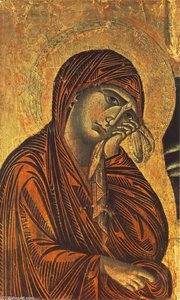
Explore Cimabue’s ‘Crucifix (detail)’ – a poignant 1268 panel painting showcasing early Renaissance emotion & technique. Discover its layered impasto, halo effect, and profound sorrow.
Biografie kunstenaar
Cimabue (1240-1302): De vroege pionier van de Italiaanse Renaissance! Zijn Byzantijnse & renaissancistische stijl, realistische figuren en invloed op Giotto. Ontdek meesterwerken!
About the painting
A Glimpse into Divine Sorrow: Cimabue’s *Crucifix (detail)*
This exquisite detail from Cimabue's larger *Crucifix* (circa 1268) offers a profoundly moving encounter with the Virgin Mary and infant Jesus. Painted during a pivotal moment in art history, this work transcends mere religious iconography to become a powerful expression of maternal grief and spiritual contemplation. It’s a piece that resonates across centuries, offering both artistic beauty and emotional depth.Historical Context & Artistic Transition
Cimabue – or *Cenni di Pepo* as he was known – stands at the cusp of the Italian Renaissance. He was one of the first artists to actively move away from the rigid conventions of the Italo-Byzantine style, which had dominated Italian painting for generations. While still exhibiting elements of Byzantine formality—note the gold halo and stylized drapery—Cimabue infused his work with a nascent naturalism. This is visible in the attempt to render more lifelike proportions and introduce subtle shading, paving the way for artists like Giotto, who would fully embrace Renaissance ideals. The artwork originates from Florence, Italy, a city rapidly becoming a center of artistic innovation. Originally created for the church of San Francesco in Pisa, it now resides at the Barts Hospital in London.Subject & Symbolism
The detail focuses intensely on the Madonna and Child. Mary cradles the infant Jesus, her expression one of profound sorrow and premonition. This isn’t a joyful depiction of motherhood; rather, it foreshadows the suffering to come – Christ's Passion and crucifixion. Key symbolic elements amplify this emotional weight:- The veil draped over Mary’s head signifies her purity and modesty, traditional attributes associated with the Virgin.
- Her downcast gaze is a powerful visual cue of grief, sorrow, and acceptance of her son's destiny.
- The gold halo surrounding both figures denotes their holiness and divine status.
Technique & Materials
Cimabue masterfully employed tempera paint on a gesso-prepared wood panel. This technique, common in the period, involved layering pigments mixed with egg yolk to create luminous colors. The artist’s skillful use of impasto – applying thick layers of paint – is particularly evident in the folds of Mary's cloak and her skin tones, adding a tactile quality and enhancing the sense of volume. Despite its age, the artwork retains a remarkable vibrancy thanks to the enduring qualities of tempera and the inclusion of gold leaf for highlights. The shallow perspective and limited atmospheric depth are characteristic of panel painting from this era.Emotional Impact & Aesthetic Qualities
The overall effect is one of solemnity, piety, and profound emotional resonance. Cimabue doesn’t simply depict a religious scene; he invites the viewer to share in Mary's sorrow and contemplate the weight of faith and sacrifice. The warm earthy tones – ochre, terracotta, and gold – create a rich, aged aesthetic that evokes a sense of timelessness. While not striving for photorealistic detail, Cimabue’s stylized approach imbues the figures with a dignified grace and emotional power. This *Crucifix (detail)* is more than just an artwork; it's a window into the spiritual world of medieval Italy and a testament to the enduring power of human emotion. It would be a stunning focal point in any collection, adding depth and historical significance to both classic and contemporary interiors.Veelgestelde vragen
Is "Crucifix (detail)" door Cimabue eerder licht of donker van kleur?
Over het algemeen wordt "Crucifix (detail)" geregistreerd als balanced. De waargenomen helderheid beschrijft hoe licht of donker het werk oogt.
Waar kan ik statistieken vinden over "Crucifix (detail)" door Cimabue?
De Statistieken-pagina van "Crucifix (detail)" door Cimabue toont statistieken over de publieksbezoeken: het aantal maandelijkse bezoeken aan dit kunstwerk, een vergelijking met de meest bekeken werken van de kunstenaar en de herkomst van de bezoekers.
Welke kleur valt het meest op in "Crucifix (detail)"?
Clay (#a8713a) is de dominante kleur van "Crucifix (detail)" door Cimabue.
Quick facts and art quiz
About Cimabue

Cimabue
1240 - 1302, Italië
Biografie kunstenaar
Giovanni Cimabue: De Pionier van de Italiaanse Schilderkunst
Giovanni Cimabue, geboren als Cenni di Pepo rond 1240 in Florence, staat als een monumentale figuur centraal – een brug tussen de gevestigde artistieke tradities van het Byzantijnse rijk en de opkomende innovaties die de Italiaanse Renaissance zouden definiëren. Zijn leven, hoewel gedeeltelijk verduisterd door de tijd en romantische beschrijvingen – vooral die van Giorgio Vasari eeuwen later – markeert een onmiskenbaar keerpunt in de westerse kunstgeschiedenis. Cimabue was niet alleen een schilder; hij was een moedige innovator die op subtiele wijze uitdagingen bracht aan artistieke conventies, de weg vrijmaakend voor de revolutionaire veranderingen die snel over Italië zouden woelen. Zelfs zijn bijnaam, vermoedelijk betekenis "olifantenkop," hint naar een sterke wil en wellicht een rebelse geest – kwaliteiten die duidelijk aanwezig waren in zijn bereidheid om met vorm en expressie te experimenteren. Hij vertegenwoordigt een cruciale moment waar kunst begon te verschuiven van puur devotionele beelden naar iets meer menselijk en emotioneel resonerend.Vroege Invloeden en Artistieke Ontwikkeling
In eerste instantie werd Cimabue ondergedompeld in de Italo-Byzantijnse stijl die doorlopend in Florence floreren, waarbij zijn vroege werk nauwkeurig aan gevestigde esthetische principes hield. Geplateerde figuren bekleed met glinsterend goud, symbolische representaties van ruimte en een diepe focus op religieuze iconografie kenmerkten deze stijl. Toch begon al vroeg een opkomende drang naar naturalisme te ontstaan. Hij was niet tevreden om bestaande vormen simpelweg te reproduceren; hij streefde ernaar zijn schilderijen met een groter gevoel van leven en emotionele diepgang in te prenten. De precieze aard van zijn vroege training blijft echter betwistbaar, maar het is waarschijnlijk dat hij zijn vaardigheden verfijnde binnen Florentijnse ateliers, de technieken en invloeden van die tijd op zich nam terwijl hij tegelijkertijd zijn eigen unieke artistieke stem ontwikkelde. De Byzantijnse stijl, gekenmerkt door haar formaliteit en spirituele focus, bood hem een solide basis, maar Cimabue begon subtiel te experimenteren met elementen die de komende Renaissance zouden voorspellen – meer aandacht voor volume, expressievere gezichtskenmerken en een beginnend begrip van ruimtelijke relaties. Dit was geen plotselinge afscheid van traditie, maar eerder een geleidelijke evolutie, een delicate balans tussen het eren van het verleden en het omarmen van nieuwe mogelijkheden.Belangrijke Werken en Artistieke Innovaties
Cimabue’s nalatenschap is verankerd in een reeks adembenemende werken die zijn evoluerende stijl laten zien. De *Maestà* (Louvre), oorspronkelijk gemaakt voor de kerk van San Francesco in Pisa, staat als een van zijn meest beroemde meesterwerken. Deze monumentale altarpal staan centraal en toont zijn beheersing van compositie en het gebruik van kleur, terwijl hij tegelijkertijd subtiel afwijkt van rigide Byzantijnse conventies. De figuren, hoewel nog steeds een zekere mate van formaliteit vertonen, tonen een nieuwe sensatie van volume en aanwezigheid. Het *Crucifixie* (San Domenico, Arezzo), daterend uit ongeveer 1270, is bijzonder significant als een vroege demonstratie van zijn afwijking van strikte Byzantijnse normen. Hier zijn de proporties realistischer en het emotionele gewicht van de scène is voelbaar – een schril contrast met de vaak-ver afstandelijke representaties die in eerdere religieuze kunst te vinden zijn. Verder bewijst Cimabue’s innovatieve geest zich in werken zoals de *Flagellation of Christ* (Frick Collection), die over het algemeen toegeschreven wordt aan zijn werkplaats. Deze complexe compositie toont een evoluerend begrip van perspectief en ruimtelijke relaties, wat wijst op een groeiende interesse in het creëren van meer meeslepende en geloofwaardige scènes. Zijn bijdragen waren niet beperkt tot panel schilderijen; Cimabue excelleerde ook als mozaïk kunstenaar, waarbij hij aanzienlijke bijdragen leverde aan de decoratie van de Baptistery in Florence – hoewel deze mozaïeken helaas zijn aangetast door veroudering.Een Cruciale Leraar: Giotto en verder
Misschien is Cimabue’s meest blijvende nalatenschap te vinden in zijn rol als leraar van Giotto di Bondone. Hoewel historische verslaggeving varieert over de exacte aard van hun relatie, wordt algemeen aanvaard dat Giotto cruciale training onder Cimabue’s begeleiding ontving. Ondanks dat historici vaak Giotto hebben overschaduwd in de opkomst van zijn beroemde pupil, hebben moderne kunsthistorici Cimabue’s eigen waarde erkend door de kwaliteit van zijn schilderijen en mozaïeken. Het was Cimabue die, na alles, de visie legde voor decoratieve christelijke kunst om verder te gaan dan iconen en een aardse, meer mensgerichte element aan devotionele altaren en fresco’s toe te voegen. Zijn bereidheid om met vorm, proportie en expressie te experimenteren heeft de weg geopend voor de innovaties van de Renaissance, waardoor hij als een cruciale overgangsfiguur in de geschiedenis van de westerse kunst wordt beschouwd.Historische Betekenis
Cimabue stierf in 1302 in Pisa, waarbij hij een oeuvre achterliet dat nog steeds fascineert en inspireert. Ondanks zijn significante bijdragen blijven details over zijn latere leven schaars. Echter, zijn artistieke nalatenschap resoneren krachtig door de werken van zijn studenten en de evolutie van Italiaanse kunst. Hij vertegenwoordigt een cruciale stap in de ontwikkeling van westerse schilderkunst, waarbij hij zich afkeerde van de gestileerde conventies van het Byzantijnse tijdperk en een meer menselijke en emotionele benadering omarmde. Zijn schilderijen zijn niet alleen historische artefacten; ze zijn ook vensters op een cruciale moment in de kunstgeschiedenis – een tijd waarin kunstenaars bereid waren om gevestigde normen te betwisten en nieuwe mogelijkheden te verkennen. Hij was een pionier, een visionair die het moedig vond om grenzen te verleggen en nieuwe horizonnen te verkennen.Quick facts about Cimabue
- Artistic Movement Or Style: Byzantijns & Renaissance
- Artists Or Movements Influenced By This Artist: ['Giotto di Bondone']
- Artists Who Influenced This Artist:
- Giunta Pisano
- Coppo di Marcovaldo
- Date Of Birth: c. 1240
- Date Of Death: 1302
- Full Name: Giovanni Cimabue
- Nationality: Italiaans
- Notable Artworks:
- Maestà
- Crucifixie
- Verschrikking Christi
- Place Of Birth: Florence, Italië
Ontdek kunstwerken georganiseerd op thema, stijl en kenmerk.


Cimabue
Crucifix (detail)
() ·
With its frame: · Hand-painted in oil on linen
Total