
Getoond: · Inclusief lijst:
 Voorvertoning
 Verstuur
 Delen
Delen
 Details bekijken
 Gids
Gids

 Download
 Vergelijkbare items
 Röntgenonderzoek
 Diavoorstelling
 Vraag & antwoord
 Statistieken
- 187.0 x 107.0 cm


€ 241
Handgemaakte olieverfreproductie
Met de hand geschilderd in olieverf op canvas in uw gewenste maat en lijst, op bestelling gemaakt door onze kunstenaars. ( Schakel over naar print Schakel over naar digitale afbeeldingen)
Formaat
·Standaardformaat
op maat gemaakt
CM
INCH
Kies uit onze vooraf ingestelde maten die overeenkomen met de originele verhoudingen van het kunstwerk.
Afmetingen laden...

breedte
hoogte
Voer de breedte en hoogte in die u nodig heeft, passend bij uw lijst of uw muur. Omdat dit handgeschilderd is, kan de kunstenaar bij een afmeting met een andere beeldverhouding iets meer rondom het schilderij schilderen of juist iets meer weglaten — u kiest zelf. Wij sturen u een digitaal mockup ter goedkeuring voordat het schilderwerk begint. De afbeelding die op deze pagina wordt getoond, is niet het uiteindelijke resultaat — alleen de mockup geeft dit weer.
 Lees meer over
Afronden
·
Wit €1

Vervagende randen €1

Doorlopende rand €1

P118B €10

P118H €10

P118W €10

P438Z €10

P508JH €12

P508YH €12

P805H €10

P805Z €10

P919BZ €10

P919G €10

P919XJ €10

P959ZH €10

P968JZ €12

W106C €8

W218G €10

W218JH €8

W218Y €10

W307PJ €10

W316G €10

W316PJ €8

W316Y €10

W398PJ €8

W4111J €10

W500HY €15

W500JH €15

W692G €12

W849H €8

W940BG €15

W953PJ €8

H24-GOLD €30

H24-SILVER €30

H36-GOLD €45

H36-SILVER €45
Verzonden in een beschermende koker, klaar om door uw eigen frameur te worden ingelijst.
Extra's
optioneelWat zijn de extra's precies?
Voorbeelden van wat aangepast kan worden: Vervang het gezicht door een foto van de klant; Voeg een huisdier toe (bijv. vervang de kat door een hond); Voeg een verborgen boodschap toe aan de achtergrond; Wijzig het landschap of de elementen in de achtergrond.
Na de bestelling zal het team van TopImpressionists.com per e-mail contact opnemen met de klant voor instructies en een mockup-voorbeeld verstrekken
Na de bestelling zal het team van TopImpressionists.com per e-mail contact opnemen met de klant voor instructies en een mockup-voorbeeld verstrekken
Wereldwijde levering () binnen 3 tot 4 weken in plaats van de standaard 5 weken. (10 november). Zonder concessies aan de kwaliteit.
Beschermende vernislaag
Naamplaatje
Details van de gegraveerde bronzen plaat
This elegant plaque features the artist's name and the title of the artwork, finely engraved for a timeless presentation.
It is made from bronze with a refined, elegant finish. The text is precisely laser-engraved for a sharp and permanent result. Measuring 9x2 cm, the plaque is compact yet easy to read. It's built to be durable and scratch-resistant, offering a professional, museum-quality look. Mounting is simple thanks to the included adhesive backing.
Details transparante acrylplaat
The plaque includes essential engraved details such as the artist's name, the title of the artwork, the date it was created, the type of media used-like oil on canvas or watercolor-a brief description of the piece, and a QR code that links to the complete artwork information.
It is crafted from clear acrylic, offering a sleek, modern appearance. The text is UV-engraved in black to ensure strong visual contrast. With a size of 10x15 cm, it ensures optimal readability. It comes equipped with two metal hooks for secure wall mounting. The plaque is designed to be weather-resistant, making it suitable for various environments, and it includes interactive features that work seamlessly with smartphone scanning.
Details zwarte acrylplaat
This elegant plaque includes engraved information such as the artist's name, the title of the artwork, the date it was created, the type of media used (like oil on canvas or watercolor), a short description of the artwork, and a QR code for quick access to more information.
The plaque itself is made from refined black acrylic with a premium finish. The text is laser-engraved in white for high contrast and readability. Its size is 10x15 cm, designed to be easy to read. It comes with two metal hooks for professional mounting. The design is sleek and fits any interior style. It is also weather-resistant and durable, with built-in digital integration for mobile compatibility.
De optie voor glas is alleen beschikbaar bij een formaat kleiner dan 110 cm.
 De optie voor glas is alleen beschikbaar bij een formaat kleiner dan 110 cm.
- Gratis wereldwijde expressverzending
- Hoogwaardig linnen canvas
- Volledige verzendverzekering
- Garantie op terugbetaling van invoerrechten
- Garantie op exacte kleurweergave
- Retourbeleid van 100 dagen (alleen bij defecten)
- 100% Geld-terug-garantie
- Korting bij meerdere afnames


Beschrijving verzamelobject
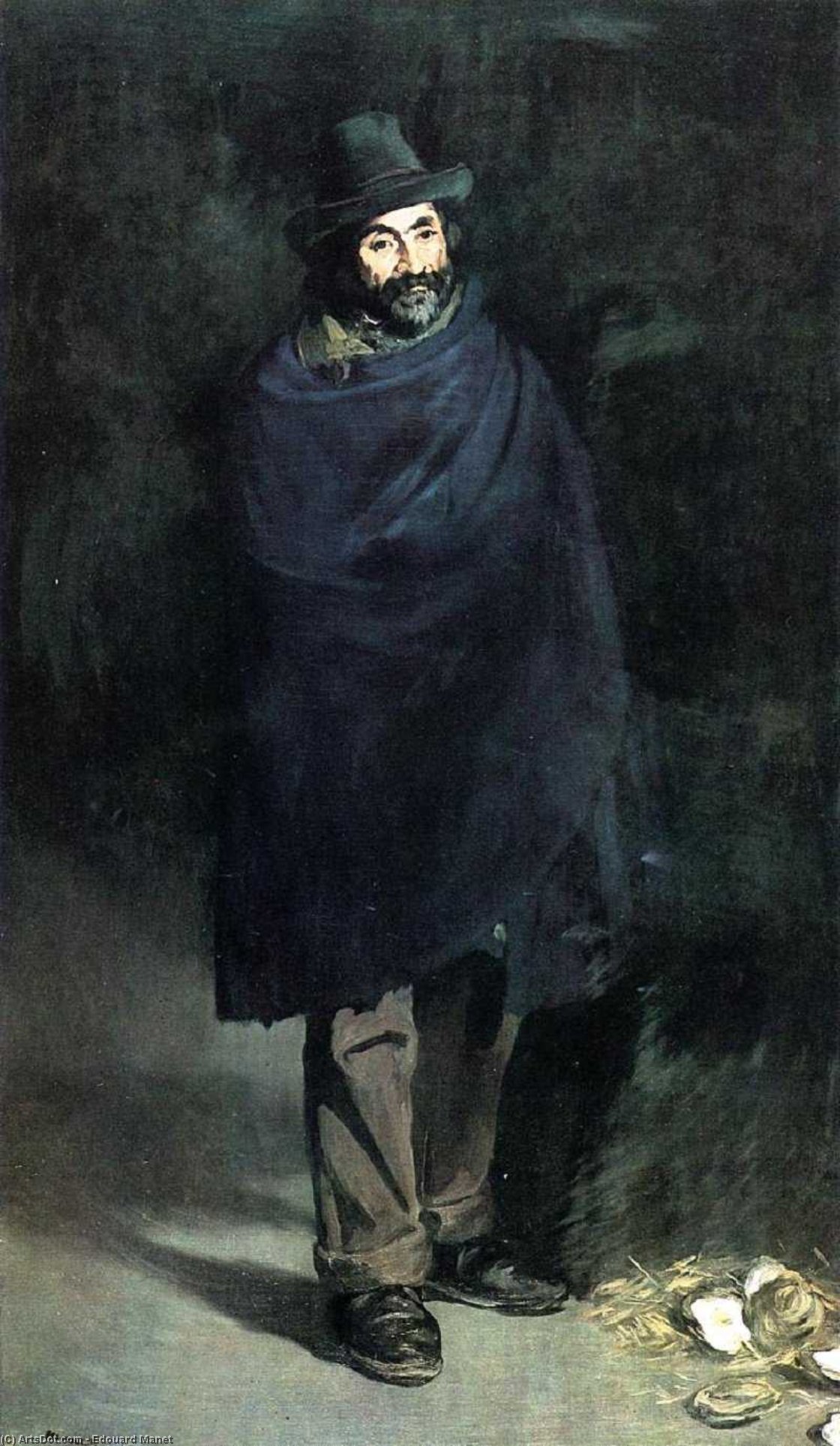
Édouard Manet's 'The Philosopher' (1867) captures a contemplative figure amidst nature, blending Realism and Impressionism. Explore the painting’s symbolism, artistic context, and legacy at The Art Institute of Chicago.
Biografie kunstenaar
Manet verbond Realisme en Impressionisme met Olympia. Ontdek de revolutionaire werken van deze Parijse meester.
Over het schilderij
The Philosopher: A Window into Manet’s Modern Soul
Édouard Manet's *The Philosopher*, painted in 1867, isn’t merely a portrait; it’s a carefully constructed tableau that encapsulates the burgeoning spirit of modern art. This oil-on-canvas work, measuring a substantial 187 x 107 cm, invites us into a quiet contemplation, a moment suspended between observation and thought. The subject, a man draped in a long coat and hat – a figure instantly recognizable as embodying intellectualism – stands on a Parisian street, his hands tucked casually into his pockets, radiating an aura of profound introspection. Yet, it’s not the individual that commands our attention entirely, but rather the subtle orchestration of elements surrounding him: the birds perched above, the clock subtly hinting at time's passage, and the carefully chosen background details. These aren’t merely decorative flourishes; they contribute to a layered narrative, inviting us to consider the nature of existence itself. The painting emerged from a pivotal moment in art history – a period of intense transition between Realism and Impressionism. Manet, already known for his provocative works like *Le Déjeuner sur l'herbe* and *Olympia*, was pushing boundaries with each new creation. He deliberately challenged academic conventions by depicting everyday life, often featuring ordinary people in unidealized ways. *The Philosopher* exemplifies this approach, eschewing the polished surfaces and heroic narratives favored by earlier generations of artists. Instead, Manet presents a scene stripped bare of sentimentality, focusing on the raw reality of urban existence. The muted palette – dominated by browns, grays, and ochres – reinforces this sense of understated observation. Notice how he employs loose brushstrokes, characteristic of his style, creating an almost hazy effect that softens the edges and contributes to the painting’s contemplative mood. Manet's stylistic choices are deeply rooted in both Realism and Impressionism. He retains a degree of realism in his depiction of the subject and setting, meticulously rendering the details of the man’s clothing and the streetscape. However, he also embraces the Impressionist emphasis on capturing fleeting moments of light and color. The dappled sunlight filtering through the background suggests movement and atmosphere, while the subtle shifts in tone create a sense of depth and spatial ambiguity. This blending of styles – realism tempered by impressionistic sensitivity – is what makes Manet such a revolutionary figure. He wasn’t simply painting what he saw; he was actively shaping how we perceive the world around us. The inclusion of birds, for instance, adds a layer of symbolic richness. Birds are often associated with freedom and intellect, further reinforcing the subject's philosophical nature. The historical context surrounding *The Philosopher* is crucial to understanding its significance. Manet’s work coincided with a period of rapid social and economic change in Paris – the rise of industrialization, urbanization, and a growing sense of alienation. His paintings reflected this turbulent atmosphere, capturing the anxieties and uncertainties of modern life. The painting's placement within the broader context of Manet's career reveals his deliberate attempt to challenge established artistic norms and pave the way for future generations of artists. *The Philosopher* stands as a testament to Manet’s innovative spirit and his profound impact on the development of modern art, ultimately finding its home in the prestigious Art Institute of Chicago, where it continues to captivate viewers with its quiet intensity and enduring relevance.Artistic Details & Symbolism
Let's delve deeper into the specific details that contribute to *The Philosopher’s* evocative power. The man himself is presented in a state of profound contemplation, his gaze directed towards an unseen horizon. His beard and mustache lend him an air of intellectual authority, solidifying his role as a philosopher. Note the careful rendering of his clothing – the long coat, the hat, the simple pocket watch – each element contributing to a sense of timelessness and dignity. The background is equally significant. The two birds perched above suggest a connection to nature, while the clock subtly reminds us of the relentless passage of time. These seemingly minor details are carefully orchestrated to create a harmonious whole, inviting viewers to engage in their own interpretations.Manet’s Legacy & Influence
Édouard Manet's influence on subsequent generations of artists is undeniable. His willingness to challenge conventions and depict modern life with unflinching honesty paved the way for Impressionism and beyond. Artists like Claude Monet, Pierre-Auguste Renoir, and Edgar Degas were deeply influenced by Manet’s techniques and his approach to subject matter. *The Philosopher*, in particular, demonstrates Manet's ability to capture a fleeting moment of human experience with remarkable sensitivity and insight. His work continues to inspire artists today, reminding us of the power of art to challenge our perceptions and expand our understanding of the world.Reproductions & Viewing Experience
TopImpressionists offers meticulously crafted hand-painted reproductions of *The Philosopher*, capturing the essence of Manet’s original masterpiece with unparalleled fidelity. Our skilled artisans employ traditional oil painting techniques, carefully recreating every brushstroke and nuance of color. These reproductions are not merely copies; they are works of art in their own right, imbued with the same spirit and emotion as the original. Whether you choose a large-scale statement piece for your home or a smaller, more intimate reproduction to adorn your office, our hand-painted versions will bring this iconic artwork into your space, allowing you to appreciate its beauty and complexity for years to come. Explore our collection today and experience *The Philosopher* in a whole new light.Veelgestelde vragen
Wie is de kunstenaar achter "The philosopher"?
De kunstenaar achter "The philosopher" is Édouard Manet. Het werk is gecatalogiseerd onder de naam van Édouard Manet.
Wat voor soort kunstwerk is "The philosopher" door Édouard Manet?
"The philosopher" door Édouard Manet wordt geclassificeerd als Wanddecoratie. Deze categorie beschrijft het type kunstwerk dat het origineel is.
Behoort "The philosopher" van Édouard Manet tot het publiek domein, en zo ja, waarom?
De auteursrechtstatus van "The philosopher" - bevindt zich in het publiek domein - de auteursrechten zijn verlopen - is gebaseerd op het overlijden van de kunstenaar in 1883.
Snelle feiten en kunstquiz
Over Édouard Manet

Édouard Manet
1832 - 1883, Frankrijk
Biografie kunstenaar
Vroege jaren, familie en opleiding
Édouard Manet werd op 23 januari 1832 geboren in Parijs. Hij groeide op in een welgesteld huishouden als de oudste zoon van een man die een belangrijke functie bekleedde binnen het Franse ministerie van Justitie. Zijn vader had een heel ander pad voor hem in gedachten, een leven in de marine of de advocatuur. De jonge man probeerde deze richting te volgen, maar hij zakte twee keer voor de toelatingsexamens van de marineacademie. Deze tegenslag verschoof zijn focus definitief naar het atelier. Uiteindelijk presenteerde hij een portfolio met schilderijen aan zijn vader om zijn toewijding aan de kunsten te bewijzen, waarmee hij eindelijk de toestemming kreeg die nodig was voor een formele opleiding.
Van 1850 tot 1856 volgde hij een opleiding in het atelier van Thomas Couture. Hoewel hij daar de technische fundamenten van de academische schilderkunst leerde, dwaalden zijn ogen vaak af naar het Louvre. Hij bracht een groot deel van zijn tijd door in die galerijen, staand voor de doeken van de oude meesters, waar hij hun methoden probeerde te kopiëren. Hij bestudeerde de manier waarop zij met licht en vorm omgingen, waarbij hij de lessen uit het verleden in zich opnam terwijl hij zich voorbereidde om zijn eigen weg te vinden. Deze periode van intensieve studie vormde het technische fundament dat de basis zou leggen voor zijn latere breuken met de traditie.
Techniek en Artistieke Stijl
Het oppervlak van een canvas onthult een bewuste breuk met de gepolijste, onzichtbare afwerking die door de Salon werd vereist. In plaats van de sporen van de penseel weg te strijken, is er sprake van een zichtbare, energieke applicatie van pigment, bekend als facture. Deze benadering geeft prioriteit aan de fysieke realiteit van de verf zelf. Door gebruik te maken van de alla prima of nat-in-nat techniek, worden de kleuren aangebracht terwijl ze nog vers zijn, waardoor een onmiddellijke kwaliteit ontstaat die de trage, gelaagde opbouw van traditionele academische methoden vermijdt. Deze methode maakt een zekere spontaniteit mogelijk in de wijze waarop licht en atmosfeer worden vastgelegd.
Er is een opvallende vlakheid in de manier waarop vormen worden geconstrueerd. Een losse handhabeling van de penseel vermijdt de zware modellering die wordt gebruikt om diepe, driedimensionale illusies te creëren. In plaats daarvan voelt de picturale ruimte vaak gecomprimeerd aan. Dit effect wordt versterkt door het gebruik van sterke, contrasterende tonen. In plaats van te vertrouwen op geleidelijke kleurskala's om vorm te definiëren, maakt het werk vaak gebruik van scherpe verschuivingen in luminositeit om het gefragmenteerde, moderne licht van de stad te suggereren. Deze verwerping van het wiskundig perspectief en naadloze blending creëert een gevoel van directheid, alsof het beeld recht voor de ogen van de toeschouwer wordt samengesteld.
Het Schandaal van Moderne Onderwerpen
De het midden van de jaren 1860 bracht een reeks confrontaties met de publieke opinie. In 1863 bood de Salon des Refusés een podium aan werken die door de officiële jury's waren afgewezen. Onder deze werken bevond zich Le Déjeuner sur l'herbe, een schilderij dat onmiddellijk voor grote opschudding zorgde. Het maakte geen gebruik van de gebruikelijke mythologische of bijbelse excuses om naaktheid te presenteren; in plaats daarvan plaatste het een naakte vrouw in een picknicksituatie naast twee volledig geklede mannen. Deze weigering om een historische of goddelijke context te bieden, liet de toeschouwer achter met niets dan de rauwe aanwezigheid van het hedendaagse leven.
De spanning nam alleen maar toe in 1865 met de tentoonstelling van Olympia. Dit werk werd beschouwd als het meest schokkende stuk in de Salon. Het nam de compositie van Titiaans Venus van Urbino aan en stripte de beschermende laag van de mythologie weg, waarbij een godin werd vervangen door een contemporaine prostituee. Ze keek niet weg of nodigde een bewonderende blik uit; ze staarde terug met een directheid die velen ongemakkelijk vond. Critici richtten hun woede op dit gebrek aan idealisering en de ongepolijstheid van de thematiek.
Naast de keuze van de onderwerpen trok de wijze waarop de verf was aangebracht hevige kritiek op. Veel toeschouwers vielen het zichtbare, energieke penseelwerk en het gebrek aan een gepolijste, naadloze afwerking aan. Zij zagen fouten in het perspectief en een weigering om de traditionele regels van decorum te volgen. Wat sommigen incompetentie noemden, herkenden anderen als een bewuste keuze om de realiteit van de verf op het canvas te tonen, in plaats van een venster naar een droomwereld.
Belangrijke Werken en Meesterlijke Schilderijen
In 1861 creëerde hij The Spanish Singer, een werk dat hem een eervolle vermelding in de Salon opleverde. Het schilderij toont een model in Andalusische klederdracht, die een gitaar vasthoudt op een manier die suggereert dat de snaren door een linkshandige speler worden ingedrukt, ook al is het instrument gestemd voor een rechtshandige muzikant. Deze kleine, bewuste imperfectie vormt een intrigerend contrast met het stereotiepe Spaanse stilleven dat bij de voeten van het model is geplaatst.
Zijn penseelstreek richtte zich vaak op het directe en het politieke. In 1867 schilderde hij The Execution of the Emperor Maximilian of Mexico. Later, toen zijn gezondheid aan het eind van de jaren 1870 begon te verslechteren, verschoof zijn focus naar kleinere, meer intieme onderwerpen. Tegen 1882 had hij A Bar at the Folies-Bergère voltooid, een meesterwerk dat de sfeer van een modern café vangt met een gevoel van psychologische ambiguïteit. Tegen het einde van zijn leven, rond 1883, wendde hij zijn aandacht tot de verstilde schoonheid van stillevens, zoals Two roses on a tablecloth.
Zijn artistieke nalatenschap wordt gekenmerkt door deze diverse meesterwerken:
The Spanish Singer (1861)
The Execution of the Emperor Maximilian of Mexico (1867)
A Bar at the Folies-Bergère (1882)
Two roses on a tablecloth (circa 1883)
Cirkel, Rivalen en Invloeden
Zijn penseelvoering draagt het gewicht in zich van de meesters die hij in het Louvre bestudeerde. Hij keek naar het dramatische licht van Caravaggio en de vloeiende, donkere tonen van Velázquez om een weg vooruit te vinden. Van Goya nam hij een zekere directheid over die de noodzaak voor gepolijste, academische afwerkingen omzeilde. Dit waren geen loutere studies; het waren de instrumenten waarmee hij de verwachtingen van de Salon ontmantelde. Hij gaf de voorkeur aan de aanwezigheid van één enkele, krachtige kleur boven het geleidelijke mengen van tonen.
In de cafés en intellectuele kringen van Parijs bewoog hij zich tussen de mensen die de tijdperk zouden herdefiniëren. Hij deelde ruimtes en ideeën met Claude Monet en Edgar Degas, mannen die eveneens de grenzen van wat een schilderij kon zijn, opzochten. Zijn persoonlijke leven was evenzeer verweven met de avant-garde; zijn schoonzus was de kunstenares Berthe Morisot. Hoewel hij vaak de goedkeuring van de officiële instituten zocht, waren zijn ware gelijken zij die werkten in de schaduwen van de gevestigde academies.
Hij vond een vroege, luidruchtige verdediger in een schrijver die de toekomst zag in zijn controversiële doeken. Deze steunpilaar publiceerde een lovend verslag van zijn werk, wat hielp bij het vormgeven van zijn positie in een veranderende kunstwereld. Zelfs toen het publiek met vijandigheid reageerde op zijn moderne onderwerpen, bood deze steun een noodzakelijk tegenwicht aan de critici die zijn stijl als onvoltooid of zijn thema's als ongepast beschouwden. Hij bleef een figuur, gevangen tussen de oude wereld van de Académie en de nieuwe, rusteloze energie van de straten.
Snelle feiten over Édouard Manet
- Artistic Movement Or Style: Realisme, Impressionisme, Avant-garde
- Artists Or Movements Influenced By This Artist:
- Impressionisme
- Avant-garde
- Claude Monet
- Berthe Morisot
- Edgar Degas
- Gauguin
- Artists Who Influenced This Artist:
- Caravaggio
- Diego Velázquez
- Francisco Goya
- Titian
- Raphael
- Frans Hals
- Peter Paul Rubens
- Date Of Birth: 1832
- Date Of Death: 1883
- Full Name: Édouard Manet
- Nationality: Frans
- Notable Artworks:
- Olympia
- Le Déjeuner sur l'herbe
- A Bar at the Folies-Bergère
- Place Of Birth: Parijs, Frankrijk
Vergelijkbare kunstwerken


Ontdek kunstwerken georganiseerd op thema, stijl en kenmerk.


Édouard Manet
The philosopher
() ·
Inclusief lijst: · Met de hand geschilderd in olieverf op linnen
Totaal