

Getoond: · Inclusief lijst:
 Voorvertoning
 Verstuur
 Delen
Delen
 Details bekijken
 Gids
Gids

 Download
 Vergelijkbare items
 Röntgenonderzoek
 Diavoorstelling
 Vraag & antwoord
 Statistieken
- 191.0 x 152.0 cm


€ 239
Handgemaakte olieverfreproductie
Met de hand geschilderd in olieverf op canvas in uw gewenste maat en lijst, op bestelling gemaakt door onze kunstenaars. ( Schakel over naar print Schakel over naar digitale afbeeldingen)
Formaat
·Standaardformaat
op maat gemaakt
CM
INCH
Kies uit onze vooraf ingestelde maten die overeenkomen met de originele verhoudingen van het kunstwerk.
Afmetingen laden...

breedte
hoogte
Voer de breedte en hoogte in die u nodig heeft, passend bij uw lijst of uw muur. Omdat dit handgeschilderd is, kan de kunstenaar bij een afmeting met een andere beeldverhouding iets meer rondom het schilderij schilderen of juist iets meer weglaten — u kiest zelf. Wij sturen u een digitaal mockup ter goedkeuring voordat het schilderwerk begint. De afbeelding die op deze pagina wordt getoond, is niet het uiteindelijke resultaat — alleen de mockup geeft dit weer.
 Lees meer over
Afronden
·
Wit €1

Vervagende randen €1

Doorlopende rand €1

P118B €10

P118H €10

P118W €10

P438Z €10

P508JH €12

P508YH €12

P805H €10

P805Z €10

P919BZ €10

P919G €10

P919XJ €10

P959ZH €10

P968JZ €12

W106C €8

W218G €10

W218JH €8

W218Y €10

W307PJ €10

W316G €10

W316PJ €8

W316Y €10

W398PJ €8

W4111J €10

W500HY €15

W500JH €15

W692G €12

W849H €8

W940BG €15

W953PJ €8

H24-GOLD €30

H24-SILVER €30

H36-GOLD €45

H36-SILVER €45
Verzonden in een beschermende koker, klaar om door uw eigen frameur te worden ingelijst.
Extra's
optioneelWat zijn de extra's precies?
Voorbeelden van wat aangepast kan worden: Vervang het gezicht door een foto van de klant; Voeg een huisdier toe (bijv. vervang de kat door een hond); Voeg een verborgen boodschap toe aan de achtergrond; Wijzig het landschap of de elementen in de achtergrond.
Na de bestelling zal het team van TopImpressionists.com per e-mail contact opnemen met de klant voor instructies en een mockup-voorbeeld verstrekken
Na de bestelling zal het team van TopImpressionists.com per e-mail contact opnemen met de klant voor instructies en een mockup-voorbeeld verstrekken
Wereldwijde levering () binnen 3 tot 4 weken in plaats van de standaard 5 weken. (4 november). Zonder concessies aan de kwaliteit.
Beschermende vernislaag
Naamplaatje
Details van de gegraveerde bronzen plaat
This elegant plaque features the artist's name and the title of the artwork, finely engraved for a timeless presentation.
It is made from bronze with a refined, elegant finish. The text is precisely laser-engraved for a sharp and permanent result. Measuring 9x2 cm, the plaque is compact yet easy to read. It's built to be durable and scratch-resistant, offering a professional, museum-quality look. Mounting is simple thanks to the included adhesive backing.
Details transparante acrylplaat
The plaque includes essential engraved details such as the artist's name, the title of the artwork, the date it was created, the type of media used-like oil on canvas or watercolor-a brief description of the piece, and a QR code that links to the complete artwork information.
It is crafted from clear acrylic, offering a sleek, modern appearance. The text is UV-engraved in black to ensure strong visual contrast. With a size of 10x15 cm, it ensures optimal readability. It comes equipped with two metal hooks for secure wall mounting. The plaque is designed to be weather-resistant, making it suitable for various environments, and it includes interactive features that work seamlessly with smartphone scanning.
Details zwarte acrylplaat
This elegant plaque includes engraved information such as the artist's name, the title of the artwork, the date it was created, the type of media used (like oil on canvas or watercolor), a short description of the artwork, and a QR code for quick access to more information.
The plaque itself is made from refined black acrylic with a premium finish. The text is laser-engraved in white for high contrast and readability. Its size is 10x15 cm, designed to be easy to read. It comes with two metal hooks for professional mounting. The design is sleek and fits any interior style. It is also weather-resistant and durable, with built-in digital integration for mobile compatibility.
De optie voor glas is alleen beschikbaar bij een formaat kleiner dan 110 cm.
 De optie voor glas is alleen beschikbaar bij een formaat kleiner dan 110 cm.
- Gratis wereldwijde expressverzending
- Hoogwaardig linnen canvas
- Volledige verzendverzekering
- Garantie op terugbetaling van invoerrechten
- Garantie op exacte kleurweergave
- Retourbeleid van 100 dagen (alleen bij defecten)
- 100% Geld-terug-garantie
- Korting bij meerdere afnames


Beschrijving verzamelobject
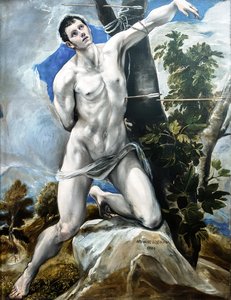
Een dramatische afbeelding van een nude figuur, waarschijnlijk een heilige of mythologische held ondergaand marteling en lijden. Een meesterwerk van El Greco dat emotie en spiritualiteit verkent.
Biografie kunstenaar
Verken El Greco's dramatische kunst! Ontdek Manneristische meesterwerken, religieuze scènes & verlengde figuren. Een pionier van Expressionisme & Cubisme – bekijk zijn iconische schilderijen!
Over het schilderij
Saint Sebastian (El Greco) – A Study in Suffering and Divine Grace
Saint Sebastian is arguably El Greco’s most iconic work, embodying the artist's signature Mannerist style and capturing the profound emotional depth that characterizes his oeuvre. Painted between 1576 and 1579 during his formative years in Toledo, Spain—a city steeped in religious fervor—the painting transcends mere depiction; it strives to convey a visceral experience of martyrdom and unwavering faith. Its enduring power lies not only in its masterful execution but also in the complex tapestry of symbolism woven into every brushstroke.- The Artist’s Vision: El Greco, born Domenikos Theotokopoulos in Crete, was profoundly influenced by Byzantine iconography and sought to elevate Christian art beyond mere representation. He deliberately rejected Renaissance ideals of balance and harmony, favoring instead a dramatic distortion of form—a technique that foreshadowed Expressionism centuries later—to heighten the emotional impact on the viewer.
- Composition & Technique: The painting’s diagonal thrust creates an unsettling dynamism, mirroring the saint's tormented posture. El Greco employs loose brushwork and chiaroscuro – a stark contrast between light and shadow – to sculpt the figure’s musculature and emphasize his anguish. The use of oil on canvas lends richness and luminosity to the skin tones, capturing the subtle nuances of human flesh.
- Classical Inspiration: Like Michelangelo's Adam in the Sistine Chapel, El Greco drew inspiration from classical sculpture—specifically Laocoön and His Sons—to inform his depiction of Saint Sebastian’s martyrdom. The pose of the saint is inverted, mirroring the sculpture’s dynamic composition, demonstrating El Greco’s meticulous study of artistic precedents.
- Symbolism & Context: Saint Sebastian's upward gaze symbolizes a plea for divine intervention amidst suffering, reflecting the fervent piety of the Counter-Reformation era. The desolate landscape—rendered in muted earth tones—evokes a sense of isolation and spiritual contemplation. The painting’s association with plague underscores its significance as a symbol of protection against disease during a time of crisis.
Exploring Mannerism – A Departure from Renaissance Ideal
El Greco's stylistic choices represent a decisive break from the humanist aesthetic prevalent in Florence and Rome during the Renaissance. Rather than striving for idealized beauty or anatomical precision—as Michelangelo championed—El Greco prioritized emotional intensity and expressive gesture. This deliberate distortion of form—elongated figures, exaggerated musculature, and stylized drapery—was considered scandalous by many contemporaries who adhered to traditional artistic conventions. Yet, it was precisely this rebellious spirit that cemented El Greco’s reputation as a visionary artist ahead of his time.- Formal Distortion: The elongated figure of Saint Sebastian exemplifies Mannerist principles, rejecting Renaissance ideals of proportion and balance. This stylistic choice underscores El Greco's rejection of humanist aesthetics and his embrace of a more psychologically driven approach to artmaking.
- Dramatic Lighting: Chiaroscuro—the masterful manipulation of light and shadow—dominates the painting’s illumination scheme, intensifying the emotional impact and directing the viewer’s gaze towards Saint Sebastian’s anguished expression. This technique aligns with Mannerist tendencies toward theatricality and heightened drama.
- Emotional Resonance: El Greco's aim was not merely to depict Saint Sebastian but to evoke a profound feeling of sorrow and spiritual torment in the spectator. The artist achieved this goal through careful attention to gesture, posture, and facial expression—elements that resonate powerfully with viewers even today.
A Legacy Enduring Through Time
Saint Sebastian continues to captivate audiences worldwide, serving as an emblem of faith, resilience, and unwavering devotion. Its enduring appeal stems from its ability to transcend temporal boundaries and speak directly to the human condition—a testament to El Greco’s genius as a painter and his profound understanding of the complexities of human emotion. Reproductions of this masterpiece offer collectors and interior designers alike the opportunity to experience firsthand the transformative power of Mannerist art, capturing the essence of suffering and divine grace in breathtaking detail.Veelgestelde vragen
Zijn de kleuren van "St Sebastiano" door El Greco levendig of gedempt?
De kleur van "St Sebastiano" heeft een verzadiging van Gedempt en een intensiteit van Monochroom.
Kan ik augmented reality gebruiken om "St Sebastiano" door El Greco in mijn eigen ruimte te bekijken?
De AR-weergave-pagina van "St Sebastiano" door El Greco maakt gebruik van augmented reality om het kunstwerk op een compatibel apparaat in uw eigen ruimte te tonen.
Hoe oud was El Greco toen "St Sebastiano" werd gemaakt?
El Greco maakte "St Sebastiano" op 36-jarige leeftijd. De kunstenaar werd geboren in 1541 en het werk dateert uit 1577.
Snelle feiten en kunstquiz
Over El Greco

El Greco
1541 - 1614, Griekenland
Biografie kunstenaar
Doménikos Theotokópoulos, called El Greco
Doménikos Theotokópoulos, known to the world as El Greco – “the Greek” – was a painter whose life and work defied easy categorization. Born in Crete, Greece (1541), his artistic journey took him through Venice and Rome before finding its ultimate expression in the spiritual heartland of Spain: Toledo. El Greco wasn’t merely a product of these places; he synthesized their influences into something wholly unique, a style that anticipated the emotional intensity of Expressionism and the fragmented forms of Cubism centuries later. His early training within the Byzantine tradition instilled in him a meticulous attention to detail and a profound understanding of religious iconography. This foundation, however, wouldn’t confine him. He signed his works in Greek, often appending “Krḗs” – Cretan – as a proud declaration of his origins, even as he ventured into new artistic territories. The seeds of his distinctive style were sown not just in technique but also in the fervent religious climate of his homeland and the rich tapestry of Venetian art.Early Life and Artistic Training
Doménikos Theotokópoulos was born in Fodele (modern Candia), Crete, which at that time belonged to the Republic of Venice. His father, Nikolaos Zacharias Kantakopoulos, was a wealthy merchant and administrator, providing him with a privileged upbringing. From a young age, Doménikos demonstrated an exceptional talent for drawing and painting, mastering the techniques of Byzantine icon painting – a tradition deeply rooted in Orthodox Christianity – under the tutelage of Eustathios Symonds, a renowned Cretan iconographer. This formative experience instilled in him a reverence for detail, a mastery of color palettes derived from Byzantine iconography, and a profound understanding of religious symbolism. The influence of Byzantium is palpable throughout his early oeuvre, particularly in works depicting saints and biblical figures rendered with serene dignity and luminous colors.Venetian Influence: Embracing Innovation
Around 1567, Doménikos moved to Venice, the epicenter of Renaissance artistic innovation. He immersed himself in the vibrant Venetian art scene, studying the masterpieces of Titian, Tintoretto, and Veronese – artists who had revolutionized painting with their mastery of color, composition, and dramatic lighting. Recognizing the limitations of Byzantine tradition alone, El Greco eagerly embraced the Venetian approach, loosening his brushwork and experimenting with oil paint—a medium previously unfamiliar to Cretan painters. This Venetian influence is vividly evident in *St. Sebastian* (1600), where anatomical detail blends seamlessly with an almost theatrical use of light and shadow. He absorbed the dynamism and expressive fervor characteristic of Venetian painting, preparing himself for a transformative encounter with Mannerism in Rome.Roman Years: Seeking Recognition Amidst Competition
In 1570, Doménikos traveled to Rome, hoping to gain recognition within the competitive artistic milieu of the papal court. However, he struggled to secure commissions and faced considerable challenges navigating the complex social dynamics of Roman art life. Despite his talent, El Greco’s style—characterized by elongated figures, distorted perspectives, and stylized draperies—didn't align with the prevailing aesthetic sensibilities of Mannerism, which favored elegance and refinement. Nevertheless, he continued to hone his craft, absorbing influences from artists like Giulio Romano and Andrea Palladio, broadening his artistic horizons and experimenting with new techniques. His Roman years were marked by a period of artistic introspection and stylistic evolution—a quest for personal expression amidst the pressures of patronage and artistic convention.Toledo: A Synthesis of Tradition and Vision
By 1577, Doménikos settled in Toledo, Spain – a city steeped in religious fervor during the Counter-Reformation and home to numerous churches eager for monumental artworks. This relocation proved decisive for El Greco’s artistic development. He received prestigious commissions from influential patrons—including Cardinal Juan Ruiz Zafra—and produced his most celebrated paintings: *The Burial of the Count of Orgaz*, *View of Toledo*, *The Opening of the Fifth Seal*, and *Christ Cleansing the Temple*. In Toledo, El Greco achieved a remarkable synthesis of Byzantine tradition and Venetian innovation, forging a style that was both deeply rooted in religious faith and strikingly original. His paintings are imbued with an emotional intensity unparalleled in Western art history—a testament to his profound spiritual vision and his unwavering commitment to artistic excellence. He became a symbol of Spanish Renaissance art, and his legacy continues to inspire artists today.Snelle feiten over El Greco
- Artistic Movement Or Style: Renaissance en Barok
- Artists Who Influenced This Artist:
- Titian
- Tintoretto
- Date Of Birth: 1541
- Full Name: Doménikos Theotokópoulos
- Nationality: Grieks
- Notable Artworks:
- De Begrafenis van Graaf Orgaz
- Een uitzicht op Toledo
- Het Openen van de Vijfde Sleutel
- Place Of Birth: Crete, Greece
Ontdek kunstwerken georganiseerd op thema, stijl en kenmerk.


El Greco
St Sebastiano
() ·
Inclusief lijst: · Met de hand geschilderd in olieverf op linnen
Totaal