

Getoond: · Inclusief lijst:
 Voorvertoning
 Verstuur
 Delen
Delen
 Details bekijken
 Gids
Gids

 Download
 Vergelijkbare items
 Röntgenonderzoek
 Diavoorstelling
 Vraag & antwoord
 Statistieken

€ 63
Giclée / Kunstafdrukken
Giclée- of canvasafdruk van museumkwaliteit met een snelle productie en flexibele afwerkingsmogelijkheden. ( Bestel handgeschilderde reproductie Schakel over naar digitale afbeeldingen)
Materiaal en techniek
 Lees meer over
De optie voor glas is alleen beschikbaar bij een formaat kleiner dan 110 cm.
Formaat
·Standaardformaat
op maat gemaakt
CM
INCH
Kies uit onze vooraf ingestelde maten die overeenkomen met de originele verhoudingen van het kunstwerk.
Afmetingen laden...

breedte
hoogte
Voer de gewenste breedte en hoogte in, passend bij uw lijst of muur. Een afdruk kan alleen worden ingekort en nooit groter worden gemaakt dan het origineel; een formaat met andere verhoudingen zal daarom een deel van de afbeelding verliezen. Wij sturen u een digitaal mockup ter goedkeuring voordat we tot drukwerk overgaan. De afbeelding op deze pagina toont niet de werkelijke uitsnede — dit is alleen te zien op het mockup.
Afronden
·
Wit €1

Vervagende randen €1

Doorlopende rand €1

P118B €10

P118H €10

P118W €10

P438Z €10

P508JH €12

P508YH €12

P805H €10

P805Z €10

P919BZ €10

P919G €10

P919XJ €10

P959ZH €10

P968JZ €12

W106C €8

W218G €10

W218JH €8

W218Y €10

W307PJ €10

W316G €10

W316PJ €8

W316Y €10

W398PJ €8

W4111J €10

W500HY €15

W500JH €15

W692G €12

W849H €8

W940BG €15

W953PJ €8

H24-GOLD €30

H24-SILVER €30

H36-GOLD €45

H36-SILVER €45
Verzonden in een beschermende koker, klaar om door uw eigen frameur te worden ingelijst.
Extra's
optioneelWat zijn de extra's precies?
Wereldwijde levering () binnen 2 weken in plaats van de standaard 4/5 weken. (25 november)
Beschermende vernislaag
Naamplaatje
Details van de gegraveerde bronzen plaat
This elegant plaque features the artist's name and the title of the artwork, finely engraved for a timeless presentation.
It is made from bronze with a refined, elegant finish. The text is precisely laser-engraved for a sharp and permanent result. Measuring 9x2 cm, the plaque is compact yet easy to read. It's built to be durable and scratch-resistant, offering a professional, museum-quality look. Mounting is simple thanks to the included adhesive backing.
Details transparante acrylplaat
The plaque includes essential engraved details such as the artist's name, the title of the artwork, the date it was created, the type of media used-like oil on canvas or watercolor-a brief description of the piece, and a QR code that links to the complete artwork information.
It is crafted from clear acrylic, offering a sleek, modern appearance. The text is UV-engraved in black to ensure strong visual contrast. With a size of 10x15 cm, it ensures optimal readability. It comes equipped with two metal hooks for secure wall mounting. The plaque is designed to be weather-resistant, making it suitable for various environments, and it includes interactive features that work seamlessly with smartphone scanning.
Details zwarte acrylplaat
This elegant plaque includes engraved information such as the artist's name, the title of the artwork, the date it was created, the type of media used (like oil on canvas or watercolor), a short description of the artwork, and a QR code for quick access to more information.
The plaque itself is made from refined black acrylic with a premium finish. The text is laser-engraved in white for high contrast and readability. Its size is 10x15 cm, designed to be easy to read. It comes with two metal hooks for professional mounting. The design is sleek and fits any interior style. It is also weather-resistant and durable, with built-in digital integration for mobile compatibility.
De optie voor glas is alleen beschikbaar bij een formaat kleiner dan 110 cm.
 De optie voor glas is alleen beschikbaar bij een formaat kleiner dan 110 cm.
- Gratis wereldwijde expressverzending
- Hoogwaardig linnen canvas
- Volledige verzendverzekering
- Garantie op terugbetaling van invoerrechten
- Garantie op exacte kleurweergave
- Retourbeleid van 100 dagen (alleen bij defecten)
- 100% Geld-terug-garantie
- Korting bij meerdere afnames


Beschrijving verzamelobject
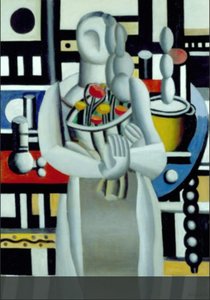
Explore Fernand Leger’s ‘Reading’ (1924): A stylized Cubist masterpiece featuring two figures in a flat, geometric composition. Discover its calm contemplation & unique artistic style.
Biografie kunstenaar
Franse kubist bekend om het tubisme en ritmische, mechanische vormen geïnspireerd door het machine-tijdperk en de neonlichten van New York City.
Over het kunstwerk
A Symphony of Form: Reimagining Fernand Léger’s Reading
In the quietude of an ambiguous interior, two figures sit side-by-side, lost in the profound intimacy of shared silence and individual discovery. Fernand Léger’s 1924 masterpiece, Reading, is far more than a mere depiction of a leisure activity; it is a rhythmic exploration of the modern soul. Through his signature lens, the act of reading becomes a structural event, where the human form and the objects of intellect merge into a singular, captivating composition. The painting invites the viewer into a world that feels both incredibly solid and strikingly abstract, offering a moment of contemplative stillness amidst the perceived chaos of the twentieth century.
The brilliance of this work lies in Léger’s revolutionary approach to shape, often described as Tubism. Moving away from the fractured, splintered planes of traditional Cubism, Léger embraced the cylinder and the rectangle, imbuing his subjects with a sense of mechanical precision and sculptural weight. In Reading, we see this manifest in the way the figures are rendered through bold, geometric volumes. There is a palpable sense of strength in their silhouettes, as if they were forged from the very industrial progress of the era. The technique is remarkably smooth, with colors applied in flat, seamless areas that eliminate distracting textures and force the eye to focus on the pure interplay of light and geometry.
The Pulse of the Machine Age
To understand the emotional resonance of this piece, one must look back to the transformative era of its creation. Emerging from the shadows of World War I, Léger sought a visual language that celebrated the vitality of contemporary life—the beauty of the machine, the clarity of industry, and the dignity of the everyday. Reading embodies this post-war optimism through its clean lines and structured clarity. The background, composed of blocky, architectural elements, provides a simplified stage that emphasizes the subjects without overwhelming them. This deliberate flattening of perspective creates a shallow depth of field, pushing the figures toward the viewer and creating an immediate, almost confrontational, presence in any space.
For the discerning collector or interior designer, this artwork offers a unique balance of intellectual depth and aesthetic versatility. The composition is masterfully balanced, utilizing a subtle asymmetry that keeps the eye moving across the canvas. While the subject matter—the pursuit of knowledge through books—carries a timeless symbolic weight, the execution is unapologetically modern. It serves as a sophisticated focal point that can anchor a contemporary room, providing a sense of calm, structured elegance. Whether placed in a minimalist gallery setting or a richly textured study, Reading radiates an aura of quiet observation and enduring strength, making it a profound addition to any curated collection.
Veelgestelde vragen
Zijn de kleuren van "Reading" door Fernand Léger verzadigd of gedempt?
Het kleurenpalet van "Reading" heeft een verzadiging van Subtle Color.
Waar kan ik kunstwerken vinden die lijken op "Reading" door Fernand Léger?
Op de Vergelijkbare werken-pagina van dit kunstwerk vindt u vergelijkbare werken als "Reading" door Fernand Léger.
Wat stelt "Reading" voor?
De onderwerpen van "Reading" zijn reading activity, geometric forms, abstract figures, modern interior, cubist composition, intellectual pursuit, flat perspective.
Snelle feiten en kunstquiz
Over Fernand Léger

Fernand Léger
1881 - 1955, Frankrijk
Biografie kunstenaar
Het Leven van Fernand Léger
Het verhaal van Fernand Léger begint in het dorp Argentan, gelegen in de regio Orne in Neder-Normandië. Hij kwam op 4 februari 1881 ter wereld als enige zoon. Zijn vroege jaren werden gevormd door de stilte van het Franse platteland en de aanwezigheid van zijn moeder, Marie-Adèle Daunou. Zijn vader, een man die zijn brood verdiende als veehandelaar, overleed toen Fernand nog een jong jongetje was, waardoor het kind werd opgevoed door zijn moeder in een huishouden dat werd gekenmerkt door haar vroomheid en een zekere bescheidenheid.
Deze opvoeding in de landelijke landschappen van Normandië bood een aardend contrast met het leven dat hij uiteindelijk zou leiden in de bruisende centra van de Franse cultuur. Terwijl zijn wortels verbonden waren met de aarde en de fysieke realiteit van het agrarische leven, werd zijn geest aangetrokken door de complexiteit van de moderne tijd. Uiteindelijk zou hij zijn horizon ver uitbreiden, tot ver voorbij de grenzen van Argentan, en een man van vele disciplines worden. Hij beperkte zich niet tot het canvas, maar zocht er juist naar om zijn visie uit te drukken via sculptuur en de bewegende beelden van de film.
Zijn leven was een constante beweging tussen de organische texturen van zijn jeugd en de gestructureerde, mechanische ritmes van de steden. Deze dualiteit definieerde zijn hele bestaan, terwijl hij navigeerde door de verschuivingen van een veranderende eeuw. Zijn pad was nooit eenvoudig, getekend door de spanning tussen de traditionele wereld van zijn kindertijd en de snelle, industriële hartslag van de toekomst die hij uiteindelijk door zijn kunst zou helpen definiëren.
Vroege Leven, Familie en Opleiding
De wortels van zijn visie werden geplant in de landelijke landschappen van Argentan, in de regio Orne in Neder-Normandië, Frankrijk. Geboren in een wereld van veeteelt, werden zijn vroege jaren gevormd door de fysieke realiteit van het land en de gestage ritmes van het agrarische leven. Deze verankering in de tastbare, werkende wereld zou een stille aanwezigheid blijven onder de oppervlakte van zijn latere, complexere verkenningen. Als enige zoon werd hij opgevoed door een moeder die zowel vroom als bescheiden was, en zijn pad werd aanvankelijk gestuurd richting de gestructureerde discipline van de architectuur. Van 1897 tot 1899 wijdde hij zich aan dit technische ambacht, waarbij hij de logica van de ruimte en de noodzaak van nauwkeurig technisch tekenen leerde.
Tegen 1900 werd de aantrekkingskracht van de stad te groot om te negeren, en hij verhuisde naar Parijs. Hij verdiende zijn brood als architectonisch tekenaar, een rol die een scherp oog voor lijn en proportie vereiste. Hoewel zijn formele opleiding in de architectuur een fundament legde van structureel inzicht, begon zijn hart naar het canvas te trekken. Hij zocht toegang tot de prestigieuze École des Beaux-Arts, maar de instelling verleende hem niet de officiële status van ingeschreven student. Onverstoord bleef hij de school bezoeken als niet-ingeschreven student, waarbij hij de lessen van de meesters in zich opnam terwijl hij zich aan de randen van het academische establishment bewoog. Deze periode van studie, hoewel soms beschreven als een zoektocht, was essentieel voor het verfijnen van de technische vaardigheid die hij uiteindelijk zou gebruiken om de wereld te ontleden en in zijn eigen beeld opnieuw op te bouwen.
De Invloed van Cézanne en het Cubisme
In 1907 vond er een diepgaande verschuiving plaats toen de kunstenaar de retrospectieve van Cézanne bezocht tijdens de Salon d'Automne. Deze ontmoeting fungeerde als een katalysator die hem wegtrok van de zachte impressies van zijn jeugd en hem richting een meer structurele manier van kijken duwde. Hij begon voorbij de oppervlakte van de dingen te kijken, op zoek naar de onderliggende geometrie die de wereld definieert. Tegen 1909 was zijn aanwezigheid in de creatieve kringen van Parijs gegroeid, terwijl hij figuren ontmoette zoals Alexander Archipenko, Jacques Lipchitz, Marc Chagall en Robert Delaunay. Deze ontmoetingen waren niet louter sociaal; het waren botsingen van nieuwe ideeën die hielpen bij het vormgeven van de richting van zijn ontluikende visie.
Naarmate de jaren verstrichen, bewoog hij zich binnen de baan van de Puteaux-groep, een kring van kunstenaars die ook wel bekend staat als de Section d'Or. Samen met Jean Metzinger en Henri Le Fauconnier verkende hij de wiskundige en structurele mogelijkheden van deze nieuwe taal. Hij was niet tevreden om simpelweg de paden te volgen die door anderen waren uitgezet, maar zocht in plaats daarvan naar zijn eigen weg door de gefragmenteerde vlakken en overlappende vormen die het tijdperk definieerden. Deze periode van intense experimenteerdrift leidde tot zijn eerste grote expositie op de Salon des indépendants in 1911, waar hij Nudes in the Forest presenteerde.
- Nudes in the Forest (1911)
Oorlog en de Mechanische Periode
De chaos van de Grote Oorlog rukte de kunstenaar weg uit de ateliers van Parijs en wierp hem in de harde realiteit van het front. Van 1914 tot 1917 diende hij in het Franse leger, waarbij hij twee uitputtende jaren doorbracht in de Argonne. Het conflict was niet louter een decor voor zijn leven, maar een transformerende kracht die zijn hele perceptie van vorm veranderde. In 1916 bracht een aanval met mosterdgas hem bijna het leven, waardoor hij de tijd moest gebruiken om te herstellen terwijl de wereld om hem heen werd herschapen door de pure kracht van industriële vernietiging. Zelfs tijdens een kort verlof in datzelfde jaar voelde hij de onweerstaanbare drang om te schilderen, wat resulteerde in Soldier with a Pipe. Dit werk legde een gevoel van de nieuwe realiteit vast, waarin het menselijk figuur de kwaliteiten begon aan te nemen van de machines die het slagveld domineerden.
Tegen 1917 had er een duidelijke verschuiving plaatsgevonden in zijn creatieve geest, wat het begin markeerde van wat later zijn mechanische periode zou worden genoemd. Hij vond een vreemde, ritmische schoonheid in de werktuigen en de technologie van de moderne oorlogsvoering en industrie. De strakke, buisvormige vormen en de precisie van mechanische onderdelen werden zijn nieuwe visuele taal. Hij zag deze objecten niet als koud of onpersoonlijk; integendeel, hij omarmde hun kracht en hun vermogen om de chaos van het moderne bestaan te ordenen. De oorlog had de zachte randen van zijn eerdere werk weggevaagd en had deze vervangen door een scherpe, structurele helderheid die de staalconstructies en zuigers van een veranderend tijdperk weerspiegelde.
Techniek en Stijl
Zijn penseelstreek bewoog met een ritmische, bijna industriële precisie, altijd zoekend naar het vastleggen van de hartslag van een veranderend tijdperk. Hij brak met de zachte, vloeiende schaduwen uit het verleden en koos er in plaats daarvan voor om zijn composities op te bouwen via een taal van robuuste, geometrische kracht. Dit leidde tot de ontwikkeling van een persoonlijke vorm van Cubisme, die door critici werd aangeduid als "Tubisme". In deze stijl werd de wereld opnieuw geïnterpreteerd door middel van buisvormige, kegelvormige en kubistische vormen, waardoor een gevoel van volume ontstond dat zowel solide als dynamisch aanvoelde. Hij schilderde niet louter objecten; hij streefde ernaar hun essentiële, structurele logica te ontdekken.
De kleuren die hij koos, waren even assertief als de vormen die zij vulden. Hij gaf de voorkeur aan een palet dat werd gedomineerd door primaire kleuren, vaak onderbroken door scherp zwart en wit, wat hielp om de scherpe contouren van zijn onderwerpen te definiëren. In plaats van te vertrouwen op traditioneel illusionisme, bracht hij verf aan in gedurfde, vlakke kleurvlakken. Hij maakte vaak gebruik van een dikke impasto, een techniek die de fysieke aanwezigheid van het medium op het canvas benadrukte. Deze texturele benadering zorgde ervoor dat zijn werk tastbaar en materieel aanvoelde, als een spiegel van de machines en stedelijke structuren die hij zo bewonderde. Zijn figuren kregen vaak strakke, mechanische vormen, waardoor de grens tussen de organische menselijke vorm en de technische precisie van het moderne tijdperk vervaagde.
- Nudes in the Forest (1910)
- The Woman in Blue (1912)
- Soldier with a Pipe (1916)
- The Mechanic (1920)
Latere Jaren en Overlijden
De wankelende stromingen van wereldwijde conflicten trokken de kunstenaar uiteindelijk weg uit zijn Parijse kringen en dwars over de Atlantische Oceaan. Tussen 1940 en 1945 woonde hij in de Verenigde Staten, een periode die een ander perspectief bood op de moderne wereld die hij zo lang had geprobeerd te vertalen naar het canvas. Deze tijd in het buitenland bood een pauze in zijn lange evolutie, een moment van transitie voordat hij uiteindelijk terugkeerde naar de Franse bodem.
Bij zijn terugkeer naar zijn moederland onderging zijn persoonlijke leven een ingrijpende verandering. In februari 1952 trouwde hij met Nadia Khodasevich. Deze verbintenis markeerde een laatste hoofdstuk in zijn leven, een tijdperk dat werd geleefd te midden van de voortdurende creatie van zijn uiteenlopende werken, van grootschalige muurschilderingen tot delicate glas-in-loodramen. Zelfs naarmate hij ouder werd, bleef zijn erkenning op het internationale toneel onverstoorbaar. In 1955 won hij de Grand Prix op de Biënnale van São Paulo, een hoge eer die hem in hetzelfde jaar bereikte als zijn overlijden. Hij stierf op 17 augustus 1955 in Gif-sur-Yvette, Frankrijk.
Erfenis en Invloed
Fernand Léger liet een spoor na dat ver reikte tot voorbij de avant-garde kringen van zijn eigen tijd. Door de kloof tussen abstracte kunst en figuratieve representatie te overbruggen, bood hij kunstenaars een manier om de moderne wereld aan te gaan zonder het menselijke onderwerp volledig op te geven. Zijn benadering maakte een dialoog mogelijk tussen de structurele logica van de geometrie en de herkenbare aanwezigheid van mensen en objecten. Dit vermogen om een middenweg te vinden tussen het puur conceptuele en het tastbare, hielp de richting te bepalen van een groot deel van de kunst die volgde.
Zijn gedurfde vereenvoudiging van de vorm en zijn fascinatie voor de esthetiek van massaproductie fungeerden als een voorloper van de popart-beweging. Hij zag een zekere schoonheid in het repetitieve, functionele karakter van het machine-tijdperk, een perspectief dat later zou resoneren bij een nieuwe generatie makers. Kunstenaars zoals Roy Lichtenstein en Andy Warhol trokken een duidelijke lijn van zijn experimenten met krachtige contouren en mechanische beeldtaal naar hun eigen verkenningen van de populaire cultuur. Hij hielp de visuele taal voor te bereiden voor een tijdperk dat uiteindelijk de industriële en commerciële elementen zou vieren die hij ooit probeerde te vertalen naar het canvas.
Waar u zijn werken vandaag de dag kunt bewonderen
Om de fysieke aanwezigheid van zijn visie werkelijk te ervaren, kan men een reis maken naar het zuiden van Frankrijk, specifiek naar Biot in de Alpes-Maritimes. Hier bevindt zich het Musée national Fernand Léger, een plek die volledig gewijd is aan de studie en het behoud van zijn creatieve nalatenschap. Het museum is gevestigd in de Mas Saint-André, een villa die ooit toebehoorde aan de kunstenaar zelf. Binnen deze muren en in de omringende tuinen vinden zijn polychrome keramische sculpturen hun natuurlijke habitat, waardoor de toeschouwer kan zien hoe zijn vormen samenspelen met het licht en de ruimte van het mediterrane landschap.
Naast dit gespecialiseerde heiligdom zijn zijn doeken en sculpturen ondergebracht in diverse vooraanstaande instellingen. Het Musée d'Art et d'Histoire in Frankrijk beheert een collectie van zijn werken, waarmee zijn aanwezigheid in het bredere narratief van de Franse kunst gewaarborgd blijft. Deze collecties maken een voortdurende studie mogelijk van de manier waarop hij de energie van het machine-tijdperk vertaalde naar statische, maar pulserende, visuele vormen. Reizigers die op zoek zijn naar zijn specifieke esthetiek kunnen zijn sporen terugvinden in verschillende grote collecties, waaronder:
- Het Kimbell Art Museum in Fort Worth
- Het Museum of Modern Art in New York City
- Het Musée National Fernand Léger in Biot
Zijn invloed klinkt ook na in het werk van anderen, maar de voornaamste manier om zijn directe hand te ervaren is via deze gevestigde bewaarplaatsen. Of men nu de gedurfde, cilindrische vormen observeert in een museumsetting of zijn sculpturen aanschouwt in de stilte van een tuin, de kijker wordt geconfronteerd met dezelfde structurele helderheid die zijn levenswerk definieerde. Zijn nalatenschap blijft verankerd in deze specifieke locaties, waar de zware, mechanische ritmes van zijn schilderijen bewaard blijven voor hen die de waarheid van zijn geometrie zoeken.
Snelle feiten over Fernand Léger
- Artistieke Stroming Of Stijl:
- Cubisme
- Tubisme
- Section d'Or
- Purisme
- Dadaïsme
- Constructivisme
- Bekende Kunstwerken:
- Nudes in the Forest
- The City
- The Mechanic
- Three Women
- The Woman in Blue
- Geboortedatum: 1881
- Geboorteplaats: Argentan, Frankrijk
- Kunstenaars Die Deze Kunstenaar Hebben Beïnvloed: ['Paul Cézanne']
- Kunstenaars Of Stromingen Beïnvloed Door Deze Kunstenaar:
- Pop Art
- Roy Lichtenstein
- Andy Warhol
- Nationaliteit: Frans
- Overlijdensdatum: 1955
- Volledige Naam: Joseph Fernand Henri Léger
Ontdek kunstwerken georganiseerd op thema, stijl en kenmerk.




Fernand Léger
Reading
() ·
Inclusief lijst: ·
Totaal