


 Voorvertoning
 Verstuur
 Delen
Delen
 Details bekijken
 Gids
Gids

 Download
 Vergelijkbare items
 Röntgenonderzoek
 Diavoorstelling
 Statistieken
Arum Lilies
 Contemporary Realism
 49.0 x 57.0 cm
Admire 'Arum Lilies' by Frederick T.W. Cook – a realistic oil painting of elegant white lilies in a patterned interior. Explore its detailed textures & refined style.
Frederick T.W. Cook (1907-1982) was a British painter known for evocative landscapes, marine scenes & powerful WWII depictions of the Blitz. Official fireman-artist; exhibited RA & beyond. Cornwall artist.
 Lees meer
De kunstwerken die op deze pagina worden weergegeven, zijn beschermd door de auteursrechtwetgeving, wat betekent dat het ons wettelijk niet is toegestaan om identieke reproducties te maken of te verkopen. Deze bescherming wordt gehandhaafd onder internationale overeenkomsten zoals de Conventie van Bern en door nationale wetgeving, waaronder de bepalingen van de Amerikaanse auteurswet - Titel 17. Alle rechten voorbehouden. Reproduceren of distribueren van afbeeldingen is niet toegestaan zonder uitdrukkelijke schriftelijke toestemming van WahooArt.com en de rechthebbenden.
Deze methode voldoet volledig aan de auteursrechtwetgeving, omdat het niet gaat om het kopiëren of dupliceren van het beschermde kunstwerk. In plaats daarvan is er sprake van een creatieve herinterpretatie — een nieuw schilderij dat door het origineel wordt geïnspireerd, maar er niet identiek aan is.
Giclée / Kunstafdrukken
Giclée- of canvasafdruk van museumkwaliteit met een snelle productie en flexibele afwerkingsmogelijkheden. ( Bestel handgeschilderde reproductie Schakel over naar digitale afbeeldingen)




































Standaardformaat
op maat gemaakt
CM
INCH
Kies uit onze vooraf ingestelde maten die overeenkomen met de originele verhoudingen van het kunstwerk.
Loading sizes...

breedte
hoogte
Voer de gewenste breedte en hoogte in, passend bij uw lijst of muur. Een afdruk kan alleen worden ingekort en nooit groter worden gemaakt dan het origineel; een formaat met andere verhoudingen zal daarom een deel van de afbeelding verliezen. Wij sturen u een digitaal mockup ter goedkeuring voordat we tot drukwerk overgaan. De afbeelding op deze pagina toont niet de werkelijke uitsnede — dit is alleen te zien op het mockup.
Wereldwijde levering () binnen 2 weken in plaats van de standaard 4/5 weken. (27 oktober)

Gratis wereldwijde expressverzending

Hoogwaardig linnen canvas

Volledige verzendverzekering

Garantie op terugbetaling van invoerrechten

Garantie op exacte kleurweergave

Retourbeleid van 100 dagen (alleen bij defecten)

100% Geld-terug-garantie

Korting bij meerdere afnames
 De optie voor glas is alleen beschikbaar bij een formaat kleiner dan 110 cm.

Arum Lilies
Giclée / Kunstafdrukken
Afmetingen reproductie
-


Eindtotaal
€ 62


Biografie kunstenaar
The Dual Vision of Frederick T.W. Cook
To encounter the work of Frederick T.W. Cook is to witness a profound dialogue between the serene and the catastrophic. Born in 1907, this London-born painter possessed a soul deeply tethered to the rugged landscapes of Cornwall, yet his eyes were often fixed upon the smoke and fire of a world at war. His artistic journey was one of remarkable duality; while he found peace in the rhythmic tides of the West Country, he simultaneously captured the visceral, bone-chilling terror of the Blitz. This tension between tranquility and turmoil defines his legacy, making him a singular voice in British art history—an artist who could interpret both the quiet mysticism of a coastal morning and the harrowing descent of an aerial bombardment.
Cook’s early development was shaped by a lifelong devotion to the West Country. Having spent every holiday painting in Cornwall from a young age, he later formalised his training at the Hampstead School of Art. His technical foundation was further bolstered by his experience as a commercial artist, a period that honed his precision and secured him various book illustration commissions. However, it was his move to Polperro in 1947, alongside his artist wife Anyon, that solidified his connection to the sea. Settling in their "Harbour Studio" right at the water's edge, Cook became a master of maritime atmosphere, developing a decorative style for harbour scenes that could shift seamlessly from charmingly satirical to brooding and tempestuous.
Expressionism and the Fireman’s Perspective
The grit and reality of Cook’s work were inextricably linked to his lived experience during World War II. Serving as an official fireman-artist, he stood at the front lines of the London Blitz, a position that granted him an unflinching view of destruction. This proximity to chaos infused his oeuvre with an Expressionist intensity, drawing inspiration from the psychological depth of masters like Edvard Munch and Oskar Kokoschka. His brushwork during this era became bold and emotive, utilizing vibrant yet often somber palettes to convey the anxiety of the age. In masterpieces such as "A Flying Bomb over Tower Bridge," Cook utilized stark imagery to distill the complex, collective trauma of a nation under siege.
Beyond the documentation of war, Cook’s stylistic evolution saw him experimenting with elements of abstraction and surrealism. He was not content with mere realism; he sought to capture the "soul" of his subjects. This is particularly evident in his marine art, where turbulent waters and crashing waves serve as metaphors for internal emotional states. His ability to blend the technical skill of a landscape painter with the raw, experimental spirit of a modern expressionist allowed him to create works that were both visually arresting and deeply symbolic. Whether depicting the local seafarers of Cornwall or the skeletal remains of a crashed Bristol Beaufighter, his work always prioritized emotional resonance over simple imitation.
Legacy and Recognition
The breadth of Cook’s contribution to British art is reflected in his prestigious exhibition history and the enduring impact of his imagery. His achievements include:
- Royal Academy Recognition: Throughout the 1940s and 1950s, Cook achieved significant acclaim through regular exhibitions at the Royal Academy, cementing his status among the respected figures of his generation.
- The Imperial War Museum Collection: His profound documentation of wartime London is preserved within the permanent collections of the Imperial War Museum, ensuring that his historical witness remains accessible to future generations.
- Mastery of Atmosphere: He is celebrated for his ability to transition between lighthearted, satirical holiday sketches and heavy, atmospheric storm scenes that capture the "mystical charm" of the West Country.
Ultimately, Frederick T.W. Cook remains an artist of profound depth. He bridged the gap between the decorative and the dramatic, the local and the universal. Through his eyes, we see the beauty of a Cornish coastline and the fury of a world in conflict, reminding us that art is most powerful when it dares to hold both light and shadow in equal measure.

Frederick T. W Cook
1907 - 1982
Belangrijkste feiten
- Full Name: Frederick T.W. Cook
- Nationality: British
- Date Of Birth: 1907
- Date Of Death: 1982
- Place Of Birth: Cornwall
- Notable Artworks:
- Bristol Beaufighter I
- Arum Lilies
- A Flying Bomb over Tower Bridge
- Artistic Movement Or Style: Expressionism
Gerelateerde artikelen
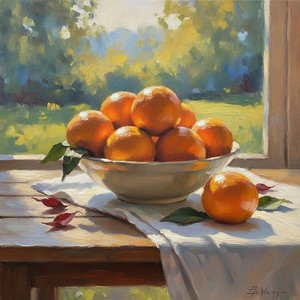
Sun-Drenched Citrus: The Vibrant Beauty of Oranges in Impressionist Masterpieces
Embark on a sensory journey through Impressionist masterpieces. Discover how Renoir and Cézanne captured the vibrant light and luscious textures of sun-drenched oranges in exquisite still life paintings designed to inspire and transform your home.