

Shown: · With its frame:
 Voorvertoning
 Verstuur
 Delen
Delen
 Details bekijken
 Gids
Gids

 Download
 Vergelijkbare items
 Röntgenonderzoek
 Diavoorstelling
 Q&A
Q&A Statistieken

€ 239
Handgemaakte olieverfreproductie
Met de hand geschilderd in olieverf op canvas in uw gewenste maat en lijst, op bestelling gemaakt door onze kunstenaars. ( Schakel over naar print Schakel over naar digitale afbeeldingen)
Dit kunstwerk is auteursrechtelijk beschermd
De kunstwerken die op deze pagina worden weergegeven, zijn beschermd door de auteursrechtwetgeving, wat betekent dat het ons wettelijk niet is toegestaan om identieke reproducties te maken of te verkopen. Deze bescherming wordt gehandhaafd onder internationale overeenkomsten zoals de Conventie van Bern en door nationale wetgeving, waaronder de bepalingen van de Amerikaanse auteurswet - Titel 17. Alle rechten voorbehouden. Reproduceren of distribueren van afbeeldingen is niet toegestaan zonder uitdrukkelijke schriftelijke toestemming van WahooArt.com en de rechthebbenden.
Als een respectvol en legaal alternatief bieden wij op maat gemaakte, handgeschilderde kunstwerken aan die geïnspireerd zijn op het origineel. Onze bekwame en professionele kunstenaars bestuderen zorgvuldig de stijl, sfeer en artistieke essentie van het origineel om een nieuw, uniek werk te creëren dat dezelfde emotie oproept – terwijl het een op zichzelf staande, originele creatie blijft.
Deze methode voldoet volledig aan de auteursrechtwetgeving, omdat het niet gaat om het kopiëren of dupliceren van het beschermde kunstwerk. In plaats daarvan is er sprake van een creatieve herinterpretatie — een nieuw schilderij dat door het origineel wordt geïnspireerd, maar er niet identiek aan is.
 Lees meer over
Size
·Standaardformaat
op maat gemaakt
CM
INCH
Kies uit onze vooraf ingestelde maten die overeenkomen met de originele verhoudingen van het kunstwerk.
Loading sizes...

breedte
hoogte
Voer de breedte en hoogte in die u nodig heeft, passend bij uw lijst of uw muur. Omdat dit handgeschilderd is, kan de kunstenaar bij een afmeting met een andere beeldverhouding iets meer rondom het schilderij schilderen of juist iets meer weglaten — u kiest zelf. Wij sturen u een digitaal mockup ter goedkeuring voordat het schilderwerk begint. De afbeelding die op deze pagina wordt getoond, is niet het uiteindelijke resultaat — alleen de mockup geeft dit weer.
Finish
·
White €1

Blurside €1

Extended €1

P118B €10

P118H €10

P118W €10

P438Z €10

P508JH €12

P508YH €12

P805H €10

P805Z €10

P919BZ €10

P919G €10

P919XJ €10

P959ZH €10

P968JZ €12

W106C €8

W218G €10

W218JH €8

W218Y €10

W307PJ €10

W316G €10

W316PJ €8

W316Y €10

W398PJ €8

W4111J €10

W500HY €15

W500JH €15

W692G €12

W849H €8

W940BG €15

W953PJ €8

H24-GOLD €30

H24-SILVER €30

H36-GOLD €45

H36-SILVER €45
Shipped in a protective tube, ready for your own framer.
Above 105 cm the frame is shipped as a kit for a professional framer — read the details.
Extras
optionalWhat do the extras include?
Examples of what can be changed: Replace face with customer photo; Add pet (e.g., replace cat with dog); Include hidden message in background; Change background landscape or elements.
After order, TopImpressionists.com team will email client for instructions and provide a mockup preview
After order, TopImpressionists.com team will email client for instructions and provide a mockup preview
Wereldwijde levering () binnen 3 tot 4 weken in plaats van de standaard 5 weken. (1 november). Zonder concessies aan de kwaliteit.
Beschermende vernislaag
Naamplaatje
Details van de gegraveerde bronzen plaat
This elegant plaque features the artist's name and the title of the artwork, finely engraved for a timeless presentation.
It is made from bronze with a refined, elegant finish. The text is precisely laser-engraved for a sharp and permanent result. Measuring 9x2 cm, the plaque is compact yet easy to read. It's built to be durable and scratch-resistant, offering a professional, museum-quality look. Mounting is simple thanks to the included adhesive backing.
Details transparante acrylplaat
The plaque includes essential engraved details such as the artist's name, the title of the artwork, the date it was created, the type of media used-like oil on canvas or watercolor-a brief description of the piece, and a QR code that links to the complete artwork information.
It is crafted from clear acrylic, offering a sleek, modern appearance. The text is UV-engraved in black to ensure strong visual contrast. With a size of 10x15 cm, it ensures optimal readability. It comes equipped with two metal hooks for secure wall mounting. The plaque is designed to be weather-resistant, making it suitable for various environments, and it includes interactive features that work seamlessly with smartphone scanning.
Details zwarte acrylplaat
This elegant plaque includes engraved information such as the artist's name, the title of the artwork, the date it was created, the type of media used (like oil on canvas or watercolor), a short description of the artwork, and a QR code for quick access to more information.
The plaque itself is made from refined black acrylic with a premium finish. The text is laser-engraved in white for high contrast and readability. Its size is 10x15 cm, designed to be easy to read. It comes with two metal hooks for professional mounting. The design is sleek and fits any interior style. It is also weather-resistant and durable, with built-in digital integration for mobile compatibility.
De optie voor glas is alleen beschikbaar bij een formaat kleiner dan 110 cm.
 De optie voor glas is alleen beschikbaar bij een formaat kleiner dan 110 cm.
- Gratis wereldwijde expressverzending
- Hoogwaardig linnen canvas
- Volledige verzendverzekering
- Garantie op terugbetaling van invoerrechten
- Garantie op exacte kleurweergave
- Retourbeleid van 100 dagen (alleen bij defecten)
- 100% Geld-terug-garantie
- Korting bij meerdere afnames


Beschrijving verzamelobject
Explore Georges Braque's masterful still lifes—featuring serene landscapes and subtle color palettes—in *The Poetry of Things*, a London exhibition celebrating his enduring legacy beyond Cubism.
Biografie kunstenaar
Georges Braque (1882-1963): Pionier van het kubisme & fauvisme. Ontdek zijn baanbrekende kunst, van 'Houses at L'Estaque' tot indrukwekkende collages. Een meester van de moderne kunst!
About the painting
A Quiet Revolution in Still Life
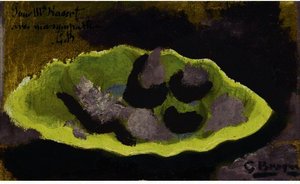
To gaze upon Georges Braque’s “Dead Nature” is to witness a profound moment of stillness within the turbulent currents of modern art history. Created in 1930, this work serves as a masterful testament to the artist's ability to find complexity within simplicity. While at first glance the painting appears to be a humble arrangement of fruit and glass, it is, in truth, a sophisticated exploration of how we perceive the physical world. Braque does not merely present a bowl of fruit; he invites the viewer into a reconstructed reality where the boundaries between object and space begin to dissolve. For the discerning collector or interior designer, this piece offers a captivating focal point that brings an intellectual depth and a sense of timelessness to any curated space.
The composition centers on a ceramic bowl, rendered in soft greenish-yellow tones, which holds a collection of fruit that seems to pulse with a muted, internal light. Beside it, a glass vessel catches the ambient light, its transparency interrupted by the rhythmic application of paint. Braque’s mastery lies in his ability to use geometric planes—subtle cubes and cylinders—to overlap and intersect, disrupting traditional perspective. This technique, a hallmark of his Cubist evolution, forces the eye to move across the canvas, discovering new facets of form with every glance. The interplay of light and shadow is not merely decorative but structural, creating a sense of weight and presence that anchors the entire composition.
The Alchemy of Texture and Tone
Braque’s technical prowess is most evident in his deliberate use of color and texture to evoke emotion. He moves away from the vibrant, almost aggressive palettes of his earlier Fauvist influences, opting instead for a harmonious arrangement of earthy ochres, deep umbers, and subtle creams. These muted tones create a sophisticated atmosphere that feels both grounded and ethereal. The artist employs delicate glazing techniques to build layers of depth, allowing light to seemingly trapped beneath the surface of the paint. This creates a tactile quality; one can almost feel the coolness of the glass and the matte smoothness of the ceramic bowl.
The emotional impact of “Dead Nature” is one of contemplative peace. There is no frantic movement here, only the quiet dignity of objects existing in a state of permanent repose. For those looking to decorate a sanctuary-like environment—perhaps a study, a library, or a minimalist living area—this artwork provides a sense of stability and intellectual rigor. It does not demand attention through loud colors but earns it through its nuanced textures and the subtle tension between its fragmented shapes. It is a piece that rewards slow looking, offering new layers of meaning to anyone willing to linger before its surface.
A Legacy of Visionary Thought
Understanding “Dead Nature” requires acknowledging the historical weight Braque carried as a pioneer of the Cubist movement. Alongside Pablo Picasso, Braque dismantled the "window onto the world" that had defined Western art since the Renaissance. He replaced it with a multidimensional experience, prioritizing how an object is known by the mind rather than just how it is seen by the eye. This painting represents a mature stage of this journey, where the radical experiments of his youth have settled into a refined, poetic language of form.
Owning a high-quality reproduction of such a seminal work allows for the integration of art history into the modern home. It is more than a decorative element; it is an invitation to participate in the dialogue of the avant-garde. Whether placed in a contemporary setting with clean lines or nestled within a classic, traditional interior, “Dead Nature” acts as a bridge between the revolutionary spirit of the early 20th century and the aesthetic sensibilities of today. It remains a profound symbol of how art can transform the mundane into the extraordinary.
Veelgestelde vragen
Waarom heeft het kunstwerk "Dead nature" deze auteursrechtelijke status?
De auteursrechtstatus van "Dead nature" - nog steeds auteursrechtelijk beschermd - is gebaseerd op het overlijden van de kunstenaar in 1963.
Hoe verhoudt "Dead nature" zich tot de terugkerende thema's van Georges Braque?
"Dead nature" verbeeldt bowl, ceramics, reflection, dots, contrast, composition, monochrome, terwijl de bekende thema's van Georges Braque geometric abstraction, picasso collaboration, formal exploration, minimalist aesthetic, cubist legacy zijn. Een vergelijking tussen beide laat zien hoe het werk zich verhoudt tot de gebruikelijke onderwerpen van de kunstenaar.
Hoe kan ik "Dead nature" door Georges Braque bekijken als een diavoorstelling?
Er is een diavoorstelling beschikbaar op de Diavoorstelling-pagina van "Dead nature" door Georges Braque.
Quick facts and art quiz
About Georges Braque

Georges Braque
1882 - 1963, Frankrijk
Biografie kunstenaar
Early Life and Artistic Foundations
Georges Braque, geboren in Argenteuil, Frankrijk, in 1882, begon een pad die diep verweven was met het evoluerende landschap van moderne kunst. Zijn opvoeding binnen een familie van huismeubelmakkers en -afwerkingen stelde hem niet alleen in staat tot technische meesterschap van materialen, maar ook tot een vroeg begrip voor vorm en structuur. Hoewel hij aanvankelijk volgde in zijn vader’s voetsporen, leidde Braque's inherente artistieke neigingen al snel tot formele opleiding aan de École des Beaux-Arts in Le Havre, waarmee hij begon aan zijn reis om een van de meest invloedrijke schilders van de 20e eeuw te worden. Deze basis—een combinatie van praktisch vakmanschap en academische studie—zou cruciaal blijken te zijn wanneer hij later traditionele artistieke conventies ontbond en herinterpreteerde.
Verhuisd naar Parijs in 1902, bleef Braque zijn studies voortzetten aan de Académie Humbert, waarbij hij zich onderdompelde in het levendige kunstenaarsmilieu van de stad. Daar ontmoette hij kunstenaars zoals Marie Laurencin en Francis Picabia, waardoor hij connecties vormde die zijn vroege ontwikkeling zouden beïnvloeden. Zijn eerste werken weerspiegelden de invloed van Impressionisme en Post-Impressionisme, maar een cruciale ontmoeting met de felle kleuren en expressieve vrijheid van Fauvisme in 1905 ontketende een nieuwe richting in zijn artistieke exploratie.
De Omarming van Fauvisme en het Ontstaan van Cubisme
Braque's adoptie van Fauvist principes— gekenmerkt door intense, niet-realistische kleuren en emotionele expressie—wordt levendig verbeeld in schilderijen zoals The Patience. Deze periode zag hem werken met kunstenaars als Henri Matisse en André Derain, waarbij ze experimenteerden met levendige paletten en gestroomlijnde vormen. Echter, Braque's betrokkenheid bij Fauvisme was niet alleen imitatie; hij infuseerde het met een unieke gevoeligheid, temperde de beweging’s ongebreidelde uitbarsting met een meer ingetogen en analytische benadering.
Een keerpunt kwam in 1907, toen hij werd blootgesteld aan de retrospectieve expositie van het werk van Paul Cézanne. Cézanne's nadruk op geometrische vormen en meerdere perspectieven had een diepe impact op Braque, waardoor de weg vrijkwam voor zijn baanbrekende samenwerking met Pablo Picasso. Vanaf 1908 begonnen deze twee artistieke titanen een periode van intens intellectueel uitwisselen die de geboorte gaf aan Cubisme—een revolutionaire beweging die traditionele concepties van representatie verstoorde.
Samen ontwikkelden Braque en Picasso Analytisch Cubisme, waarbij objecten werden ontbonden in fragmentarische geometrische vormen en vanuit meerdere perspectieven tegelijkertijd werden gepresenteerd. Schilderijen zoals Houses at L'Estaque tonen deze vroege fase, die een radicale afwijking van conventioneel perspectief en een focus op de onderliggende structuur van vormen laat zien.
Innovatie door Fragmentatie en Collage
De partnerschap tussen Braque en Picasso ging echter door met het uitbreiden van de grenzen van artistieke expressie, wat leidde tot de ontwikkeling van Synthetisch Cubisme rond 1912. Deze fase zag de introductie van collage—het integreren van real-world materialen zoals krantenknipsels, wallpaper en stof in schilderijen. Deze innovatie daagde de traditionele hiërarchie tussen schilderkunst en beeldhouwkunst uit, waardoor de lijnen tussen kunst en leven vervaagd werden.
Braque's pioniersgebruik van *papier collé* (geplakt papier) markeerde een significante verschuiving in zijn artistieke evolutie. Door fragmenten van alledaagse objecten in zijn composities te integreren, verstoorde hij de illusievolle ruimte van traditionele schilderkunst en introduceerde hij een nieuw niveau van materialiteit en textuur. Deze techniek breidde niet alleen de formele mogelijkheden van kunst uit, maar weerspiegelde ook een groeiend belang voor de relatie tussen representatie en realiteit.
Later Jaren en Erfgoed
Na de oorlog evolueerde Braque's stijl verder dan de strikte grenzen van Cubisme, waarbij elementen van klassieke compositie werden opgenomen en een hernieuwde interesse werd gewekt voor stillevens. Hoewel hij de geometrische invloeden behield die zijn vroege werk hadden gedefinieerd, ontwikkelde hij een meer genuanceerde en contemplatieve benadering van schilderen. Zijn latere landschappen en interieurs worden gekenmerkt door hun serene sfeer en subtiele harmonieën van kleur.
Door zijn hele carrière bleef Braque toegewijd aan het verkennen van de fundamentele principes van vorm, ruimte en representatie. Hij experimenteerde voortdurend met verschillende materialen en technieken, waardoor de grenzen van artistieke expressie werden verlegd tot zijn dood in 1963. Zijn invloed op latere generaties kunstenaars is onbetaalbaar, waardoor de loop van moderne kunst werd gevormd en talloze schilders, beeldhouwers en collagisten inspireerde.
Braque's nalatenschap strekt zich verder uit dan zijn individuele werken; hij veranderde fundamenteel ons begrip van hoe we de wereld om ons heen waarnemen en representeren. Zijn partnerschap met Picasso, gecombineerd met zijn eigen unieke artistieke visie, zette hem op een vaste plaats in de kunstgeschiedenis—een meester die durfde conventies uit te dagen en de mogelijkheden van schilderkunst opnieuw te definiëren.
Invloeden en Bekende Werken
- Invloedrijke personen: Henri Matisse, André Derain, Paul Cézanne
- Belangrijk werk: Houses at L'Estaque, The Patience, Violin and Palette, Mandola
- Impact op de kunstgeschiedenis: Revolutioneerde de 20e-eeuwse kunst door Cubisme; daagde traditionele concepties van perspectief en representatie uit.
Quick facts about Georges Braque
- Artistic Movement Or Style: Cubisme, Fauvisme
- Artists Or Movements Influenced By This Artist:
- Picasso
- Modern Kunst
- Artists Who Influenced This Artist:
- Matisse
- Derain
- Cézanne
- Date Of Birth: 13 mei 1882
- Date Of Death: 31 augustus 1963
- Full Name: Georges Braque
- Nationality: Frans
- Notable Artworks:
- Houses L'Estaque
- Patience
- Violin Palette
- Place Of Birth: Argenteuil, Frankrijk
Ontdek kunstwerken georganiseerd op thema, stijl en kenmerk.


Georges Braque
Dead nature
() ·
With its frame: · Hand-painted in oil on linen
Total