


 Voorvertoning
 Verstuur
 Delen
Delen
 Details bekijken
 Gids
Gids

 Download
 Vergelijkbare items
 Röntgenonderzoek
 Diavoorstelling
 Q&A
Q&A Statistieken
Nature studies


Explore Giuseppe Arcimboldo’s ‘Nature Studies,’ whimsical watercolor portraits crafted from flora & fauna. A unique Mannerist masterpiece – timeless art for your collection!
 Lees meer
Giuseppe Arcimboldo (1527-1593) was een Italiaanse meester van surrealistische portretten, beroemd om zijn fantasierijke composities met fruit, bloemen en objecten. Zijn unieke stijl voorspelde Surrealisme en blijft fascinerend!
Handgemaakte olieverfreproductie
Met de hand geschilderd in olieverf op canvas in uw gewenste maat en lijst, op bestelling gemaakt door onze kunstenaars. ( Schakel over naar print Schakel over naar digitale afbeeldingen)




P118B €10

P118H €10

P118W €10

P438Z €10

P508JH €12

P508YH €12

P805H €10

P805Z €10

P919BZ €10

P919G €10

P919XJ €10

P959ZH €10

P968JZ €12

W106C €8

W218G €10

W218JH €8

W218Y €10

W307PJ €10

W316G €10

W316PJ €8

W316Y €10

W398PJ €8

W4111J €10

W500HY €15

W500JH €15

W692G €12

W849H €8

W940BG €15

W953PJ €8




Standaardformaat
op maat gemaakt
CM
INCH
Kies uit onze vooraf ingestelde maten die overeenkomen met de originele verhoudingen van het kunstwerk.
Loading sizes...

breedte
hoogte
Voer de breedte en hoogte in die u nodig heeft, passend bij uw lijst of uw muur. Omdat dit handgeschilderd is, kan de kunstenaar bij een afmeting met een andere beeldverhouding iets meer rondom het schilderij schilderen of juist iets meer weglaten — u kiest zelf. Wij sturen u een digitaal mockup ter goedkeuring voordat het schilderwerk begint. De afbeelding die op deze pagina wordt getoond, is niet het uiteindelijke resultaat — alleen de mockup geeft dit weer.
Voorbeelden van aanpassingen: Vervang het gezicht met een eigen foto; Voeg een huisdier toe (bijv. vervang de kat door een hond); Verwerk een verborgen boodschap in de achtergrond; Wijzig het landschap of andere elementen in de achtergrond.
Na de bestelling zal het team van TopImpressionists.com per e-mail contact opnemen met de klant voor instructies en een mockup-voorbeeld sturen.
Na de bestelling zal het team van TopImpressionists.com per e-mail contact opnemen met de klant voor instructies en een mockup-voorbeeld sturen.
Wereldwijde levering () binnen 3 tot 4 weken in plaats van de standaard 5 weken. (28 oktober). Zonder concessies aan de kwaliteit.

Gratis wereldwijde expressverzending

Hoogwaardig linnen canvas

Volledige verzendverzekering

Garantie op terugbetaling van invoerrechten

Garantie op exacte kleurweergave

Retourbeleid van 100 dagen (alleen bij defecten)

100% Geld-terug-garantie

Korting bij meerdere afnames
 De optie voor glas is alleen beschikbaar bij een formaat kleiner dan 110 cm.

Nature studies
Druktechniek
Afmetingen reproductie
-


Eindtotaal
€ 237
Giuseppe Arcimboldo: A Renaissance Visionary Reimagined
Giuseppe Arcimboldo (1527 – 1593), an Italian Mannerist painter, stands apart from his contemporaries not merely for his technical prowess but for a singular artistic concept—the creation of portrait heads entirely composed of meticulously arranged objects. This revolutionary approach challenged conventional artistic norms and cemented his place as one of the most inventive figures in Renaissance art history. Born in Milan during a period marked by intellectual ferment and religious upheaval, Arcimboldo’s career unfolded amidst the opulent courts of Europe, where he served as court painter to emperors Rudolf II and Maximilian II, demonstrating an unparalleled ability to capture the spirit of his time through visual symbolism.- The Composite Portrait: Arcimboldo's technique involved transforming recognizable human faces into fantastical representations using fruits, vegetables, flowers, fish, books, musical instruments—a deliberate departure from traditional portraiture that prioritized idealized beauty and anatomical accuracy.
- Mannerist Influence: His work embodies the core tenets of Mannerism, an artistic movement characterized by stylized forms, exaggerated proportions, and a preoccupation with illusionistic effects. Unlike the serene harmony championed by High Renaissance artists like Leonardo da Vinci and Raphael, Arcimboldo embraced discordance and theatricality to convey complex ideas.
- Symbolic Depth: Each element incorporated into Arcimboldo’s portraits carried significant symbolic weight, reflecting Renaissance humanist thought and astrological beliefs. For instance, “Vertumnus,” depicting Rudolf II as a head of intertwined plants and animals, embodies the Roman god of fertility and transformation—a deliberate allusion to Rudolf II's ambition to rule over all realms.
Technique and Materials: Watercolor Alchemy
Arcimboldo’s mastery lay not only in his conceptual vision but also in his meticulous execution. He primarily utilized watercolor paint on parchment, a medium known for its delicate luminosity and ability to achieve subtle tonal variations—qualities perfectly suited to capturing the ethereal beauty of his composite heads. The artist painstakingly glued together meticulously cut-out objects onto the parchment surface, creating an intricate mosaic that demanded extraordinary precision and patience. This painstaking process ensured that every detail contributed to the overall illusionistic effect, reinforcing Arcimboldo’s commitment to Mannerist principles.- Layering Techniques: Arcimboldo skillfully employed layering techniques—applying thin washes of watercolor over multiple layers—to build up depth and texture, enhancing the visual impact of his compositions.
- Color Palette: The artist favored muted palettes dominated by browns, blacks, creams, and whites, creating a sense of solemn grandeur and emphasizing the symbolic significance of each element.
- Precision Cutting & Gluing: Achieving the astonishing realism of Arcimboldo’s portraits required exceptional skill in cutting out objects with exacting accuracy and gluing them onto the parchment surface—a testament to his dedication to craftmanship.
Historical Context: Rudolf II's Court and Renaissance Curiosity
Arcimboldo’s artistic endeavors flourished during the reign of Rudolf II, Holy Roman Emperor (1576–1613), a ruler renowned for his patronage of arts and sciences—a period characterized by an unprecedented fascination with exotic cultures and intellectual exploration. Rudolf II’s court embraced Arcimboldo's unconventional style as a reflection of the broader Renaissance spirit—a desire to transcend conventional boundaries and engage in imaginative contemplation. The emperor recognized Arcimboldo’s genius, commissioning numerous portraits that served as visual emblems of his authority and embodying the humanist ideals prevalent at the time.- The Habsburg Court: Arcimboldo's work resonated deeply with Rudolf II and his court, who appreciated its intellectual complexity and artistic daring—a counterpoint to the prevailing aesthetic sensibilities of the era.
- Renaissance Symbolism: The artist’s use of symbolic imagery aligned seamlessly with Renaissance humanist thought, which emphasized the importance of reason and observation in understanding the natural world—a legacy that continues to inspire artists and scholars today.
- Influence on Later Artists: Arcimboldo's innovative technique and conceptual vision exerted a considerable influence on subsequent generations of painters, establishing him as a pivotal figure in the development of Mannerist art and shaping the trajectory of artistic expression for centuries to come.
Emotional Resonance: Beyond Representation – An Invitation to Wonder
Ultimately, Arcimboldo’s portraits transcend mere visual representation—they invite viewers into a realm of imaginative contemplation and evoke a profound sense of wonder. By transforming familiar objects into evocative symbols, Arcimboldo compels us to reconsider our perceptions of beauty and reality—challenging the conventions of portraiture while simultaneously celebrating the richness and complexity of the natural world. His work remains a testament to the enduring power of artistic innovation and its ability to capture the spirit of an era—a timeless masterpiece that continues to captivate audiences with its arresting visual impact and intellectual depth.Veelgestelde vragen
Kan ik een röntgenopname van "Nature studies" door Giuseppe Arcimboldo bekijken?
"Nature studies" kan laag voor laag worden onderzocht op de Röntgenanalyse pagina van het kunstwerk, een interactieve viewer geïnspireerd op de lichttafel van een restaurator met elf optische lagen van de afbeelding.
Wordt "Nature studies" door Giuseppe Arcimboldo bewaard in het land van herkomst van de kunstenaar?
Nee - het kunstwerk wordt in het buitenland bewaard. "Nature studies" bevindt zich in Oostenrijk, terwijl Giuseppe Arcimboldo werd geboren in Italië.
Waar kan ik handgeschilderde reproducties van "Nature studies" door Giuseppe Arcimboldo kopen?
"Nature studies" is verkrijgbaar als een met de hand geschilderde olieverfreproductie op linnen canvas. U kunt uw bestelling plaatsen op de Handgeschilderde reproductie pagina, met een keuze uit verschillende formaten.
Biografie kunstenaar
Giuseppe Arcimboldo (1527-1593): De Mysticus van de Composite Hoofd
Giuseppe Arcimboldo, een naam die onlosmakelijk verbonden is met een wereld van bizarre schoonheid en verbluffende illusies, blijft een van de meest unieke figuren uit de Renaissance. Geboren in Milaan in 1527, ontvouwde zijn artistieke carrière zich tegen de achtergrond van Europa, doordrenkt van intellectuele opwinding, religieuze verschuivingen en een onstilende nieuwsgierigheid naar de natuurlijke wereld. Hoewel aanvankelijk erkend voor meer conventionele werken – fresco’s die kathedralen sieren en portretten die zich houden aan gevestigde hofstandaarden – ligt Arcimboldo's blijvende nalatenschap in een reeks composiethoofden, volledig samengesteld uit zorgvuldig geplaatste objecten: fruit, groenten, bloemen, boeken, zelfs muziekinstrumenten. Deze waren niet simpelweg speelse oefeningen in visuele truckunst; ze waren complexe allegorieën, doordrenkt van symboliek die resoneren met de Renaissance-wereldvisie en het publiek tot op de dag van vandaag fascineren. Zijn vader, Biagio Arcimboldo, was zelf een kunstenaar, waardoor hij Giuseppe een vroege artistieke training gaf en waarschijnlijk ook zijn eerste pogingen tot ontwerpwerk voor glasramen en fresco’s in de kathedraal van Milaan rond 1549 beïnvloedde. Deze fundamentele ervaring scherpte zijn technische vaardigheid en oog voor detail – kwaliteiten die later kenmerken zouden worden van zijn meer onconventionele creaties.
Hofelijke Opdrachten en de Opkomst van een Unieke Stijl
Arcimboldo's traject nam een significante wending in 1562, toen hij benoemd werd tot hofportretist van Ferdinand I bij de Habsburgse vorstendynastie in Wenen. Dit markeerde het begin van meer dan twee decennia aan artistieke polyvalentie voor drie opeenvolgende Habsburgse heersers: Maximiliaan II en zijn zoon, Rudolf II. Naast het schilderen van portretten – hoewel zelfs deze vaak subtiele excentriciteiten vertoonden – omvatten Arcimboldo's taken kostuumontwerp, festivaldecoraties en de organisatie van keizerlijke collecties. Binnen dit milieu van verfijnde smaak en intellectuele nieuwsgierigheid begon zijn kenmerkende stijl te bloeien. De hofelijke vraag naar vernieuwing en spektakel bood vruchtbare grond voor experimenten, waardoor hij verder kon gaan dan traditionele portrettuur richting de creatie van zijn beroemde “composiethoofden”. Deze werden niet geboren uit een plotselinge impuls, maar ontwikkelden zich geleidelijk, gebaseerd op de Renaissance-fascinering voor raadsels, puzzels en het verkennen van verborgen betekenissen in alledaagse objecten. De invloed van eerdere kunstenaars die experimenteerden met *trompe l'oeil*-effecten en vervormde perspectieven kan worden waargenomen, maar Arcimboldo synthetiseerde deze elementen tot iets radicaals – een unieke visuele taal die conventionele representaties uitdaagt. Zijn vader’s ervaring met glasramen en fresco’s gaf hem de technische vaardigheden om dit te realiseren.
Het Ontcijferen van Symboliek: Meer Dan Het Eerst Aanzien
Om Arcimboldo's werk simpelweg als speels te beschouwen, is te negeren dat het diepe intellectuele betekenis bevat. Elk object binnen zijn composiethoofden werd zorgvuldig gekozen, geladen met symbolische betekenis gerelateerd aan de identiteit van de persoon, hun beroep of sociale status. *De Bibliothecaris*, bijvoorbeeld, is niet alleen een gezicht samengesteld uit boeken; het is een subtiele kritiek op academische pretentie – een commentaar op degenen die kennis vergaren zonder zich daadwerkelijk met haar inhoud te verdiepen. De dierlijke staarten die de baard vormen, duiden op stofdoeken, wat wijst op vergeten boeken die stof verzamelen op planken. Vergelijkbare symboliek is aanwezig in zijn portretten van de seizoenen – vooral *Vertumnus*, die keizer Rudolf II afbeeldt als de Romeinse god van tuinen en verandering – en zijn composities zijn rijk aan botanische symboliek, die de keizerlijke patronage van wetenschap en natuurkunde weerspiegelen. Deze waren niet bedoeld om onmiddellijk te worden ontcijferd; ze waren ontworpen om contemplatie te stimuleren, het publiek uit te nodigen om lagen betekenis te ontrafelen die verborgen liggen in de schijnbaar speelse opstelling van objecten. Het zelf creëren van een menselijk portret uit onstoffelijke voorwerpen was een meditatie over de onderlinge verbondenheid van alle dingen – een weerspiegeling van de Neoplatonische filosofie, die geloofde in de onderliggende harmonie van het universum.
Erfgoed en Ontdekking: Een Voorloper van Surrealisme
Ondanks zijn succes tijdens zijn leven, vervaagde Arcimboldo's reputatie na zijn dood in 1593. Zijn werk werd vaak vergeten in de wereld van kunst, beschouwd als een curiositeit – gewaardeerd om zijn technische vaardigheid maar afgewezen als het gebrek aan serieuze artistieke waarde. Het was pas in de 20e eeuw dat een hernieuwde waardering voor zijn kunst ontstond, aangedreven door de opkomst van Surrealisme. Kunstenaars zoals Salvador Dalí herkenden in Arcimboldo een gelijkgestemde – een visionair die conventionele percepties uitdaagde en het onderbewustzijn verkende via onverwachte juxtaposities van beelden. De invloed van Arcimboldo is te zien in Dalí's eigen dromerige composities en zijn fascinatie voor transformatie en illusie. Vandaag de dag wordt Arcimboldo gevierd als een sleutelfiguur in kunstgeschiedenis – een voorloper van Surrealisme wiens innovatieve gebruik van symboliek en speelse vervorming nog steeds kunstenaars inspireert en het publiek fascineert wereldwijd. Zijn schilderijen worden tentoongesteld in prestigieuze musea, zoals het Kunsthistorisches Museum in Wenen en het Louvre in Parijs.

Giuseppe Arcimboldo
1527 - 1593 , Italië
Belangrijkste feiten
- Artistic Movement Or Style: Manierisme, Surrealisme
- Artists Or Movements Influenced By This Artist: ['Salvador Dalí']
- Artists Who Influenced This Artist: ['Leonardo da Vinci']
- Date Of Birth: 5 april 1527
- Date Of Death: 11 juli 1593
- Full Name: Giuseppe Arcimboldo
- Nationality: Italiaans
- Notable Artworks:
- De Vier Seizoenen
- Vertumnus
- De Bibliothecaris
- Place Of Birth: Milaan, Italië
Gerelateerde artikelen
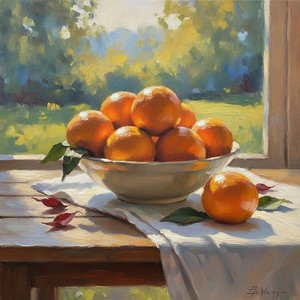
Sun-Drenched Citrus: The Vibrant Beauty of Oranges in Impressionist Masterpieces
Embark on a sensory journey through Impressionist masterpieces. Discover how Renoir and Cézanne captured the vibrant light and luscious textures of sun-drenched oranges in exquisite still life paintings designed to inspire and transform your home.
Ontdek kunstwerken georganiseerd op thema, stijl en kenmerk.


