

Getoond: · Inclusief lijst:
 Voorvertoning
 Verstuur
 Delen
Delen
 Details bekijken
 Gids
Gids

 Download
 Vergelijkbare items
 Röntgenonderzoek
 Diavoorstelling
 Vraag & antwoord
 Statistieken

€ 240
Handgemaakte olieverfreproductie
Met de hand geschilderd in olieverf op canvas in uw gewenste maat en lijst, op bestelling gemaakt door onze kunstenaars. ( Schakel over naar print Schakel over naar digitale afbeeldingen)
Formaat
·Standaardformaat
op maat gemaakt
CM
INCH
Kies uit onze vooraf ingestelde maten die overeenkomen met de originele verhoudingen van het kunstwerk.
Afmetingen laden...

breedte
hoogte
Voer de breedte en hoogte in die u nodig heeft, passend bij uw lijst of uw muur. Omdat dit handgeschilderd is, kan de kunstenaar bij een afmeting met een andere beeldverhouding iets meer rondom het schilderij schilderen of juist iets meer weglaten — u kiest zelf. Wij sturen u een digitaal mockup ter goedkeuring voordat het schilderwerk begint. De afbeelding die op deze pagina wordt getoond, is niet het uiteindelijke resultaat — alleen de mockup geeft dit weer.
 Lees meer over
Afronden
·
Wit €1

Vervagende randen €1

Doorlopende rand €1

P118B €10

P118H €10

P118W €10

P438Z €10

P508JH €12

P508YH €12

P805H €10

P805Z €10

P919BZ €10

P919G €10

P919XJ €10

P959ZH €10

P968JZ €12

W106C €8

W218G €10

W218JH €8

W218Y €10

W307PJ €10

W316G €10

W316PJ €8

W316Y €10

W398PJ €8

W4111J €10

W500HY €15

W500JH €15

W692G €12

W849H €8

W940BG €15

W953PJ €8

H24-GOLD €30

H24-SILVER €30

H36-GOLD €45

H36-SILVER €45
Verzonden in een beschermende koker, klaar om door uw eigen frameur te worden ingelijst.
Extra's
optioneelWat zijn de extra's precies?
Voorbeelden van wat aangepast kan worden: Vervang het gezicht door een foto van de klant; Voeg een huisdier toe (bijv. vervang de kat door een hond); Voeg een verborgen boodschap toe aan de achtergrond; Wijzig het landschap of de elementen in de achtergrond.
Na de bestelling zal het team van TopImpressionists.com per e-mail contact opnemen met de klant voor instructies en een mockup-voorbeeld verstrekken
Na de bestelling zal het team van TopImpressionists.com per e-mail contact opnemen met de klant voor instructies en een mockup-voorbeeld verstrekken
Wereldwijde levering () binnen 3 tot 4 weken in plaats van de standaard 5 weken. (7 november). Zonder concessies aan de kwaliteit.
Beschermende vernislaag
Naamplaatje
Details van de gegraveerde bronzen plaat
This elegant plaque features the artist's name and the title of the artwork, finely engraved for a timeless presentation.
It is made from bronze with a refined, elegant finish. The text is precisely laser-engraved for a sharp and permanent result. Measuring 9x2 cm, the plaque is compact yet easy to read. It's built to be durable and scratch-resistant, offering a professional, museum-quality look. Mounting is simple thanks to the included adhesive backing.
Details transparante acrylplaat
The plaque includes essential engraved details such as the artist's name, the title of the artwork, the date it was created, the type of media used-like oil on canvas or watercolor-a brief description of the piece, and a QR code that links to the complete artwork information.
It is crafted from clear acrylic, offering a sleek, modern appearance. The text is UV-engraved in black to ensure strong visual contrast. With a size of 10x15 cm, it ensures optimal readability. It comes equipped with two metal hooks for secure wall mounting. The plaque is designed to be weather-resistant, making it suitable for various environments, and it includes interactive features that work seamlessly with smartphone scanning.
Details zwarte acrylplaat
This elegant plaque includes engraved information such as the artist's name, the title of the artwork, the date it was created, the type of media used (like oil on canvas or watercolor), a short description of the artwork, and a QR code for quick access to more information.
The plaque itself is made from refined black acrylic with a premium finish. The text is laser-engraved in white for high contrast and readability. Its size is 10x15 cm, designed to be easy to read. It comes with two metal hooks for professional mounting. The design is sleek and fits any interior style. It is also weather-resistant and durable, with built-in digital integration for mobile compatibility.
De optie voor glas is alleen beschikbaar bij een formaat kleiner dan 110 cm.
 De optie voor glas is alleen beschikbaar bij een formaat kleiner dan 110 cm.
- Gratis wereldwijde expressverzending
- Hoogwaardig linnen canvas
- Volledige verzendverzekering
- Garantie op terugbetaling van invoerrechten
- Garantie op exacte kleurweergave
- Retourbeleid van 100 dagen (alleen bij defecten)
- 100% Geld-terug-garantie
- Korting bij meerdere afnames


Beschrijving verzamelobject
Gustave Caillebotte's 'The Floor Scrapers (study)' captures Parisian laborers with striking realism and light. Explore this iconic Impressionist work depicting urban life, showcasing Caillebotte’s unique perspective.
Biografie kunstenaar
Gustave Caillebotte (1848-1894): Een Franse meester van realisme & impressionisme, bekend om 'Paris Street; Rainy Day' en unieke perspectieven op het moderne Parijs.
Over het schilderij
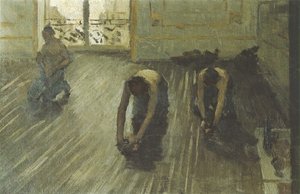
The Floor Scrapers (Study) 02: A Glimpse into Parisian Labor
Gustave Caillebotte’s “The Floor Scrapers (Study) 02,” painted in 1875, isn't merely a depiction of three men diligently working; it’s a meticulously observed and subtly powerful portrait of urban life in late 19th-century Paris. This early work, often considered a pivotal piece in Caillebotte’s artistic development, offers a rare and intimate view into the lives of the city's working class – a subject largely absent from the grand narratives of the era. The painting immediately draws the eye with its stark contrast: the muted tones of the darkened room, punctuated by the bright white of the freshly sanded floorboards, create an almost photographic realism that was revolutionary for its time.
Caillebotte’s artistic journey began with a formal training in law and engineering, but it was his encounter with photography – particularly the work of Nadar – that profoundly shaped his approach to painting. He recognized the power of capturing fleeting moments and precise details, mirroring the photographic process. This influence is evident in the meticulous rendering of the men’s postures, their tools, and the textures of the wood. The composition itself feels deliberately staged, reminiscent of a photograph, with its careful attention to perspective and lighting. The figures are not idealized; they are presented as ordinary laborers, their faces obscured by shadow, emphasizing their anonymity within the bustling city.
Impressionistic Techniques and a Revolutionary Perspective
“The Floor Scrapers” exemplifies Caillebotte’s early embrace of Impressionism, though with a distinct realism that sets him apart from many of his contemporaries. He employed broken brushstrokes to capture the play of light on the wood and the men's clothing, creating a sense of movement and atmosphere. The use of complementary colors – the cool blues and greens of the shadows against the warm browns and yellows of the floor – adds depth and vibrancy to the scene. Notably, Caillebotte’s decision to depict these laborers in a darkened room, bathed in the diffused light of an unseen window, was a bold departure from traditional studio settings. This choice immediately imbued the painting with a sense of immediacy and authenticity.
Furthermore, Caillebotte's innovative perspective—a low-angle shot that emphasizes the scale of the men and their work—was groundbreaking. It forces the viewer to confront the scene directly, fostering a feeling of intimacy and engagement. The composition isn’t about glorifying labor; it’s about presenting it as a fundamental aspect of urban existence. The painting's technical mastery lies in its ability to convey both the physical reality of the work and the emotional weight of the men’s efforts.
Symbolism and Social Commentary
While seemingly straightforward, “The Floor Scrapers” carries subtle layers of symbolism. The act of scraping floors represents a repetitive, demanding task – a symbol of the daily grind endured by countless working-class individuals in Paris at the time. The absence of any discernible hierarchy or leadership among the men suggests a shared experience of labor and resilience. It’s important to note that Caillebotte was one of the first artists to depict urban proletariat, a subject rarely addressed in art during this period. This choice speaks volumes about his desire to challenge conventional artistic norms and offer a more nuanced representation of Parisian society.
The painting's historical context is crucial to understanding its significance. Paris in the 1870s was undergoing rapid industrialization, leading to significant social and economic changes. The working class faced harsh conditions, long hours, and low wages. Caillebotte’s work serves as a poignant reminder of these realities, offering a glimpse into the lives of those often overlooked by history.
A Timeless Reflection on Labor and Urban Life
“The Floor Scrapers (Study) 02” remains a powerful and evocative artwork. It's not just a depiction of three men working; it’s a meditation on labor, poverty, and the human condition. Caillebotte’s meticulous observation, innovative perspective, and subtle symbolism combine to create a work that continues to resonate with viewers today. Reproductions of this painting offer an opportunity to appreciate Caillebotte's artistic vision and gain a deeper understanding of Parisian life in the 19th century – a testament to the enduring power of art to illuminate social realities.
Veelgestelde vragen
Uit welke materialen bestaat "The Floor Scrapers (study) 02" en in welke stijl is het uitgevoerd?
"The Floor Scrapers (study) 02" is vervaardigd in Acrylic On Canvas, in de Impressionist Painting-stijl.
Is er een factsheet over "The Floor Scrapers (study) 02" door Gustave Caillebotte voor studenten?
De Informatieblad-pagina van "The Floor Scrapers (study) 02" door Gustave Caillebotte biedt een printbaar factsheet van twee pagina's: het kunstwerk met de bijbehorende identificatietabel, een tijdlijn die het werk plaatst binnen de levensloop van de kunstenaar, andere werken van de kunstenaar, het gemeten kleurenpalet en kant-en-klare citaten in vier verschillende stijlen.
Welke kleur valt het meest op in "The Floor Scrapers (study) 02"?
De kleur die het meest opvalt in "The Floor Scrapers (study) 02" is Espresso (#504d40). De dominante kleur is handig bij het afstemmen van een kunstwerk op een interieur.
Snelle feiten en kunstquiz
Over Gustave Caillebotte

Gustave Caillebotte
1848 - 1894, Frankrijk
Biografie kunstenaar
A Parisian of the New Age: The Life and Art of Gustave Caillebotte
Gustave Caillebotte, geboren in Parijs in 1848, was een kunstenaar die uniek gepositioneerd was om de dramatische transformaties te vangen die zijn stad vormden. Zijn vader, Martial Caillebotte, erfde een succesvol textielbedrijf en diende als rechter, waardoor Gustave zowel financiële zekerheid als een perspectief kreeg om de bloeiende moderne wereld te observeren. Hoewel hij aanvankelijk juridisch studeerde – rechten behaalde hij in 1868 en 1870 – was Caillebotte’s ware roeping in de kunst. Hij begon ernstige training onder Léon Bonnat, waarbij hij zich verdiepte in schilderen terwijl hij tegelijkertijd een groot belang ontwikkelde voor fotografie, een opkomende kunstvorm die zijn artistieke visie fundamenteel zou beïnvloeden. Deze vroege blootstelling aan fotografische principes – framing, perspectief en het vastleggen van vluchtige momenten – zouden kenmerken worden van zijn onderscheidende stijl. Caillebotte registreerde niet alleen verandering; hij engageerde zich actief met de esthetische mogelijkheden die deze bood.Realisme Verweven met Impressionistisch Licht
Caillebotte’s artistieke weg verschild van strikte academische traditie, maar hij omarmde nooit volledig de puur optische verkenningen van veel van zijn impressionistische tijdgenoten. Hij vond gemeenschappelijke grond met kunstenaars als Edgar Degas en Giuseppe de Nittis, die een fascinatie deelden voor modern leven, maar het benaderden door een lens van naukeurig realisme. Zijn vroege meesterwerk, *Les Raboteurs de Parquet (The Floor Scrapers)*, dat werd getoond in de Salon van 1875, vestigde zijn reputatie onmiddellijk als een moedige en onconventionele schilder. Het werk toont drie arbeiders die met onverzettelijke eerlijkheid een houten vloer afslijpen, wat sommige kijkers schokte terwijl het anderen fascineerde. Het ging niet alleen om het onderwerp – de arbeidersklasse stond zelden op het doek van de kunst — maar ook om de compositie: gekropt, bijna schokkend direct en zonder sentimentele idealisering. Deze toewijding aan het weergeven van hedendaags leven zonder embellissement bleef terugkeren in werken zoals *The Iron Bridge*, waar hij meesterlijk de industriële landschap van een snel veranderende Parijs vastlegde. Echter, Caillebotte was niet immuun voor de invloed van het Impressionisme; zijn palet werd geleidelijk lichter en experimenteerde hij met gebroken penseelstreken en atmosferische effecten, wat vooral zichtbaar is in zijn prachtige uitzichten op Parijse daken bedekt met sneeuw, zoals *View of Rooftops (Snow)*.Een Patron en een Pionier: Navigeren door de Kunstwereld
Naast zijn eigen artistieke inspanningen speelde Caillebotte een cruciale rol in het ondersteunen van de Impressionistische beweging. Zijn financiële onafhankelijkheid stelde hem in staat om een significante mecenas te worden, waarbij hij werken van Monet, Renoir, Pissarro, Cézanne en anderen kocht op een tijd dat hun kunst grotendeels werd afgewezen door het officiële Salon. Hij was niet alleen een verzamelaar; hij promootte deze kunstenaars actief, organiseerde en financierde verschillende Impressionistische tentoonstellingen die conventionele artistieke normen veroverden. Deze toewijding aan innovatie strekte zich uit tot zijn eigen collectie, die hij aan de Franse staat nalatigde na zijn dood in 1894 – een nalatenschap aanvankelijk ontmoet met weerstand maar uiteindelijk de hoeksteen vormde van de Impressionistische holdings van het Musée d’Orsay. Caillebotte’s unieke perspectief manifesteerde zich ook in zijn composities; werken zoals *Boulevard vu d’en haut (Boulevard Seen from Above)*, geschilderd in 1880, tonen een verrassend moderne kijkhoek met een dynamische compositie die de fotografische perspectieven van de 20e eeuw vooruitwijst. Deze innovatieve benadering van compositie, mogelijk beïnvloed door Japanse prints en zijn eigen fotografische experimenten, plaatste hem als een ware pionier.Belangrijke Werken
- Les Raboteurs de Parquet (The Floor Scrapers) (1875): Een baanbrekend werk dat Caillebotte’s realisme en onconventionele compositie laat zien.
- View of Rooftops (Snow) (1878): Demonstreert zijn gebruik van hoge kijkhoeken en atmosferische effecten, beïnvloed door fotografie en Japanse prints.
- Boulevard vu d’en haut (Boulevard Seen from Above) (1880): Een verrassend moderne compositie met een dynamische perspectief.
- Paris Street; Rainy Day (1877): Misschien zijn meest bekende werk, dat de drukke energie van Parijs vastlegt in een uniek en evocatief beeld.
- The Bezique Game(1881) : Een boeiend Impressionistisch schilderij van Parijse ontspanning.
Historische Betekenis
Gustave Caillebotte’s kunst staat niet alleen bekend om zijn technische vaardigheid en intellectuele diepgang, maar ook om zijn visie. Hij was een getuige van de snelle veranderingen in Parijs aan het einde van de 19e eeuw – de opkomst van de industrie, de groeiende stedelijke bevolking en de verschuivingen in sociale structuren. Zijn werk biedt een uniek inzicht in deze periode, doordat hij de moderne wereld vastlegt met een realistische maar tegelijkertijd expressieve stijl. Caillebotte’s invloed strekt zich uit verder dan zijn eigen tijd; zijn innovatieve composities en zijn toewijding aan het weergeven van de wereld om hem heen hebben hem geholpen om een belangrijke plaats in de geschiedenis van de kunst in te nemen. Zijn schilderijen zijn niet alleen beelden van modern leven; ze zijn diepe meditaties over de complexiteit van stedelijk bestaan, de veranderende sociale landschap en de evoluerende relatie tussen kunst en realiteit.Snelle feiten over Gustave Caillebotte
- Artistic Movement Or Style: Realisme, Impressionisme
- Artists Or Movements Influenced By This Artist: ['Impressionisme']
- Artists Who Influenced This Artist:
- Bonnat
- Degas
- Nittis
- Date Of Birth: 19 aug 1848
- Date Of Death: 21 feb 1894
- Full Name: Gustave Caillebotte
- Nationality: Frans
- Notable Artworks:
- Les Raboteurs
- Rooftops (Snow)
- Boulevard
- Paris Street
- Place Of Birth: Parijs, Frankrijk
Vergelijkbare kunstwerken


Ontdek kunstwerken georganiseerd op thema, stijl en kenmerk.


Gustave Caillebotte
The Floor Scrapers (study) 02
() ·
Inclusief lijst: · Met de hand geschilderd in olieverf op linnen
Totaal