

Getoond: · Inclusief lijst:
 Voorvertoning
 Verstuur
 Delen
Delen
 Details bekijken
 Gids
Gids

 Download
 Vergelijkbare items
 Röntgenonderzoek
 Diavoorstelling
 Vraag & antwoord
 Statistieken

€ 240
Handgemaakte olieverfreproductie
Met de hand geschilderd in olieverf op canvas in uw gewenste maat en lijst, op bestelling gemaakt door onze kunstenaars. ( Schakel over naar print Schakel over naar digitale afbeeldingen)
Formaat
·Standaardformaat
op maat gemaakt
CM
INCH
Kies uit onze vooraf ingestelde maten die overeenkomen met de originele verhoudingen van het kunstwerk.
Afmetingen laden...

breedte
hoogte
Voer de breedte en hoogte in die u nodig heeft, passend bij uw lijst of uw muur. Omdat dit handgeschilderd is, kan de kunstenaar bij een afmeting met een andere beeldverhouding iets meer rondom het schilderij schilderen of juist iets meer weglaten — u kiest zelf. Wij sturen u een digitaal mockup ter goedkeuring voordat het schilderwerk begint. De afbeelding die op deze pagina wordt getoond, is niet het uiteindelijke resultaat — alleen de mockup geeft dit weer.
 Lees meer over
Afronden
·
Wit €1

Vervagende randen €1

Doorlopende rand €1

P118B €10

P118H €10

P118W €10

P438Z €10

P508JH €12

P508YH €12

P805H €10

P805Z €10

P919BZ €10

P919G €10

P919XJ €10

P959ZH €10

P968JZ €12

W106C €8

W218G €10

W218JH €8

W218Y €10

W307PJ €10

W316G €10

W316PJ €8

W316Y €10

W398PJ €8

W4111J €10

W500HY €15

W500JH €15

W692G €12

W849H €8

W940BG €15

W953PJ €8

H24-GOLD €30

H24-SILVER €30

H36-GOLD €45

H36-SILVER €45
Verzonden in een beschermende koker, klaar om door uw eigen frameur te worden ingelijst.
Extra's
optioneelWat zijn de extra's precies?
Voorbeelden van wat aangepast kan worden: Vervang het gezicht door een foto van de klant; Voeg een huisdier toe (bijv. vervang de kat door een hond); Voeg een verborgen boodschap toe aan de achtergrond; Wijzig het landschap of de elementen in de achtergrond.
Na de bestelling zal het team van TopImpressionists.com per e-mail contact opnemen met de klant voor instructies en een mockup-voorbeeld verstrekken
Na de bestelling zal het team van TopImpressionists.com per e-mail contact opnemen met de klant voor instructies en een mockup-voorbeeld verstrekken
Wereldwijde levering () binnen 3 tot 4 weken in plaats van de standaard 5 weken. (7 november). Zonder concessies aan de kwaliteit.
Beschermende vernislaag
Naamplaatje
Details van de gegraveerde bronzen plaat
This elegant plaque features the artist's name and the title of the artwork, finely engraved for a timeless presentation.
It is made from bronze with a refined, elegant finish. The text is precisely laser-engraved for a sharp and permanent result. Measuring 9x2 cm, the plaque is compact yet easy to read. It's built to be durable and scratch-resistant, offering a professional, museum-quality look. Mounting is simple thanks to the included adhesive backing.
Details transparante acrylplaat
The plaque includes essential engraved details such as the artist's name, the title of the artwork, the date it was created, the type of media used-like oil on canvas or watercolor-a brief description of the piece, and a QR code that links to the complete artwork information.
It is crafted from clear acrylic, offering a sleek, modern appearance. The text is UV-engraved in black to ensure strong visual contrast. With a size of 10x15 cm, it ensures optimal readability. It comes equipped with two metal hooks for secure wall mounting. The plaque is designed to be weather-resistant, making it suitable for various environments, and it includes interactive features that work seamlessly with smartphone scanning.
Details zwarte acrylplaat
This elegant plaque includes engraved information such as the artist's name, the title of the artwork, the date it was created, the type of media used (like oil on canvas or watercolor), a short description of the artwork, and a QR code for quick access to more information.
The plaque itself is made from refined black acrylic with a premium finish. The text is laser-engraved in white for high contrast and readability. Its size is 10x15 cm, designed to be easy to read. It comes with two metal hooks for professional mounting. The design is sleek and fits any interior style. It is also weather-resistant and durable, with built-in digital integration for mobile compatibility.
De optie voor glas is alleen beschikbaar bij een formaat kleiner dan 110 cm.
 De optie voor glas is alleen beschikbaar bij een formaat kleiner dan 110 cm.
- Gratis wereldwijde expressverzending
- Hoogwaardig linnen canvas
- Volledige verzendverzekering
- Garantie op terugbetaling van invoerrechten
- Garantie op exacte kleurweergave
- Retourbeleid van 100 dagen (alleen bij defecten)
- 100% Geld-terug-garantie
- Korting bij meerdere afnames


Beschrijving verzamelobject
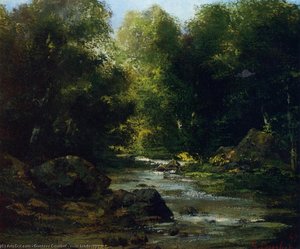
Het schilderij toont een rustig rivierlandschap met weelderig groen en verspreide rotsen, met twee figuren die genieten van de serene atmosfeer.
Biografie kunstenaar
Gustave Courbet (1819-1877): Een baanbrekende kunstenaar die Realisme nastreefde en een kritische blik op de samenleving bood, zoals zichtbaar in 'Een Begrafenis te Ornans'. Ontdek zijn invloedrijke stijl!
Over het schilderij
Een Symfonie van Natuur en Realisme
In dit meeslepende rivierlandschap nodigt Gustave Courbet de kijker uit in een heiligdom van diepe stilte. De scène ontvouwt zich met een zacht stromend beekje dat door een weelderig, groen bos slingert, waar het samenspel van licht en schaduw danst op het wateroppervlak. Omringd door eeuwenoude bomen en verspreide rotsen die de compositie verankeren, legt het schilderij een moment van pure, onvervalste sereniteit vast. Binnen deze natuurlijke omhelzing verschijnen twee figuren bijna als stille getuigen van de majesteit van het landschap, waarbij hun aanwezigheid een menselijke dimensie toevoegt aan de wilde schoonheid van het woud. De atmosfeer ademt een diepe vrede uit, een uitnodiging om even stil te staan en de koele, vochtige lucht van een afgelegen bosretraite in te ademen.De Meesterschap van de Realistische Penseelstreek
Buiten de oppervlakkige schoonheid dient dit werk als een getuigenis van Courbets revolutionaire benadering van de kunst. Door de gepolijste, geïdealiseerde landschappen van de Romantische era te vermijden, omarmde Courbet de plein air-techniek, waarbij hij rechtstreeks vanuit de natuur schilderde om de rauwe essentie van zijn omgeving te vangen. Zijn methode was er een van minutieuze observatie en tactiele diepte; door dunne kleurlagen over elkaar aan te brengen en pigmenten direct op het canvas te mengen, bereikte hij een opmerkelijke tonale gradatie die de texturen van bemoste stenen en rimpelend water tot leven brengt. Er is hier geen sprake van geromantiseerde versiering—slechts de eerlijke, robuuste schoonheid van de aarde. Deze toewijding aan het Realisme stelt de kijker in staat om het gewicht van de rotsen en de koelte van de beek te voelen, waardoor het landschap minder aanvoelt als een verre herinnering en meer als een levend, ademend wezen.Een Blijvende Aanwezigheid voor de Verfijnde Verzamelaar
Voor de kunstliefhebber of interieurontwerper biedt deze reproductie veel meer dan louter decoratie; het vormt een emotioneel anker voor elke ruimte. De evenwichtige compositie en het diepe, aardse palet creëren een gevoel van stabiliteit en organische warmte, waardoor het een ideaal middelpunt vormt voor een geraffineerde studeerkamer, een rustgevende slaapkamer of een imposante woonkamer. Het bezitten van een dergelijk stuk is het vasthouden van een fragment van de kunstgeschiedenis—een verbinding met de rebelse geest van een man die durfde grootheid te vinden in het alledaagse. Het brengt de herstellende kracht van de natuurlijke wereld in huis en biedt een tijdloos venster op een landschap dat vandaag de dag nog even vitaal en ontroerend is als in de negentiende eeuw.Veelgestelde vragen
Tot welke stijl behoort "rivierlandschap"?
De kunststroming die verbonden is aan "rivierlandschap" door Gustave Courbet is Romantisch Realisme. Deze classificatie plaatst het werk binnen een context van verwante kunstenaars en kunstwerken.
Zijn er werken die lijken op "rivierlandschap"?
Op de Vergelijkbare werken-pagina van dit kunstwerk vindt u vergelijkbare werken als "rivierlandschap" door Gustave Courbet.
Wat is de algemene sfeer van "rivierlandschap" door Gustave Courbet?
"rivierlandschap" heeft een Sereniteit atmosfeer.
Snelle feiten en kunstquiz
Over Gustave Courbet

Gustave Courbet
1819 - 1877, Frankrijk
Biografie kunstenaar
A Rebel’s Brush: The Life and Legacy of Gustave Courbet
Jean Désiré Gustave Courbet, born in Ornans, France, on June 10, 1819, stands as a monumental figure in the history of art – a defiant iconoclast who irrevocably altered the trajectory of painting during the mid-nineteenth century. More than simply capturing visual impressions; his artistic journey embodies a profound rejection of convention and an unwavering dedication to portraying reality with uncompromising honesty. His upbringing within a moderately prosperous bourgeois family fostered an early appreciation for artistic pursuits, nurtured by his mother’s encouragement – a formative influence that propelled him toward a revolutionary vision of artistic expression. Formal training commenced at the École des Beaux-Arts in Paris in 1839, yet Courbet swiftly recognized the stifling limitations imposed by academic dogma and Romantic idealism. While acknowledging debts to artists like Eugène Delacroix and Théodore Géricault – figures who championed dramatic emotion and historical narrative – Courbet resolutely forged his own path, prioritizing observation over imagination and truth above all else. This deliberate divergence from established artistic norms would define his entire career and establish him as the undisputed leader of Realism.The Birth of Realism: Challenging Artistic Conventions
Courbet’s artistic development was characterized by a conscious repudiation of prevailing aesthetic standards. He eschewed mythological tales and heroic allegories, instead focusing intently on the everyday lives of ordinary individuals – particularly laborers and rural inhabitants. This commitment to depicting the world without embellishment—a stance that would soon become synonymous with Realism—encountered vehement opposition from critics accustomed to idealized representations steeped in romantic sentimentality. Early canvases explored landscapes and portraits; however, he swiftly transitioned toward scenes of working-class existence, rendered on monumental scales traditionally reserved for grand historical or religious paintings. This deliberate choice wasn’t merely stylistic; it was a declaration about the inherent dignity and significance of subjects often marginalized by artistic discourse. The Stone Breakers (1849), tragically destroyed during World War II, exemplifies this approach—a stark portrayal of two laborers toiling under oppressive conditions, their faces obscured by exhaustion and despair. Critics deemed such depictions vulgar and unworthy of serious consideration, highlighting the profound challenge Courbet posed to the prevailing artistic sensibilities of his time.Major Works and Artistic Philosophy
Courbet’s artistic philosophy extended beyond subject matter to encompass technique. He championed a direct, impasto style—applying paint thickly onto the canvas—that prioritized the materiality of the medium itself. This method deliberately rejected the smooth surfaces favored by academic painters, emphasizing texture and physicality as crucial elements of visual expression. His most celebrated paintings include A Burial at Ornans (1850-51), a monumental canvas depicting a provincial funeral that provoked considerable controversy upon its exhibition. Unlike Romantic artists who sought to elevate emotion and inspire awe, Courbet presented the mourners with unflinching realism—faces etched with sorrow, boredom, and resignation—challenging viewers to confront uncomfortable truths about human experience. Similarly, Château du Chillon (1874), a breathtaking depiction of the medieval castle overlooking Lake Geneva, showcases Courbet’s meticulous attention to detail and his masterful command of light and color. He sought to capture not merely what he saw but also how it felt—a profound ambition that resonated deeply with fellow artists grappling for new modes of artistic representation.Legacy and Historical Significance
Gustave Courbet's influence on subsequent art movements is undeniable. While acknowledging debts to earlier masters like Caravaggio for their dramatic realism and use of chiaroscuro, his impact transcended mere imitation. He fundamentally reshaped the landscape of painting by liberating artists from the constraints of tradition—encouraging them to explore uncharted territories of visual perception. His unwavering advocacy for artistic freedom cemented his position as a champion of intellectual dissent and fueled the burgeoning movement toward socially engaged art. Courbet’s participation in the Salon des Refusés (1863)—an audacious defiance of official censure—solidified his reputation as an iconoclastic rebel who refused to compromise on his convictions. He died peacefully in Paris on April 29, 1877, leaving behind a legacy that continues to inspire artists and scholars alike – a testament to the transformative power of art to confront societal norms and illuminate the complexities of human existence.Snelle feiten over Gustave Courbet
- Artistic Movement Or Style: Realisme
- Artists Or Movements Influenced By This Artist:
- Impressionisme
- Post-impressionisme
- Artists Who Influenced This Artist:
- Eugène Delacroix
- Théodore Géricault
- Caravaggio
- Date Of Birth: 10 juni 1819
- Date Of Death: 31 december 1877
- Full Name: Gustave Courbet
- Nationality: Frans
- Notable Artworks:
- De Steenbakers
- Een begrafenis te Ornans
- De Schilderstudio
- Place Of Birth: Orléans, Frankrijk
Vergelijkbare kunstwerken


Ontdek kunstwerken georganiseerd op thema, stijl en kenmerk.


Gustave Courbet
rivierlandschap
() ·
Inclusief lijst: · Met de hand geschilderd in olieverf op linnen
Totaal