


 Bekijk op ware grootte
 Verstuur
 Delen
Delen
 Details bekijken
 Gids
Gids

 Download
 Vergelijkbare items
 Röntgenonderzoek
 Diavoorstelling
 Statistieken
Reverie
 Acrylic On Canvas
- WallArt
- Romantic Landscape Painting
 1860
1860 50.0 x 37.0 cm
 Metropolitan Museum of Art
 Lees meer
Koop een digitale afbeelding in hoge resolutie met verbeterde kwaliteit, die veel superieur is aan de online voorvertoning.
Elk bestand wordt met uiterste precisie voorbereid door onze interne specialisten, met behulp van geavanceerde tools en deskundige handmatige retouche. Wij garanderen dat elke afbeelding een uitzonderlijke helderheid, nauwkeurige kleurweergave en verfijnde details bezit.
Het uiteindelijke bestand wordt binnen 72 uur per e-mail geleverd, geoptimaliseerd voor direct gebruik in professionele, redactionele en printomgevingen. Dit is dezelfde kwaliteit waarop vooraanstaande designstudio's, uitgevers en galerieën vertrouwen.
Digitale afbeeldingen
Download een bestand met hoge resolutie voor persoonlijke weergave, afdrukken en creatieve projecten. ( Schakel over naar print Koop handgeschilderd kunstwerk)
Inbegrepen bij elke bestelling van een digitale afbeelding
Professionele digitale levering, gegarandeerd
Wanneer u kiest voor TopImpressionists.com, ontvangt u niet alleen een afbeelding – u krijgt een professioneel verbeterd digitaal kunstwerk, met precisie vervaardigd en voorzien van een tevredenheidsgarantie. Dit is alles wat automatisch bij uw bestelling is inbegrepen:

Directe levering per e-mail
Uw hoogwaardige digitale afbeeldingsbestand wordt binnen 72 uur na bestelling naar u gemaild – klaar voor direct gebruik.

AI-geoptimaliseerd digitaal bestand
Uw kunstwerk wordt professioneel geoptimaliseerd met behulp van geavanceerde AI-tools en handmatige bewerkingen, waardoor maximale details, helderheid en kleurnauwkeurigheid worden gegarandeerd.

Gratis levenslange herlevering
Je bestand per ongeluk verwijderd of kwijtgeraakt? Geen zorgen – we sturen het u op elk gewenst moment gratis opnieuw toe.

Geen invoerkosten – nooit
Geniet direct van uw kunstwerk zonder invoerrechten, belastingen of verzendkosten – digitale downloads zijn altijd belastingvrij.

Garantie op kleurgetrouwheid
Met behulp van professionele hulpmiddelen en kleurbeheer zorgen wij ervoor dat uw digitale afbeelding de originele kleuren zo nauwkeurig mogelijk weergeeft.

100 dagen tevredenheidsgarantie
Als u niet tevreden bent met uw digitale afbeelding, passen wij deze aan of storten wij 100% terug binnen 100 dagen - zonder vragen te stellen.

100% Geld-terug-garantie
Niet tevreden? Ontvang een volledige terugbetaling binnen 100 dagen na ontvangst van uw digitale bestand – zonder vragen te stellen.

Korting bij grote bestellingen
Koop 3 afbeeldingen, bespaar 10% - Koop 5, bespaar 15% - Koop 10+, bespaar 20%. Ideaal voor creatieve projecten, galerieën en bureaus.
A Moment of Quiet Contemplation: Corot’s “Reverie”
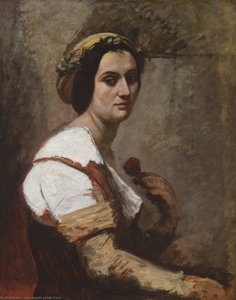
Jean-Baptiste-Camille Corot's "Reverie," painted in 1860, is not merely a portrait; it’s a carefully constructed invitation into the quiet depths of human experience. This intimate work, rendered in muted tones and imbued with an almost palpable stillness, captures a fleeting moment of introspection—a woman lost in thought beneath a somber sky. Corot, a pivotal figure in bridging the gap between Romanticism and Impressionism, masterfully utilizes light and shadow to evoke a profound sense of mood and mystery. The painting’s power lies not in dramatic gesture or vibrant color, but rather in its subtle nuances and the suggestion of untold stories.
The Painter's Palette: Technique and Composition
Corot’s technique is characterized by a loose, almost sketch-like application of paint—a hallmark of his approach to landscape and portraiture. He employed a broken brushstroke method, layering thin washes of color upon one another to create atmospheric effects and a sense of depth. Notice how the sky, rendered in shades of grey and blue, seems to press down on the figure, intensifying the feeling of solitude. The use of *contre-jour*, or light from the side, is particularly effective, highlighting the contours of her face and hands while leaving much of the background shrouded in shadow. The placement of the book—a deliberate inclusion—hints at a recent interruption to her reverie, grounding the scene in a familiar domesticity even as it elevates the subject’s internal state.
A Portrait of an Era: Context and Symbolism
"Reverie" was painted during a fascinating period of transition for Corot. While he had previously depicted peasants in Italy, this work marks a shift towards more studio-based portraiture, incorporating props like the book to firmly establish it within the genre painting tradition. However, even with these additions, Corot retains his signature sensitivity and ability to capture the essence of his subject. The woman’s expression is deliberately ambiguous; she doesn't offer a direct gaze but instead seems lost in her own thoughts. This lack of explicit emotion invites viewers to project their own feelings and experiences onto the scene, creating a deeply personal connection with the artwork. The simple white dress further contributes to the painting’s timeless quality, suggesting an innocence and vulnerability.
Echoes of Light and Landscape
Corot's lifelong fascination with light is evident in every brushstroke of "Reverie." He wasn’t simply interested in depicting landscapes; he sought to capture their *atmosphere*, the way light transforms surfaces and creates a sense of mood. This painting exemplifies that pursuit perfectly. The subdued palette, combined with the atmospheric sky, evokes a feeling of melancholy or quiet contemplation—a space for reflection. It's a scene reminiscent of his earlier rural studies, yet imbued with a subtle urbanity through the inclusion of studio props. “Reverie” stands as a testament to Corot’s ability to distill profound emotion and philosophical inquiry into a remarkably simple composition.
Bringing "Reverie" Home: A Reproduction for Your Space
TopImpressionists offers exquisite, hand-painted reproductions of Jean-Baptiste-Camille Corot's “Reverie,” meticulously crafted to capture the original’s delicate beauty and atmospheric depth. Whether you are an art enthusiast, a collector seeking a piece of French Impressionist history, or simply someone looking for a captivating addition to your interior design, our reproduction provides an authentic representation of this iconic work. The scale of 50 x 37 cm makes it ideal for smaller spaces, while the high-quality materials ensure that the colors and textures faithfully replicate those of the original painting. Experience the quiet contemplation of “Reverie” in your own home – a timeless masterpiece brought to life.
Gerelateerde kunstwerken




Biografie van de kunstenaar
A Life Immersed in Light and Landscape
Jean-Baptiste-Camille Corot, a name that resonates with the tranquil beauty of 19th-century French landscape painting, was born into a comfortable Parisian bourgeois family on July 16, 1796. Though initially steered towards a commercial path, destiny – and perhaps an innate artistic sensibility – intervened. His early years were marked by an unconventional upbringing; entrusted to the care of a nurse in the countryside near L’Isle-Adam until age four, he developed a profound connection with nature that would indelibly shape his artistic vision. This initial immersion in rural tranquility stood in stark contrast to the bustling city life awaiting him, yet it laid the foundation for a lifelong pursuit of capturing the ephemeral qualities of light and atmosphere. His parents, successful milliners, provided financial stability, allowing Corot the freedom to explore his burgeoning passion for painting after an unsuccessful attempt at mercantile pursuits – a rare privilege for aspiring artists of that era. This support was crucial, enabling him to dedicate himself fully to artistic training without the immediate pressures of earning a livelihood.From Academic Foundations to Plein-Air Innovation
Corot’s formal artistic education began with studies under Achille Etna Michallon and later Jean-Victor Bertin, both esteemed landscape painters steeped in the neoclassical tradition. This grounding instilled in him a meticulous approach to composition and form, emphasizing clarity and structure. However, Corot wasn't content merely replicating established styles; he yearned for something more authentic, a way to convey not just *what* he saw, but *how* it felt to be immersed within the landscape. A pivotal moment arrived with his first journey to Italy in 1825. The Roman Campagna, bathed in golden light and steeped in history, ignited his imagination. He spent years sketching and painting en plein air – directly from nature – a practice that was still relatively uncommon at the time. This dedication to direct observation allowed him to capture the subtle nuances of light and shadow, the delicate atmospheric effects that would become hallmarks of his style. He wasn’t simply recording topographical details; he was striving to evoke a mood, a feeling of tranquility and harmony. His early Italian works demonstrate a clarity of form and bright palette influenced by classical ideals, yet already hint at the softer, more evocative approach that would define his mature style. He meticulously studied the masters, copying their work in the Roman galleries, but always filtered these lessons through his own increasingly sensitive perception of nature.A Bridge Between Traditions
Corot’s artistic development wasn't linear; it was a delicate balancing act between tradition and innovation. He exhibited regularly at the Paris Salon, initially gaining recognition for works rooted in neoclassical conventions. However, as he continued to explore plein-air painting, his style began to evolve. He moved away from highly finished, detailed compositions towards looser brushwork and a more muted palette. This shift wasn't a rejection of academic principles entirely; rather, it was an attempt to infuse them with the immediacy and emotional resonance of direct observation. He became a master of tonalism, using subtle variations in value to create depth and atmosphere. His landscapes weren’t about dramatic narratives or grand gestures; they were about quiet contemplation, the beauty of everyday scenes – a forest glade, a sun-dappled meadow, a tranquil riverbank. This approach resonated with a growing audience seeking respite from the rapid industrialization and social upheaval of 19th-century France. He skillfully blended elements of realism with an almost poetic sensibility, creating landscapes that felt both familiar and deeply personal. He wasn’t interested in grand pronouncements or political statements; his art was about finding beauty in the ordinary, elevating the commonplace to a realm of serene contemplation.Influence and Legacy
Jean-Baptiste-Camille Corot's influence on subsequent generations of artists is immeasurable. He served as a crucial link between the neoclassical tradition and the emerging Impressionist movement. Artists like Monet, Pissarro, and Sisley deeply admired his ability to capture the fleeting effects of light and atmosphere, and they built upon his innovations in their own groundbreaking work. Corot’s emphasis on direct observation and plein-air painting paved the way for the Impressionists' radical departure from studio-based practices. However, Corot wasn’t simply a precursor to Impressionism; he was a unique and significant artist in his own right. His vast output – encompassing landscapes, portraits, and figure studies – continues to captivate audiences with its serene beauty and emotional depth. His works can be found in major museums around the world, including the Musée des Beaux-Arts in Dunkirk and the Musée Courbet in Ornans, France, as well as the National Gallery in London and the Metropolitan Museum of Art in New York. He died on February 22, 1875, leaving behind a legacy that continues to inspire artists and art lovers alike – a testament to the enduring power of light, landscape, and quiet contemplation. The Repose, Interrupted Reading, and Agostina remain iconic examples of his mastery, showcasing his ability to capture both the physical world and the inner life of his subjects with remarkable sensitivity and grace. His influence extends beyond painting; he fostered a spirit of artistic freedom and encouraged younger artists to find their own voice, solidifying his place as a pivotal figure in the history of art.
Corot
1796 - 1875 , Frankrijk
Kerngegevens
- Artistic Movement Or Style: Realisme, Impressionisme
- Artists Or Movements Influenced By This Artist:
- Monet
- Pissarro
- Sisley
- Artists Who Influenced This Artist:
- Michallon
- Bertin
- Date Of Birth: 16 juli 1796
- Date Of Death: 22 februari 1875
- Full Name: Jean-Baptiste-Camille Corot
- Nationality: Frans
- Notable Artworks:
- Le Repose
- Interrupted Reading
- Agostina
- Place Of Birth: Parijs, Frankrijk