A Vision of Catalan Identity and Inner Landscapes
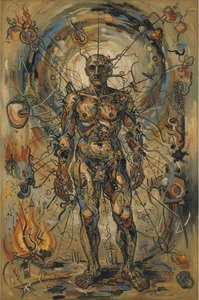
Joan Miró’s “Bañista” (The Bather), painted in 1925, isn't merely a depiction of a figure immersed in water; it’s an immersion into the artist’s deeply personal world—a vibrant collision of Catalan folklore, Surrealist dreamscapes, and a profound exploration of the subconscious. This captivating blue abstraction immediately draws the eye to its central figure: a man seemingly suspended before a luminous moon, his head crowned with a bowl – a potent symbol that anchors the work within a rich tapestry of meaning. The painting pulsates with an energy born from Miró’s unique vision, reflecting both the rugged beauty of his native Catalonia and the turbulent currents of his inner life.
Miró's artistic journey was inextricably linked to his Catalan heritage. Born in Barcelona, he absorbed the spirit of the region—its ancient myths, its distinctive architecture (particularly the organic forms championed by Antoni Gaudí), and a deep-seated sense of identity. “Bañista” is infused with this regionalism; the bowl on the man’s head echoes traditional Catalan hats, while the overall composition evokes the landscapes and textures of his homeland. Yet, Miró transcends mere representation, transforming these familiar elements into symbols open to multiple interpretations.
Surrealist Techniques and a Dreamlike Atmosphere
Technically, “Bañista” exemplifies Miró’s distinctive approach to Surrealism. He eschewed the rigid logic of Freudian dream analysis, instead employing a method he termed "automatism"—a process of spontaneous creation guided by intuition and subconscious impulses. The painting is built upon a foundation of bold, biomorphic shapes—circles, spirals, and amorphous forms—that seem to float weightlessly across the canvas. These aren’t meticulously rendered objects but rather evocative symbols, each imbued with personal significance for Miró.
The use of color is equally crucial. The dominant blues evoke a sense of tranquility and mystery, while contrasting yellows and oranges inject bursts of energy and warmth. Miró's technique involved applying paint directly from the tube, often layering colors in rapid succession to create a textured surface that seems to shimmer with movement. This immediacy reflects his desire to bypass conscious control and tap into the unfiltered flow of his imagination.
Symbolism and Emotional Resonance
The bowl perched atop the man’s head is arguably the most compelling symbol in “Bañista.” It can be interpreted as a representation of the crown, signifying authority or perhaps even a vessel for thoughts and emotions. The moon, positioned to the left, represents intuition, dreams, and the cyclical nature of time—elements deeply intertwined with Miró's artistic process. The birds scattered throughout the composition symbolize freedom and aspiration, while the clock suggests the passage of time and the fleeting nature of existence.
Beyond these specific symbols, “Bañista” resonates with a profound sense of melancholy and introspection. The solitary figure in the water invites contemplation on themes of isolation, vulnerability, and the search for meaning. It’s a painting that doesn't offer easy answers but instead encourages viewers to engage with their own inner landscapes—to confront their dreams, fears, and desires.
A Timeless Masterpiece – Perfect for Reproduction
“Bañista” remains one of Joan Miró’s most iconic works, captivating audiences with its dreamlike quality and symbolic richness. TopImpressionists offers meticulously crafted hand-painted reproductions that faithfully capture the essence of this extraordinary painting. Whether you're an art enthusiast, a collector seeking to expand your collection, or an interior designer searching for a unique statement piece, a reproduction of “Bañista” will bring a touch of Surrealist magic and Catalan spirit into any space. Explore our high-quality reproductions today and experience the enduring allure of Miró’s visionary world.



 Preview
 Bestel schilderij
 Verstuur
 Delen
Delen
 Details bekijken

 Download
 Vergelijkbare werken
 Röntgenonderzoek
 Diavoorstelling
 Lees meer






































 De optie voor glas is alleen beschikbaar bij een formaat kleiner dan 110 cm.