

Shown: · With its frame:
 Voorvertoning
 Verstuur
 Delen
Delen
 Details bekijken
 Gids
Gids

 Download
 Vergelijkbare items
 Röntgenonderzoek
 Diavoorstelling
 Q&A
Q&A Statistieken

€ 237
Handgemaakte olieverfreproductie
Met de hand geschilderd in olieverf op canvas in uw gewenste maat en lijst, op bestelling gemaakt door onze kunstenaars. ( Schakel over naar print Schakel over naar digitale afbeeldingen)
Dit kunstwerk is auteursrechtelijk beschermd
De kunstwerken die op deze pagina worden weergegeven, zijn beschermd door de auteursrechtwetgeving, wat betekent dat het ons wettelijk niet is toegestaan om identieke reproducties te maken of te verkopen. Deze bescherming wordt gehandhaafd onder internationale overeenkomsten zoals de Conventie van Bern en door nationale wetgeving, waaronder de bepalingen van de Amerikaanse auteurswet - Titel 17. Alle rechten voorbehouden. Reproduceren of distribueren van afbeeldingen is niet toegestaan zonder uitdrukkelijke schriftelijke toestemming van WahooArt.com en de rechthebbenden.
Als een respectvol en legaal alternatief bieden wij op maat gemaakte, handgeschilderde kunstwerken aan die geïnspireerd zijn op het origineel. Onze bekwame en professionele kunstenaars bestuderen zorgvuldig de stijl, sfeer en artistieke essentie van het origineel om een nieuw, uniek werk te creëren dat dezelfde emotie oproept – terwijl het een op zichzelf staande, originele creatie blijft.
Deze methode voldoet volledig aan de auteursrechtwetgeving, omdat het niet gaat om het kopiëren of dupliceren van het beschermde kunstwerk. In plaats daarvan is er sprake van een creatieve herinterpretatie — een nieuw schilderij dat door het origineel wordt geïnspireerd, maar er niet identiek aan is.
 Lees meer over
Size
·Standaardformaat
op maat gemaakt
CM
INCH
Kies uit onze vooraf ingestelde maten die overeenkomen met de originele verhoudingen van het kunstwerk.
Loading sizes...

breedte
hoogte
Voer de breedte en hoogte in die u nodig heeft, passend bij uw lijst of uw muur. Omdat dit handgeschilderd is, kan de kunstenaar bij een afmeting met een andere beeldverhouding iets meer rondom het schilderij schilderen of juist iets meer weglaten — u kiest zelf. Wij sturen u een digitaal mockup ter goedkeuring voordat het schilderwerk begint. De afbeelding die op deze pagina wordt getoond, is niet het uiteindelijke resultaat — alleen de mockup geeft dit weer.
Finish
·
White €1

Blurside €1

Extended €1

P118B €10

P118H €10

P118W €10

P438Z €10

P508JH €12

P508YH €12

P805H €10

P805Z €10

P919BZ €10

P919G €10

P919XJ €10

P959ZH €10

P968JZ €12

W106C €8

W218G €10

W218JH €8

W218Y €10

W307PJ €10

W316G €10

W316PJ €8

W316Y €10

W398PJ €8

W4111J €10

W500HY €15

W500JH €15

W692G €12

W849H €8

W940BG €15

W953PJ €8

H24-GOLD €30

H24-SILVER €30

H36-GOLD €45

H36-SILVER €45
Shipped in a protective tube, ready for your own framer.
Above 105 cm the frame is shipped as a kit for a professional framer — read the details.
Extras
optionalWhat do the extras include?
Examples of what can be changed: Replace face with customer photo; Add pet (e.g., replace cat with dog); Include hidden message in background; Change background landscape or elements.
After order, TopImpressionists.com team will email client for instructions and provide a mockup preview
After order, TopImpressionists.com team will email client for instructions and provide a mockup preview
Wereldwijde levering () binnen 3 tot 4 weken in plaats van de standaard 5 weken. (30 oktober). Zonder concessies aan de kwaliteit.
Beschermende vernislaag
Naamplaatje
Details van de gegraveerde bronzen plaat
This elegant plaque features the artist's name and the title of the artwork, finely engraved for a timeless presentation.
It is made from bronze with a refined, elegant finish. The text is precisely laser-engraved for a sharp and permanent result. Measuring 9x2 cm, the plaque is compact yet easy to read. It's built to be durable and scratch-resistant, offering a professional, museum-quality look. Mounting is simple thanks to the included adhesive backing.
Details transparante acrylplaat
The plaque includes essential engraved details such as the artist's name, the title of the artwork, the date it was created, the type of media used-like oil on canvas or watercolor-a brief description of the piece, and a QR code that links to the complete artwork information.
It is crafted from clear acrylic, offering a sleek, modern appearance. The text is UV-engraved in black to ensure strong visual contrast. With a size of 10x15 cm, it ensures optimal readability. It comes equipped with two metal hooks for secure wall mounting. The plaque is designed to be weather-resistant, making it suitable for various environments, and it includes interactive features that work seamlessly with smartphone scanning.
Details zwarte acrylplaat
This elegant plaque includes engraved information such as the artist's name, the title of the artwork, the date it was created, the type of media used (like oil on canvas or watercolor), a short description of the artwork, and a QR code for quick access to more information.
The plaque itself is made from refined black acrylic with a premium finish. The text is laser-engraved in white for high contrast and readability. Its size is 10x15 cm, designed to be easy to read. It comes with two metal hooks for professional mounting. The design is sleek and fits any interior style. It is also weather-resistant and durable, with built-in digital integration for mobile compatibility.
De optie voor glas is alleen beschikbaar bij een formaat kleiner dan 110 cm.
 De optie voor glas is alleen beschikbaar bij een formaat kleiner dan 110 cm.
- Gratis wereldwijde expressverzending
- Hoogwaardig linnen canvas
- Volledige verzendverzekering
- Garantie op terugbetaling van invoerrechten
- Garantie op exacte kleurweergave
- Retourbeleid van 100 dagen (alleen bij defecten)
- 100% Geld-terug-garantie
- Korting bij meerdere afnames


Beschrijving verzamelobject
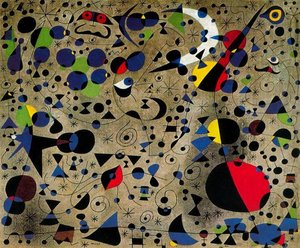
"La Poetisa" van Joan Miró: Een surrealistische schilderkunst met een vrouw met een vogelaanzijn hoofd en geometrische vormen. Ontdek de symboliek en kunstenaarschap achter deze iconische werken op TopImpressionists.com!
Biografie kunstenaar
Ontdek Joan Miró's prachtige surrealistische kunst! Een icoon van de Spaanse avantgarde met kleurrijke vormen & symbolische kleuren. Bekijk zijn werken op TopImpressionists!
About the painting
La Poetisa: Un Viaje Surrealista al Corazón del Arte
“La Poetisa” de Joan Miró no es simplemente una pintura; es un encuentro con el universo interior del artista catalán, una invitación a explorar los sueños y las emociones que yacen ocultos bajo la superficie de lo visible. Esta obra maestra surrealista, creada en 1959, captura la esencia misma de este movimiento artístico revolucionario, donde la razón abandona el paso ante la fuerza impulsiva de la imaginación libre. En TopImpressionists.com nos sumergimos en las complejidades de esta pieza excepcional, descubriendo los símbolos que Miró utilizó para comunicar su visión del mundo y la maestría técnica con la que logró plasmar esos pensamientos en lienzo.Una Composición Simbólica: Formas Geométricas y Referencias Anatómicas
La composición de “La Poetisa” es deliberadamente inquietante pero también profundamente armoniosa. Una mujer cuyo rostro está dominado por una cabeza de pájaro ocupa el centro del cuadro, rodeada por círculos brillantes y otras figuras geométricas que parecen flotar en el espacio. Estos círculos no son solo elementos decorativos; representan la totalidad, la unidad y el ciclo continuo de la vida, conceptos centrales en la filosofía surrealista. Además, la presencia de un reloj abierto en el lado derecho del cuadro introduce una tensión temporal que cuestiona nuestra percepción del tiempo y la realidad. Miró utilizó meticulosamente estos símbolos para transmitir mensajes complejos sobre la condición humana y la relación entre el pasado, el presente y el futuro.El Estilo Surrealista: Una Mezcla Entre Fantasía y Observación
Joan Miró fue un pionero en la exploración de lo inconsciente, buscando inspiración en los sueños y las asociaciones libres para crear obras que desafiaban las convenciones artísticas tradicionales. Su estilo surrealista se caracteriza por una combinación única de elementos figurativos y abstractos, donde las formas geométricas y las líneas curvas dialogan entre sí para generar imágenes evocadoras y sugestivas. Miró empleó técnicas innovadoras como el *pochoir*, una impresión en relieve que permite obtener colores vibrantes y efectos especiales, como el brillo característico del lienzo. Esta técnica fue especialmente adecuada para expresar la atmósfera onírica y misteriosa que caracteriza al artista.El Contexto Histórico: Barcelona y la Influencia de Gaudí
La obra de Miró nació en un entorno cultural rico y diverso, marcado por la influencia de Antoni Gaudí, cuyo estilo arquitectónico inspirado en la naturaleza fue una fuente constante de inspiración para el pintor catalán. Miró vivió principalmente en Barcelona y Palma de Mallorca, ciudades que reflejan la identidad artística y filosófica del artista. La Fundació Joan Miró, establecida en 1975, es un testimonio de este legado artístico, ofreciendo una exposición permanente de las obras más importantes del pintor y un espacio dedicado a la investigación sobre su vida y obra. Esta fundación también impulsa proyectos educativos y culturales que buscan difundir el conocimiento sobre el arte contemporáneo y la cultura catalana.Más Allá de la Reproducción: Una Experiencia Sensorial Completa
En TopImpressionists.com entendemos que apreciar una obra maestra como “La Poetisa” implica más que simplemente observar un cuadro en una pared; es vivir una experiencia sensorial completa que conecta con nuestros propios sueños y emociones. Por eso ofrecemos reproducciones hechas a mano de la más alta calidad, utilizando pigmentos originales y técnicas tradicionales para asegurar que la belleza y el espíritu del arte de Miró puedan sentirse en cualquier hogar. Una inversión en arte que celebra la creatividad humana y nos invita a reflexionar sobre los misterios del universo interior.Veelgestelde vragen
Is een download met hoge resolutie van "La Poetisa" beschikbaar?
Om een digitale afbeelding van "La Poetisa" door Joan Miró te verkrijgen, kunt u een digitale afbeelding in hoge resolutie om te downloaden bestellen op de Digitale afbeelding pagina.
Is Joan Miró, maker van "La Poetisa", bekend onder andere namen?
Andere namen waaronder Joan Miró, maker van "La Poetisa", bekend is, zijn onder andere Jo de Miró.
Waarom heeft het kunstwerk "La Poetisa" deze auteursrechtelijke status?
"La Poetisa" door Joan Miró is nog steeds auteursrechtelijk beschermd. De auteursrechtelijke bescherming loopt vanaf het overlijden van de kunstenaar, dat plaatsvond in 1983.
Quick facts and art quiz
About Joan Miró

Joan Miró
1893 - 1983, Spanje
Biografie kunstenaar
A Catalan Visionary: The Life and Art of Joan Miró
Joan Miró i Ferrà, born in Barcelona in 1893, stands as one of the most significant figures in 20th-century art. His journey was not merely a progression through styles but an exploration of inner worlds, translating dreams, memories, and Catalan identity onto canvas with a uniquely poetic visual language. From humble beginnings marked by illness and initial parental reservations about his artistic pursuits, Miró persevered, driven by an innate need to express the intangible—the emotions, sensations, and subconscious currents that lie beneath the surface of reality. His early life was steeped in the traditions of Barcelona, a city brimming with architectural marvels thanks to Antoni Gaudí, whose organic forms would subtly influence Miró’s later abstractions. The goldsmithing profession of his father instilled an appreciation for meticulous craftsmanship, while the rugged Catalan landscape became a recurring motif and source of inspiration throughout his career.Early Influences and the Path to Surrealism
Miró's formal artistic training began at La Llotja in Barcelona, where he honed his skills in traditional techniques. However, it was exposure to the avant-garde movements sweeping through Paris that truly ignited his creative evolution. The vibrant colors of Fauvism and the fragmented forms of Cubism resonated deeply, prompting him to move to Paris in 1920. This period proved pivotal as he encountered artists like Pablo Picasso and began experimenting with increasingly abstract compositions. Yet, Miró didn’t simply adopt these styles; he synthesized them, forging a path toward his own distinctive aesthetic. He sought to distill forms to their essence, stripping away representational details in favor of symbolic shapes and evocative colors. This exploration led him to the Surrealist group in 1924, aligning him with artists such as Max Ernst and Salvador Dalí. While embracing the Surrealist interest in the subconscious, Miró maintained a unique sensibility—his work was less about shocking imagery or Freudian symbolism than it was about creating a world of playful forms and poetic suggestion.The Language of Symbols: Key Works and Artistic Innovations
Throughout the 1920s and 30s, Miró developed his signature visual vocabulary—a universe populated by biomorphic shapes, floating forms, and vibrant colors. The Farm (1922), often considered a cornerstone of his oeuvre, exemplifies this transition. It’s not merely a depiction of rural life but an evocation of Catalan identity and a symbolic representation of the natural world. His collaborative spirit led to innovative techniques like *grattage*, pioneered with Max Ernst in 1926 for designs intended for Sergei Diaghilev's ballet, where textures were revealed by scraping paint across canvas. The Dutch Interiors (1928) series demonstrated his ability to reinterpret the Old Masters through a distinctly modern lens, transforming domestic scenes into dreamlike abstractions. Painting (1933), with its bold colors and simplified forms, encapsulates Miró’s exploration of the subconscious and his rejection of conventional artistic boundaries. Beyond painting, Miró fearlessly experimented with sculpture, ceramics, and printmaking, expanding his creative horizons and demonstrating a remarkable versatility.Legacy and Enduring Influence
Joan Miró's impact on 20th-century art is undeniable. He wasn’t simply a painter; he was a visionary who challenged the very definition of artistic expression. His work paved the way for abstract expressionism and continues to inspire artists across disciplines. He established two foundations—the Fundació Joan Miró in Barcelona (1975) and the Fundació Pilar i Joan Miró in Palma de Mallorca (1981)—ensuring that his legacy would endure, providing spaces for artistic exploration and education. Throughout his long career, he remained committed to pushing boundaries, questioning conventions, and exploring the depths of human imagination. Miró’s art is a testament to the power of abstraction, symbolism, and poetic expression—a vibrant celebration of life, dreams, and the enduring spirit of Catalan culture. His work continues to resonate with audiences worldwide, inviting us to enter a world where anything is possible and the boundaries between reality and fantasy blur into a captivating dance of color and form.Quick facts about Joan Miró
- Artistic Movement Or Style: Surrealisme, Abstract Art
- Artists Who Influenced This Artist:
- Pablo Picasso
- Sergei Diaghilev
- Date Of Birth: 20 april 1893
- Full Name: Joan Miró i Ferrà
- Nationality: Spanish
- Notable Artworks:
- The Farm
- Dutch Interiors
- Painting
- Place Of Birth: Barcelona, Spain
Ontdek kunstwerken georganiseerd op thema, stijl en kenmerk.


Joan Miró
La Poetisa
() ·
With its frame: · Hand-painted in oil on linen
Total