


 Voorvertoning
 Verstuur
 Delen
Delen
 Details bekijken
 Gids
Gids

 Download
 Vergelijkbare items
 Röntgenonderzoek
 Diavoorstelling
 Statistieken
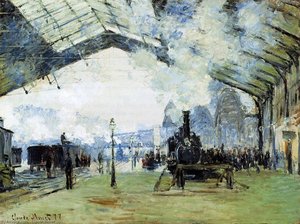
Sitges train station
 Oil
Oil- WallArt
- Impressionism
 1882
1882- 19th Century
 31.0 x 41.0 cm
 Maricel Museum
A powerful steam engine billows smoke through the bustling Sitges train station in this 1882 Impressionistic masterpiece by Joan Roig Soler, inviting you to bring a piece of Catalan history into your home.
 Lees meer
Discover Joan Roig Soler’s captivating landscapes & cityscapes of Spain (1852-1909). Explore his vibrant paintings of Sitges, Blanes & Madrid – a master of light & color!
Ontvang een bestand dat klaar is voor drukwerk en de kwaliteit van het online voorbeeld ver overstijgt. Elke digitale afbeelding die wij verkopen, is afkomstig van een high-resolution master uit onze database — meestal tussen de 5.000 en 15.000 pixels breed — zodat u met vertrouwen groot kunt afdrukken, nauwkeurig kunt bijsnijden of fijne details kunt reproduceren.
Geen enkel bestand verlaat ons atelier onbewerkt. Een digitaal expert controleert de kleuren aan de hand van het originele schilderij en corrigeert deze indien nodig, om vervolgens de helderheid en details te verbeteren met professionele retoucheertechnieken — waarbij de penseelstreek en stijl van de kunstenaar altijd strikt worden gerespecteerd. Het resultaat is een afbeelding die oogt als het schilderij zelf, en niet als een gescande foto met een filter.
U keurt goed voordat het proces wordt afgerond: onze expert stuurt de afbeelding binnen 72 uur per e-mail naar u toe ter beoordeling. Niet tevreden? Vraag om verbeteringen of correcties, of vraag een terugbetaling aan als de kwaliteit niet voldoet.
Dit is de kwaliteit waarop uitgevers, designstudio's, galeries en drukkerijen vertrouwen.
Digitale afbeeldingen
Download een bestand met hoge resolutie voor persoonlijke weergave, afdrukken en creatieve projecten. ( Schakel over naar print Bestel handgeschilderde reproductie)
Inbegrepen bij elke bestelling van een digitale afbeelding
Professionele digitale levering, gegarandeerd
Wanneer u kiest voor TopImpressionists.com, ontvangt u niet alleen een afbeelding – u krijgt een professioneel verbeterd digitaal kunstwerk, met precisie vervaardigd en voorzien van een tevredenheidsgarantie. Dit is alles wat automatisch bij uw bestelling is inbegrepen:

Snelle levering per e-mail
Uw hoogwaardige digitale afbeeldingsbestand wordt binnen 72 uur na bestelling naar u gemaild – klaar voor direct gebruik.

AI-verbeterd digitaal bestand
Uw kunstwerk wordt professioneel geoptimaliseerd met behulp van geavanceerde AI-tools en handmatige bewerkingen, waardoor maximale details, helderheid en kleurnauwkeurigheid worden gegarandeerd.

Gratis levenslange herlevering van digitale bestanden
Je bestand per ongeluk verwijderd of kwijtgeraakt? Geen zorgen – we sturen het u op elk gewenst moment gratis opnieuw toe.

Geen invoerkosten – nooit
Geniet direct van uw kunstwerk zonder invoerrechten, belastingen of verzendkosten – digitale downloads zijn altijd belastingvrij.

Garantie op kleurgetrouwheid
Met behulp van professionele hulpmiddelen en kleurbeheer zorgen wij ervoor dat uw digitale afbeelding de originele kleuren zo nauwkeurig mogelijk weergeeft.

100 dagen tevredenheidsgarantie
Mocht u niet tevreden zijn met uw digitale afbeelding, dan passen wij deze aan of storten wij 100% terug binnen 100 dagen – zonder vragen te stellen.

100% Geld-terug-garantie
Niet tevreden? Ontvang een volledige terugbetaling binnen 100 dagen na ontvangst van uw digitale bestand – zonder vragen te stellen.

Korting bij grote bestellingen
Koop 3 afbeeldingen, bespaar 10% - Koop 5, bespaar 15% - Koop 10+, bespaar 20%. Ideaal voor creatieve projecten, galerieën en bureaus.
A Moment Frozen in Steam and Light
In the evocative masterpiece Sitges train station, painted in 1882, Joan Roig Soler invites us into a fleeting moment of late nineteenth-century life, where the industrial pulse of progress meets the quiet anticipation of travel. The canvas captures the bustling energy of a Catalan railway platform, dominated by the magnificent presence of a steam engine as it pulls its heavy carts along the tracks. As the locomotive surges forward, thick plumes of billowing smoke rise into the sky, creating a dramatic interplay between the solid, dark machinery and the ethereal, transient atmosphere of the morning air. It is a scene that breathes with movement, capturing not just a location, but the very sensation of arrival and departure.
Roig Soler, a master of light and color, employs an Impressionistic sensibility to breathe life into this industrial landscape. Rather than focusing solely on the mechanical precision of the train, he directs our gaze toward the human element—the twelve figures scattered across the platform, each caught in a private moment of observation or waiting. Some lean forward with curiosity, while others sit quietly on the station benches, their silhouettes softened by the atmospheric haze. The artist’s technique allows light to dance across the scene, illuminating the textures of the steam and the subtle shadows cast by the passengers, creating a sense of depth that pulls the viewer directly onto the platform alongside the travelers.
The Intersection of Progress and Nostalgia
Historically, this work serves as a poignant window into the era of rapid modernization in Spain. The train station, once a symbol of cutting-edge technology and the shrinking of distances, is depicted here with a sense of romantic grandeur. There is a profound symbolism in the contrast between the heavy, unstoppable force of the steam engine and the fragile, transient nature of the people watching it pass. For the contemporary collector or interior designer, this painting offers more than just a historical record; it provides a sophisticated narrative of transition. The composition, which stretches across the canvas from left to right, guides the eye through a rhythmic progression of movement and stillness.
For those seeking to adorn a space with art that evokes emotion and conversation, Sitges train station is an incomparable choice. Its palette of earthy tones, punctuated by the dramatic whites of the steam, lends itself beautifully to both classical and modern interiors. Whether placed in a grand study or a contemporary living area, this reproduction brings with it a sense of timelessness and a quiet, contemplative energy. It is a piece that celebrates the beauty found in the mundane, transforming a routine moment at a station into an enduring vision of light, motion, and human connection.
Veelgestelde vragen
Voor welke ruimte wordt "Sitges train station" door Joan Roig Soler aanbevolen?
"Sitges train station" door Joan Roig Soler wordt aanbevolen voor een Coffee Shop. Deze suggestie is gebaseerd op het onderwerp, de kleuren en de sfeer van het werk.
Waar kan ik handgeschilderde reproducties van "Sitges train station" door Joan Roig Soler kopen?
Handgeschilderde reproducties van "Sitges train station" door Joan Roig Soler zijn verkrijgbaar via deze website: een met de hand geschilderde olieverfreproductie op linnen canvas, te bestellen op de Handgeschilderde reproductie pagina.
Welke stemming en emotie komen samen in "Sitges train station"?
De vastgelegde stemming van "Sitges train station" door Joan Roig Soler is Nostalgic, en de emotionele toon ervan is Nostalgic.
Vergelijkbare kunstwerken




Kunstenaarsbiografie
The Luminous Legacy of Joan Roig Soler
In the golden age of Spanish Impressionism, few artists captured the ephemeral dance of light upon the Mediterranean coast as poignantly as Joan Roig Soler. Born in Barcelona in 1852, Soler emerged from a lineage of artistic passion, having been nurtured by a father who first ignited his fascination with the nuances of color and form. His formal training at the Escuela Superior de Bellas Artes Barcelona provided him with a rigorous foundation in Academic realism, yet it was his ability to transcend the rigid boundaries of tradition that would define his career. As the nineteenth century progressed, Soler began to weave the meticulous precision of his classical education with the burgeoning, atmospheric sensibilities of the Impressionist movement, creating a style that felt both grounded in reality and elevated by light.
The heart of Soler’s oeuvre lies within the sun-drenched landscapes of Catalonia, particularly the picturesque seaside enclave of Sitges. It was here, amidst the shimmering vistas of the Costa Brava, that he truly found his voice. He possessed a rare, almost intuitive ability to translate the fleeting textures of the Mediterranean—the way sunlight refracts through sea spray or how the midday heat softens the edges of coastal villas. His works from this period are not merely landscapes but sensory experiences; in masterpieces such as Sitges Study, one can almost feel the warmth of the sand and the salt in the breeze. This dedication to capturing the transient beauty of the coast cemented his reputation as a master of Impressionistic realism, an artist capable of freezing a moment in time while maintaining its vibrant, breathing essence.
Urban Rhythms and Industrial Echoes
While the tranquil shores of Sitges offered him a sanctuary of light, Roig Soler was equally captivated by the burgeoning energy of Spain’s urban centers. His travels to Madrid allowed him to explore a different facet of the human experience—the dynamic, often chaotic pulse of city life. In canvases such as Avenida de los catalanes, he moved away from the serene coastal horizons to embrace the complex interplay of shadow and movement found in metropolitan streets. These urban impressions showcase his remarkable versatility, proving that his mastery of light was just as effective in the narrow, shaded corridors of a city as it was on an open beach.
Perhaps most striking is his ability to find beauty within the machinery of progress. In his evocative 1882 work, Sitges train station, Soler captures a profound intersection between the industrial revolution and the quietude of daily life. The painting presents a dramatic tableau where the heavy, dark presence of a steam engine meets the ethereal plumes of billowing smoke, creating a sense of atmospheric depth that pulls the viewer onto the platform. Through this work, he explores themes of nostalgia and modernization, using the locomotive as a symbol of an unstoppable future encroaching upon the timeless landscape. By focusing on the human element—the passengers caught in moments of waiting or curiosity—he imbues the industrial scene with a deeply relatable, emotional resonance.
Artistic Influences and Historical Significance
The evolution of Roig Soler’s technique was profoundly shaped by the giants of European art. He drew significant inspiration from the works of Claude Monet and Frédéric Bazille, adopting their focus on light and broken brushstrokes to enhance the luminosity of his palettes. Yet, unlike some of his more radical contemporaries, Soler never fully abandoned the structural integrity of the Academic tradition. This unique synthesis—the marriage of expressive, Impressionistic strokes with a disciplined, realist composition—distinguishes his work from the broader movement and provides it with a lasting, sculptural quality.
Though history occasionally places him in the shadow of contemporaries like Joaquín Sorolla, the enduring significance of Joan Roig Soler lies in his role as a vital chronicler of the Catalan spirit. His paintings serve as a visual archive of a transformative era in Spanish history, capturing both the natural splendor of the Mediterranean and the rapid modernization of the late nineteenth century. Today, his legacy continues to inspire, offering a window into a world where light, color, and movement converge to tell the story of a changing nation.

Joan Roig Soler
1852 - 1909 , Spain
Belangrijkste feiten
- Full Name: Joan Roig y Soler
- Nationality: Spanish
- Date Of Birth: 1852
- Date Of Death: 1909
- Place Of Birth: Barcelona, Spain
- Notable Artworks:
- African Chief
- Sitges Study
- Alighting from the carriage
- Artistic Movement Or Style: Realist Painting & Impressionism
- Artists Who Influenced This Artist: ['Mariano Fortuny y Marsal']
- Artists Or Movements Influenced By This Artist: ['Impressionism']