Atelier — Gratis verzending wereldwijd — Levertijd 2–6 weken
Van foto naar schilderij Verlanglijstje Winkelwagen
Bekijk op ware grootteBekijk op ware grootte Bekijk in ARBekijk in AR Bestel een print Bestel een printBestel een handgeschilderde reproductie van dit verzamelobject Bestel een handgeschilderde reproductie van dit verzamelobject VerstuurVerstuur
Details bekijkenDetails bekijken Toevoegen aan favorieten Toevoegen aan favorieten DownloadDownload Vergelijkbare werkenVergelijkbare werken RöntgenonderzoekRöntgenonderzoek DiavoorstellingDiavoorstelling

Studio Scene

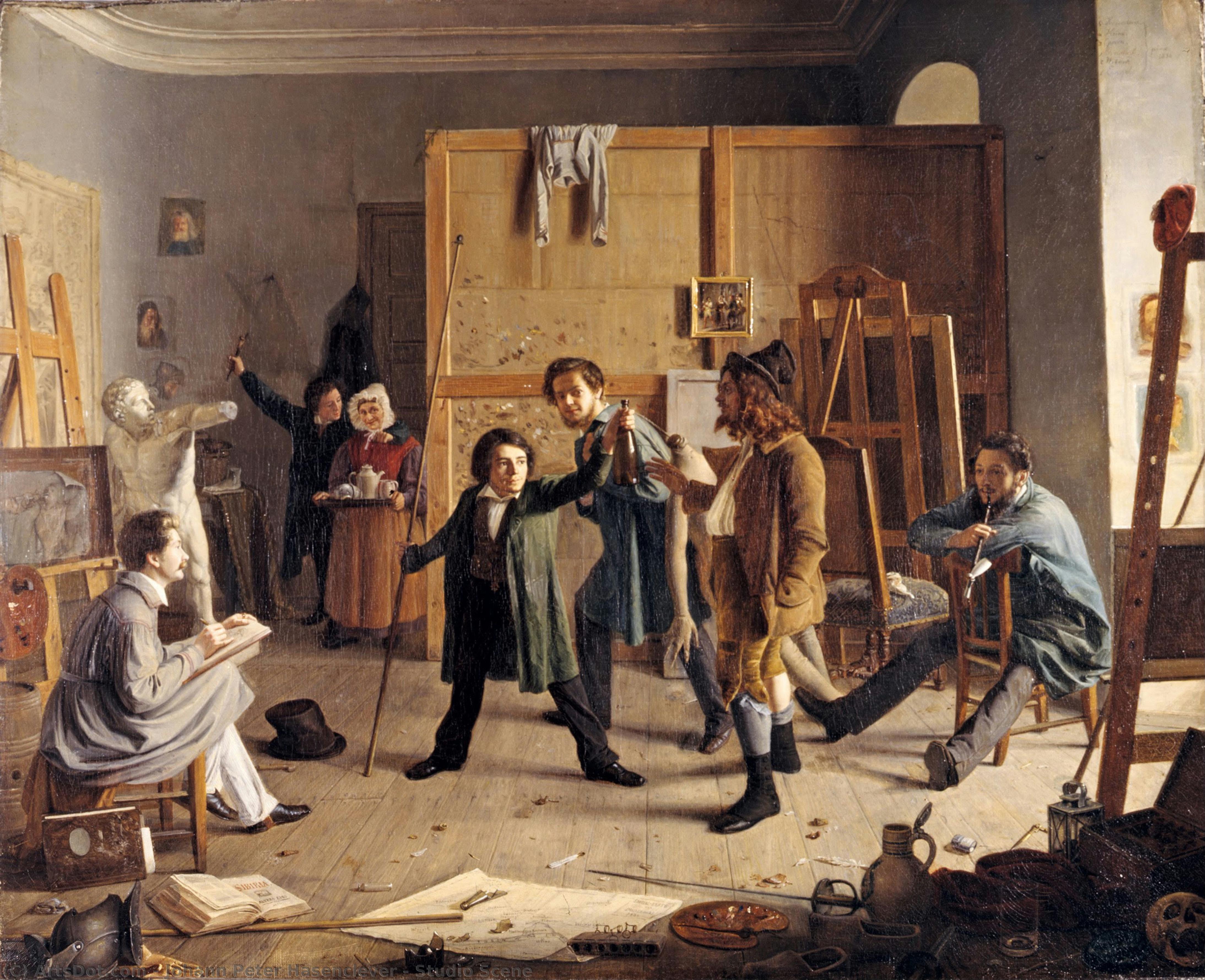
A lively studio scene capturing the vibrant energy of the Düsseldorf School through a group of artists at work by Johann Peter Hasenclever, inviting you to explore this masterpiece of nineteenth-century genre painting.

Explore the genre paintings of Johann Peter Hasenclever! Capturing Biedermeier life & social commentary, like 'Hieronymus Jobs,' a key figure in Düsseldorf art.

Koop een digitale afbeelding in hoge resolutie met verbeterde kwaliteit, die veel superieur is aan de online voorvertoning.

Elk bestand wordt met uiterste precisie voorbereid door onze interne specialisten, met behulp van geavanceerde tools en deskundige handmatige retouche. Wij garanderen dat elke afbeelding een uitzonderlijke helderheid, nauwkeurige kleurweergave en verfijnde details bezit.

Het uiteindelijke bestand wordt binnen 72 uur per e-mail geleverd, geoptimaliseerd voor direct gebruik in professionele, redactionele en printomgevingen. Dit is dezelfde kwaliteit waarop topontwerpstudio's, uitgevers en galerieën vertrouwen.

Digitale afbeeldingen

Download een bestand met hoge resolutie voor persoonlijke weergave, afdrukken en creatieve projecten. (Bestel een print Bestel een printBestel een handgeschilderde reproductie van dit verzamelobject Bestel een handgeschilderde reproductie van dit verzamelobject)

Eindtotaal

$9.99

Inbegrepen bij elke bestelling van een digitale afbeelding

Professionele digitale levering, gegarandeerd

Wanneer u kiest voor TopImpressionists.com, ontvangt u niet alleen een afbeelding – u krijgt een professioneel verbeterd digitaal kunstwerk, met precisie vervaardigd en voorzien van een tevredenheidsgarantie. Dit is alles wat automatisch bij uw bestelling is inbegrepen:

shipping_icon
Direct per e-mail ontvangen

Uw hoogwaardige digitale afbeeldingsbestand wordt binnen 72 uur na bestelling naar u gemaild – klaar voor direct gebruik.

canvas_icon
Met AI verbeterd digitaal bestand

Uw kunstwerk wordt professioneel geoptimaliseerd met behulp van geavanceerde AI-tools en handmatige bewerkingen, waardoor maximale details, helderheid en kleurnauwkeurigheid worden gegarandeerd.

insurance_icon
Gratis levenslange herlevering

Je bestand per ongeluk verwijderd of kwijtgeraakt? Geen zorgen – we sturen het u op elk gewenst moment gratis opnieuw toe.

tax_icon
Geen invoerkosten – nooit

Geniet direct van uw kunstwerk zonder invoerrechten, belastingen of verzendkosten – digitale downloads zijn altijd belastingvrij.

color_icon
Garantie op kleurgetrouwheid

Met behulp van professionele hulpmiddelen en kleurbeheer zorgen wij ervoor dat uw digitale afbeelding de originele kleuren zo nauwkeurig mogelijk weergeeft.

return_icon
60 dagen tevredenheidsgarantie

Als u niet tevreden bent met uw digitale afbeelding, passen wij deze aan of storten wij 100% terug binnen 60 dagen – zonder vragen gesteld.

guarantee_icon
100% Geld-terug-garantie

Niet tevreden? Ontvang binnen 60 dagen na ontvangst van uw digitale bestand uw volledige aankoopbedrag terug – zonder vragen te stellen.

discount_icon
Korting bij grote bestellingen

Koop 3 afbeeldingen, bespaar 10% - Koop 5, bespaar 15% - Koop 10+, bespaar 20%. Ideaal voor creatieve projecten, galerieën en bureaus.

Belangrijkste kenmerken

  • Title: Studio Scene
  • Notable elements: Tableau vivant, realistic props
  • Artistic style: Genre painting
  • Dimensions: 880 x 720 cm
  • Subject or theme: Artists in a studio workshop
  • Year: 1836

Kunstquiz

Er is slechts één goed antwoord op elke vraag.

Vraag 1:
What does the 'Studio Scene' represent regarding the Düsseldorf School of Painting?
Vraag 2:
Which items in the painting are described as being 'thrown away' to signify the rejection of outdated teaching materials?
Vraag 3:
According to the description, where does 'real life' take place in the context of these genre painters?
Vraag 4:
What is being used as a 'wind trap' and to wipe off brushes in the scene?
Vraag 5:
What is the overall atmosphere of the scene described in the photo description?

Beschrijving verzamelobject

Genre painters A. Greven, J. P. Hasenclever, J. Wilms, O. Grashof, W. Heine and C. Engel von der Rabenau create a ‘tableau vivant’ as if on a stage, drawn from real life rather than from some literary model. Behind the humorous scene we can discern the new way the genre painters viewed the creative team process, with its roots in real life, and the call for realistic art. Outdated teaching materials such as the ancient plaster model of the fencer, the manikin, and the props for a poetic-idealist form of history painting are thrown away, along with the knight’s helmet. Mouse traps and the map of Düsseldorf show where real life takes place: between the pawn shop and the brothel. The role of the genre painters as outsiders in the Academy and their banishment to Siberia (the book title) unites them as zestful drinking companions. Instead of a history painting, the back of which is being used as a wind trap and to wipe off brushes, before our eyes a new, true image arises that shows how genre painting comes about. The picture as painted art theory is a programmatic image for the Düsseldorf School of Painting. (Bettina Baumgärtel)

Biografie van de kunstenaar

Early Life and Artistic Beginnings

Johann Peter Hasenclever, born in the industrial town of Remscheid, Germany, on May 18th, 1810, emerged as a pivotal figure within the Düsseldorf School of painting. His father, a toolsmith deeply rooted in the local iron trade, provided a practical upbringing, yet it was an early aptitude for drawing that would chart a different course for young Johann Peter. At age ten, he began schooling in Ronsdorf and soon found himself under the tutelage of Johann Peter Fasbender, a teacher who recognized and actively nurtured his burgeoning talent. This encouragement proved crucial; at seventeen, Hasenclever enrolled at the prestigious Kunstakademie Düsseldorf, initially studying architecture before pivoting to history painting under the direction of Friedrich Wilhelm von Schadow. However, this first foray into formal training was short-lived—Schadow’s expressed doubts about his abilities led to a temporary retreat from academic instruction. Undeterred, Hasenclever returned to study in 1836 with Theodor Hildebrandt, an artist deeply inspired by the Dutch Golden Age masters. This second attempt at formal education proved transformative. Genre painting, still relatively nascent in Germany, captivated him, and he began to develop a style that would become synonymous with capturing the nuances of everyday life.

The Rise to Prominence: Munich and the *Jobsiade* Illustrations

A move to Munich in 1838 marked a turning point in Hasenclever’s career. It was here he received his first significant commission—to create illustrations for Carl Arnold Kortum's satirical poem, the *Jobsiade*. This work, a humorous and often ironic chronicle of a “perpetual student” whose life takes an unexpected turn as a night watchman, provided Hasenclever with fertile ground to explore his burgeoning talent. He produced twenty paintings that were subsequently lithographed for publication, bringing his art to a wider audience. The series resonated deeply, capturing the spirit of the time and establishing him as a rising star. A pivotal moment came in 1840 when King Ludwig I of Bavaria acquired “Hieronymus Jobs at the Exam,” solidifying Hasenclever’s reputation and paving the way for his return to Düsseldorf three years later.

Düsseldorf, Biedermeier Life, and Social Commentary

Upon his return to Düsseldorf in 1843, Hasenclever was welcomed as a celebrated artist and inducted into the Prussian Academy of Arts. This period saw him fully embrace depictions of everyday life during the Biedermeier era—a time characterized by domesticity, simplicity, and a focus on middle-class values. However, Hasenclever’s work transcended mere idyllic representation. He possessed a keen eye for social commentary, subtly embedding critiques within his seemingly innocuous scenes. His paintings often reveal humorous observations of human foibles and the complexities of societal norms. His personal life also flourished during this time; he married Caroline Anna Babette Trentini in 1843, and they had three children. Hasenclever’s commitment to social issues extended beyond his art. He became involved in the political movements of the Vormärz period—the years leading up to the revolutions of 1848—and was among the first German artists to actively incorporate social critique into their work, joining the anti-academic artist's association “Crignic” and contributing to the satirical *Düsseldorfer Monathefte*.

Influences, Style, and Lasting Legacy

Hasenclever’s artistic development was shaped by a diverse range of influences. The Dutch Golden Age masters, particularly their genre scenes, provided a foundation for his meticulous attention to detail and realistic portrayal of everyday life. He also drew inspiration from English painters like William Hogarth and Thomas Rowlandson, admiring their satirical wit and ability to capture the nuances of human character. David Wilkie’s “The Opening of the Will” proved especially impactful, influencing Hasenclever's use of theatrical lighting and exaggerated physiognomy. His style is characterized by a blend of realism and humor, often infused with subtle social commentary. He masterfully depicted interiors and scenes of middle-class life, capturing both the charm and the underlying tensions of Biedermeier society.

Final Years and Historical Significance

Tragically, Johann Peter Hasenclever’s life was cut short by typhus in December 1853 at the age of forty-three. Shortly before his death, Karl Marx himself praised his work, specifically highlighting “Worker's Delegation Before the Magistrate” as an example of proletarian art—a testament to the power and resonance of his social commentary. While largely overlooked for a period after his passing, Hasenclever experienced a revival in interest during the 1960s and 70s, particularly within the German Democratic Republic, where art historians like Wolfgang Hütt recognized the Marxist elements present in his paintings. Today, he is celebrated as one of Germany’s most important genre painters of the 19th century, an artist who not only captured the spirit of his time but also dared to challenge its conventions and offer a critical reflection on society. His influence can be seen in the work of artists such as Carl Spitzweg and Wilhelm Busch, solidifying his place as a significant figure in German art history.

johann peter hasenclever

johann peter hasenclever

1810 - 1853 , Germany

Kerngegevens

  • Artistic Movement Or Style: Biedermeier Painting
  • Artists Or Movements Influenced By This Artist: ['Düsseldorf School Paintin']
  • Artists Who Influenced This Artist: ['Carl Spitzweg']
  • Date Of Birth: May 18, 1810
  • Full Name: Johann Peter Hasenclever
  • Nationality: German
  • Notable Artworks: ['Hieronymus Jobs at His Exam']
  • Place Of Birth: Remscheid, Germany
© TopImpressionists.com — Alle rechten voorbehouden  ·  100% Met de hand geschilderd · Tevredenheid gegarandeerd · Gratis wereldwijde verzending
VISA MASTERCARD