

 Voorvertoning
 Verstuur
 Delen
Delen
 Details bekijken
 Gids
Gids

 Download
 Vergelijkbare items
 Röntgenonderzoek
 Diavoorstelling
 Q&A
Q&A Statistieken
A mechanical Baa-Baa!

- 41.0 x 32.0 cm


Discover John French Sloan’s ‘A mechanical Baa-Baa!’ – a detailed pencil drawing of a Victorian shop scene. Explore realism, nostalgia & intricate mechanics in this 1906 artwork.
 Lees meer
"meta_description": "John French Sloan (1871-1951) was een Amerikaanse schilder van de Ashcan School, bekend om zijn realistische en sfeervolle afbeeldingen van het New Yorkse leven. Zijn werk toont de schoonheid van alledaagse momenten en sociale thema's."
Giclée / Kunstafdrukken
Giclée- of canvasafdruk van museumkwaliteit met een snelle productie en flexibele afwerkingsmogelijkheden. ( Bestel handgeschilderde reproductie Schakel over naar digitale afbeeldingen)




P118B €10

P118H €10

P118W €10

P438Z €10

P508JH €12

P508YH €12

P805H €10

P805Z €10

P919BZ €10

P919G €10

P919XJ €10

P959ZH €10

P968JZ €12

W106C €8

W218G €10

W218JH €8

W218Y €10

W307PJ €10

W316G €10

W316PJ €8

W316Y €10

W398PJ €8

W4111J €10

W500HY €15

W500JH €15

W692G €12

W849H €8

W940BG €15

W953PJ €8




Standaardformaat
op maat gemaakt
CM
INCH
Kies uit onze vooraf ingestelde maten die overeenkomen met de originele verhoudingen van het kunstwerk.
Loading sizes...

breedte
hoogte
Voer de gewenste breedte en hoogte in, passend bij uw lijst of muur. Een afdruk kan alleen worden ingekort en nooit groter worden gemaakt dan het origineel; een formaat met andere verhoudingen zal daarom een deel van de afbeelding verliezen. Wij sturen u een digitaal mockup ter goedkeuring voordat we tot drukwerk overgaan. De afbeelding op deze pagina toont niet de werkelijke uitsnede — dit is alleen te zien op het mockup.
Wereldwijde levering () binnen 2 weken in plaats van de standaard 4/5 weken. (1 november)

Gratis wereldwijde expressverzending

Hoogwaardig linnen canvas

Volledige verzendverzekering

Garantie op terugbetaling van invoerrechten

Garantie op exacte kleurweergave

Retourbeleid van 100 dagen (alleen bij defecten)

100% Geld-terug-garantie

Korting bij meerdere afnames
 De optie voor glas is alleen beschikbaar bij een formaat kleiner dan 110 cm.

A mechanical Baa-Baa!
Giclée / Kunstafdrukken
Afmetingen reproductie
-


Eindtotaal
€ 62
A Mechanical Baa-Baa!: A Glimpse into Victorian Curiosity
John French Sloan’s “A Mechanical Baa-Baa!” isn't merely a depiction of an antique shop; it’s a meticulously crafted narrative frozen in time, offering a poignant window into the burgeoning fascination with industrial innovation and the quiet rhythms of everyday life at the turn of the 20th century. Painted in 1906, during his tenure as a key figure within the Ashcan School movement – an American realist style that championed the gritty realities of urban existence – Sloan masterfully captures a scene brimming with both mechanical wonder and subtle human connection. The artwork immediately draws the viewer into a densely packed interior, dominated by shelves overflowing with intricate automata, gleaming brass instruments, and curious mechanical toys. Two men, their faces partially obscured yet radiating an air of animated conversation, are positioned at the heart of this captivating tableau, suggesting a shared appreciation for the wonders before them.
A Study in Draftsmanship and Texture
Sloan’s technique is remarkably detailed, relying almost entirely on the skillful manipulation of pencil shading to build up an astonishingly rich tapestry of textures. Hatching, cross-hatching, and stippling are employed with precision, creating a palpable sense of volume and form within each object – from the rough grain of the wooden furniture to the polished sheen of the mechanical components. The artist’s mastery lies in his ability to render these disparate surfaces with convincing realism, inviting the viewer to almost reach out and touch the cool metal or feel the worn texture of the aged wood. The deliberate flattening of perspective, a characteristic of illustrative drawings, serves not as a limitation but rather as a strategic device, directing our attention towards the central figures and immersing us within the scene’s contained world.
Symbolism and the Echoes of Nostalgia
Beyond its technical brilliance, “A Mechanical Baa-Baa!” resonates with layers of symbolic meaning. The title itself – a playful juxtaposition of pastoral imagery (“baa-baa,” evoking sheep) and industrial innovation – hints at a broader commentary on the changing landscape of American society. The antique shop, a repository of forgotten technologies and bygone eras, becomes a symbol of nostalgia, prompting reflection on childhood memories and the enduring allure of intricate mechanisms. The two men engaged in conversation likely discuss these objects, perhaps reminiscing about their own youthful fascination with such wonders. There’s an undeniable sense of mystery surrounding their dialogue; what are they debating? What shared experience connects them to this collection of mechanical marvels?
Historical Context and the Rise of Modernity
To fully appreciate “A Mechanical Baa-Baa!” it’s crucial to consider its historical context. The late 19th and early 20th centuries witnessed an unprecedented surge in technological innovation, fueled by advancements in steam power, electricity, and mass production. Automata, mechanical toys, and intricate clocks became increasingly popular status symbols, reflecting a growing fascination with efficiency, precision, and the promise of a mechanized future. Sloan’s artwork captures this spirit of progress while simultaneously acknowledging the sentimental value associated with traditional craftsmanship and the fading allure of simpler times. The painting stands as a testament to a pivotal moment in history – a transition from a largely agrarian society to an increasingly industrialized world.
This meticulously rendered reproduction offers a captivating glimpse into Sloan’s artistic vision and the social landscape of early 20th-century America. Its rich textures, evocative composition, and subtle symbolism make it a compelling addition to any collection or a striking focal point for interior design, transporting viewers back in time to a world brimming with mechanical wonders and quiet contemplation.
Veelgestelde vragen
Is "A mechanical Baa-Baa!" door John French Sloan een licht of een donker kunstwerk?
De vastgestelde waarden voor "A mechanical Baa-Baa!" door John French Sloan zijn: brilliant helderheid en Bright Balance luminantie.
Is "A mechanical Baa-Baa!" te bekijken via een augmented reality-preview?
"A mechanical Baa-Baa!" door John French Sloan kan via de AR-weergave-pagina van het kunstwerk op uw eigen muur worden geproefd met behulp van augmented reality op een compatibel apparaat.
Is er een download beschikbaar voor "A mechanical Baa-Baa!"?
De afbeelding van "A mechanical Baa-Baa!" door John French Sloan is te downloaden op de Downloaden-pagina van het kunstwerk: een digitale afbeelding in hoge resolutie om te downloaden.
Biografie kunstenaar
Early Life and Artistic Awakening
John French Sloan, geboren op 2 augustus 1871 in Lock Haven, Pennsylvania, ontstond uit bescheiden omstandigheden die zijn artistieke visie diepgaand vormgaven. Zijn jeugd werd gekenmerkt door een behoefte aan familieleven; de mentale gezondheidsproblemen van zijn vader vereisten dat jonge John verantwoordelijkheden op zich nam die verder gingen dan zijn leeftijd. Deze vroege blootstelling aan de realiteit van het werkniveau – een wereld die vaak over het hoofd werd gezien door de gevestigde kunstwereld – zou een kenmerkende eigenschap worden van zijn oeuvre. Hij verhuisde met zijn familie naar Philadelphia, waar hij aanvankelijk zijn vaardigheden ontwikkelde niet via formele academische training, maar als boekhouder bij Porter and Coates, een boekhandel vol prints en illustraties. Deze omgeving bleek vruchtbaar; het stelde hem in staat om lessen te nemen van meesters zoals Dürer en Rembrandt, waardoor hij een diepe waardering ontwikkelde voor draftsmanship en gravuretechnieken. Het was hier, midden in de handel in gedrukte beelden, dat Sloan begon zijn eigen kunst te creëren, rustig een stijl ontwikkelde die geworteld was in observatie en minutieuze details. Zijn vroege werk werd niet geboren uit privilege of vermaak, maar uit noodzaak en een scherp oog voor de wereld om hem heen – een basis waarop hij een opmerkelijk carrière zou bouwen.De Ashcan School en Urban Realisme
Sloans traject verschoof dramatisch met zijn ontmoeting met Robert Henri, een charismatische schilder die artistieke onafhankelijkheid en een toewijding aan het portretteren van alledaagse levens bevorderde. Deze connectie leidde Sloan naar het hart van wat bekend werd als de Ashcan School – een groep kunstenaars die toegewijd waren om de ruwe realiteit van het New Yorkse leven van de beginjaren twintigste eeuw te schilderen. Samen met William Glackens, George Luks, Everett Shinn en anderen verweren ze de geïdealiseerde landschappen en portretten die door velen werden geprezen, en richtten hun aandacht in plaats daarvan op de drukke straten, overvolle woningen en levendige sociale levens van de armere wijken van de stad. Zijn werk werd een visueel verslag van deze vaak vergeten wereld – een chroniqueel van scènes uit de straat, de kroeg, de haven en de dagelijkse routine van de arbeidersklasse. Sloan was niet alleen een documentmaker; hij investeerde in deze beelden met empathie en waardigheid, waardoor het leven van gewone mensen op het doek werd geplaatst. Hij bezat een ongewoon vermogen om de *essentie* van de buurt te vangen, de subtiele gebaren en vluchtige momenten die het karakter van een plek en haar inwoners onthulden. Deze toewijding aan realisme was niet alleen esthetisch; het werd ook beïnvloed door zijn socialistische opvattingen, hoewel hij altijd een onderscheid handhaafde tussen zijn kunst en zijn politieke overtuigingen.Stijl en Invloeden
Sloans artistieke stijl wordt gekenmerkt door een kenmerkende mix van invloeden. Hoewel geworteld in realisme, was zijn werk niet zonder stijlicie. Hij gebruikte donkere, rijke tinten – vaak contrasten tussen licht en schaduw benadrukkend – om een gevoel van drama en sfeer te creëren. Zijn composities waren zorgvuldig opgebouwd, vaak met sterke diagonalen die de blik van de toeschouwer naar het beeld leidden. De invloed van gravure is zichtbaar in zijn nauwkeurige lijnenwerk en aandacht voor detail, zelfs in zijn schilderijen. Naast Henri haalde Sloan inspiratie uit Europese meesters zoals Edgar Degas en Honoré Daumier, bewonderend hun vermogen om beweging en sociale commentaar vast te leggen. Echter, hij ontwikkelde een unieke Amerikaanse stem, die resoneerde met de energie en dynamiek van New York City. Zijn werk was niet bedoeld voor grote verhalen of historische gebeurtenissen; het ging over kleine momenten, de alledaagse ervaringen die de structuur van stedelijk leven vormden. Hij vond schoonheid in het banale, waardoor gewone scènes tot boeiende kunstwerken werden. Wake of the Ferry is bijvoorbeeld een voorbeeld van zijn vermogen om emotionele diepte en symbolische resonans in een schijnbaar eenvoudige scène te leggen.Belangrijkste Prestaties en Historische Betekenis
John French Sloans nalatenschap strekt zich verder uit dan zijn bijdragen aan de Ashcan School. Hij was een prolificus kunstenaar die werkte in verschillende media – schilderen, gravure, lithografie, tekenen – en voortdurend thema's van stedelijk leven, sociale rechtvaardigheid en menselijke verbinding verkende. Zijn toewijding om de realiteit van het werkniveau in Amerika te portretteren legde de basis voor toekomstige generaties kunstenaars die streden voor artistieke normen en zich inspande om met maatschappelijke kwesties in aanraking te komen. Hij was een toegewijd leraar, zijn kennis en passie doorgegeven aan talloze studenten gedurende zijn carrière. Zelfs als artistieke smaken evolueerden, bleef Sloan trouw aan zijn visie, schilderde scènes die zijn diepe verbinding met New York City en haar inwoners weerspiegelden. Zijn werk resonneert nog steeds vandaag de dag, waardoor een aangenaam beeld van een verleden wordt geschetst en ons eraan herinnert dat kunst de kracht heeft om de menselijke conditie te belichten. Zijn schilderijen zijn niet alleen historische documenten; ze zijn tijdloze portretten van het leven, liefde en verdriet. Sloans invloed is zichtbaar in het werk van latere realisten en inspireert kunstenaars die op zoek gaan naar schoonheid en betekenis in de alledaagse wereld.
John French Sloan
1871 - 1951 , Verenigde Staten van Amerika
Belangrijkste feiten
- Artistic Movement Or Style: Ashcan School, Realisme
- Artists Or Movements Influenced By This Artist: ['Volgende generaties kunstenaars']
- Artists Who Influenced This Artist: ['Robert Henri']
- Date Of Birth: 2 aug 1871
- Date Of Death: 7 sep 1951
- Full Name: John French Sloan
- Nationality: Amerikaans
- Notable Artworks:
- A mechanisch Baa-Baa!
- Herfst van de Greenwich Village Bastille
- Place Of Birth: Lock Haven, USA
Gerelateerde artikelen
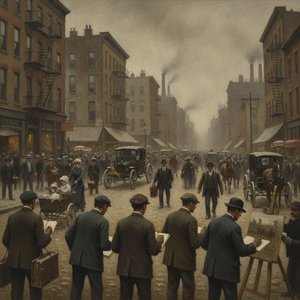
The Ashcan School: Capturing the Raw, Unfiltered Soul of Urban Life through American Realism
Discover the raw beauty of the Ashcan School. Explore how masters like Bellows and Henri captured the gritty, vibrant soul of early 20th-century New York through profound American Realism and evocative urban landscapes.
Ontdek kunstwerken georganiseerd op thema, stijl en kenmerk.
