
Shown: · With its frame:
 Voorvertoning
 Verstuur
 Delen
Delen
 Details bekijken
 Gids
Gids

 Download
 Vergelijkbare items
 Röntgenonderzoek
 Diavoorstelling
 Q&A
Q&A Statistieken
- 22.0 x 15.0 cm


€ 239
Handgemaakte olieverfreproductie
Met de hand geschilderd in olieverf op canvas in uw gewenste maat en lijst, op bestelling gemaakt door onze kunstenaars. ( Schakel over naar print Schakel over naar digitale afbeeldingen)
Size
·Standaardformaat
op maat gemaakt
CM
INCH
Kies uit onze vooraf ingestelde maten die overeenkomen met de originele verhoudingen van het kunstwerk.
Loading sizes...

breedte
hoogte
Voer de breedte en hoogte in die u nodig heeft, passend bij uw lijst of uw muur. Omdat dit handgeschilderd is, kan de kunstenaar bij een afmeting met een andere beeldverhouding iets meer rondom het schilderij schilderen of juist iets meer weglaten — u kiest zelf. Wij sturen u een digitaal mockup ter goedkeuring voordat het schilderwerk begint. De afbeelding die op deze pagina wordt getoond, is niet het uiteindelijke resultaat — alleen de mockup geeft dit weer.
 Lees meer over
Finish
·
White €1

Blurside €1

Extended €1

P118B €10

P118H €10

P118W €10

P438Z €10

P508JH €12

P508YH €12

P805H €10

P805Z €10

P919BZ €10

P919G €10

P919XJ €10

P959ZH €10

P968JZ €12

W106C €8

W218G €10

W218JH €8

W218Y €10

W307PJ €10

W316G €10

W316PJ €8

W316Y €10

W398PJ €8

W4111J €10

W500HY €15

W500JH €15

W692G €12

W849H €8

W940BG €15

W953PJ €8

H24-GOLD €30

H24-SILVER €30

H36-GOLD €45

H36-SILVER €45
Shipped in a protective tube, ready for your own framer.
Above 105 cm the frame is shipped as a kit for a professional framer — read the details.
Extras
optionalWhat do the extras include?
Examples of what can be changed: Replace face with customer photo; Add pet (e.g., replace cat with dog); Include hidden message in background; Change background landscape or elements.
After order, TopImpressionists.com team will email client for instructions and provide a mockup preview
After order, TopImpressionists.com team will email client for instructions and provide a mockup preview
Wereldwijde levering () binnen 3 tot 4 weken in plaats van de standaard 5 weken. (31 oktober). Zonder concessies aan de kwaliteit.
Beschermende vernislaag
Naamplaatje
Details van de gegraveerde bronzen plaat
This elegant plaque features the artist's name and the title of the artwork, finely engraved for a timeless presentation.
It is made from bronze with a refined, elegant finish. The text is precisely laser-engraved for a sharp and permanent result. Measuring 9x2 cm, the plaque is compact yet easy to read. It's built to be durable and scratch-resistant, offering a professional, museum-quality look. Mounting is simple thanks to the included adhesive backing.
Details transparante acrylplaat
The plaque includes essential engraved details such as the artist's name, the title of the artwork, the date it was created, the type of media used-like oil on canvas or watercolor-a brief description of the piece, and a QR code that links to the complete artwork information.
It is crafted from clear acrylic, offering a sleek, modern appearance. The text is UV-engraved in black to ensure strong visual contrast. With a size of 10x15 cm, it ensures optimal readability. It comes equipped with two metal hooks for secure wall mounting. The plaque is designed to be weather-resistant, making it suitable for various environments, and it includes interactive features that work seamlessly with smartphone scanning.
Details zwarte acrylplaat
This elegant plaque includes engraved information such as the artist's name, the title of the artwork, the date it was created, the type of media used (like oil on canvas or watercolor), a short description of the artwork, and a QR code for quick access to more information.
The plaque itself is made from refined black acrylic with a premium finish. The text is laser-engraved in white for high contrast and readability. Its size is 10x15 cm, designed to be easy to read. It comes with two metal hooks for professional mounting. The design is sleek and fits any interior style. It is also weather-resistant and durable, with built-in digital integration for mobile compatibility.
De optie voor glas is alleen beschikbaar bij een formaat kleiner dan 110 cm.
 De optie voor glas is alleen beschikbaar bij een formaat kleiner dan 110 cm.
- Gratis wereldwijde expressverzending
- Hoogwaardig linnen canvas
- Volledige verzendverzekering
- Garantie op terugbetaling van invoerrechten
- Garantie op exacte kleurweergave
- Retourbeleid van 100 dagen (alleen bij defecten)
- 100% Geld-terug-garantie
- Korting bij meerdere afnames


Beschrijving verzamelobject
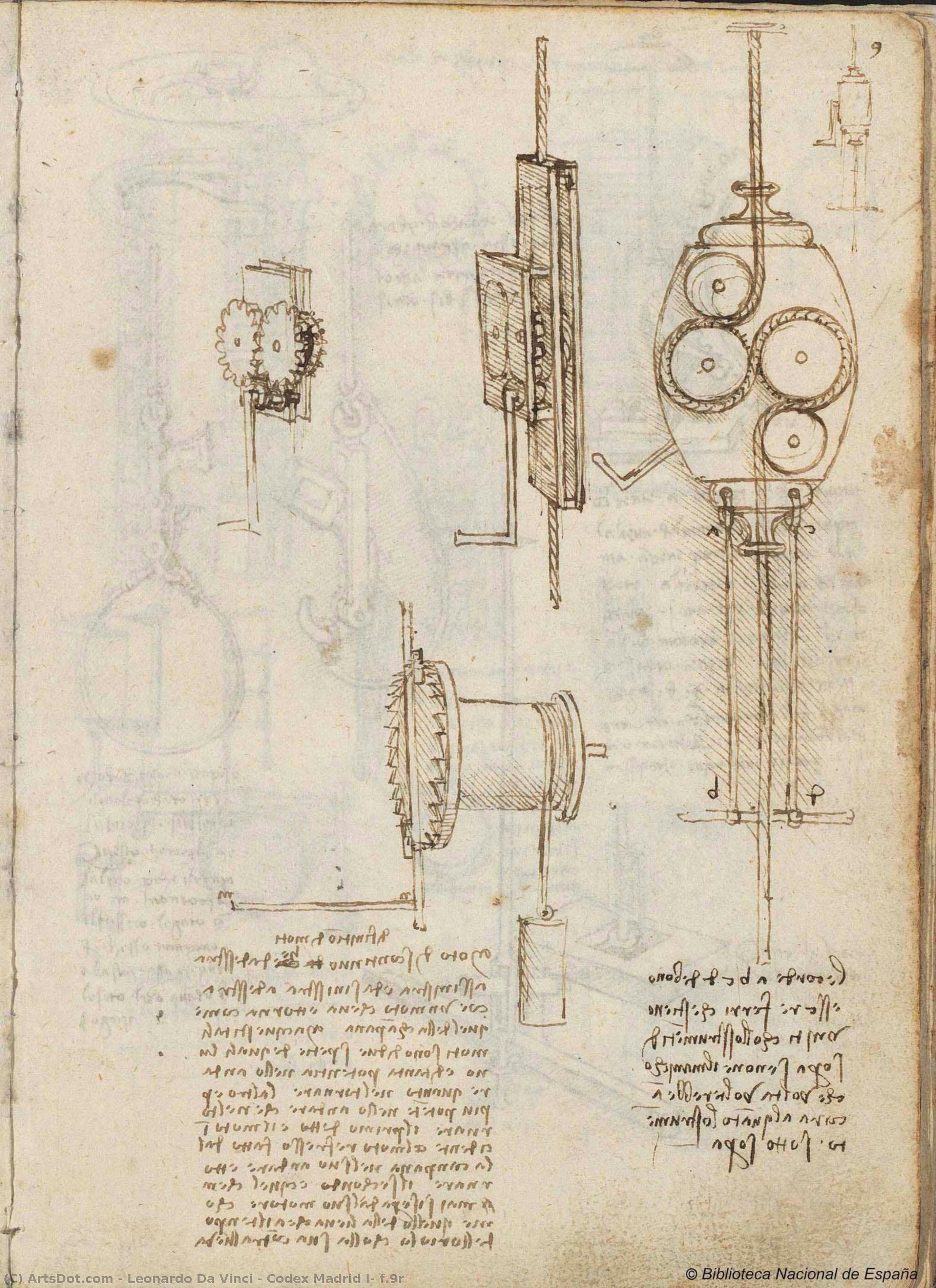
Explore Leonardo da Vinci's Codex Madrid I, f.9r – a meticulously detailed drawing of an ingenious mechanical device schematics labeled in Latin. Admire the Renaissance master’s scientific curiosity and artistic brilliance.
Biografie kunstenaar
Ontdek Leonardo da Vinci (1452-1519): het Renaissance-genie achter de Mona Lisa & Het Laatste Avondmaal! Ontdek zijn sfumato-techniek, anatomische studies & baanbrekende uitvindingen.
About the painting
A Mechanical Revelation: Decoding Leonardo’s Vision
To gaze upon the Codex Madrid I, folio 9r is to witness a profound moment of intellectual transcendence, where the boundaries between scientific inquiry and artistic mastery dissolve into a single, breathtaking vision. This singular drawing by Leonardo da Vinci serves as much more than a mere technical schematic; it is a window into the very soul of the Renaissance mind. Within these delicate graphite lines, we find the restless spirit of a polymath who refused to accept the limits of the known world. The folio presents an intricate, detailed illustration of an experimental hydraulic device, a complex machine that whispers of Da Vinci’s relentless pursuit of understanding the natural world through the lens of practical engineering and geometric precision.
The subject matter itself is a testament to Leonardo's fascination with the mechanics of life and motion. The drawing portrays a detailed schematic of what appears to be an experimental hydraulic device, perhaps conceived as a method for lifting heavy objects or channeling the raw power of water. Each component is rendered with such meticulous care that one can almost sense the movement of fluid through its channels. There is a quiet, rhythmic beauty in the way the machine's parts are laid out, suggesting a harmony between human ingenuity and the elemental forces of nature. For the collector or the admirer of fine art, this piece offers a rare glimpse into the "pre-industrial" imagination—a blueprint for a future that Leonardo was already dreaming of centuries before its time.
The Mastery of Line and Light
Technically, the folio is a masterclass in observational drawing. Executed with graphite on paper, the work demonstrates Da Vinci's unparalleled ability to use simple tools to convey profound structural integrity. The lines are not merely marks on a page; they are carefully calculated strokes designed to communicate accurate proportions and weight. Through subtle yet effective shading, Leonardo creates a sense of three-dimensional depth, allowing the various mechanical components to emerge from the paper with a palpable presence. This interplay of light and shadow does more than define shape—it breathes life into the inanimate, transforming a technical diagram into a work of evocative fine art.
The aesthetic appeal of this piece lies in its deceptive simplicity. While the content is scientific, the execution is deeply artistic. The way the text—labels written in Latin—intertwines with the mechanical drawings creates a beautiful, organic texture across the parchment. This integration of language and image reflects the Renaissance ideal that art and science are not separate disciplines, but rather two sides of the same coin. For an interior designer, such a piece provides a sophisticated focal point, offering a sense of intellectual depth and historical gravity to any curated space.
A Legacy of Infinite Curiosity
The historical context of the Codex Madrid I places it within the heart of Leonardo’s most prolific era. During this period, Da Vinci was actively engaged in developing technologies that would bridge the gap between medieval tradition and modern innovation. This drawing is a tangible manifestation of his belief that by documenting our observations, we can unlock the secrets of the universe for future generations. It represents a period of significant advancement in engineering and mechanics, where the artist’s eye was just as vital to discovery as the scientist's logic.
Beyond its mechanical utility, the folio carries a profound emotional impact. There is an inherent sense of wonder embedded in every stroke—a feeling of standing on the precipice of discovery. It evokes a sense of nostalgia for the era of the "universal man," reminding us of a time when human potential seemed limitless. Owning or displaying a high-quality reproduction of this work is not merely about decorating a wall; it is about inviting the spirit of innovation, curiosity, and timeless genius into one's personal environment. It serves as a constant reminder that through observation and imagination, we can decode the very mechanics of our existence.
Veelgestelde vragen
Is de afbeelding van "Codex Madrid I, f.9r" door Leonardo Da Vinci vrij van auteursrecht?
De auteursrechtelijke status van "Codex Madrid I, f.9r" door Leonardo Da Vinci: het werk is bevindt zich in het publiek domein - de auteursrechten zijn verlopen. Dit bepaalt of reproducties van de afbeelding vrijelijk mogen worden gemaakt.
Hoe bekend is "Codex Madrid I, f.9r" van Leonardo Da Vinci?
Het populariteitsniveau van "Codex Madrid I, f.9r" door Leonardo Da Vinci is Iconic.
Hoe harmonieren de kleuren van "Codex Madrid I, f.9r" met elkaar?
De kleuren van "Codex Madrid I, f.9r" door Leonardo Da Vinci vertonen een Unified Palette harmonie. Harmonie beschrijft de onderlinge relatie tussen de kleuren.
Quick facts and art quiz
About Leonardo Da Vinci

Leonardo Da Vinci
1452 - 1519, Italië
Biografie kunstenaar
Het leven en de nalatenschap van Leonardo da Vinci.
Leonardo di ser Piero da Vinci, geboren in 1452 nabij het Toscaanse dorpje Vinci, blijft ongetwijfeld de meest universeel erkende figuur uit de Renaissance—een ware polymath wiens onverzadigbare nieuwsgierigheid hem over vele disciplines dreef en een onuitwisbare stempel drukte op kunst, wetenschap en techniek. Zijn naam is synoniem geworden met genialiteit, een bewijs van zijn buitengewone breedte aan talent en visionair denkvermogen. Geboren buiten het huwelijk uit Piero da Vinci, een notaris, en Caterina, een boerin, was Leonardo’s vroege leven onconventioneel, maar bood hem tegelijkertijd toegang tot zowel de praktische wereld als een waardering voor de natuur die zijn artistieke visie diepgaand zou vormen. Hij ontving een basisopleiding in lezen, schrijven en rekenen, maar het was zijn leerperiode onder Andrea del Verrocchio in Florence die zijn creatieve vonk echt aanwakkerde. Binnen de werkplaats van Verrocchio leerde Leonardo niet enkel schilderen of beeldhouwen; hij werd ondergedompeld in een wereld van technische vaardigheid, waarbij hij meesterschap verwierf in metaalbewerking, houtbewerking, tekenkunst en de complexiteit van artistieke creatie—een fundament waarop hij zijn veelzijdige genie zou bouwen. Zelfs tijdens deze vormende periode gingen er geruchten rond over zijn uitzonderlijke talent, met verhalen die suggereerden dat Verrocchio zelf het schilderen neerlegde nadat hij getuige was geweest van Leonardo’s superieure bekwaamheid.
Milanese innovaties en artistieke bloei
In 1482 begon Leonardo aan een nieuw hoofdstuk toen hij in dienst trad bij Ludovico Sforza, de hertog van Milaan. Dit was niet louter een artistieke aanstelling; Leonardo fungeerde als militair ingenieur, architect, beeldhouwer en ontwerper voor het hof—een getuigenis van zijn diverse vaardigheden. Hij bedacht innovatieve fortificaties, ontwierp uitgebreide toneeldecors en schetste zelfs plannen voor fantastische machines. Het was echter tijdens deze periode dat hij begon aan een van zijn meest iconische meesterwerken: Het Laatste Avondmaal. Geschilderd als fresco in het refectorium van het klooster Santa Maria delle Grazie, overstijgt dit werk loutere representatie; het is een diepgaande verkenning van menselijke emotie en psychologisch drama, waarbij het exacte moment waarop Christus zijn verraad aankondigt, wordt vastgelegd. De compositie, innovatief voor zijn tijd, en het meesterlijke gebruik van perspectief zouden de westerse kunst eeuwenlang diepgaand beïnvloeden. Hoewel veel beeldhouwprojecten tijdens zijn Milanese periode onvoltooid bleven, bleef Leonardo's inventieve geest floreren, wat de basis legde voor toekomstige wetenschappelijke ontdekkingen.
De terugkeer naar Florence en het streven naar perfectie
Na de Franse invasie van Milaan in 1499 keerde Leonardo terug naar Florence, een stad die een hoogtepunt in artistieke ontwikkeling beleefde. Hoewel hij in deze tijd minder voltooide werken produceerde, was hun impact immens. Het was hier dat hij begon aan wat ongetwijfeld het beroemdste schilderij ter wereld zou worden: de Mona Lisa (La Gioconda). De raadselachtige glimlach en de hypnotiserende blik van het onderwerp hebben toeschouwers generaties lang gefascineerd, terwijl Leonardo’s revolutionaire sfumato-techniek—het subtiele verloop van licht en schaduw om vage contouren en atmosferisch perspectief te creëren—aanzienlijk bijdroeg aan de etherische kwaliteit van het schilderij. Deze periode zag ook de voortdurende verfijning van zijn anatomische studies, gedreven door een onwankelbaar verlangen om het menselijk lichaam met wetenschappelijke precisie te begrijrei. Hij ontleedde lijken en documenteerde nauwgezet spieren, botten en organen in een reeks ongelooflijk gedetailleerde tekeningen die eeuwen voor hun tijd waren.
Een nalatenschap voorbij de kunst: wetenschap, uitvinding en blijvende invloed
De latere jaren van Leonardo werden gekenmerkt door reizen tussen Florence, Milaan en Rome, waarbij hij altijd werd gezocht vanwege zijn expertise, maar vaak projecten onvoltooid achterliet—misschien een weerspiegeling van zijn rusteloze intellect en de enorme omvang van zijn interesses. In 1516 aanvaardde hij een uitnodiging van koning Frans I om te leven en werken in het Château du Clos Lucé nabij Amboise in Frankrijk, waar hij zijn laatste jaren doorbracht. Hij stierf daar in 1519 en liet een enorme nalatenschap na die veel verder reikt dan de wereld van de kunst. Zijn notitieboeken onthullen baanbrekend werk op het gebied van anatomie, optica, hydraulica, geologie en cartografie—en bevatten concepten voor uitvindingen die eeuwen voor hun tijd lagen, waaronder vliegmachines, tanks en geavanceerde wapens. De impact van Leonardo da Vinci op de kunstgeschiedenis is onmeetbaar. Hij verhief de status van kunstenaars van bekwame ambachtslieden naar intellectuele figuren, door aan te tonen dat artistieke creatie gevoed kon worden door wetenschappelijk onderzoek en een diep begrip van de natuurlijke wereld. Zijn schilderijen worden gevierd om hun realisme, psychologische diepgang en innovatieve technieken. Hij blijft een symbool van menselijke nieuwsgierigheid, creativiteit en het onvermoeibare streven naar kennis—een ware belichaming van de geest van de Renaissance, wiens nalatenschap eeuwen na zijn dood nog steeds ontzag en fascinatie oproept.
Belangrijkste prestaties & blijvende impact
- Schilderkunst: Mona Lisa, Het Laatste Avondmaal, Madonna van de Rotsen, Annunciatie
- Tekenen & Schetsen: Uitgebreide anatomische studies, Ingenieursontwerpen (vliegmachines, wapens), Botanische illustraties
- Wetenschap & Techniek: Baanbrekend werk in anatomie, optica, hydraulica, geologie en cartografie. Concepten voor uitvindingen die eeuwen voor hun tijd lagen.
Quick facts about Leonardo Da Vinci
- Artistic Movement Or Style: Hoge Renaissance
- Artists Or Movements Influenced By This Artist: ['Renaissance kunst']
- Artists Who Influenced This Artist: ['Andrea del Verrocchio']
- Date Of Birth: 15 april 1452
- Date Of Death: 2 mei 1519
- Full Name: Leonardo da Vinci
- Nationality: Italiaans
- Notable Artworks (List Of Titles):
- Mona Lisa
- Het Laatste Avondmaal
- Place Of Birth (City And Country): Vinci, Italië
Ontdek kunstwerken georganiseerd op thema, stijl en kenmerk.


Leonardo Da Vinci
Codex Madrid I, f.9r
() ·
With its frame: · Hand-painted in oil on linen
Total