

 Bekijk op ware grootte
 Verstuur
 Delen
Delen
 Details bekijken
 Gids voor studentenkunstwerken

 Download
 Vergelijkbare items
 Röntgenonderzoek
 Diavoorstelling
 Statistieken
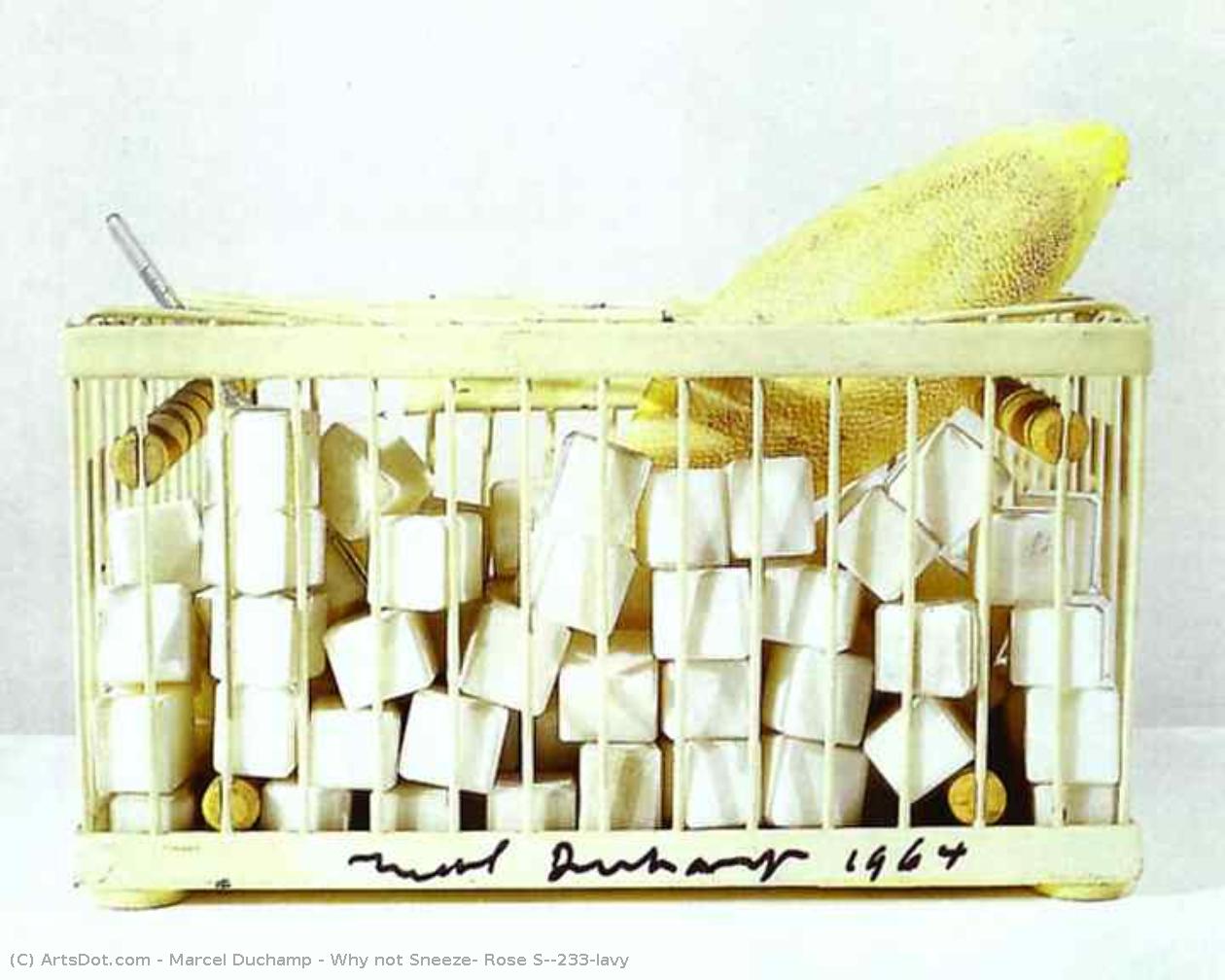
Why not Sneeze, Rose Sélavy
 Acrylic On Canvas
- WallArt
- Dada Gesamtkunstwerk
 1921
1921 12.0 x 22.0 cm
 Tate Modern
 Lees meer
De kunstwerken die op deze pagina worden weergegeven, zijn beschermd door de auteursrechtwetgeving, wat betekent dat het ons wettelijk niet is toegestaan om identieke reproducties te maken of te verkopen. Deze bescherming wordt gehandhaafd onder internationale overeenkomsten zoals de Conventie van Bern en door nationale wetgeving, waaronder de bepalingen van de Amerikaanse auteurswet - Titel 17. Alle rechten voorbehouden. Reproduceren of distribueren van afbeeldingen is niet toegestaan zonder uitdrukkelijke schriftelijke toestemming van WahooArt.com en de rechthebbenden.
Als een respectvol en legaal alternatief bieden wij op maat gemaakte, handgeschilderde kunstwerken aan die geïnspireerd zijn op het origineel. Onze bekwame en professionele kunstenaars bestuderen zorgvuldig de stijl, sfeer en artistieke essentie van het origineel om een nieuw, uniek werk te creëren dat dezelfde emotie oproept – terwijl het een op zichzelf staande, originele creatie blijft.
Deze methode voldoet volledig aan de auteursrechtwetgeving, omdat het niet gaat om het kopiëren of dupliceren van het beschermde kunstwerk. In plaats daarvan is er sprake van een creatieve herinterpretatie — een nieuw schilderij dat door het origineel wordt geïnspireerd, maar er niet identiek aan is.
Handgemaakte olieverfreproductie
Met de hand geschilderd in olieverf op canvas in uw gewenste maat en lijst, op bestelling gemaakt door onze kunstenaars. ( Schakel over naar print Schakel over naar digitale afbeeldingen)




P118B €10

P118H €10

P118W €10

P438Z €10

P508JH €12

P508YH €12

P805H €10

P805Z €10

P919BZ €10

P919G €10

P919XJ €10

P959ZH €10

P968JZ €12

W106C €8

W218G €10

W218JH €8

W218Y €10

W307PJ €10

W316G €10

W316PJ €8

W316Y €10

W398PJ €8

W4111J €10

W500HY €15

W500JH €15

W692G €12

W849H €8

W940BG €15

W953PJ €8




Standaardformaat
op maat gemaakt
CM
INCH
Kies uit onze vooraf ingestelde maten die overeenkomen met de originele verhoudingen van het kunstwerk.
Loading sizes...

breedte
hoogte
Voer de breedte en de hoogte in die u nodig heeft, passend bij uw lijst of uw muur. Dit is handgeschilderd, dus bij een afmeting met een andere vormverhouding kan de kunstenaar iets meer rondom het schilderij schilderen of juist iets meer weglaten — u kiest zelf. Wij sturen u een digitaal mockup ter goedkeuring voordat het schilderwerk begint. De afbeelding die op deze pagina wordt getoond, is niet het uiteindelijke resultaat — alleen de mockup geeft dit weer.
Voorbeelden van wat aangepast kan worden: Vervang het gezicht met een eigen foto; Voeg een huisdier toe (bijv. vervang de kat door een hond); Verwerk een verborgen boodschap in de achtergrond; Wijzig het landschap of andere elementen in de achtergrond.
Na de bestelling zal het team van TopImpressionists.com per e-mail contact opnemen met de klant voor instructies en een mockup-voorbeeld sturen.
Na de bestelling zal het team van TopImpressionists.com per e-mail contact opnemen met de klant voor instructies en een mockup-voorbeeld sturen.
Wereldwijde levering () binnen 3 tot 4 weken in plaats van de standaard 5 weken. (22 oktober). Zonder concessies aan de kwaliteit.

Gratis wereldwijde expressverzending

Hoogwaardig linnen canvas

Volledige verzendverzekering

Garantie op terugbetaling van invoerrechten

Garantie op exacte kleurweergave

Retourbeleid van 100 dagen (alleen bij defecten)

100% Geld-terug-garantie

Korting bij meerdere afnames
 De optie voor glas is alleen beschikbaar bij een formaat kleiner dan 110 cm.

Why not Sneeze, Rose Sélavy
Reproductiemethode
Formaat reproductie
-


Totaalprijs
€ 236
A Provocative Pause: Unpacking “Why Not Sneeze, Rose Sélavy”
Marcel Duchamp’s "Why Not Sneeze, Rose Sélavy," painted in 1921, isn't merely a still life; it’s an audacious declaration. This deceptively simple image – a white box containing a yellow banana alongside several cups and spoons – immediately throws the viewer off balance, demanding they reconsider their assumptions about art itself. Duchamp, a pivotal figure in the Dada movement, wasn’t interested in replicating reality or expressing personal emotion through traditional means. Instead, he sought to dismantle established artistic conventions, forcing us to confront the very definition of what constitutes “art” and its role within society.
The painting's genesis lies within Duchamp’s exploration of chance and readymades – everyday objects presented as art without alteration. "Why Not Sneeze" exemplifies this approach perfectly. The choice of a banana, an utterly mundane item, elevates it to the status of subject matter through its placement within the box, transforming it into something worthy of contemplation. The inclusion of the cups and spoons further complicates the scene, suggesting a potential for consumption or ritual – elements deliberately devoid of inherent meaning, yet imbued with a subtle tension.
Dadaist Disruptions: Style and Technique
“Why Not Sneeze” is firmly rooted in the principles of Dadaism, a movement born from the disillusionment following World War I. Rejecting logic and reason, Dada artists embraced absurdity, chance, and anti-art sentiments. Duchamp’s technique reflects this ethos; he employed a precise, almost clinical approach to rendering the objects, using oil paint on canvas with a smooth, matte finish. There's no attempt at illusionistic depth or vibrant color – instead, the focus is entirely on the arrangement of the elements and their juxtaposition. The stark white box acts as a frame, isolating the objects and intensifying their impact.
Interestingly, Duchamp’s process involved a degree of chance. He reportedly placed the banana in the box after it had been emptied, allowing the positioning to be determined by accident. This element of randomness underscores the movement's core belief that art should not be dictated by conscious intention but rather emerge from unexpected encounters and unforeseen circumstances.
Symbolic Whispers: Interpretation and Context
The symbolism within “Why Not Sneeze” is deliberately ambiguous, inviting multiple interpretations. The banana itself has been suggested to represent fertility, sexuality, or even a subtle critique of consumer culture – a small, yellow object placed in an enclosed space, hinting at both abundance and confinement. The cups and spoons could symbolize hospitality, offering, or perhaps the act of consuming – again, devoid of any specific narrative but laden with potential meanings.
Furthermore, the title itself, “Why Not Sneeze?”, is a direct challenge to conventional artistic expectations. Duchamp’s question implies that there are no rules governing art, no prescribed methods for creating it. It's an invitation to embrace spontaneity and reject rigid constraints. The painting can be viewed as a meditation on the absurdity of artistic norms and a playful provocation against established aesthetic values.
A Timeless Dialogue: Emotional Impact and Legacy
Despite its seemingly simple composition, “Why Not Sneeze, Rose Sélavy” possesses a profound emotional impact. It’s unsettling, humorous, and thought-provoking – qualities that have cemented its place as one of the most significant works in modern art history. Duchamp's work continues to resonate today, prompting us to question our own perceptions of beauty, value, and the very nature of artistic expression. A reproduction of this iconic piece offers a unique opportunity to engage with a pivotal moment in art history and contemplate the enduring legacy of Marcel Duchamp’s revolutionary spirit.
Vragen & Antwoorden
Is "Why not Sneeze, Rose Sélavy" beschikbaar als een fine art print?
Om een print van "Why not Sneeze, Rose Sélavy" door Marcel Duchamp te bemachtigen, kunt u deze eenvoudig bestellen op de Fine Art Print pagina: een fine art print op katoenen canvas of archiefwaardig canvaspapier.
Welke stemming en emotie komen samen in "Why not Sneeze, Rose Sélavy"?
In "Why not Sneeze, Rose Sélavy" gaat een Playful stemming gepaard met een Playful emotie.
In welke periode van de carrière van Marcel Duchamp valt "Why not Sneeze, Rose Sélavy"?
"Why not Sneeze, Rose Sélavy" behoort tot de Dada Phase in de carrière van Marcel Duchamp. Deze classificatie plaatst het werk in de context van de ontwikkeling van de kunstenaar.
Biografie van de kunstenaar
Een Revolutionaire Geest: Het Leven en de Kunst van Marcel Duchamp
Marcel Duchamp, geboren als Henri-Robert-Marcel Duchamp in 1887 in Blainville-Crevon, Normandië, was meer dan een kunstenaar; hij was een filosofische provocateur die de koers van de moderne kunst fundamenteel heeft veranderd. Zijn vroege leven, hoewel schijnbaar conventioneel – gevormd binnen een familie die artistieke expressie waardeerde en waarin beide broers succesvolle carrières als kunstenaar nastreefden – hintte al naar het iconoclasme dat nog zou komen. Duchamp volgde aanvankelijk een formele opleiding, waarbij hij traditionele technieken meester werd en experimenteerde met postimpressionistische stijlen. Deze academische basis diende echter niet als een doel op zich, maar als een springplank om de essentie van kunst, haar doel en haar definitie ter discussie te stellen. Hij was niet tevreden met het louter afbeelden van de wereld; hij zocht naar manieren om onze perceptie ervan uit te dagen en te bevragen wat werkelijke artistieke waarde vormt. Deze rusteloze intellectuele nieuwsgierigheid zou het kenmerkende aspect worden van zijn vruchtbare carrière.Van Cubisme naar Dada: Een Afwijzing van Conventie
Duchamps artistieke reis werd gekenmerkt door een constante evolutie, een doelbewuste ontmanteling van gevestigde normen. Zijn vroege betrokkenheid bij het Cubisme, duidelijk zichtbaar in werken zoals Portrait of Chess Players (1911), toonde een interesse in gefragmenteerde vormen en meervoudige perspectieven – een breuk met de traditionele representatie. Toch bewoog hij zich snel voorbij louter esthetische overwegingen, omdat hij besefte dat het simpelweg herordenen van visuele elementen niet volstond om de diepere vragen te beantwoorden die in hem opborrelden. De gruwelen van de Eerste Wereldoorlog voedden dit onbehagen, wat ertoe leidde dat Duchamp het Dadaïsme omarmde, een beweging die voortkwam uit desillusie en een verwerping van logica, rede en traditionele artistieke waarden. Het was binnen het Dadaïstische kader dat Duchamp werkelijk begon de conventionele opvattingen over kunst af te breken. Hij was niet geïnteresseerd in het creëren van mooie objecten; hij wilde gedachten prikkelen, aannames uitdagen en de willekeur van esthetisch oordeel blootleggen. Deze periode zag de geboorte van zijn meest radicale innovatie: de ‘readymade’.De Readymades en de Subversie van de Kunst
De introductie van readymades – alledaagse, industrieel vervaardigde objecten die geselecteerd en gepresenteerd werden als kunst – vormde Duchamps meest significante bijdrage aan de 20e eeuw. Dit waren niet simpelweg gevonden voorwerpen; het waren bewuste daden van artistieke subversie. Door een alledaags item, zoals een urinoir (Fountain, 1917), te voorzien van de handtekening “R. Mutt” en dit in te dienen voor een kunstexpositie, daagde Duchamp de definitie van artistiek vakmanschap en auteurschap uit. Was het de hand van de kunstenaar die het werk creëerde, of was het het idee van de kunstenaar? Deze vraag werd centraal in zijn oeuvre en legde de basis voor de conceptuele kunst. Andere opmerkelijke readymades, zoals L.H.O.O.Q. (1919) – een ansichtkaartreproductie van de Mona Lisa, bewerkt met een snor en een sikje – waren speelse maar scherpe kritieken op de kunstgeschiedenis en gevestigde culturele iconen. Deze werken waren niet bedoeld om bewonderd te worden om hun esthetische kwaliteiten; ze waren bedoeld om debat uit te lokken en toeschouwers te dwingen hun vooroordelen over wat kunst is, te heroverwegen. Duchamp geloofde dat kunst in de geest moet verblijven, en niet enkel in het oog.Nalatenschap en Blijvende Invloed
De impact van Marcel Duchamp op opeenvolgende generaties kunstenaars is onmeetbaar. Hij veranderde ons begrip van kunst fundamenteel en plaveide de weg voor bewegingen zoals de conceptuele kunst, het minimalisme, de popart en talloze anderen. Zijn nadruk op het idee van de kunstenaar – het concept achter het werk – boven de esthetische eigenschappen, blijft kunstenaars tot op de dag van vandaag inspireren.- Cubisme: Vroege verkenning van gefragmenteerde vormen en ruimtelijke representatie.
- Dadaïsme: Verwerping van logica, rede en traditionele artistieke waarden als reactie op de Eerste Wereldoorlog.
- Conceptuele Kunst: De nadruk op het idee achter het kunstwerk in plaats van de esthetische kwaliteiten.

Marcel Duchamp
1887 - 1968 , Frankrijk
Snelle feiten
- Artistic Movement Or Style:
- Cubisme
- Dadaïsme
- Conceptuele kunst
- Artists Or Movements Influenced By This Artist:
- Cubisme
- Surrealisme
- Conceptuele kunst
- Date Of Birth: 28 juli 1887
- Date Of Death: 2 oktober 1968
- Full Name: Marcel Duchamp
- Nationality: Frans-Amerikaans
- Notable Artworks:
- Fontein
- L.H.O.O.Q.
- Het grote glas
- Boîte-en-valise
- Place Of Birth: Blainville, Frankrijk
Gerelateerde artikelen

Dadaism Unveiled: The Beautiful Chaos of Art's Most Rebellious Movement
Explore the profound rebellion of Dadaism. Discover how this avant-garde movement emerged from the chaos of WWI to redefine art through absurdity, anti-logic, and a legacy that shaped Surrealism and Pop Art. A deep dive into the beautiful chaos of art history for the true enthusiast.

Pop Surrealism Unveiled: The Sophisticated Intersection of Vibrant Pop Art and Dreamlike Subconscious Landscapes
Explore the captivating world of Pop Surrealism. Discover how vibrant Pop Art meets dreamlike subconscious imagery through the works of masters like Jeff Soto and Ryan Heshka. An expert guide for discerning collectors seeking to understand this profound contemporary art movement.
Ontdek kunstwerken georganiseerd op thema, stijl en kenmerk.


