

 Bekijk op ware grootte
 Verstuur
 Delen
Delen
 Details bekijken
 Gids voor studentenkunstwerken

 Download
 Vergelijkbare items
 Röntgenonderzoek
 Diavoorstelling
 Statistieken
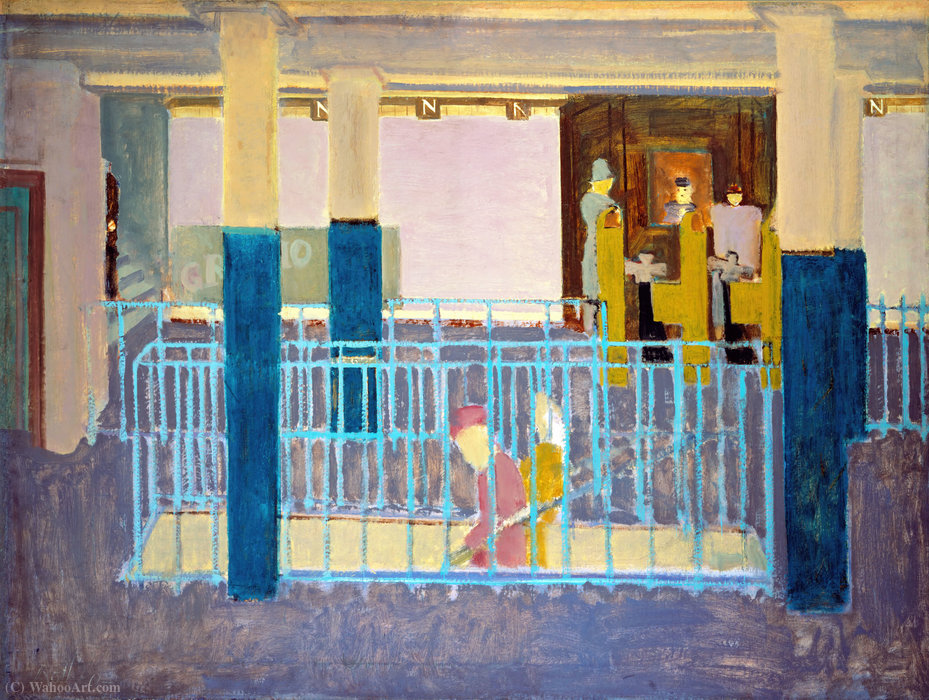
Entrée au métro


Een groot blauw en geel schilderij dat een metroscène weergeeft. Het werk staat bekend om zijn kleurgebruik en eenvoudige compositie, die een gevoel van melancholie oproepen. Een kunstwerk van Mark Rothko uit 1938.
 Lees meer
Ontdek Mark Rothko (1903-1970), een Amerikaanse kunstenaar die kleurgebruik revolutioneerde en emotionele kunst creëerde met zijn iconische Color Field schilderijen & Abstract Expressionisme.
De kunstwerken die op deze pagina worden weergegeven, zijn beschermd door de auteursrechtwetgeving, wat betekent dat het ons wettelijk niet is toegestaan om identieke reproducties te maken of te verkopen. Deze bescherming wordt gehandhaafd onder internationale overeenkomsten zoals de Conventie van Bern en door nationale wetgeving, waaronder de bepalingen van de Amerikaanse auteurswet - Titel 17. Alle rechten voorbehouden. Reproduceren of distribueren van afbeeldingen is niet toegestaan zonder uitdrukkelijke schriftelijke toestemming van WahooArt.com en de rechthebbenden.
Als een respectvol en legaal alternatief bieden wij op maat gemaakte, handgeschilderde kunstwerken aan die geïnspireerd zijn op het origineel. Onze bekwame en professionele kunstenaars bestuderen zorgvuldig de stijl, sfeer en artistieke essentie van het origineel om een nieuw, uniek werk te creëren dat dezelfde emotie oproept – terwijl het een op zichzelf staande, originele creatie blijft.
Deze methode voldoet volledig aan de auteursrechtwetgeving, omdat het niet gaat om het kopiëren of dupliceren van het beschermde kunstwerk. In plaats daarvan is er sprake van een creatieve herinterpretatie — een nieuw schilderij dat door het origineel wordt geïnspireerd, maar er niet identiek aan is.
Handgemaakte olieverfreproductie
Met de hand geschilderd in olieverf op canvas in uw gewenste maat en lijst, op bestelling gemaakt door onze kunstenaars. ( Schakel over naar print Schakel over naar digitale afbeeldingen)




P118B €10

P118H €10

P118W €10

P438Z €10

P508JH €12

P508YH €12

P805H €10

P805Z €10

P919BZ €10

P919G €10

P919XJ €10

P959ZH €10

P968JZ €12

W106C €8

W218G €10

W218JH €8

W218Y €10

W307PJ €10

W316G €10

W316PJ €8

W316Y €10

W398PJ €8

W4111J €10

W500HY €15

W500JH €15

W692G €12

W849H €8

W940BG €15

W953PJ €8




Standaardformaat
op maat gemaakt
CM
INCH
Kies uit onze vooraf ingestelde maten die overeenkomen met de originele verhoudingen van het kunstwerk.
Loading sizes...

breedte
hoogte
Voer de breedte en de hoogte in die u nodig heeft, passend bij uw lijst of uw muur. Dit is handgeschilderd, dus bij een afmeting met een andere vormverhouding kan de kunstenaar iets meer rondom het schilderij schilderen of juist iets meer weglaten — u kiest zelf. Wij sturen u een digitaal mockup ter goedkeuring voordat het schilderwerk begint. De afbeelding die op deze pagina wordt getoond, is niet het uiteindelijke resultaat — alleen de mockup geeft dit weer.
Voorbeelden van wat aangepast kan worden: Vervang het gezicht met een eigen foto; Voeg een huisdier toe (bijv. vervang de kat door een hond); Verwerk een verborgen boodschap in de achtergrond; Wijzig het landschap of andere elementen in de achtergrond.
Na de bestelling zal het team van TopImpressionists.com per e-mail contact opnemen met de klant voor instructies en een mockup-voorbeeld sturen.
Na de bestelling zal het team van TopImpressionists.com per e-mail contact opnemen met de klant voor instructies en een mockup-voorbeeld sturen.
Wereldwijde levering () binnen 3 tot 4 weken in plaats van de standaard 5 weken. (23 oktober). Zonder concessies aan de kwaliteit.

Gratis wereldwijde expressverzending

Hoogwaardig linnen canvas

Volledige verzendverzekering

Garantie op terugbetaling van invoerrechten

Garantie op exacte kleurweergave

Retourbeleid van 100 dagen (alleen bij defecten)

100% Geld-terug-garantie

Korting bij meerdere afnames
 De optie voor glas is alleen beschikbaar bij een formaat kleiner dan 110 cm.

Entrée au métro
Reproductiemethode
Formaat reproductie
-


Totaalprijs
€ 236
Entrance to Subway (Subway Station.Subway Scene)
Mark Rothko's "Entrance to Subway" isn’t merely a depiction of a New York City subway station; it’s an immersion into the collective experience of urban life, a poignant meditation on anonymity and the fleeting nature of human connection. Painted in 1938 during a period of intense social and political upheaval – a time when the anxieties of war were beginning to surface – this large-scale oil painting captures not just a physical space but also an emotional landscape. Rothko, a key figure in the Abstract Expressionist movement, deliberately eschewed traditional representational techniques, opting instead for a bold simplification of form and color to evoke profound feelings within the viewer.
The dominant hues of blue and yellow immediately establish a dynamic atmosphere, far removed from the muted tones often associated with depictions of urban decay. These colors aren’t simply applied; they bleed into one another, creating a sense of movement and suggesting the constant flow of people through the station. The composition is anchored by two prominent benches – one centrally positioned, the other subtly placed on the right – offering momentary points of rest amidst the bustling scene. Notice how Rothko uses geometric forms—the rectangular shapes of the benches and the implied lines of the platform—to create a sense of structure within an otherwise amorphous space. These elements aren’t meant to define the scene precisely, but rather to provide a framework for the viewer’s interpretation.
The Language of Color: Rothko’s Abstract Expressionist Approach
Rothko’s technique is characterized by its deliberate lack of detail and emphasis on color fields. He applied paint in broad, sweeping strokes, allowing the colors to overlap and blend organically. This process—often described as “all-over” painting—means that there's no single focal point; instead, the viewer’s eye is invited to wander across the entire surface of the canvas, absorbing the interplay of hues and textures. The thickness of the paint itself contributes to the work’s tactile quality, inviting a physical engagement with the artwork.
It's crucial to understand Rothko’s artistic philosophy during this period. He wasn’t interested in creating images that could be easily identified or understood; rather, he sought to evoke primal emotions—a sense of awe, mystery, and perhaps even melancholy—through the pure experience of color. He famously stated, “Colors are performers,” suggesting that his paintings were meant to act upon the viewer’s subconscious, triggering a deeply personal response.
A Reflection of an Era: Contextualizing "Entrance to Subway"
“Entrance to Subway” was created during a time of significant social and political change in America. The Great Depression had left its mark on the nation, and anxieties about war were growing as Europe teetered on the brink of conflict. Rothko’s work reflects this atmosphere of uncertainty and displacement. The anonymous figures depicted in the painting—a collection of faces lost within the urban landscape—can be interpreted as symbols of the individual’s struggle to find meaning and connection in a rapidly changing world.
Interestingly, Rothko’s early career involved figurative work, depicting portraits and urban scenes. However, he gradually moved away from representational art, seeking a more direct means of expressing his emotions. This shift aligns with the broader trends of the Abstract Expressionist movement, which rejected traditional artistic conventions in favor of exploring new forms of expression.
Legacy and Reproduction: Bringing Rothko’s Vision to Life
Mark Rothko's influence extends far beyond the realm of abstract painting. Artists like Yayoi Kusama, known for her immersive installations that explore themes of infinity and self-obliteration, have cited Rothko as a key inspiration. His work continues to resonate with viewers today, prompting reflection on the nature of human experience and the complexities of modern life.
TopImpressionists is proud to offer meticulously crafted, hand-painted reproductions of “Entrance to Subway.” These aren’t simply prints; they are faithful interpretations of Rothko’s original masterpiece, capturing the vibrancy of color, the texture of paint, and the emotional depth of the artwork. Each reproduction is created by skilled artists who have a deep understanding of Rothko’s technique and philosophy. Explore the details and dimensions on TopImpressionists. For those seeking to delve deeper into Rothko’s life and work, we encourage you to visit Yayoi Kusama's website or explore the extensive resources available on Wikipedia: Wikipedia.
Vragen & Antwoorden
Hoeveel licht lijken de kleuren van "Entrée au métro" te reflecteren?
De luminantie die is vastgesteld voor "Entrée au métro" door Mark Rothko is Zachte luminantie.
Wat is de waargenomen helderheid van "Entrée au métro" door Mark Rothko?
De waargenomen helderheid van "Entrée au métro" door Mark Rothko is helder. Deze kan worden afgestemd op het licht in de beoogde ruimte.
Is "Entrée au métro" door Mark Rothko een bekend kunstwerk?
Het populariteitsniveau dat is vastgelegd voor "Entrée au métro" door Mark Rothko is Iconisch.
Biografie van de kunstenaar
Een Leven in Kleur: De Reis van Markus Rothkowitz tot Mark Rothko
Mark Rothko, geboren als Markus Yakovlevich Rothkowitz in 1903 in het Russische Dvinsk (het huidige Daugavpils, Letland), droeg al vroeg een gevoel van onthechting met zich mee dat zijn artistieke pad diepgaand zou beïnvloeden. Zijn jeugdjaren waren getekend door de onzekerheid van een Joods gezin in het Pale of Settlement, bedreigd door pogroms en politieke onrust. Deze atmosfeer schiep een intense gevoeligheid voor menselijk lijden, een thema dat als rode draad door zijn gehele oeuvre loopt. De emigratie naar Portland, Oregon in 1913 was niet slechts een geografische verandering; het betekende een culturele omwenteling voor de jonge Rothkowitz. Hoewel zijn vader, een apotheker en intellectueel met socialistische ideeën, een thuis creëerde waarin debat en kennis centraal stonden, wierp het vroege overlijden van Jacob Rothkowitz kort na aankomst een lange schaduw. Deze eerste ervaring met verlies, gecombineerd met de uitdagingen van assimilatie, voedde een levenslange zoektocht naar existentiële vragen – sterfelijkheid, trauma en de behoefte aan betekenis in een chaotische wereld. Ondanks zijn academisch succes aan Yale University voelde Rothko zich meer aangetrokken tot de bruisende energie van New York City, waar hij zijn passie voor kunst nastreefde op de Art Students League. Deze vormende jaren legden de basis voor een artistieke visie die conventionele noties over schilderkunst zou uitdagen en de emotionele kracht van kleur opnieuw zou definiëren.Van Figuratieve Beginnen tot Abstract Expressionisme
Rothko’s eerste artistieke experimenten waren stevig geworteld in het realisme, met gedetailleerde weergaven van stedelijke scènes en portretten. Deze vroege werken verraadden echter al de psychologische diepgang die zo kenmerkend zou worden voor zijn latere stijl. Naarmate de jaren veertig naderden en de wereld worstelde met de verschrikkingen van de Tweede Wereldoorlog, onderging Rothko’s kunst een ingrijpende transformatie. Geïnspireerd door het surrealisme en mythologie begon hij zich af te keren van representatieve beelden, op zoek naar manieren om universele menselijke emoties uit te drukken door middel van symbolische vormen. Deze periode zag de opkomst van multi-vorm schilderijen – doeken bevolkt met ambigue, biomorfe figuren die leken te zweven tussen figuration en abstractie. Dit waren geen louter formele experimenten; het waren diep gevoelde reacties op de angst en onzekerheid van een wereld in oorlog. Tegen het einde van de jaren veertig had Rothko zijn kenmerkende stijl bereikt: grootschalige doeken met rechthoekige kleurblokken die leken te zweven en met elkaar te resoneren. Hij schrapte alle sporen van herkenbare beelden, waarbij hij zich uitsluitend richtte op de pure emotionele impact van kleur en vorm. Dit markeerde een cruciaal moment in de ontwikkeling van het Abstract Expressionisme en vestigde Rothko als een vooraanstaande figuur binnen deze baanbrekende beweging.Het Kleurenveld en de Zoektocht naar Transcendentie
Rothko’s volwassen werk wordt gekenmerkt door wat bekend staat als “Color Field” schilderkunst – uitgestrekte vlakken van lichtgevende kleur die de toeschouwer omhullen in een meeslepende ervaring. Deze schilderijen gaan niet over *wat* ze afbeelden, maar eerder over *hoe* ze je laten voelen. Rothko geloofde dat kunst de toeschouwer direct moest aanspreken, zonder intellectuele analyse en rechtstreeks op de emoties inwerkend. Hij legde minutieus dunne lagen verf aan, waardoor subtiele variaties in toon en textuur ontstonden die leken voort te komen uit het doek zelf. De randen van zijn rechthoekige vormen zijn vaak vervaagd, waardoor ze met elkaar versmelten en interageren, wat een gevoel van diepte en beweging creëert. Rothko vermeed bewust titels voorbij nummers – “No. 1”, “No. 6” – om toeschouwers aan te moedigen de schilderijen zonder vooroordelen te benaderen en hun eigen emotionele reacties te laten leiden. Hij zocht een ruimte voor contemplatie, een heiligdom waar toeschouwers in contact konden komen met iets groters dan zichzelf. Zijn ambitie was niets minder dan het oproepen van diepe spirituele ervaringen door middel van de taal van kleur.Belangrijkste Prestaties en Blijvende Erfenis
Tot Rothko’s belangrijkste prestaties behoren “No. 10 (1950)”, een cruciaal werk dat zijn evoluerende stijl illustreert, en de Seagram Murals (1958). In opdracht van het Four Seasons Restaurant in New York City werden deze muurschilderingen uiteindelijk afgewezen door Rothko, die vond dat ze zouden worden aangetast door hun beoogde omgeving. Hij schonk ze vervolgens aan de Tate Gallery in Londen, waar ze tot op de dag van vandaag ontzag en contemplatie blijven inspireren. Misschien was zijn meest ambitieuze project de Rothko Chapel (1971) in Houston, Texas – een niet-confessioneel heiligdom met veertien van zijn schilderijen. Ontworpen als een ruimte voor stille reflectie, wordt de kapel door velen beschouwd als een heilige plaats, die Rothko’s geloof in de spirituele kracht van kunst belichaamt. Rothko's invloed op latere generaties kunstenaars is enorm geweest. Hij baande de weg voor het Minimalisme en blijft hedendaagse schilders inspireren die de emotionele mogelijkheden van abstractie onderzoeken. Ondanks dat hij zijn hele leven worstelde met depressie, wat culmineerde in zijn tragische zelfmoord in 1970, is Mark Rothko een van de belangrijkste en invloedrijkste kunstenaars van de twintigste eeuw gebleven – een meester van kleur wiens werk nog steeds resoneert bij publiek over de hele wereld.De Blijvende Kracht van Emotionele Resonantie
- Rothko’s schilderijen worden geprezen om hun vermogen universele menselijke emoties over te brengen – tragedie, extase, wanhoop en hoop.
- Zijn verkenning van kleur als drager van emotionele expressie heeft de abstracte schilderkunst gerevolutioneerd.
- De Rothko Chapel staat als een getuigenis van zijn geloof in de spirituele kracht van kunst.
- Hij blijft een sleutelfiguur binnen het Abstract Expressionisme en een belangrijke inspiratiebron voor hedendaagse kunstenaars.

Mark Rothko
1903 - 1970 , Letland
Snelle feiten
- Artistic Movement Or Style: Color Field Painting
- Artists Or Movements Influenced By This Artist: ['Minimalisme']
- Date Of Birth: 25 september 1903
- Date Of Death: 25 februari 1970
- Full Name: Mark Rothko
- Nationality: Amerikaans
- Notable Artworks:
- No. 10 (1950)
- Seagram Murals
- Place Of Birth: Daugavpils, Letland
Gerelateerde artikelen

Color Field Painting: The Emotional Power of Pure Abstraction and Chromatic Depth
Explore the profound emotional depth of Color Field painting. Discover the history of mid-century abstraction, from Rothko to Newman, and learn how pure color transforms the viewer's experience through our expert art history guide.

Mark Rothko's Top 25 Meesterwerken: Kleur, Emotie & Abstracte Kunst voor uw Interieur
Ontdek de top 25 meesterwerken van Mark Rothko! Duik diep in zijn emotionele kleurveldschilderijen en abstract expressionisme. Vind museumkwaliteit Rothko reproducties & interieurinspiratie op TopImpressionists.com.

Top 10 Abstract Expressionisme Meesterwerken: Kunst voor uw Interieur | TopImpressionists.com
Ontdek de 10 meest invloedrijke werken van Abstract Expressionisme! Leer over Jackson Pollock, Mark Rothko & meer. Museumkwaliteit kunst reproducties voor uw interieur. Bekijk de collectie op TopImpressionists.com.

The Sublimity of Color: Exploring the Emotional Landscapes of Mark Rothko's Abstract Expressionism
Explore the profound emotional depth of Mark Rothko's abstract expressionism. Discover the history, techniques & lasting impact of this pivotal Color Field painter. Expert insights for collectors and art enthusiasts.

Beyond the Brushstroke: A Definitive Guide to the Emotional Power of Color Field Painting
Explore the profound history and emotional depth of Color Field painting. From Mark Rothko to Barnett Newman, discover how pure color redefined modern art through our expert-led guide for students and collectors alike.
Ontdek kunstwerken georganiseerd op thema, stijl en kenmerk.


