
 Voorvertoning
 Verstuur
 Delen
Delen
 Details bekijken
 Gids
Gids

 Download
 Vergelijkbare items
 Röntgenonderzoek
 Diavoorstelling
 Q&A
Q&A Statistieken
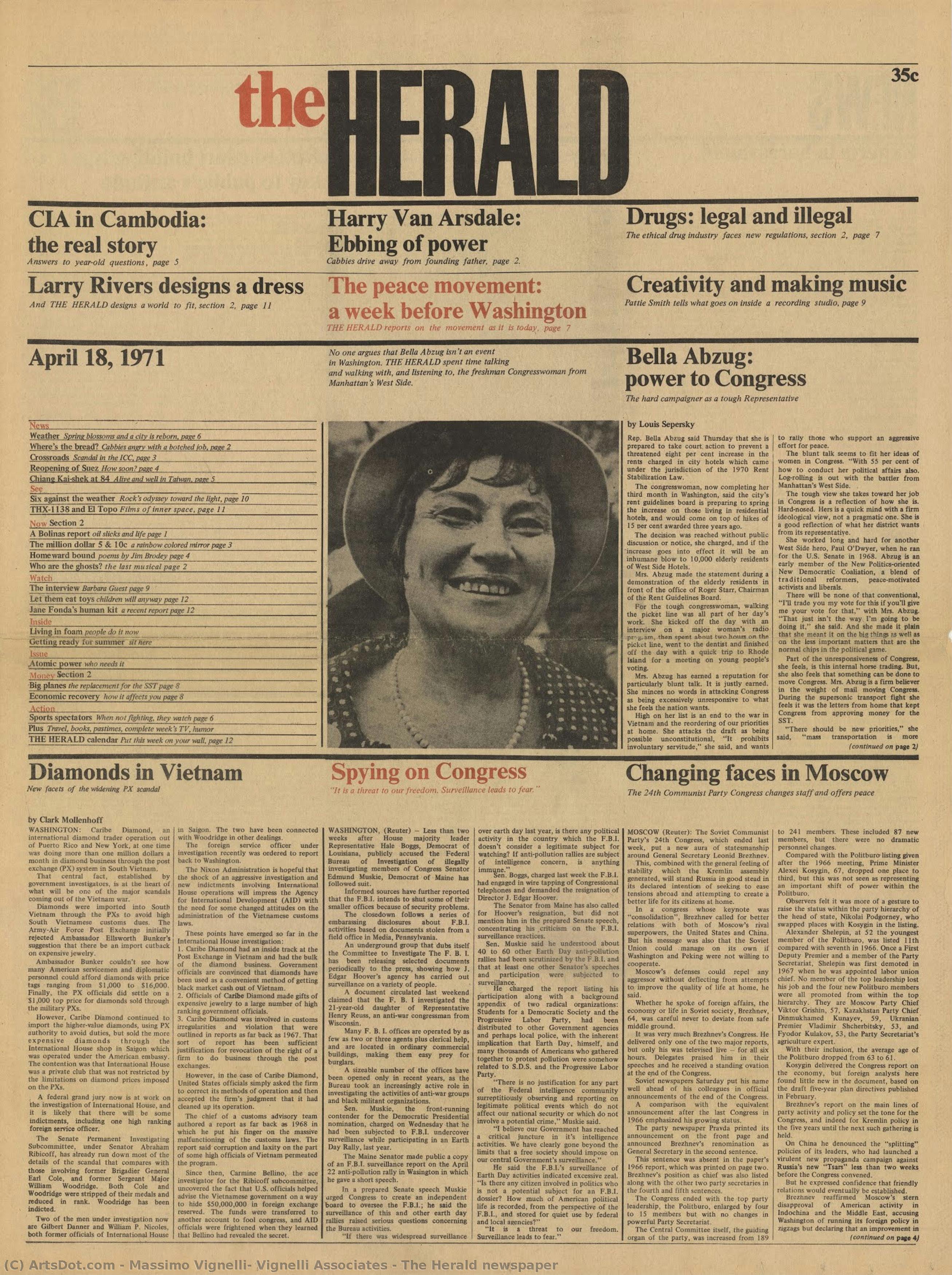
The Herald newspaper

- 43.0 x 57.0 cm


Experience the modernist grid design of The Herald newspaper by Massimo Vignelli (1971), showcasing vintage graphic communication art; discover this iconic piece today.
 Lees meer
Massimo Vignelli (1931-2014): Italiaanse ontwerpkunstenaar bekend om minimalistische grafische ontwerpen, waaronder de NYC Subway kaart. Ontdek zijn nalatenschap!
De kunstwerken die op deze pagina worden weergegeven, zijn beschermd door de auteursrechtwetgeving, wat betekent dat het ons wettelijk niet is toegestaan om identieke reproducties te maken of te verkopen. Deze bescherming wordt gehandhaafd onder internationale overeenkomsten zoals de Conventie van Bern en door nationale wetgeving, waaronder de bepalingen van de Amerikaanse auteurswet - Titel 17. Alle rechten voorbehouden. Reproduceren of distribueren van afbeeldingen is niet toegestaan zonder uitdrukkelijke schriftelijke toestemming van WahooArt.com en de rechthebbenden.
Deze methode voldoet volledig aan de auteursrechtwetgeving, omdat het niet gaat om het kopiëren of dupliceren van het beschermde kunstwerk. In plaats daarvan is er sprake van een creatieve herinterpretatie — een nieuw schilderij dat door het origineel wordt geïnspireerd, maar er niet identiek aan is.
Giclée / Kunstafdrukken
Giclée- of canvasafdruk van museumkwaliteit met een snelle productie en flexibele afwerkingsmogelijkheden. ( Bestel handgeschilderde reproductie Schakel over naar digitale afbeeldingen)




P118B €10

P118H €10

P118W €10

P438Z €10

P508JH €12

P508YH €12

P805H €10

P805Z €10

P919BZ €10

P919G €10

P919XJ €10

P959ZH €10

P968JZ €12

W106C €8

W218G €10

W218JH €8

W218Y €10

W307PJ €10

W316G €10

W316PJ €8

W316Y €10

W398PJ €8

W4111J €10

W500HY €15

W500JH €15

W692G €12

W849H €8

W940BG €15

W953PJ €8




Standaardformaat
op maat gemaakt
CM
INCH
Kies uit onze vooraf ingestelde maten die overeenkomen met de originele verhoudingen van het kunstwerk.
Loading sizes...

breedte
hoogte
Voer de gewenste breedte en hoogte in, passend bij uw lijst of muur. Een afdruk kan alleen worden ingekort en nooit groter worden gemaakt dan het origineel; een formaat met andere verhoudingen zal daarom een deel van de afbeelding verliezen. Wij sturen u een digitaal mockup ter goedkeuring voordat we tot drukwerk overgaan. De afbeelding op deze pagina toont niet de werkelijke uitsnede — dit is alleen te zien op het mockup.
Wereldwijde levering () binnen 2 weken in plaats van de standaard 4/5 weken. (1 november)

Gratis wereldwijde expressverzending

Hoogwaardig linnen canvas

Volledige verzendverzekering

Garantie op terugbetaling van invoerrechten

Garantie op exacte kleurweergave

Retourbeleid van 100 dagen (alleen bij defecten)

100% Geld-terug-garantie

Korting bij meerdere afnames
 De optie voor glas is alleen beschikbaar bij een formaat kleiner dan 110 cm.

The Herald newspaper
Giclée / Kunstafdrukken
Afmetingen reproductie
-


Eindtotaal
€ 62
The Grid of Modern Communication: Vignelli's The Herald
To encounter this piece is to step directly into the vibrant, structured chaos of mid-century New York journalism. This reproduction of The Herald newspaper from April 1971, conceived by Massimo Vignelli and his associates, is far more than mere ephemera; it is a meticulously designed artifact of visual communication history. It captures a moment when design principles—simplicity, functionality, and rigorous structure—were being aggressively applied to the seemingly unruly medium of print journalism. The very act of presenting this newspaper front page transforms what might be considered disposable media into a profound study in modernist graphic discipline.
A Masterclass in Structured Design
Vignelli’s genius, always rooted in an almost architectural understanding of space, is on full display here. The description notes the structure: a rigid grid of six columns and sixteen modules per column. This underlying skeleton dictates every element—the placement of headlines like "Diamonds in Vietnam," the accompanying portrait of the smiling woman, and the smaller articles detailing everything from spying congress to changing leaves in Moscow. Vignelli’s commitment to using a single typeface, Times Roman, across various weights and sizes, speaks volumes about his belief in universal legibility. It is a powerful testament to the idea that restraint—the disciplined use of negative space and consistent typography—can generate an overwhelming sense of order and sophistication.
Historical Resonance and Materiality
The year 1971 places this work within a fascinating cultural nexus, post-war modernism grappling with the burgeoning media landscape. While the paper itself ultimately folded due to distribution issues, its surviving design remains potent. For the collector or designer, understanding this context is key. This piece speaks to an era obsessed with efficiency and clarity in information transfer. When considering a reproduction for your space, you are not just acquiring art; you are curating a dialogue about how we consume knowledge—a conversation between the fleeting headline and the enduring power of good design.
Symbolism of the Grid
The grid itself functions as the primary symbolic element. In an age where digital information often feels overwhelming, this physical manifestation of order offers a visual anchor. It symbolizes control, but not oppressive control; rather, it suggests that even complex narratives—the confluence of international events and local interest—can be organized into digestible, beautiful patterns. The interplay between the large, arresting photograph and the tightly packed textual modules creates a dynamic tension, mirroring the very energy of a bustling city like New York in that era.
Bringing Modernist Precision Home
For interior design or gallery display, this piece offers an unparalleled opportunity to inject intellectual rigor into a space. It pairs beautifully with minimalist furniture, mid-century modern accents, or any setting that appreciates the clean lines of 20th-century industrial aesthetics. Owning this reproduction is an homage to Massimo Vignelli’s lifelong dedication to elevating the mundane—the daily newspaper—into something enduringly beautiful and intellectually stimulating.
Veelgestelde vragen
Tot welke stijl behoort "The Herald newspaper"?
De kunststroming die verbonden is aan "The Herald newspaper" door Massimo Vignelli, Vignelli Associates is Modernism. Deze classificatie plaatst het werk binnen een context van verwante kunstenaars en kunstwerken.
Waarvoor wordt een afdruk van "The Herald newspaper" aanbevolen?
Een afdruk van "The Herald newspaper" wordt aanbevolen voor Statement.
Wat zijn de verhoudingen van "The Herald newspaper" door Massimo Vignelli, Vignelli Associates en wat zijn de afmetingen?
Het formaat van "The Herald newspaper" is Portrait en het origineel heeft de afmetingen 43 x 57 cm. Beide zijn nuttig bij het plannen van een reproductie.
Biografie kunstenaar
Een leven gewijd aan vorm: De wereld van Massimo Vignelli
Geboren in Milaan, Italië, in 1931, was de reis van Massimo Vignelli er een van onwankelbare toewijding aan de principes van het modernistische design. Van jongs af aan toonde hij een aangeboren begrip van visuele communicatie, waarbij hij zijn formele opleiding in architectuur begon aan het Politecnico di Milano en later voortzette aan de Università Iuvel di Venezia. Het was echter een stage bij de gerespecteerde broers Castiglioni – pioniers in het Italiaanse industriële ontwerp – die zijn passie voor het vormgeven van de wereld door middel van doordachte creatie werkelijk aanwakkerde. Deze vroege blootstelling plantte in hem een diep geloof in functionaliteit, eenvoud en de kracht van elegante oplossingen voor alledaagse problemen. Hij ontwierp niet louter objecten; hij creëerde ervaringen, stroomlijnde interacties en verhief het alledaagse tot iets memorabels. Deze vormende periode legde de basis voor een carrière die de visuele cultuur over verschillende continenten zou herdefiniëren.Van Italië naar New York: Een transatlantische visie
Vignelli's pad leidde hem in 1966 naar Amerika, waar hij een cruciale rol speelde bij de oprichting van het New Yorkse kantoor van Unimark International. Dit markeerde een beslissend moment, niet alleen voor zijn eigen carrière, maar ook voor het landschap van het Amerikaanse design. Unimark steeg snel in belang, en Vignelli's bijdragen – met name het blijvende logo voor American Airlines – bevestigden zijn reputatie als een meester in corporate identity. Een groeiende divergentie in creatieve filosofie bracht hem echter ertoe om een onafhankelijke onderneming te starten. In 1971 richtte hij, samen met zijn vrouw en levenslange medewerker Lella Vignelli, Vignelli Associates op. Dit partnerschap bleek buitengewoon vruchtbaar en werd synoniem met verfijnde designoplossingen die varieerden van grafisch ontwerp en interieurontwerp tot productontwerp en architectuur. De ethiek van het bureau was geworteld in de overtuiging dat goed design toegankelijk, tijdloos en uiterst nuttig moet zijn – principes die zij gedurende hun hele loopbaan consequent verdedigden.Iconische creaties: Een nalatenschap van helderheid
De invloed van Massimo Vignelli is verweven met het weefsel van het moderne leven. Misschien wel zijn meest herkenbare prestatie is de herontwerp van de metrokaart van New York City in 1972. Hoewel aanvankelijk controversieel vanwege de afwijking van strikte geografische nauwkeurigheid, was het een gedurfd statement van helderheid en bruikbaarheid. Vignelli gaf de voorkeur aan leesbaarheid en intuïtieve navigatie boven letterlijke representatie, waardoor een diagrammatische kaart ontstond die dagelijks miljoenen forenzen blijft begeleiden. Dit project belichaamt zijn kernfilosofie: communicatie boven alles prioriteren. Naast de metrokaart liet Vignelli Associates een onuitwisbare indruk achter bij talloze merken en instellingen. Hun werk voor Bloomingdale’s – inclusief de iconische bruine papieren tas met het eenvoudige witte logo – transformeerde een winkelervaring tot een uiting van stijl. Ze ontwierpen meubels voor Knoll, verpakkingen voor Heller en bedrijfsidentiteiten die onmiddellijk herkenbare symbolen van kwaliteit en innovatie werden. Zijn Heller Rainbow Dinnerware staat als een testament voor zijn minimalistische esthetiek, waarbij levendige kleuren worden getoond binnen strakke geometrische vormen. De poster voor de Tredicesima Triennale di Milano illustreert zijn gedurfde gebruik van kleur en vorm, terwijl de Knoll Design cover zijn vermogen demonstreert om opvallende visuals te creëren voor gerenommeerde merken.Een blijvende impact: Voorbij de esthetiek
De impact van Massimo Vignelli reikt veel verder dan individuele projecten; hij heeft fundamenteel veranderd hoe wij design zelf waarnemen. Hij was een vurig pleitbezorger van typografische discipline en bepleitte beroemd om een beperkt palet aan lettertypen – in de overtuiging dat ware creativiteit niet ligt in eindeloze opties, maar in meesterlijke uitvoering met zorgvuldig gekozen instrumenten. Zijn boek, The Vignelli Canon, werd een manifest voor ontwerpers, waarin hij zijn principes van helderheid, eenvoud en blijvende elegantie uiteenzette. Hij creëerde niet simpelweg visueel aantrekkelijke objecten; hij streefde ernaar om orde uit chaos te scheppen, om effectief te communiceren en de menselijke ervaring te verheffen door middel van doordacht ontwerp. Zijn werk blijft generaties ontwerpers inspireren en herinnert hen eraan dat ware innovatie ligt in het weglaten van het overbodige en het focussen op de essentie. Het Vignelli Center for Design Studies aan het Rochester Institute of Technology dient als een blijvend eerbetoon aan zijn nalatenschap, waarbij een uitgebreid archief van zijn werk wordt bewaard en verdere verkenning van zijn baanbrekende ideeën wordt gestimuleerd. Hij overleed in 2014, maar zijn ontwerpen blijven krachtig aanwezig en vormen onze wereld met hun blijvende elegantie en onwankelbare toewijding aan helderheid.
Massimo Vignelli, Vignelli Associates
1931 - 2014 , Italie
Belangrijkste feiten
- Artistic Movement Or Style: Modernisme
- Artists Or Movements Influenced By This Artist: ['Minimalisme']
- Artists Who Influenced This Artist:
- Achille Castiglioni
- Pier Giacomo Castiglioni
- Date Of Birth: 1931
- Date Of Death: 2014
- Full Name: Massimo Vignelli
- Nationality: Italiaans
- Notable Artworks:
- American Airlines logo
- NYC Subway kaart
- Bloomingdale's papieren zak
- Place Of Birth: Milan, Italië
Gerelateerde artikelen

TopImpressionists.com F.A.Q.: Discover the Vibrant Beauty of Our Premium Art Poster Prints
Explore the technical excellence of TopImpressionists.com's premium art poster prints. Discover how our 12-color pigment system and archival inks capture the luminous beauty of Impressionist masterpieces with unmatched color fidelity and museum-grade durability for the discerning collector.
Ontdek kunstwerken georganiseerd op thema, stijl en kenmerk.


