

Shown: · With its frame:
 Voorvertoning
 Verstuur
 Delen
Delen
 Details bekijken
 Gids
Gids

 Download
 Vergelijkbare items
 Röntgenonderzoek
 Diavoorstelling
 Q&A
Q&A Statistieken


€ 239
Handgemaakte olieverfreproductie
Met de hand geschilderd in olieverf op canvas in uw gewenste maat en lijst, op bestelling gemaakt door onze kunstenaars. ( Schakel over naar print Schakel over naar digitale afbeeldingen)
Size
·Standaardformaat
op maat gemaakt
CM
INCH
Kies uit onze vooraf ingestelde maten die overeenkomen met de originele verhoudingen van het kunstwerk.
Loading sizes...

breedte
hoogte
Voer de breedte en hoogte in die u nodig heeft, passend bij uw lijst of uw muur. Omdat dit handgeschilderd is, kan de kunstenaar bij een afmeting met een andere beeldverhouding iets meer rondom het schilderij schilderen of juist iets meer weglaten — u kiest zelf. Wij sturen u een digitaal mockup ter goedkeuring voordat het schilderwerk begint. De afbeelding die op deze pagina wordt getoond, is niet het uiteindelijke resultaat — alleen de mockup geeft dit weer.
 Lees meer over
Finish
·
White €1

Blurside €1

Extended €1

P118B €10

P118H €10

P118W €10

P438Z €10

P508JH €12

P508YH €12

P805H €10

P805Z €10

P919BZ €10

P919G €10

P919XJ €10

P959ZH €10

P968JZ €12

W106C €8

W218G €10

W218JH €8

W218Y €10

W307PJ €10

W316G €10

W316PJ €8

W316Y €10

W398PJ €8

W4111J €10

W500HY €15

W500JH €15

W692G €12

W849H €8

W940BG €15

W953PJ €8

H24-GOLD €30

H24-SILVER €30

H36-GOLD €45

H36-SILVER €45
Shipped in a protective tube, ready for your own framer.
Above 105 cm the frame is shipped as a kit for a professional framer — read the details.
Extras
optionalWhat do the extras include?
Examples of what can be changed: Replace face with customer photo; Add pet (e.g., replace cat with dog); Include hidden message in background; Change background landscape or elements.
After order, TopImpressionists.com team will email client for instructions and provide a mockup preview
After order, TopImpressionists.com team will email client for instructions and provide a mockup preview
Wereldwijde levering () binnen 3 tot 4 weken in plaats van de standaard 5 weken. (30 oktober). Zonder concessies aan de kwaliteit.
Beschermende vernislaag
Naamplaatje
Details van de gegraveerde bronzen plaat
This elegant plaque features the artist's name and the title of the artwork, finely engraved for a timeless presentation.
It is made from bronze with a refined, elegant finish. The text is precisely laser-engraved for a sharp and permanent result. Measuring 9x2 cm, the plaque is compact yet easy to read. It's built to be durable and scratch-resistant, offering a professional, museum-quality look. Mounting is simple thanks to the included adhesive backing.
Details transparante acrylplaat
The plaque includes essential engraved details such as the artist's name, the title of the artwork, the date it was created, the type of media used-like oil on canvas or watercolor-a brief description of the piece, and a QR code that links to the complete artwork information.
It is crafted from clear acrylic, offering a sleek, modern appearance. The text is UV-engraved in black to ensure strong visual contrast. With a size of 10x15 cm, it ensures optimal readability. It comes equipped with two metal hooks for secure wall mounting. The plaque is designed to be weather-resistant, making it suitable for various environments, and it includes interactive features that work seamlessly with smartphone scanning.
Details zwarte acrylplaat
This elegant plaque includes engraved information such as the artist's name, the title of the artwork, the date it was created, the type of media used (like oil on canvas or watercolor), a short description of the artwork, and a QR code for quick access to more information.
The plaque itself is made from refined black acrylic with a premium finish. The text is laser-engraved in white for high contrast and readability. Its size is 10x15 cm, designed to be easy to read. It comes with two metal hooks for professional mounting. The design is sleek and fits any interior style. It is also weather-resistant and durable, with built-in digital integration for mobile compatibility.
De optie voor glas is alleen beschikbaar bij een formaat kleiner dan 110 cm.
 De optie voor glas is alleen beschikbaar bij een formaat kleiner dan 110 cm.
- Gratis wereldwijde expressverzending
- Hoogwaardig linnen canvas
- Volledige verzendverzekering
- Garantie op terugbetaling van invoerrechten
- Garantie op exacte kleurweergave
- Retourbeleid van 100 dagen (alleen bij defecten)
- 100% Geld-terug-garantie
- Korting bij meerdere afnames


Beschrijving verzamelobject
Biografie kunstenaar
Ontdek Nicolas Poussin's prachtige Barok schilderkunst—bekend om vredige landschappen en mythologische verhalen geïnspireerd door klassieke oudheid. Laat je fascineren door iconische kunstwerken op TopImpressionists!
About the painting
A Moment Frozen in Time: Poussin’s ‘Two Silver Birches’
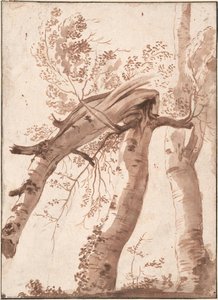
Nicolas Poussin's “Two Silver Birches, the Front One Fallen,” painted circa 1629, isn’t merely a depiction of trees; it’s a carefully constructed meditation on mortality, harmony, and the enduring power of classical ideals. Emerging from his formative years in France and culminating in his profound immersion within the Roman artistic landscape, Poussin sought to synthesize the sensual richness of Venetian painting with the rigorous order and intellectual depth of antiquity. This work, created during a pivotal period of his career, exemplifies this ambition – a quiet yet profoundly resonant scene that speaks volumes about the artist’s evolving philosophy.
The painting immediately draws the eye with its stark simplicity. Two birch trees dominate the composition, their silvery bark rendered with an almost luminous quality. The tree on the right stands tall and proud, branches reaching skyward as if in defiant grace, while its counterpart lies prone at the base of the canvas, a fallen sentinel marking the passage of time. The absence of leaves is deliberate; it strips away the seasonal distractions, focusing instead on the skeletal beauty of the trees themselves – a motif frequently associated with death and remembrance within classical art. This reduction to essential form allows Poussin to explore the underlying structure of nature, mirroring his broader interest in geometric principles and mathematical harmony.
The Language of Line and Light
Poussin’s technique is characterized by an exquisite control of line and light. He employs a meticulous layering of thin washes of paint – a hallmark of his style – to build up the forms with remarkable precision. The branches, particularly those of the upright birch, are delineated with delicate, almost hesitant strokes, creating a sense of movement and vulnerability. The fallen tree is rendered with a slightly heavier touch, suggesting its weight and the inevitability of decay. Light plays a crucial role in shaping the scene; it seems to emanate from an unseen source, bathing the trees in a soft, diffused glow that enhances their silvery sheen. This masterful manipulation of light not only creates visual beauty but also imbues the painting with a sense of spiritual depth.
Noticeably, Poussin includes a human figure – a small, dark silhouette standing near the base of the fallen tree. The identity and purpose of this figure remain deliberately ambiguous, adding another layer of complexity to the work. Some scholars interpret it as representing contemplation or perhaps even mourning, while others see it as a symbol of humanity’s relationship with nature—a witness to its cycles of growth and decline. The figure's presence subtly anchors the scene in the realm of human experience, reminding us that even within the grandeur of the natural world, we are confronted by our own mortality.
Symbolism Rooted in Antiquity
The birch tree itself carries a rich symbolic weight throughout Western art history. Often associated with purity, resilience, and the afterlife, it frequently appears in funerary monuments and depictions of mourning. Its slender form and delicate branches evoke images of fragility and vulnerability, while its ability to withstand harsh winters speaks to an enduring spirit. Poussin’s choice of birch trees aligns perfectly with his engagement with classical themes – particularly those found in Roman mythology and literature, where the tree frequently served as a symbol of transition and renewal.
Furthermore, the fallen tree can be interpreted as a representation of *memento mori*—a reminder of death. This concept was central to Renaissance art, serving as a powerful tool for prompting reflection on the transience of earthly life. Poussin’s painting, therefore, transcends mere botanical observation; it becomes a poignant meditation on the cyclical nature of existence and the inevitability of loss. The composition invites us to contemplate our own place within this grand scheme, fostering a sense of both melancholy and acceptance.
A Timeless Masterpiece for Reproduction
TopImpressionists offers meticulously crafted hand-painted reproductions of “Two Silver Birches, the Front One Fallen,” allowing you to bring this iconic work into your home or office. Our artists replicate Poussin’s delicate brushwork and masterful use of light with unparalleled precision, ensuring that every detail is faithfully reproduced. Whether you are an art enthusiast, a collector seeking to expand your collection, or an interior designer searching for a touch of classical elegance, our reproductions provide a beautiful and authentic representation of this timeless masterpiece. Experience the profound beauty and intellectual depth of Poussin’s vision – a moment frozen in time, brought vividly back to life.
Veelgestelde vragen
Maakt "Two Silver Birches, the Front One Fallen, c. 1629" door Nicolas Poussin gebruik van sterke contrasten of zachte harmonieën?
In "Two Silver Birches, the Front One Fallen, c. 1629" wordt een Gentle contrast gecombineerd met een Unified Palette harmonie.
Wat stelt "Two Silver Birches, the Front One Fallen, c. 1629" door Nicolas Poussin voor, en welke stemming straalt het uit?
"Two Silver Birches, the Front One Fallen, c. 1629" toont birches, trees, fallen tree, tranquility, poussin, landscape, classical, harmony en de vastgelegde stemming is Calm.
Hoe komen stroming en tijdperk samen in "Two Silver Birches, the Front One Fallen, c. 1629" door Nicolas Poussin?
"Two Silver Birches, the Front One Fallen, c. 1629" behoort tot de French Baroque Painting-stroming en de maker ervan was werkzaam in het Vroegmoderne tijd-tijdperk.
Quick facts and art quiz
About Nicolas Poussin

Nicolas Poussin
1594 - 1665, Frankrijk
Biografie kunstenaar
Nicolas Poussin – Een Symbool van Franse Barok Kunst
Nicolas Poussin, een naam die synoniem staat voor de grandeur van Franse Barok kunst, was echter een ziel die diep geworteld was in Italiaanse grond voor het grootste deel van zijn artistieke leven. Geboren in Les Andelys, Normandië, in juni 1594, blijven zijn vroegste jaren enigszins gehuld in mysterie, maar ze legden onmiskenbaar de basis voor een carrière die zou worden cruciaal bij het vormen van de klassieke traditie binnen Franse kunst. Hoewel hij kortstondig studeerde aan Parijs tijdens het begin van de 1610er jaren, waarbij hij invloed opnam van minder bekende kunstenaars van dat tijdperk, was zijn reis naar Rome in 1624 echt een vonkende kracht achter zijn artistieke bestemming. Dit was niet alleen een geografische verschuiving; het betekende een onderdompeling in het hart van de oudheid, een pelgrimstocht naar de bron van inspiratie die zijn esthetische visie zou definiëren. Zijn eerste pogingen tot schilderen werden gekenmerkt door een sensuele kwaliteit die doet denken aan Venetiaanse meesters zoals Titiaan, maar zelfs hierin begon een nieuwe vorm van ordening en intellectuele ernst te emergensen—een voorbode van de stijl waarin hij zo magistraal zou verbeteren.De Romeinse Jaren: Het Vormgeven van Een Klassieke Ideeel
Rome bleek meer dan alleen een atelier voor Poussin; het werd zijn intellectuele kruispunt. Hij bevond zich middenin een bruisende cirkel van geleerden, archeologen en mede kunstenaars, waaronder Cassiano dal Pozzo, wiens diepe kennis van klassieke oudheid de kunstenaar’s benadering enorm beïnvloedde. Dal Pozzo's toegewijdheid aan het zorgvuldig documenteren van oude resten gaf Poussin een diepe waardering voor historische nauwkeurigheid en een drang om zijn schilderijen te voorzien van een gevoel van tijdloosheid. Deze periode zag Poussin weg bewegen van de flamboyante exuberantie van sommige van zijn tijdgenoten, maar omarmde een stijl gekenmerkt door helderheid, balans en een bewuste nadruk op lijn compositie. Hij bestudeerde meticulëus Raphael’s werken, waarbij hij hun harmonieuze arrangementen en elegante vormen absorbeerde, terwijl hij tegelijkertijd inspiratie haalde uit oude sculpturen en literatuur bronnen zoals Ovid's *Metamorphoses*. Zijn schilderijen begonnen zich te bevinden met figuren getrokken uit klassieke geschiedenis en mythologie, afgebeeld niet alleen als decoratieve elementen maar als verkondigers van morele deugden en filosofische idealen. Hij werd bijzonder getroffen door het werk van Raphael, wiens stijl hij als een voorbeeld beschouwde voor harmonie en elegantie. Zijn aandacht voor licht en kleur was een directe echo van de Venetiaanse traditie, waarbij hij een gevoel voor atmosfeer en emotionele expressie nastreefte.De Invloed van Klassieke Oudheid
Poussin’s artistieke ontwikkeling werd sterk bepaald door zijn fascinatie voor het klassieke wereldbeeld. Hij volgde nauwlettend de ontwikkelingen binnen de wetenschap en archeologie van zijn tijd, waarbij hij zich liet leiden door nieuwe ontdekkingen die het beeld van het oude Griekenland en Italië verbreedden. Zijn studie van oude kunstwerken gaf hem een diepe waardering voor schoonheid en proportie, maar ook een kritische geest die hem aanmoedigde om bestaande conventies uit te dagen. Hij zag zichzelf als een voortzetter van de Renaissance Humanisme, waarbij hij zich liet inspireren door filosofen zoals Erasmus en Pico della Mirandola. Deze intellectuele zoektocht leidde tot een stijl die zowel technisch hoogstaand als filosofisch doordrongen was—een stijl die zou resulteren in werken die niet alleen prachtige schoonheid bezitten maar ook een diepe boodschap dragen over de menselijke natuur en het universum. Zijn kunstenaarschap werd gekenmerkt door een voortdurende zoektocht naar nieuwe vormen van expressie, terwijl hij zich steeds meer richtte op het verkennen van complexe thema’s zoals liefde, dood en religieuze contemplatie. Hij wilde niet alleen de wereld vastleggen maar ook een manier vinden om deze te begrijpen en te waarderen—een doel dat hem leidde tot een stijl die zowel technisch innovatief als artistiek doordrongen was.Een Laatste Legacy: Het Vormgeven van Franse Kunst
Ondanks dat hij het grootste deel van zijn werk buiten Frankrijk doorbracht, had Nicolas Poussin een enorme invloed op Franse kunst. Hij werd kortstondig aangesteld als eerste schilder aan het hof van Kardinaal Richelieu in 1640, maar vond zichzelf verstoken van de dynamiek en intriges van het koninklijk huis. Hij keerde snel terug naar Rome, waar hij bleef schilderen tot zijn dood in 1665. Zijn toegewijdheid aan klassieke principes hielp een standaard voor kunstenaarschap en praktijk binnen Frankrijk te vestigen, waardoor hij generaties van kunstenaars inspireerde die volgden. Hij werd een leidende figuur in de Académie Royale de Peinture et de Sculpture, waarbij hij zijn positie bevestigde als een hoeksteen van Franse Classicisme. Kunstenaars zoals Jacques-Louis David en Paul Cézanne bekroonden hun erkenning voor Poussin’s strenge benadering en intellectuele diepte met een directe verwijzing naar zijn stijl en filosofische visie. Zijn kunstwerken blijven een bron van inspiratie voor kunstenaars en critici tot op de dag van vandaag, waardoor hij een plaats heeft verdiend in de geschiedenis als een van de meest invloedrijke kunstenaars van zijn tijdperk.Quick facts about Nicolas Poussin
- Artistic Movement Or Style: Baroque, Classicisme
- Artists Who Influenced This Artist:
- Raphael
- Titian
- Date Of Birth: 1594
- Full Name: Nicolas Poussin
- Nationality: Frans
- Notable Artworks:
- De dood van Germanicus
- De Zevens Sacramenten Serie
- Een Romeinse Weg
- Orion Geblinderd Zoekt de Zon
- Place Of Birth: Les Andelys, Frankrijk
Ontdek kunstwerken georganiseerd op thema, stijl en kenmerk.


Nicolas Poussin
Two Silver Birches, the Front One Fallen, c. 1629
() ·
With its frame: · Hand-painted in oil on linen
Total