
Shown: · With its frame:
 Voorvertoning
 Verstuur
 Delen
Delen
 Details bekijken
 Gids
Gids

 Download
 Vergelijkbare items
 Röntgenonderzoek
 Diavoorstelling
 Q&A
Q&A Statistieken
- 37.0 x 27.0 cm


€ 239
Handgemaakte olieverfreproductie
Met de hand geschilderd in olieverf op canvas in uw gewenste maat en lijst, op bestelling gemaakt door onze kunstenaars. ( Schakel over naar print Schakel over naar digitale afbeeldingen)
Size
·Standaardformaat
op maat gemaakt
CM
INCH
Kies uit onze vooraf ingestelde maten die overeenkomen met de originele verhoudingen van het kunstwerk.
Loading sizes...

breedte
hoogte
Voer de breedte en hoogte in die u nodig heeft, passend bij uw lijst of uw muur. Omdat dit handgeschilderd is, kan de kunstenaar bij een afmeting met een andere beeldverhouding iets meer rondom het schilderij schilderen of juist iets meer weglaten — u kiest zelf. Wij sturen u een digitaal mockup ter goedkeuring voordat het schilderwerk begint. De afbeelding die op deze pagina wordt getoond, is niet het uiteindelijke resultaat — alleen de mockup geeft dit weer.
 Lees meer over
Finish
·
White €1

Blurside €1

Extended €1

P118B €10

P118H €10

P118W €10

P438Z €10

P508JH €12

P508YH €12

P805H €10

P805Z €10

P919BZ €10

P919G €10

P919XJ €10

P959ZH €10

P968JZ €12

W106C €8

W218G €10

W218JH €8

W218Y €10

W307PJ €10

W316G €10

W316PJ €8

W316Y €10

W398PJ €8

W4111J €10

W500HY €15

W500JH €15

W692G €12

W849H €8

W940BG €15

W953PJ €8

H24-GOLD €30

H24-SILVER €30

H36-GOLD €45

H36-SILVER €45
Shipped in a protective tube, ready for your own framer.
Above 105 cm the frame is shipped as a kit for a professional framer — read the details.
Extras
optionalWhat do the extras include?
Examples of what can be changed: Replace face with customer photo; Add pet (e.g., replace cat with dog); Include hidden message in background; Change background landscape or elements.
After order, TopImpressionists.com team will email client for instructions and provide a mockup preview
After order, TopImpressionists.com team will email client for instructions and provide a mockup preview
Wereldwijde levering () binnen 3 tot 4 weken in plaats van de standaard 5 weken. (2 november). Zonder concessies aan de kwaliteit.
Beschermende vernislaag
Naamplaatje
Details van de gegraveerde bronzen plaat
This elegant plaque features the artist's name and the title of the artwork, finely engraved for a timeless presentation.
It is made from bronze with a refined, elegant finish. The text is precisely laser-engraved for a sharp and permanent result. Measuring 9x2 cm, the plaque is compact yet easy to read. It's built to be durable and scratch-resistant, offering a professional, museum-quality look. Mounting is simple thanks to the included adhesive backing.
Details transparante acrylplaat
The plaque includes essential engraved details such as the artist's name, the title of the artwork, the date it was created, the type of media used-like oil on canvas or watercolor-a brief description of the piece, and a QR code that links to the complete artwork information.
It is crafted from clear acrylic, offering a sleek, modern appearance. The text is UV-engraved in black to ensure strong visual contrast. With a size of 10x15 cm, it ensures optimal readability. It comes equipped with two metal hooks for secure wall mounting. The plaque is designed to be weather-resistant, making it suitable for various environments, and it includes interactive features that work seamlessly with smartphone scanning.
Details zwarte acrylplaat
This elegant plaque includes engraved information such as the artist's name, the title of the artwork, the date it was created, the type of media used (like oil on canvas or watercolor), a short description of the artwork, and a QR code for quick access to more information.
The plaque itself is made from refined black acrylic with a premium finish. The text is laser-engraved in white for high contrast and readability. Its size is 10x15 cm, designed to be easy to read. It comes with two metal hooks for professional mounting. The design is sleek and fits any interior style. It is also weather-resistant and durable, with built-in digital integration for mobile compatibility.
De optie voor glas is alleen beschikbaar bij een formaat kleiner dan 110 cm.
 De optie voor glas is alleen beschikbaar bij een formaat kleiner dan 110 cm.
- Gratis wereldwijde expressverzending
- Hoogwaardig linnen canvas
- Volledige verzendverzekering
- Garantie op terugbetaling van invoerrechten
- Garantie op exacte kleurweergave
- Retourbeleid van 100 dagen (alleen bij defecten)
- 100% Geld-terug-garantie
- Korting bij meerdere afnames


Beschrijving verzamelobject
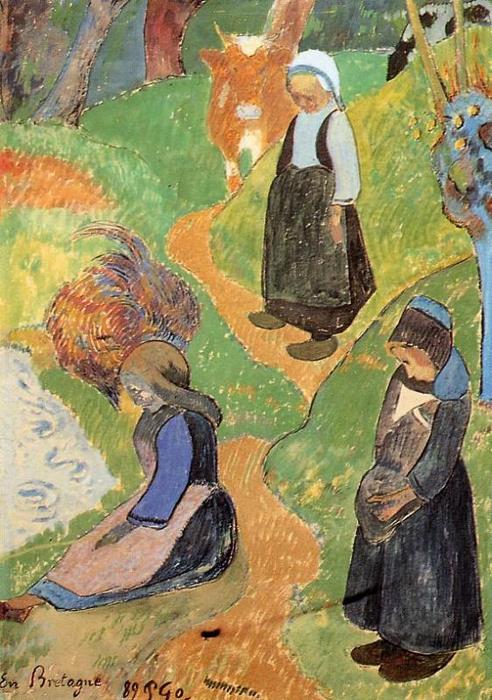
Ontdek "In Brittany" van Paul Gauguin, een iconische Post-Impressionistische schildering die de eenvoud en schoonheid van het Bretonse landschap vastlegt. Een prachtige reproductie voor uw kunstcollectie!
Biografie kunstenaar
Paul Gauguin: Een revolutionaire Post-Impressionist schilder met felle kleuren, exotische onderwerpen & symbolistische thema's. Ontdek zijn reis van financieel succes naar kunstlegende.
About the painting
In Brittany
Paul Gauguin’s “In Brittany,” painted in 1889, stands as a cornerstone of Post-Impressionism—a movement that sought to liberate painting from the constraints of objective observation and delve into subjective experience. More than just a depiction of rural life, it embodies Gauguin’s profound connection with nature and his unwavering belief in its ability to communicate spiritual truths. This watercolor captures a tranquil scene featuring three women tending to livestock amidst a sunlit field—a tableau that resonates with the artist’s fascination for primitive landscapes and cultures.Artistic Style and Technique
Gauguin’s stylistic approach was radically different from his Impressionist predecessors. Rejecting the fleeting effects of light, he prioritized bold color palettes and simplified forms to convey emotion rather than precise representation. Watercolor proved ideal for achieving this expressive goal, allowing for luminous washes and subtle gradations that imbue the canvas with a sense of atmosphere. The composition is deliberately asymmetrical, guiding the viewer’s eye across the scene and emphasizing the interplay between figures and environment. Gauguin employed thick impasto—applying paint in textured layers—to create palpable solidity and heighten visual impact. This technique reflects his desire to capture not merely what he saw but how it *felt*. He meticulously blended colors, layering hues to build up depth and luminosity—a masterful demonstration of watercolor’s versatility.Historical Context & Symbolism
Painted during Gauguin’s Breton period, “In Brittany,” aligns with the broader artistic currents of the time. Artists like Cézanne and Van Gogh were similarly exploring expressive landscapes and rejecting academic conventions. The painting's symbolism is rich—the women represent fertility and maternal care, while the animals symbolize harmony with the natural world. Gauguin’s use of color – predominantly yellows and greens – evokes feelings of warmth and vitality, mirroring the optimism inherent in his belief in the transformative power of art. The scene harkens back to medieval Breton folklore and mythology, reflecting Gauguin’s interest in exploring primal spirituality. It speaks to a yearning for authenticity—a rejection of bourgeois materialism in favor of a simpler, more elemental existence.Similar Works by Paul Gauguin
Gauguin’s artistic vision extended beyond Brittany; he embarked on voyages to Tahiti and the Marquesas Islands where he produced equally evocative paintings that solidified his reputation as a pioneer of Symbolism. “The Joys of Brittany,” housed at the Indianapolis Museum of Art, exemplifies this style—a luminous landscape dominated by vibrant hues and simplified shapes—demonstrating Gauguin’s unwavering commitment to capturing the essence of his surroundings. Similarly, "Martinique Landscape," showcases Gauguin's masterful technique in conveying mood and emotion through color and texture. These paintings stand as testament to Gauguin’s enduring influence on modern art and continue to inspire artists today. They represent a profound shift away from objective observation toward subjective experience—a legacy that continues to resonate with audiences worldwide. ## Conclusion “In Brittany” is more than just a beautiful watercolor; it’s a meditation on the human spirit’s connection to the natural world and its capacity for conveying spiritual truths. Its delicate execution and harmonious composition encapsulate the spirit of Post-Impressionism, inviting viewers to contemplate its enduring power and beauty. To delve deeper into Gauguin's artistic legacy and explore reproductions of his masterpieces, visit TopImpressionists.com—where you can discover exceptional handmade oil painting reproductions of some of the world’s most celebrated artworks, including “In Brittany.”Veelgestelde vragen
Waar bevindt "In Brittany" door Paul Gauguin zich binnen de kunstgeschiedenis?
De kunsthistorische classificatie van "In Brittany" door Paul Gauguin is Post-Impressionism, uit de Modern-periode.
In welke fase van de carrière van Paul Gauguin valt "In Brittany", gezien de datum?
Gezien de datering uit 1889, valt "In Brittany" binnen de Mature Period van Paul Gauguin.
Wat is de luminantie van "In Brittany" door Paul Gauguin?
De vastgestelde luminantie voor "In Brittany" door Paul Gauguin is Zachte luminantie.
Quick facts and art quiz
About Paul Gauguin

Paul Gauguin
1848 - 1903, Frankrijk
Biografie kunstenaar
Eugène Henri Paul Gauguin: Een Leven in Wilde Kleuren
Eugène Henri Paul Gauguin, een naam die resoneert met levendige kleuren en rebellie, staat als een cruciale figuur in de overgang van Impressionisme naar moderne kunst. Geboren in Parijs in 1848 was zijn leven allesbehalve conventioneel. Zijn vroege jaren werden gevormd door een ongebruikelijk opvoeding; zijn vader een journalist en zijn moeder afkomstig van Peruviaanse aristocratie – haar grootmoeder, Flora Tristan, een baanbrekende feministe en socialistische schrijver wiens idealen ongetwijfeld in de familie weerklanken veroorzaakten. Deze erfenis zou Gauguin’s artistieke visie diepgaand beïnvloeden, een fascinatie met culturen buiten Europa aanwakkeren. Een opvoeding in Peru als kind, na de verhuizing van zijn familie in 1850, dwong hem tot een wereld die radicaal anders was dan Parijs, een ervaring die bleef hangen en uiteindelijk zijn zoektocht naar authenticiteit in kunst voedde. Na terugkeer naar Frankrijk na het overlijden van zijn vader, ontving Gauguin een formele opleiding, maar voelde zich aangetrokken tot de academische wereld, maar eerder tot de bloeiende financiële wereld, waar hij een carrière als beursmakelaar begon – een pad dat opvallend tegenstond aan het artistieke lot dat hem wachtte.Van Financier naar Kunstenaar
Gauguin leidde jarenlang een dubbelleven, met toewijding aan zijn zakelijke ondernemingen terwijl hij heimelijk een passie voor schilderkunst cultiveerde. In eerste instantie werd hij beïnvloed door de Impressionisten en experimenteerde hij in zijn vrije tijd met kleur en licht, maar voelde hij snel dat ze zich beperkten tot het vastleggen van vluchtige momenten van realiteit. De financiële crisis van 1882 bleek een keerpunt te zijn, waardoor hij zijn lucratieve carrière opgaf en zich vol overtuiging stortte in zijn artistieke roeping. Dit was niet alleen een verandering van beroep; het was een fundamentele verschuiving in wereldbeeld. Hij zocht begeleiding bij Camille Pissarro, die zijn ontwikkeling aanmoedigde en hem introduceerde bij de avant-garde cirkels van Parijs. Gauguin begon echter snel af te wijken van Impressionistische principes, verlangend naar iets expressiever, iets symbolischer – een manier om niet alleen *wat* hij zag, maar wat hij *voelde* over te brengen. Deze drang leidde hem op een reis van artistieke exploratie die hem verder zou voeren dan de Parijse salons en in het hart van ‘primitieve’ culturen. Hij was niet alleen geïnteresseerd in het vastleggen van deze culturen; hij zocht ernaar om hun essentie te absorberen, ervan uitgaande dat ze een zuiverheid boden die verloren was gegaan in de Westerse beschaving.De Aanroep naar Bretagne en Tahiti
Gauguin’s artistieke evolutie was onlosmakelijk verbonden met zijn reizen. Hij bracht tijd door in Bretagne, gefascineerd door het ruige landschap en de diepgewortelde tradities van zijn bewoners. Deze periode zag hij experimenteren met platte vormen, felle lijnen en een vereenvoudiging van compositie – technieken die hem verder wegvoerden van naturalisme en dichter naar een meer symbolische taal. Maar zijn reis naar Tahiti in 1891 ontketende werkelijk zijn creatieve potentieel. Op zoek naar een toevluchtsoord van wat hij beschouwde als de verstikkende beperkingen van Europese civilisatie, hoopte Gauguin inspiratie te vinden in Polynesiëse cultuur, ervan uitgaande dat deze een zuiverder, authentieker manier van leven bood. Dit was niet alleen een artistieke zoektocht; het was een spirituele missie. Hij dompelde zich onder in lokale gebruiken en geloofsovertuigingen, vastleggend Polynesiërs vrouwen, landschappen en religieuze praktijken door zijn unieke lens. Beïnvloed door Japanse prints – *Japonisme* – en middeleeuwse kunst ontwikkelde hij een kenmerkende esthetiek gekenmerkt door levendige kleuren, exotische onderwerpen en een sfeer van mysterie. Iconische schilderijen zoals “Vahine no te miti” (Vrouw met mango), “Manao Tupapau” (Gevangen door de Geest van de Dood) en “The Day of Gods ontstonden in deze periode, waarmee zijn reputatie als een visionaire kunstenaar werd verstevigd. Zijn gebruik van kleur werd steeds heviger en niet-natuurlijk, bedoeld om emotie en spirituele betekenis uit te drukken, niet om de realiteit te reproduceren.Erfgoed en Controversie
Ondanks zijn artistieke doorbraken was Gauguin’s leven vaak gekleurd door moeilijkheden. Hij had financiële problemen en een verslechterend gezondheidstoestand tijdens zijn verblijf in Tahiti en later op de Marquesas eilanden, waar hij uiteindelijk vestigde. Toch bleef hij productief schilderen, voortdurend thema's van het leven, de dood en spiritualiteit onderzoeken. Hij stierf in 1903 op Hiva Oa, een afgelegen eiland in de Marquesas-archipel, grotendeels onherkenbaar voor zijn genie. Pas na zijn dood begon Gauguin’s werk de erkenning te krijgen die het verdiende. Vandaag de dag wordt hij geëerd als een cruciale figuur in de ontwikkeling van moderne kunst, die de overgang van Impressionisme naar Symbolisme inluidde en het pad bereidde voor bewegingen zoals Fauvism. Zijn gebruik van kleur, vereenvoudigde vormen en symbolische beelden heeft kunstenaars zoals Pablo Picasso, Henri Matisse en velen anderen aanzienlijk beïnvloed. Echter, Gauguin blijft een controversiële figuur vanwege aspecten van zijn persoonlijke leven – met name zijn relaties met jonge Polynesiërs vrouwen – die voortdurend worden herzien in het licht van hedendaagse ethische overwegingen. Ondanks dit blijft zijn artistieke bijdragen onbetwistbaar, en zijn nalatenschap inspireert kunstenaars en kunstliefhebbers over de hele wereld. Hij was een ware innovator, een rebel die durfde conventies uit te dagen en zijn eigen pad te volgen, waardoor een oeuvre achterbleef dat net zo boeiend en raadselachtig is als de man zelf.Belangrijke Invloeden & Artistieke Kenmerken
- Impressionisme: Vroege invloed op kleur en licht, later verworpen vanwege de focus op vluchtige realiteit.
- Japonisme: Inspireerde platte perspectieven, felle lijnen en decoratieve patronen.
- Middeleeuwse Kunst: Beïnvloed symbolische beelden en een afwijzing van strikte realisme.
- Synthetisch: Een stijl ontwikkeld door Gauguin die de creatie van kunst benadrukt op basis van subjectieve ervaring in plaats van objectieve observatie.
- Primitivisme: Fascinering voor niet-westerse culturen, ervan uitgaande dat ze een zuiverere en spirituelere manier van leven boden. Dit wordt weerspiegeld in zijn onderwerpen en stijlelementen.
Quick facts about Paul Gauguin
- Artistic Movement Or Style: Post-Impressionisme, Symbolisme
- Artists Or Movements Influenced By This Artist:
- Pablo Picasso
- Henri Matisse
- Artists Who Influenced This Artist: ['Camille Pissarro']
- Date Of Birth: 1848
- Date Of Death: 1903
- Full Name: Eugène Henri Paul Gauguin
- Nationality: Frans
- Notable Artworks:
- Vahine no te miti
- Manao Tupapau
- The Day of Gods
- Place Of Birth: Parijs, Frankrijk
Vergelijkbare kunstwerken


Ontdek kunstwerken georganiseerd op thema, stijl en kenmerk.


Paul Gauguin
In Brittany
() ·
With its frame: · Hand-painted in oil on linen
Total