

Shown: · With its frame:
 Voorvertoning
 Verstuur
 Delen
Delen
 Details bekijken
 Gids
Gids

 Download
 Vergelijkbare items
 Röntgenonderzoek
 Diavoorstelling
 Q&A
Q&A Statistieken
- 44.0 x 46.0 cm


€ 239
Handgemaakte olieverfreproductie
Met de hand geschilderd in olieverf op canvas in uw gewenste maat en lijst, op bestelling gemaakt door onze kunstenaars. ( Schakel over naar print Schakel over naar digitale afbeeldingen)
Size
·Standaardformaat
op maat gemaakt
CM
INCH
Kies uit onze vooraf ingestelde maten die overeenkomen met de originele verhoudingen van het kunstwerk.
Loading sizes...

breedte
hoogte
Voer de breedte en hoogte in die u nodig heeft, passend bij uw lijst of uw muur. Omdat dit handgeschilderd is, kan de kunstenaar bij een afmeting met een andere beeldverhouding iets meer rondom het schilderij schilderen of juist iets meer weglaten — u kiest zelf. Wij sturen u een digitaal mockup ter goedkeuring voordat het schilderwerk begint. De afbeelding die op deze pagina wordt getoond, is niet het uiteindelijke resultaat — alleen de mockup geeft dit weer.
 Lees meer over
Finish
·
White €1

Blurside €1

Extended €1

P118B €10

P118H €10

P118W €10

P438Z €10

P508JH €12

P508YH €12

P805H €10

P805Z €10

P919BZ €10

P919G €10

P919XJ €10

P959ZH €10

P968JZ €12

W106C €8

W218G €10

W218JH €8

W218Y €10

W307PJ €10

W316G €10

W316PJ €8

W316Y €10

W398PJ €8

W4111J €10

W500HY €15

W500JH €15

W692G €12

W849H €8

W940BG €15

W953PJ €8

H24-GOLD €30

H24-SILVER €30

H36-GOLD €45

H36-SILVER €45
Shipped in a protective tube, ready for your own framer.
Above 105 cm the frame is shipped as a kit for a professional framer — read the details.
Extras
optionalWhat do the extras include?
Examples of what can be changed: Replace face with customer photo; Add pet (e.g., replace cat with dog); Include hidden message in background; Change background landscape or elements.
After order, TopImpressionists.com team will email client for instructions and provide a mockup preview
After order, TopImpressionists.com team will email client for instructions and provide a mockup preview
Wereldwijde levering () binnen 3 tot 4 weken in plaats van de standaard 5 weken. (2 november). Zonder concessies aan de kwaliteit.
Beschermende vernislaag
Naamplaatje
Details van de gegraveerde bronzen plaat
This elegant plaque features the artist's name and the title of the artwork, finely engraved for a timeless presentation.
It is made from bronze with a refined, elegant finish. The text is precisely laser-engraved for a sharp and permanent result. Measuring 9x2 cm, the plaque is compact yet easy to read. It's built to be durable and scratch-resistant, offering a professional, museum-quality look. Mounting is simple thanks to the included adhesive backing.
Details transparante acrylplaat
The plaque includes essential engraved details such as the artist's name, the title of the artwork, the date it was created, the type of media used-like oil on canvas or watercolor-a brief description of the piece, and a QR code that links to the complete artwork information.
It is crafted from clear acrylic, offering a sleek, modern appearance. The text is UV-engraved in black to ensure strong visual contrast. With a size of 10x15 cm, it ensures optimal readability. It comes equipped with two metal hooks for secure wall mounting. The plaque is designed to be weather-resistant, making it suitable for various environments, and it includes interactive features that work seamlessly with smartphone scanning.
Details zwarte acrylplaat
This elegant plaque includes engraved information such as the artist's name, the title of the artwork, the date it was created, the type of media used (like oil on canvas or watercolor), a short description of the artwork, and a QR code for quick access to more information.
The plaque itself is made from refined black acrylic with a premium finish. The text is laser-engraved in white for high contrast and readability. Its size is 10x15 cm, designed to be easy to read. It comes with two metal hooks for professional mounting. The design is sleek and fits any interior style. It is also weather-resistant and durable, with built-in digital integration for mobile compatibility.
De optie voor glas is alleen beschikbaar bij een formaat kleiner dan 110 cm.
 De optie voor glas is alleen beschikbaar bij een formaat kleiner dan 110 cm.
- Gratis wereldwijde expressverzending
- Hoogwaardig linnen canvas
- Volledige verzendverzekering
- Garantie op terugbetaling van invoerrechten
- Garantie op exacte kleurweergave
- Retourbeleid van 100 dagen (alleen bij defecten)
- 100% Geld-terug-garantie
- Korting bij meerdere afnames


Beschrijving verzamelobject
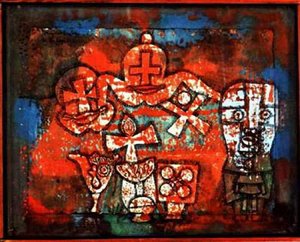
Chinese porcelain - Paul Klee (1879-1940) – This striking painting features four faces arranged on a vibrant red background, embodying Klee’s signature style of playful abstraction and surrealism. Measuring 44 x 46 cm, created in 1940, it showcases Klee's masterful use of color and form.
Biografie kunstenaar
Ontdek Paul Klee (1879-1940): Een Zwitserse kunstenaar die Expressionisme, Kubisme en Surrealisme combineerde tot een speelse abstracte stijl. Laat je inspireren door zijn kleurtheorie & Bauhaus invloed!
About the painting
A Symphony of Geometric Abstraction
In the twilight of his life, Paul Klee composed a visual masterpiece that transcends mere pigment on canvas. The Four Faces, painted in 1940, is not simply an arrangement of shapes but a profound exploration of the human psyche through the lens of geometric abstraction. Moving away from the traditional pursuit of realism, Klee invites the viewer into a world where the boundaries between reality and imagination dissolve. Through a deliberate use of interlocking circles, squares, and triangles, he creates a flattened plane that paradoxically feels infinitely deep, offering a window into an internal landscape where every line and shape carries a weight of meaning.This work stands as a testament to Klee’s ability to reject external appearances in favor of exploring the profound depths of emotion, making it a captivating centerpiece for any collection focused on the evolution of modern art.
The Emotional Resonance of Color and Texture
The true soul of this work lies in its meticulously orchestrated color palette, which functions much like a musical arrangement. Klee utilizes crimson to pulse with passion and vitality, while the earthy tones of ochre provide a grounding sense of stability. The deep, contemplative presence of indigo is balanced by the sudden, radiant joy of lemon yellow—a carefully considered orchestration designed to stimulate an immediate emotional response.This chromatic tension is brought to life through Klee’s masterful technique; by layering delicate watercolor washes with the opaque richness of gouache, he achieves a textural complexity that creates an illusion of movement across the canvas. At the heart of this composition, the presence of a central cross symbol and the varying expressions of the four faces create a surrealistic atmosphere, prompting a deep, meditative engagement with the piece.
A Legacy of Resilience Amidst Chaos
To behold The Four Faces is to witness a silent dialogue with history. Created during the profound uncertainty of World War II, the painting’s fragmented forms serve as a poignant metaphor for the fractured identities and societal upheaval of the era. Each face, positioned in its own corner of the canvas, reflects a different facet of human experience—some searching, some stoic, all part of a larger, broken whole.For the discerning collector or interior designer, this piece offers more than just aesthetic beauty; it provides an intellectual and emotional anchor. A high-quality reproduction of this work brings a sense of historical gravity and sophisticated abstraction to any space, serving as a timeless reminder of the human spirit's ability to find harmony even amidst the most turbulent of times.
Veelgestelde vragen
Hoe is de kleurcompositie van "Chinese porcelain" door Paul Klee opgebouwd?
De kleurcompositie van "Chinese porcelain" door Paul Klee combineert een Bold contrast met een Strong Color Unity harmonie.
Wat is de dominante kleur van "Chinese porcelain" door Paul Klee?
De dominante kleur van "Chinese porcelain" door Paul Klee is Mahogany (#c43d21).
Welk onderwerp en welke sfeer combineert "Chinese porcelain" door Paul Klee?
"Chinese porcelain" door Paul Klee combineert faces, color, geometric shapes, symbolism, expressionism, texture, red background met een Elegant atmosfeer.
Quick facts and art quiz
About Paul Klee

Paul Klee
1879 - 1940, Zwitserland
Biografie kunstenaar
Een Leven Gevuld met Kleur en Vorm
Paul Klee, een naam die synoniem staat voor speelse abstractie en diepe emotionele rijkdom, neemt een unieke positie in het landschap van de 20e-eeuwse kunst in. Geboren op 18 december 1879 in Münchenbuchsee, Zwitserland, was zijn artistieke reis er één van constante verkenning, die zich onttrok aan gemakkelijke categorisering en een pad smidde dat invloeden uit het Expressionisme, Kubisme en Surrealisme combineerde tot een opvallend persoonlijke visuele taal. Klees jeugd voedde een vroege waardering voor de kunsten; zijn vader, een Duitse muziekdocent, en zijn moeder, een Zwitserse zangeres, instilleerden in hem een gevoeligheid voor zowel auditieve als visuele harmonie. Deze fundamentele verbinding tussen muziek en schilderkunst zou een bepalend kenmerk van zijn oeuvre worden, dat niet alleen zijn compositorische benadering vormgaf, maar ook zijn theoretisch begrip van kunst als een vorm van abstracte expressie die vergelijkbaar is met muzikale arrangementen. Aanvankelijk aangetrokken tot tekenen, verliet Klee al snel het nastreven van realistische representatie en erkende de beperkingen ervan bij het overbrengen van de innerlijke wereld van emoties en ideeën die hij wilde uiten. Hij schreef zich in tussen 1898 en 1901 in aan de Academie voor Beeldende Kunsten in München, een periode gekenmerkt door experimenten en de ontwikkeling van zijn unieke artistieke stem.De Vorming van een Artistiek Visie
Klees vroege werk onthult de invloed van Art Nouveau en Symbolisme, maar zelfs binnen deze kaders begonnen er hints van zijn toekomstige stijl te ontstaan. Een cruciaal moment in zijn artistieke ontwikkeling was een reis naar Tunesië in 1914. Het intense licht en de levendige sfeer van Noord-Afrika hadden een diepgaande invloed op zijn kleurgebruik, waardoor hij zich losmaakte van gedempte tinten en overging op gedurfder, expressievere paletten. Deze ervaring markeerde een keerpunt, dat zijn toewijding aan abstractie versterkte als middel om de essentie van perceptie vast te leggen in plaats van alleen het oppervlak ervan na te bootsen. Hij *zag* Tunesië niet simpelweg; hij vertaalde de emotionele resonantie ervan naar visuele vorm. Gedurende deze periode engageerde Klee zich met verschillende artistieke bewegingen, absorbeerde hun principes en verzet zich tegelijkertijd tegen volledige naleving van één enkele ideologie. Zijn interesse in muziek bleef van het grootste belang en hij sprak vaak over schilderen als een proces dat analoog is aan het componeren van muziekstukken – een zorgvuldige rangschikking van elementen om een harmonieus geheel te creëren. Deze synesthetische benadering blijkt uit de ritmische kwaliteit van zijn lijnen, de delicate balans van kleuren en het algehele gevoel van beweging dat veel van zijn werken doordringt.Bauhaus en Verder: Een Periode van Bloei
Van 1931 tot 1933 accepteerde Klee een onderwijsfunctie aan de invloedrijke Bauhaus-school voor kunst, design en architectuur, naast Wassily Kandinsky. Deze periode bleek opmerkelijk vruchtbaar te zijn voor zijn artistieke ontwikkeling. Omringd door innovatieve denkers en medekunstenaars bloeide hij in een omgeving die experimenten en theoretisch onderzoek aanmoedigde. Zijn werk uit deze jaren verdiepte zich verder in de kleurtheorie en formele relaties, waarbij hij de wisselwerking tussen abstracte vormen en emotionele expressie onderzocht. Deze creatieve haven werd echter verstoord door de opkomst van het nazisme in Duitsland. In 1933 werd Klee ontslagen uit het Bauhaus omdat zijn kunst als "ontaard" werd bestempeld door het Nazi-regime – een huiveringwekkend bewijs van de gevaren van politieke ideologie die artistieke vrijheid onderdrukt. Gedwongen terug te keren naar Zwitserland, bleef hij schilderen, maar zijn gezondheid verslechterde onder de schaduw van toenemende politieke onrust en persoonlijke ontberingen. Ondanks deze uitdagingen bleef Klee trouw aan zijn artistieke visie en produceerde werken die zowel de angsten van het tijdperk weerspiegelden als zijn aanhoudend geloof in de kracht van kunst om tegenspoed te overstijgen.Thema's, Stijl en Blijvende Erfenis
Het werk van Paul Klee wordt gekenmerkt door een boeiende mix van speelsheid en diepe contemplatie. Hij gebruikte vaak kinderlijke beelden en grillige composities, doordrenkt met lagen van symbolische betekenis. Terugkerende thema's in zijn kunst omvatten tuinen, landschappen, portretten en abstracte arrangementen – elk als een voertuig voor het verkennen van de complexiteit van menselijke ervaringen. Zijn “Paul Klee Notebooks”, postuum gepubliceerd, bieden waardevolle inzichten in zijn uitgebreide theoretische onderzoeken naar kleur en design, die een nauwgezette en intellectuele benadering van artistieke creatie onthullen. Hij schilderde niet simpelweg; hij construeerde een visuele taal gebaseerd op principes van harmonie, evenwicht en emotionele resonantie. Hamamet, Tuin van het Zuiden en De Zwitscher-Maschine zijn slechts enkele voorbeelden die zijn beheersing van kleur en vorm laten zien. Paul Klee stierf op 29 juni 1940 in Muralto, Zwitserland, en liet een erfenis achter die kunstenaars blijft inspireren en publiek wereldwijd boeit. Hij wordt terecht beschouwd als een van de belangrijkste figuren van de 20e-eeuwse kunst, die de kloof overbrugde tussen figuratieve en abstracte expressie en zijn plaats verankerde als een iconische vernieuwer wiens werk eeuwig relevant blijft.Musea & Verder Onderzoek
- Zentrum Paul Klee (Bern): Thuisbasis van de grootste collectie werken van Klee, die een uitgebreid overzicht biedt van zijn artistieke reis.
- Museum voor Schone Kunsten Bern: Bevat belangrijke stukken van Klee naast meesterwerken van Picasso en Hodler.
- Kunstmuseum Bern: Zwitserlands oudste kunstmuseum, met een diverse collectie waaronder werken van Klee en andere moderne meesters.
Quick facts about Paul Klee
- Artistic Movement Or Style: Expressionisme, Kubisme, Surrealisme
- Artists Or Movements Influenced By This Artist: ['Moderne kunst']
- Artists Who Influenced This Artist: ['Wassily Kandinsky']
- Date Of Birth: 18 december 1879
- Date Of Death: 29 juni 1940
- Full Name: Paul Klee
- Nationality: Zwitsers-Duits
- Notable Artworks:
- Hamamet
- Siblings
- En la corriente seis umbrales
- Place Of Birth: Münchenbuchsee, Zwitserland
Ontdek kunstwerken georganiseerd op thema, stijl en kenmerk.


Paul Klee
Chinese porcelain
() ·
With its frame: · Hand-painted in oil on linen
Total