


 Bekijk op ware grootte
 Verstuur
 Delen
Delen
 Details bekijken
 Gids voor studentenkunstwerken

 Download
 Vergelijkbare items
 Röntgenonderzoek
 Diavoorstelling
 Statistieken
The Wall


Experience Sérusier's vibrant Synthetism in The Wall (1890), a Post-Impressionist mosaic echoing Gauguin's bold color theory; discover this masterpiece today.
 Lees meer
Paul Sérusier (1864-1927) was een Franse kunstenaar die pionier was in abstractie en de invloedrijkste Nabis-beweging inspireerde. Bekend om zijn cloisonnismestijl, met iconische werken zoals "The Talisman", en een belangrijke rol in de ontwikkeling van moderne kunst.
Giclée / Kunstafdrukken
Giclée- of canvasafdruk van museumkwaliteit met een snelle productie en flexibele afwerkingsmogelijkheden. ( Koop handgeschilderd kunstwerk Schakel over naar digitale afbeeldingen)




P118B €10

P118H €10

P118W €10

P438Z €10

P508JH €12

P508YH €12

P805H €10

P805Z €10

P919BZ €10

P919G €10

P919XJ €10

P959ZH €10

P968JZ €12

W106C €8

W218G €10

W218JH €8

W218Y €10

W307PJ €10

W316G €10

W316PJ €8

W316Y €10

W398PJ €8

W4111J €10

W500HY €15

W500JH €15

W692G €12

W849H €8

W940BG €15

W953PJ €8




Standaardformaat
op maat gemaakt
CM
INCH
Kies uit onze vooraf ingestelde maten die overeenkomen met de originele verhoudingen van het kunstwerk.
Loading sizes...

breedte
hoogte
U kunt uw eigen afmetingen opgeven om in een specifieke lijst of ruimte te passen. Als de door u gekozen maat niet overeenkomt met de proporties van het originele kunstwerk, zullen wij de afbeelding bijsnijden of uitbreiden met een gespiegelde of effen rand. Een digitaal mockup wordt ter goedkeuring naar u verzonden voordat de productie begint.
Houd er rekening mee dat de preview op het scherm de werkelijke bijsneding of uitbreiding niet weergeeft. Alleen de mockup toont de uiteindelijke compositie nauwkeurig.
Hoewel aangepaste maten beschikbaar zijn, raden wij aan een afmeting uit de vooraf bepaalde lijst te kiezen om de originele proporties te behouden.
Wereldwijde levering () binnen 2 weken in plaats van de standaard 4/5 weken. (12 oktober)

Gratis wereldwijde expressverzending

Hoogwaardig linnen canvas

Volledige verzendverzekering

Garantie op terugbetaling van invoerrechten

Garantie op exacte kleurweergave

Retourbeleid van 100 dagen (alleen bij defecten)

100% Geld-terug-garantie

Korting bij meerdere afnames
 De optie voor glas is alleen beschikbaar bij een formaat kleiner dan 110 cm.

The Wall
Giclée / Kunstafdrukken
Formaat reproductie
-


Totaalprijs
€ 60
A Visionary Echo of Gauguin's Influence
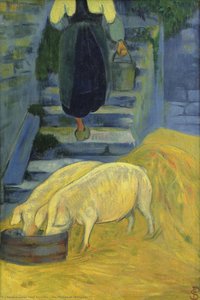
Paul Sérusier’s “The Wall,” painted in 1890, stands as a testament to the burgeoning spirit of abstraction within Post-Impressionism and represents a crucial juncture in artistic history. Executed during his formative years alongside Vincent van Gogh and Paul Gauguin at Pont-Aven, Brittany, this unassuming landscape transcends mere depiction; it embodies a deliberate quest for expressive simplification—a technique championed by Gauguin himself—that would profoundly shape the trajectory of modern art.
- Subject Matter: The painting captures a tranquil rural scene featuring a man seated beside a weathered fence, framed against a backdrop of lush greenery and scattered trees.
- Style: Sérusier’s style aligns squarely with Synthetism, an avant-garde movement born from Gauguin's exploration of pure color and form. It eschews meticulous realism in favor of conveying emotion and spiritual resonance through flattened planes of pigment.
Technique: Cloisonnism – A Bold Departure From Tradition
Sérusier’s masterful application of cloisonnism—a technique popularized by Gauguin—is immediately apparent. Unlike traditional oil painting, where colors blend seamlessly, cloisonnism employs thin layers of pigment separated by lines of white gesso or bole. This method creates a mosaic-like effect, emphasizing distinct areas of color and enhancing the textural quality of the artwork. The deliberate use of white adds luminosity and contributes to the overall sense of serenity.
Historical Context: Gauguin’s Pont-Aven Circle & The Seeds of Abstraction
“The Wall” emerged from the influential Pont-Aven circle, where Sérusier collaborated closely with Gauguin on groundbreaking artistic experiments. Gauguin's unwavering belief in the power of color and symbolic representation served as a catalyst for artists like Sérusier to push beyond Impressionistic conventions. This painting represents not merely a beautiful landscape but also an active engagement with philosophical ideas concerning spirituality and the relationship between humanity and nature—themes central to the broader artistic discourse of the period.
Symbolism & Emotional Resonance: Beyond Representation
The composition itself speaks volumes about Sérusier’s intentions. The solitary figure, positioned near the fence, suggests contemplation and introspection. While seemingly simple in its visual elements, “The Wall” vibrates with emotional depth—a quiet stillness punctuated by the vibrant hues of the surrounding landscape. It invites viewers to consider not what is seen but what is felt; a subtle echo of Gauguin’s desire to capture the essence of experience rather than merely reproducing it.
A Legacy of Influence
"The Wall" solidified Sérusier's position as one of the foremost figures in Synthetism and profoundly impacted subsequent generations of artists. Its understated beauty combined with its innovative technique continues to inspire admiration and serves as a poignant reminder of the transformative potential inherent within artistic exploration—a legacy that resonates powerfully even today.
Vragen & Antwoorden
Waar kan ik "The Wall" door Paul Sérusier downloaden?
"The Wall" door Paul Sérusier kan worden gedownload via de Downloaden-pagina van het kunstwerk, als een download van een digitale afbeelding in hoge resolutie.
Welke ruimte past bij de kleuren van "The Wall" door Paul Sérusier?
De Dark kleuren van "The Wall" door Paul Sérusier passen perfect bij de aanbevolen ruimte: een Living Room.
Hoe kan ik een reproductie van "The Wall" door Paul Sérusier bekijken?
Op de Voorvertoning-pagina van "The Wall" kunt u het kunstwerk bekijken voordat u bestelt.
Kan ik een olieverfreproductie van "The Wall" bestellen?
"The Wall" is verkrijgbaar als een met de hand geschilderde olieverfreproductie op linnen canvas. De bestelling kan worden geplaatst via deze pagina, met een keuze uit verschillende formaten.
Waarvoor wordt een reproductie van "The Wall" door Paul Sérusier aanbevolen?
Het aanbevolen gebruik van een afdruk van "The Wall" is Accent.
Hoe oud was Paul Sérusier toen "The Wall" werd gemaakt?
Paul Sérusier was 26 jaar oud bij het creëren van "The Wall" in 1890. De leeftijd is berekend op basis van het geboortejaar van de kunstenaar, 1864.
Waar zou een reproductie van "The Wall" door Paul Sérusier opgehangen moeten worden?
Formaat (Landscape) en aanbevolen ruimte (Living Room) zijn de twee plaatsingskenmerken vastgelegd voor "The Wall" door Paul Sérusier.
Is "The Wall" door Paul Sérusier een licht of een donker kunstwerk?
De vastgestelde waarden voor "The Wall" door Paul Sérusier zijn: balanced helderheid, Gentle Luminance luminantie.
Gerelateerde kunstwerken




Biografie van de kunstenaar
Paul Sérusier: De Pionier van Abstractie en de Nabis
Paul Sérusier, geboren in Parijs op 9 november 1864 en overleden in Morlaix op 7 oktober 1927, was een Franse kunstenaar die een onmiskenbare rol speelde in de ontwikkeling van abstracte kunst. Hij behoort tot de invloedrijke groep de Nabis, maar zijn baanbrekende experimenten met kleur, vorm en compositie legden de basis voor veel latere ontwikkelingen in de moderne kunst.
Sérusier’s jeugd was gekleurd door een comfortabele achtergrond. Zijn vader, een succesvolle parfumeur, kon hem een goede opleiding bieden. Hij begon zijn artistieke reis op de École Fénelon, waar hij snel werd erkend als een uitzonderlijk talent. Een belangrijke invloed kwam echter via het bezoek aan de Académie Julian, waar hij kennismaakte met andere jonge kunstenaars en de werken van Paul Gauguin ontdekte – een ontdekking die zijn artistieke visie voorgoed zou veranderen.
De Invloed van Pont-Aven en Gauguin
In de zomer van 1888 reisde Sérusier naar Pont-Aven, een pittoresk dorp in Brittany. Daar sloot hij zich aan bij een kring van kunstenaars die onder leiding stond van Paul Gauguin. Onder Gauguin’s begeleiding experimenteerde Sérusier met nieuwe technieken en benaderingen. Een cruciaal moment was de schilderij *Le Talisman*, dat hij in 1888 maakte. Dit werk, een extreem voorbeeld van cloisonnism – een stijl gekenmerkt door dichte, afgebakende vormen en heldere kleuren – markeerde een belangrijke verschuiving naar abstractie. Gauguin’s advies om de werkelijkheid te interpreteren in plaats van letterlijk na te bootsen, vormde hierbij de basis.
De omgeving van Pont-Aven, met zijn ruige landschappen en mysterieuze bossen, inspireerde Sérusier enorm. Hij probeerde de essentie van de natuur vast te leggen in zijn schilderijen, waarbij hij zich concentreerde op het overbrengen van emoties en gevoelens in plaats van een exacte weergave van de omgeving.
De Nabis: Een Nieuw Artistiek Idiom
Samen met Gauguin, Maurice Denis, Pierre Bonnard en Édouard Vuillard richtte Sérusier de groep de Nabis op. De naam ‘Nabis’ verwijst naar het Hebreeuwse woord voor ‘profet’, wat duidt op hun streven om een nieuwe artistieke richting te bepalen. De Nabis-kunstenaars zagen zichzelf als volgers van Christ, die door hun kunst de wereld wilden verlichten. Hun werk kenmerkte zich door een expressieve kleurgebruik, het gebruik van platte vormen en een focus op symboliek.
Sérusier’s bijdrage aan de Nabis was cruciaal. Hij experimenteerde met verschillende technieken, waaronder cloisonnism en synthetism – een stijl die gericht was op het combineren van elementen uit verschillende kunststromingen. Zijn werk diende als inspiratie voor andere Nabis-kunstenaars en legde de basis voor de ontwikkeling van abstracte kunst in Frankrijk.
Belangrijke Werken en Erfgoed
Sérusier’s oeuvre omvat een reeks schilderijen die getuigen van zijn innovatieve stijl. Enkele bekende werken zijn *L'Averse* (1893), dat zich afspeelt in het Musée d'Orsay, Parijs; *Portrait of Paul Ranson* (1890), ook te zien in het Musée d’Orsay; en *The Snake Eaters* (1894), een krachtig beeld van de Bretonse landelijke cultuur, nu te vinden in het Nationaal Museum van Warschau. Zijn latere jaren brachten leswerk aan de École Ranson en de publicatie van zijn boek ‘ABC de la peinture’ in 1921.
Paul Sérusier’s nalatenschap is enorm. Hij wordt beschouwd als een pionier van abstracte kunst en een belangrijke invloedrijke figuur binnen de Nabis-beweging. Zijn experimenten met kleur, vorm en compositie hebben generaties kunstenaars geïnspireerd en de weg geëffend voor de ontwikkeling van moderne kunst.

Paul Sérusier
1864 - 1927 , Frankrijk
Snelle feiten
- Artistic Movement Or Style: Post-Impressionisme
- Artists Or Movements Influenced By This Artist: ['Les Nabis']
- Artists Who Influenced This Artist:
- Paul Gauguin
- Maurice Denis
- Date Of Birth: 9 november 1864
- Date Of Death: 7 oktober 1927
- Full Name: Louis-Paul-Henri Sérusier
- Nationality: Frans
- Notable Artworks:
- Le Talisman
- L'Averse
- Melancholy
- Place Of Birth: Parijs, Frankrijk
Gerelateerde artikelen

Modern Soul, Timeless Light: Bringing the Magic of Impressionist Masterpieces into Contemporary Interiors
Discover how to infuse contemporary spaces with the luminous magic of Impressionism. From Monet's light to Renoir's warmth, learn expert tips for styling hand-painted masterpieces and custom art reproductions in your modern home.

Capturing Contemplation: The Most Thoughtful Impressionist Masterpieces
Explore the profound emotional depth of Impressionist and Post-Impressionist masterpieces. From Renoir's tranquil landscapes to Van Gogh's vibrant soul, discover how these legendary artists captured the essence of contemplation through light, color, and texture.

The Art of Connection: Capturing Beautiful Gatherings through Impressionist Masterpieces
Explore the profound beauty of human connection through Impressionist and Post-Impressionist masterpieces. Discover how masters like Renoir and Van Gogh captured light, emotion, and communal joy in timeless works of art designed to inspire your home.

Capturing the Soul: The Most Emotionally Moving Impressionist and Post-Impressionist Masterpieces
Discover the profound emotional depth of Impressionist and Post-Impressionist masterpieces. Explore how legends like Monet, Van Gogh, and Gauguin captured light and soul through evocative landscapes and vibrant brushwork for a timeless connection to art history.

Beyond the Light: Discovering the Soul and Emotional Depth of Post-Impressionism
Embark on a cultural journey through Post-Impressionism. Discover the profound emotional depth of masters like Van Gogh and Cézanne, exploring how they moved beyond light to capture the very soul of human experience through vibrant color and symbolic form.
Ontdek kunstwerken georganiseerd op thema, stijl en kenmerk.


