

Shown: · With its frame:
 Voorvertoning
 Verstuur
 Delen
Delen
 Details bekijken
 Gids
Gids

 Download
 Vergelijkbare items
 Röntgenonderzoek
 Diavoorstelling
 Q&A
Q&A Statistieken
 Acrylic On Canvas
- WallArt
- Neo-Impressionistic Pointillism
 1904
1904- 19th Century
 65.0 x 81.0 cm
€ 237
Handgemaakte olieverfreproductie
Met de hand geschilderd in olieverf op canvas in uw gewenste maat en lijst, op bestelling gemaakt door onze kunstenaars. ( Schakel over naar print Schakel over naar digitale afbeeldingen)
Size
·Standaardformaat
op maat gemaakt
CM
INCH
Kies uit onze vooraf ingestelde maten die overeenkomen met de originele verhoudingen van het kunstwerk.
Loading sizes...

breedte
hoogte
Voer de breedte en hoogte in die u nodig heeft, passend bij uw lijst of uw muur. Omdat dit handgeschilderd is, kan de kunstenaar bij een afmeting met een andere beeldverhouding iets meer rondom het schilderij schilderen of juist iets meer weglaten — u kiest zelf. Wij sturen u een digitaal mockup ter goedkeuring voordat het schilderwerk begint. De afbeelding die op deze pagina wordt getoond, is niet het uiteindelijke resultaat — alleen de mockup geeft dit weer.
 Lees meer over
Finish
·
White €1

Blurside €1

Extended €1

P118B €10

P118H €10

P118W €10

P438Z €10

P508JH €12

P508YH €12

P805H €10

P805Z €10

P919BZ €10

P919G €10

P919XJ €10

P959ZH €10

P968JZ €12

W106C €8

W218G €10

W218JH €8

W218Y €10

W307PJ €10

W316G €10

W316PJ €8

W316Y €10

W398PJ €8

W4111J €10

W500HY €15

W500JH €15

W692G €12

W849H €8

W940BG €15

W953PJ €8

H24-GOLD €30

H24-SILVER €30

H36-GOLD €45

H36-SILVER €45
Shipped in a protective tube, ready for your own framer.
Above 105 cm the frame is shipped as a kit for a professional framer — read the details.
Extras
optionalWhat do the extras include?
Examples of what can be changed: Replace face with customer photo; Add pet (e.g., replace cat with dog); Include hidden message in background; Change background landscape or elements.
After order, TopImpressionists.com team will email client for instructions and provide a mockup preview
After order, TopImpressionists.com team will email client for instructions and provide a mockup preview
Wereldwijde levering () binnen 3 tot 4 weken in plaats van de standaard 5 weken. (30 oktober). Zonder concessies aan de kwaliteit.
Beschermende vernislaag
Naamplaatje
Details van de gegraveerde bronzen plaat
This elegant plaque features the artist's name and the title of the artwork, finely engraved for a timeless presentation.
It is made from bronze with a refined, elegant finish. The text is precisely laser-engraved for a sharp and permanent result. Measuring 9x2 cm, the plaque is compact yet easy to read. It's built to be durable and scratch-resistant, offering a professional, museum-quality look. Mounting is simple thanks to the included adhesive backing.
Details transparante acrylplaat
The plaque includes essential engraved details such as the artist's name, the title of the artwork, the date it was created, the type of media used-like oil on canvas or watercolor-a brief description of the piece, and a QR code that links to the complete artwork information.
It is crafted from clear acrylic, offering a sleek, modern appearance. The text is UV-engraved in black to ensure strong visual contrast. With a size of 10x15 cm, it ensures optimal readability. It comes equipped with two metal hooks for secure wall mounting. The plaque is designed to be weather-resistant, making it suitable for various environments, and it includes interactive features that work seamlessly with smartphone scanning.
Details zwarte acrylplaat
This elegant plaque includes engraved information such as the artist's name, the title of the artwork, the date it was created, the type of media used (like oil on canvas or watercolor), a short description of the artwork, and a QR code for quick access to more information.
The plaque itself is made from refined black acrylic with a premium finish. The text is laser-engraved in white for high contrast and readability. Its size is 10x15 cm, designed to be easy to read. It comes with two metal hooks for professional mounting. The design is sleek and fits any interior style. It is also weather-resistant and durable, with built-in digital integration for mobile compatibility.
De optie voor glas is alleen beschikbaar bij een formaat kleiner dan 110 cm.
 De optie voor glas is alleen beschikbaar bij een formaat kleiner dan 110 cm.
- Gratis wereldwijde expressverzending
- Hoogwaardig linnen canvas
- Volledige verzendverzekering
- Garantie op terugbetaling van invoerrechten
- Garantie op exacte kleurweergave
- Retourbeleid van 100 dagen (alleen bij defecten)
- 100% Geld-terug-garantie
- Korting bij meerdere afnames


Beschrijving verzamelobject
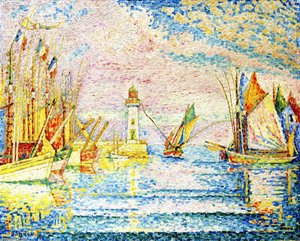
Experience Paul Signac’s vibrant ‘La Voile verte,’ a stunning Pointillist masterpiece capturing sailboats with colorful sails in 1904. This iconic artwork, a cornerstone of Neo-Impressionism, offers a beautiful glimpse into the Harmonious Vision of Paul Signac – discover or own this timeless treasure.
Biografie kunstenaar
Paul Signac (1863-1935): De vindingrijke Neo-Impressionist met zijn kenmerkende Pointillisme, die de kleuren van de zee en steden meesterlijk vastlegde. Ontdek zijn briljante werken!
About the painting
Paul Signac’s *La Voile verte*: A Symphony of Light and Color
Paul Signac's 1904 painting, *La Voile verte*, is more than just a depiction of a serene coastal scene; it’s a meticulously constructed testament to the revolutionary principles of Neo-Impressionism. This vibrant canvas captures a fleeting moment on the water – sailboats gliding across a brilliant blue expanse – rendered with an almost scientific precision that reveals Signac's deep engagement with the burgeoning field of color theory. The painting, measuring 65 x 81 cm, immediately draws the viewer into its luminous embrace, inviting contemplation of light, movement, and the very nature of perception.
The Pointillist Technique: A Calculated Brilliance
*La Voile verte* exemplifies Signac’s mastery of Pointillism, a technique he developed in collaboration with Georges Seurat. Rather than blending colors on the palette or directly on the canvas, Signac employed thousands of tiny, distinct dots – *touches* as he called them – of pure color. These individual points, when viewed from a distance, optically blend to create an illusion of tone and hue. This method wasn’t simply a stylistic choice; it was rooted in scientific observation of how the human eye perceives color. Signac believed that by isolating and applying these pure colors, he could achieve a greater luminosity and vibrancy than traditional blending techniques allowed. The result is a shimmering surface alive with reflected light, capturing the dynamism of the water and the sails with remarkable fidelity.
Historical Context: Neo-Impressionism’s Pursuit of Scientific Beauty
Created in 1904, *La Voile verte* sits firmly within the context of Neo-Impressionism, a movement that emerged as a reaction against the subjective Impressionists. While Impressionists sought to capture fleeting moments and atmospheric effects, Signac and Seurat aimed for a more systematic approach – one grounded in scientific principles. They drew inspiration from the work of Eugène Chevreul, a chemist who had studied color perception and demonstrated how complementary colors could enhance each other’s brilliance. This pursuit of ‘scientific beauty’ sought to unlock the secrets of light and color through rigorous observation and methodical application.
Symbolism and Emotional Impact
Beyond its technical innovation, *La Voile verte* evokes a powerful sense of tranquility and leisure. The sailboats, with their billowing green sails, represent freedom, movement, and connection to nature. The bright blue water mirrors the sky, creating a harmonious balance that is both visually stunning and emotionally soothing. Signac’s meticulous attention to detail – from the reflections on the water to the subtle variations in color – invites the viewer to lose themselves in the scene, experiencing a moment of quiet contemplation amidst the bustle of modern life. This painting continues to resonate with its masterful use of light and color, offering a timeless depiction of beauty and serenity.
Veelgestelde vragen
Is "La Voile verte" typerend voor het werk van Paul Signac?
De terugkerende thema's van Paul Signac omvatten monet, seurat influence, color theory exploration, pointillism technique applied, coastal scene depiction, signac’s artistic evolution; "La Voile verte" richt zich op sailboats, water scene, pointillism, color theory, signac artwork, blue hues, coastal painting.
Waarom heeft het kunstwerk "La Voile verte" deze auteursrechtelijke status?
De auteursrechtstatus van "La Voile verte" - bevindt zich in het publiek domein - de auteursrechten zijn verlopen - is gebaseerd op het overlijden van de kunstenaar in 1935.
Wat zijn de afmetingen van het originele "La Voile verte"?
De afmetingen van "La Voile verte" door Paul Signac zijn 65 x 81 cm. Reproducties kunnen in andere formaten worden besteld met behoud van dezelfde verhoudingen.
Quick facts and art quiz
About Paul Signac

Paul Signac
1863 - 1935, Frankrijk
Biografie kunstenaar
The Harmonious Vision of Paul Signac
Paul Victor Jules Signac, geboren in Parijs in 1863, kwam op als een sleutelfiguur in de evolutie van moderne kunst, onlosmakelijk verbonden met de geboorte en ontwikkeling van Neo-Impressionisme. In eerste instantie aangetrokken tot architectuur, leidde een jeugdige ontmoeting met de tentoonstelling van Claude Monet binnenin hem een blijvende passie voor schilderkunst, die hem op een pad plaatste dat kleurtheorie en artistieke expressie opnieuw zou definiëren. Signac was niet alleen een kunstenaar; hij was een toegewijde verkenner van licht, kleur en het fundamentele wetenschappelijke begrip van visuele waarneming. Zijn vroege werken, hoewel Impressionistische neigingen vertoonden, evolueerden snel onder de diepe invloed van Georges Seurat, waardoor een partnerschap ontstond dat Pointillisme – een techniek gekenmerkt door de nauwkeurige toepassing van minuscule, afzonderlijke punten van zuivere kleur bedoeld om optisch te mengen in het oog van de toeschouwer – tot leven bracht. Dit was niet alleen een kwestie van esthetiek; het was een poging om schilderkunst systematisch aan te pakken, het te verankeren in wetenschappelijke principes en conventionele artistieke normen uit te dagen.Een Dialoog met Seurat en de Geboorte van Neo-Impressionisme
De ontmoeting tussen Signac en Seurat in 1884 bleek transformatief voor beide kunstenaars. Ze deelden een fascinatie voor de geschriften van Eugène Delacroix over kleurtheorie, met name zijn verkenning van complementaire contrasten en het emotionele effect van tinten. Samen begonnen ze een rigoureuze onderzoeksronde in deze principes, die ze vertaalden naar een revolutionaire schildertechniek. Signac omarmde Seurat’s visie volkomen, liet de vluchtige penseelstreken van het Impressionisme achter en nam de nauwkeurige, berekende toepassing van kleurpunten aan. *Boulevard de Clichy* (1886) staat als een vroeg bewijs van deze nieuwe benadering, die Signac’s nauwkeurige stijl en zijn toewijding om het bruisende leven van de stad te vangen door middel van een wetenschappelijke lens weer te geven. Echter, hun samenwerking was niet alleen technisch; het was ook intellectueel, gevoed door een gedeelde wens om schilderkunst op hetzelfde niveau als een strenge rationaliteit te tillen. Signac werd een toegewijde pleitbezorger voor Seurat’s ideeën, die de Neo-Impressionistische beweging onvermoeibaar promootte en zijn principes verdedigde tegen kritiek. Het tragische vroege overlijden van Seurat in 1891 liet Signac achter als de belangrijkste vertegenwoordiger van hun gedeelde artistieke visie, een rol die hij met onwrikbare toewijding omarmde.Zeegezichten en Artistieke Onafhankelijkheid
Na het overlijden van Seurat nam Signac’s artistieke reis een nieuwe dimensie aan, sterk beïnvloed door zijn diepe liefde voor zeilen en de aantrekkingskracht van de Middellandse Zee. Hij ontdekte Saint-Tropez in 1892 en vestigde daar een thuis dat een schuilplaats werd voor kunstenaars en een bron van eindeloze inspiratie. De fonkelende wateren, zonnige havens en pittoreske kustlandschappen boden de ideale setting om de interactie tussen licht en kleur te verkennen. *The Red Buoy, Saint-Tropez* (1895) toont dit, waarbij zijn meesterschap van Pointillisme wordt getoond bij het vastleggen van de levendige kleuren en dynamische energie van de zee. Zijn techniek evolueerde, werd vloeiender en expressiever terwijl hij toch vasthield aan de wetenschappelijke basis. Hij begon te experimenteren met grotere penseelstreken en een bredere palet, waarbij hij verder ging dan het strikte naleven van Seurat’s nauwkeurige dottechniek. Signac’s reizen gingen verder dan Frankrijk, omvatten Italië, Nederland en zelfs Constantinopel, elk reisje verrijkte zijn artistieke woordenschat en breidde zijn perspectief uit.Een Patron van de Avant-Garde en Erfgoed
Naast zijn eigen artistieke inspanningen speelde Signac een cruciale rol bij het bevorderen van de ontwikkeling van moderne kunst door zijn leiderschap binnen de Société des Artistes Indépendants. Als president vanaf 1908 tot aan zijn overlijden in 1935, promootte hij artistieke vrijheid en bood hij een platform voor opkomende talenten, waaronder Henri Matisse, André Derain en andere pioniers van Fauvisme en Kubisme. Hij was een van de eersten die hun baanbrekende werk erkende en steunde, controversiële werken tentoonstelde die conventionele esthetische normen uitdaagden. Signac’s toewijding aan inclusiviteit en zijn bereidheid om innovatie te omarmen hebben de loopbaan van de 20e-eeuwse kunst vormgegeven, een blijvend spoor achterlatend voor generaties kunstenaars. Zijn theoretische geschriften, met name *From Eugène Delacroix to Neo-Impressionism* (1899), versterkten zijn positie als een leidende intellectuele figuur in de kunstwereld.Belangrijke datums & prestaties
- 1863: Geboren in Parijs, Frankrijk.
- 1884: Co-stichtte de Société des Artistes Indépendants met Georges Seurat.
- 1886: Schilderde *Boulevard de Clichy*, een sleutelvoorbeeld van vroege Pointillisme.
- 1895: Creeerde *The Red Buoy, Saint-Tropez*, die zijn meesterschap van kustlandschappen demonstreert.
- 1899: Publiceerde *From Eugène Delacroix to Neo-Impressionism*, een baanbrekend werk over kleurtheorie.
- 1908 – 1935: Diende als president van de Société des Artistes Indépendants, die avant-garde kunstenaars promootte.
- 1935: Overleden in Parijs op 72-jarige leeftijd, achterlatend een rijke artistieke nalatenschap.
Quick facts about Paul Signac
- Artistic Movement Or Style: Neo-Impressionisme, Pointillisme
- Artists Or Movements Influenced By This Artist:
- Henri Matisse
- Fauvisme
- Artists Who Influenced This Artist:
- Claude Monet
- Georges Seurat
- Date Of Birth: 11 november 1863
- Date Of Death: 15 augustus 1935
- Full Name: Paul Victor Jules Signac
- Nationality: Frans
- Notable Artworks:
- Boulevard de Clichy
- De Rode Vlag
- La Valleuse
- De Velodrome
- Place Of Birth: Parijs, Frankrijk
Vergelijkbare kunstwerken




Ontdek kunstwerken georganiseerd op thema, stijl en kenmerk.


Paul Signac
La Voile verte
() ·
With its frame: · Hand-painted in oil on linen
Total