

Shown: · With its frame:
 Voorvertoning
 Verstuur
 Delen
Delen
 Details bekijken
 Gids
Gids

 Download
 Vergelijkbare items
 Röntgenonderzoek
 Diavoorstelling
 Q&A
Q&A Statistieken
 Acrylic On Canvas
- WallArt
- German Romanticism
 1809
1809- 19th Century
 225.0 x 189.0 cm
 Hamburger Kunsthalle
€ 239
Handgemaakte olieverfreproductie
Met de hand geschilderd in olieverf op canvas in uw gewenste maat en lijst, op bestelling gemaakt door onze kunstenaars. ( Schakel over naar print Schakel over naar digitale afbeeldingen)
Size
·Standaardformaat
op maat gemaakt
CM
INCH
Kies uit onze vooraf ingestelde maten die overeenkomen met de originele verhoudingen van het kunstwerk.
Loading sizes...

breedte
hoogte
Voer de breedte en hoogte in die u nodig heeft, passend bij uw lijst of uw muur. Omdat dit handgeschilderd is, kan de kunstenaar bij een afmeting met een andere beeldverhouding iets meer rondom het schilderij schilderen of juist iets meer weglaten — u kiest zelf. Wij sturen u een digitaal mockup ter goedkeuring voordat het schilderwerk begint. De afbeelding die op deze pagina wordt getoond, is niet het uiteindelijke resultaat — alleen de mockup geeft dit weer.
 Lees meer over
Finish
·
White €1

Blurside €1

Extended €1

P118B €10

P118H €10

P118W €10

P438Z €10

P508JH €12

P508YH €12

P805H €10

P805Z €10

P919BZ €10

P919G €10

P919XJ €10

P959ZH €10

P968JZ €12

W106C €8

W218G €10

W218JH €8

W218Y €10

W307PJ €10

W316G €10

W316PJ €8

W316Y €10

W398PJ €8

W4111J €10

W500HY €15

W500JH €15

W692G €12

W849H €8

W940BG €15

W953PJ €8

H24-GOLD €30

H24-SILVER €30

H36-GOLD €45

H36-SILVER €45
Shipped in a protective tube, ready for your own framer.
Above 105 cm the frame is shipped as a kit for a professional framer — read the details.
Extras
optionalWhat do the extras include?
Examples of what can be changed: Replace face with customer photo; Add pet (e.g., replace cat with dog); Include hidden message in background; Change background landscape or elements.
After order, TopImpressionists.com team will email client for instructions and provide a mockup preview
After order, TopImpressionists.com team will email client for instructions and provide a mockup preview
Wereldwijde levering () binnen 3 tot 4 weken in plaats van de standaard 5 weken. (31 oktober). Zonder concessies aan de kwaliteit.
Beschermende vernislaag
Naamplaatje
Details van de gegraveerde bronzen plaat
This elegant plaque features the artist's name and the title of the artwork, finely engraved for a timeless presentation.
It is made from bronze with a refined, elegant finish. The text is precisely laser-engraved for a sharp and permanent result. Measuring 9x2 cm, the plaque is compact yet easy to read. It's built to be durable and scratch-resistant, offering a professional, museum-quality look. Mounting is simple thanks to the included adhesive backing.
Details transparante acrylplaat
The plaque includes essential engraved details such as the artist's name, the title of the artwork, the date it was created, the type of media used-like oil on canvas or watercolor-a brief description of the piece, and a QR code that links to the complete artwork information.
It is crafted from clear acrylic, offering a sleek, modern appearance. The text is UV-engraved in black to ensure strong visual contrast. With a size of 10x15 cm, it ensures optimal readability. It comes equipped with two metal hooks for secure wall mounting. The plaque is designed to be weather-resistant, making it suitable for various environments, and it includes interactive features that work seamlessly with smartphone scanning.
Details zwarte acrylplaat
This elegant plaque includes engraved information such as the artist's name, the title of the artwork, the date it was created, the type of media used (like oil on canvas or watercolor), a short description of the artwork, and a QR code for quick access to more information.
The plaque itself is made from refined black acrylic with a premium finish. The text is laser-engraved in white for high contrast and readability. Its size is 10x15 cm, designed to be easy to read. It comes with two metal hooks for professional mounting. The design is sleek and fits any interior style. It is also weather-resistant and durable, with built-in digital integration for mobile compatibility.
De optie voor glas is alleen beschikbaar bij een formaat kleiner dan 110 cm.
 De optie voor glas is alleen beschikbaar bij een formaat kleiner dan 110 cm.
- Gratis wereldwijde expressverzending
- Hoogwaardig linnen canvas
- Volledige verzendverzekering
- Garantie op terugbetaling van invoerrechten
- Garantie op exacte kleurweergave
- Retourbeleid van 100 dagen (alleen bij defecten)
- 100% Geld-terug-garantie
- Korting bij meerdere afnames


Beschrijving verzamelobject
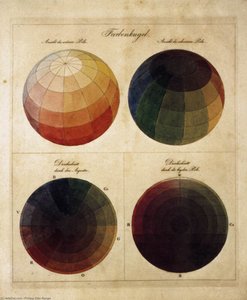
Experience 'Colour Spheres' by Philipp Otto Runge – a mesmerizing 1809 engraving depicting vibrant color spheres arranged in a harmonious circular design. A captivating piece of Romantic art.
Biografie kunstenaar
Philipp Otto Runge (1777-1810) was een Duits romantisch schilder beroemd om zijn symbolische landschappen, portretten en baanbrekende kleurtheorie ('Kleursfeer'). Ontdek zijn mystieke kunst en blijvende invloed.
About the painting
A Symphony of Color: Philipp Otto Runge’s “Colour Spheres”
Philipp Otto Runge's "Colour Spheres," painted in 1809, isn’t merely a depiction of spheres; it’s an intensely personal and profoundly symbolic exploration of color theory, spirituality, and the very essence of perception. Created during a pivotal moment in German Romanticism – a period grappling with tradition versus innovation, reason versus emotion – Runge sought to move beyond the constraints of academic painting and forge a new visual language rooted in his own deeply felt inner world. The work, now housed within the Kunsthalle in Hamburg, Germany, is a testament to this ambition, radiating an almost palpable sense of contemplative energy.
The composition itself is deceptively simple: four distinct spheres dominate the canvas, each imbued with a unique chromatic harmony. These aren’t static objects; they appear to pulse with light and movement, their surfaces shimmering with subtle gradations of color. Runge masterfully employs a technique reminiscent of both pastel drawing and early Impressionism – delicate layering of translucent washes creates an ethereal quality, while careful attention to value and hue establishes a remarkable sense of depth and luminosity. The spheres aren’t rendered with photographic realism; instead, they are idealized forms, suggesting a connection to the divine or the abstract realms of consciousness. The choice of materials—engraving media—contributes to this luminous effect, allowing for a richness of tone rarely achieved with oil paint alone.
The Roots of Color Theory and Spiritual Symbolism
Runge’s fascination with color stemmed from his deep engagement with the philosophy of Jakob Böhme, a 17th-century German mystic who believed that colors possessed inherent spiritual significance. Böhme posited that each hue corresponded to a specific stage of human development or a particular aspect of the divine. Runge sought to translate these esoteric ideas into visual form, believing that color could be used to unlock deeper levels of understanding and experience. His work reflects this intellectual pursuit, moving beyond mere representation to become a vehicle for conveying complex philosophical concepts.
The arrangement of the spheres themselves is laden with symbolic meaning. The central sphere, predominantly red, often represents passion, energy, and earthly existence – the realm of the senses. The green sphere embodies growth, harmony, and connection to nature. Blue signifies intellect, contemplation, and the spiritual realm. Yellow, positioned furthest from the viewer, evokes joy, enlightenment, and divine grace. The circular arrangement suggests a cyclical process—a journey through different states of consciousness or stages of life. It’s important to note that Runge's color theory was radically different from prevailing scientific understanding at the time; he prioritized subjective experience over objective measurement.
A Dialogue with Goethe and the Romantic Spirit
Runge’s work resonated deeply with his contemporary, Johann Wolfgang von Goethe, who shared a profound interest in color theory. The two artists engaged in extensive correspondence, exchanging ideas about the nature of perception and the expressive potential of color. Indeed, Runge's exploration of color was heavily influenced by Goethe’s theories on optics and aesthetics. This intellectual exchange highlights the vibrant artistic and philosophical ferment of the early 19th century – a period marked by a renewed interest in spirituality, emotion, and the power of individual experience.
Furthermore, “Colour Spheres” embodies the core tenets of German Romanticism: an emphasis on intuition, imagination, and the sublime. It rejects the rationalism of the Enlightenment in favor of a more subjective and emotionally charged approach to art. The painting’s evocative atmosphere—its sense of mystery, wonder, and spiritual yearning—captures the essence of this artistic movement perfectly. It invites the viewer not simply to *see* the colors but to *feel* them, to connect with their own inner world.
Collecting a Timeless Masterpiece
Reproductions of “Colour Spheres” offer a remarkable opportunity to bring Runge’s visionary aesthetic into any interior space. The delicate layering and luminous quality of the original are faithfully reproduced in high-quality prints, allowing the painting's subtle nuances to shine through. Whether displayed as a statement piece or incorporated into a more restrained color scheme, this artwork will undoubtedly serve as a focal point, sparking conversation and inspiring contemplation. Consider commissioning a hand-painted reproduction – a truly unique and authentic representation of this seminal work of German Romantic art.
Veelgestelde vragen
Waarvoor wordt een afdruk van "Colour Spheres" aanbevolen?
Een afdruk van "Colour Spheres" wordt aanbevolen voor Statement.
Hoe groot is het contrast in "Colour Spheres" door Philipp Otto Runge?
Het licht-donkercontrast van "Colour Spheres" wordt weergegeven als Statement. Contrast beschrijft hoe sterk de lichte en donkere vlakken van elkaar verschillen.
Is "Colour Spheres" te bekijken via een augmented reality-preview?
De AR-weergave-pagina van "Colour Spheres" door Philipp Otto Runge maakt gebruik van augmented reality om het kunstwerk op een compatibel apparaat in uw eigen ruimte te tonen.
Quick facts and art quiz
About Philipp Otto Runge

Philipp Otto Runge
1777 - 1810, Duitsland
Biografie kunstenaar
Een Leven Verlicht door Innerlijke Visie
Philipp Otto Runge, een naam die resoneert met de opkomende geest van de Duitse Romantiek, was een kunstenaar wiens tragisch korte leven de enorme diepte en originaliteit van zijn visie verraadde. Geboren in 1777 in Wolgast, destijds deel van Zweeds Pommeren, in een familie doordrenkt van scheepsbouw en verbonden met Pruisische adel, werden Runge’s vroege jaren gekenmerkt door ziekte, wat een contemplatieve aard bevorderde die zijn artistieke streven diepgaand zou beïnvloeden. Deze periode van fysieke kwetsbaarheid voedde ook een vroeg talent voor *silhouetknipsels*, een praktijk die hij zijn hele leven voortzette – een bewijs van zijn aangeboren vermogen om vorm en emotie met opmerkelijke precisie te distilleren. Zijn formele opleiding begon later dan gebruikelijk, aanvankelijk via een commerciële leerlingplaats in Hamburg bij het bedrijf van zijn broer Daniel. De aantrekkingskracht van artistieke expressie bleek echter te sterk, wat hem in 1799 naar Kopenhagen leidde om schilderkunst te studeren onder Jens Juel. Dit markeerde de ware start van Runge’s reis om een van Duitslands meest innovatieve en spiritueel gedreven kunstenaars te worden.De Dageraad van Romantisch Symbolisme
Runge’s artistieke ontwikkeling werd diepgaand beïnvloed door zijn verhuizing naar Dresden in 1801, waar hij belangrijke figuren ontmoette zoals Caspar David Friedrich en Ludwig Tieck. Hier ontmoette hij ook Pauline Bassenge, met wie hij in 1804 trouwde. Deze periode getuigde van een groeiende fascinatie voor de mystieke geschriften van Jakob Böhme, wiens filosofische verkenningen van de verborgen harmonieën van het universum diep resoneerden met Runge’s eigen spirituele neigingen. Een cruciaal moment kwam in 1803 toen hij onverwacht Johann Wolfgang von Goethe ontmoette in Weimar, wat een vriendschap smidde gebaseerd op gedeelde interesses in kleurtheorie en artistieke expressie. Deze ontmoeting bleek transformatief, waardoor Runge verder werd aangemoedigd om dieper te duiken in de symbolische taal van kunst en de onderling verbondenheid van alle dingen te verkennen. Zijn vroege werken begonnen deze opkomende Romantische gevoeligheid te weerspiegelen, waarbij hij zich afkeerde van Neoclassicistische terughoudendheid naar emotioneel geladen landschappen en portretten doordrenkt met persoonlijke betekenis. De *Hülsenbeck Kinderen* (1805) is bijvoorbeeld niet slechts een portret, maar een ontroerende weergave van familiale intimiteit en de onschuld van de kindertijd, gerenderd met een bijna etherische kwaliteit.Kleur als Kosmische Taal
Runge’s meest blijvende nalatenschap ligt in zijn baanbrekende werk op het gebied van kleurtheorie. Hij geloofde dat kleur niet simpelweg een visueel fenomeen was, maar een fundamentele kracht die onze perceptie van de werkelijkheid vormgeeft en goddelijke orde weerspiegelt. Deze overtuiging leidde tot de ontwikkeling van zijn *Farben-Kugel* (Kleurencirkel), gepubliceerd in 1810, kort voor zijn voortijdige dood aan tuberculose op de leeftijd van drieëndertig jaar. De Kleurencirkel was niet slechts een wetenschappelijk traktaat; het was een poging om het volledige kleurenspectrum in kaart te brengen op een driedimensionale vorm, met wit en zwart die tegenpolen vertegenwoordigen en de primaire kleuren – blauw, geel en rood – die het christelijke drietal symboliseren. Blauw stond voor God en de nacht, rood symboliseerde ochtend, avond en Jezus, terwijl geel de Heilige Geest belichaamde. Runge’s nauwgezette disk-kleurmeng experimenten waren een poging om empirisch bewijs te leveren voor zijn theoretische kader, waarbij hij aantoonde hoe kleuren harmonieus konden worden gemengd om een breed scala aan tinten te creëren. Deze verkenning was geïsoleerd; het was verweven met zijn artistieke praktijk en beïnvloedde het symbolische gebruik van kleur in zijn schilderijen en tekeningen.De Onvoltooide Symfonie van ‘Tijden van de Dag’
Runge visualiseerde een *Gesamtkunstwerk* – een totaal kunstwerk – dat schilderkunst, poëzie, muziek en architectuur zou versmelten tot een uniforme zintuiglijke ervaring. Deze ambitie vond zijn meest ambitieuze uitdrukking in zijn serie *Tageszeiten* (Tijden van de Dag), begonnen in 1803. Het project bestond uit vier monumentale schilderijen die ochtend, middag, avond en nacht vertegenwoordigden, elk ontworpen om te worden bekeken binnen een speciaal gebouwd gebouw vergezeld door muziek en poëzie. Hoewel slechts twee versies van “Ochtend” zijn voltooid, onthullen de tekeningen voor de volledige cyclus Runge’s diepgaande begrip van symboliek en zijn verlangen om de spirituele essentie van tijd zelf vast te leggen. Deze werken markeerden een vertrek van traditionele landschapsschilderkunst, waarbij de natuur religieuze en emotionele betekenis kreeg. Hij zocht niet alleen naar het afbeelden van de externe wereld, maar ook naar het overbrengen van de innerlijke harmonie en goddelijke aanwezigheid ervan. Het concept was revolutionair voor zijn tijd, wat latere ontwikkelingen in abstracte kunst en multimedia-installaties anticipeerde.Een Blijvende Invloed
Hoewel zijn carrière werd afgebroken door ziekte, is de impact van Philipp Otto Runge op de Duitse Romantiek en de ontwikkeling van moderne kunst onmiskenbaar. Zijn verkenning van kleurtheorie beïnvloedde generaties kunstenaars, waaronder die geassocieerd met de Bauhaus-beweging. Zijn nadruk op symboliek en emotionele expressie baande de weg voor latere expressionistische schilders. Runge’s unieke combinatie van wetenschappelijk onderzoek, spirituele overtuiging en artistische innovatie blijft boeien en inspireren. Hij blijft een belangrijk figuur in de kunstgeschiedenis – een visionaire kunstenaar die durfde om de verborgen diepten van menselijke perceptie en de mysteries van het universum te verkennen door de taal van kleur, vorm en symboliek. Zijn werken zijn niet slechts schilderijen; ze zijn ramen naar een wereld verlicht door innerlijke visie, die ons uitnodigen om na te denken over de diepe onderling verbondenheid van alle dingen.Quick facts about Philipp Otto Runge
- Artistic Movement Or Style: Romantiek
- Artists Or Movements Influenced By This Artist: ['Caspar David Friedrich']
- Artists Who Influenced This Artist:
- Jakob Böhme
- Goethe
- Date Of Birth: 1777
- Date Of Death: 1810
- Full Name: Philipp Otto Runge
- Nationality: Duits
- Notable Artworks (List Of Titles):
- Hülsenbeck Kinderen
- The Great Morning
- Color Sphere
- Place Of Birth (City And Country): Wolgast, Duitsland
Ontdek kunstwerken georganiseerd op thema, stijl en kenmerk.

Philipp Otto Runge
Colour Spheres
() ·
With its frame: · Hand-painted in oil on linen
Total