

Getoond: · Inclusief lijst:
 Voorvertoning
 Verstuur
 Delen
Delen
 Details bekijken
 Gids
Gids

 Download
 Vergelijkbare items
 Röntgenonderzoek
 Diavoorstelling
 Vraag & antwoord
 Statistieken

€ 240
Handgemaakte olieverfreproductie
Met de hand geschilderd in olieverf op canvas in uw gewenste maat en lijst, op bestelling gemaakt door onze kunstenaars. ( Schakel over naar print Schakel over naar digitale afbeeldingen)
Formaat
·Standaardformaat
op maat gemaakt
CM
INCH
Kies uit onze vooraf ingestelde maten die overeenkomen met de originele verhoudingen van het kunstwerk.
Afmetingen laden...

breedte
hoogte
Voer de breedte en hoogte in die u nodig heeft, passend bij uw lijst of uw muur. Omdat dit handgeschilderd is, kan de kunstenaar bij een afmeting met een andere beeldverhouding iets meer rondom het schilderij schilderen of juist iets meer weglaten — u kiest zelf. Wij sturen u een digitaal mockup ter goedkeuring voordat het schilderwerk begint. De afbeelding die op deze pagina wordt getoond, is niet het uiteindelijke resultaat — alleen de mockup geeft dit weer.
 Lees meer over
Afronden
·
Wit €1

Vervagende randen €1

Doorlopende rand €1

P118B €10

P118H €10

P118W €10

P438Z €10

P508JH €12

P508YH €12

P805H €10

P805Z €10

P919BZ €10

P919G €10

P919XJ €10

P959ZH €10

P968JZ €12

W106C €8

W218G €10

W218JH €8

W218Y €10

W307PJ €10

W316G €10

W316PJ €8

W316Y €10

W398PJ €8

W4111J €10

W500HY €15

W500JH €15

W692G €12

W849H €8

W940BG €15

W953PJ €8

H24-GOLD €30

H24-SILVER €30

H36-GOLD €45

H36-SILVER €45
Verzonden in een beschermende koker, klaar om door uw eigen frameur te worden ingelijst.
Extra's
optioneelWat zijn de extra's precies?
Voorbeelden van wat aangepast kan worden: Vervang het gezicht door een foto van de klant; Voeg een huisdier toe (bijv. vervang de kat door een hond); Voeg een verborgen boodschap toe aan de achtergrond; Wijzig het landschap of de elementen in de achtergrond.
Na de bestelling zal het team van TopImpressionists.com per e-mail contact opnemen met de klant voor instructies en een mockup-voorbeeld verstrekken
Na de bestelling zal het team van TopImpressionists.com per e-mail contact opnemen met de klant voor instructies en een mockup-voorbeeld verstrekken
Wereldwijde levering () binnen 3 tot 4 weken in plaats van de standaard 5 weken. (7 november). Zonder concessies aan de kwaliteit.
Beschermende vernislaag
Naamplaatje
Details van de gegraveerde bronzen plaat
This elegant plaque features the artist's name and the title of the artwork, finely engraved for a timeless presentation.
It is made from bronze with a refined, elegant finish. The text is precisely laser-engraved for a sharp and permanent result. Measuring 9x2 cm, the plaque is compact yet easy to read. It's built to be durable and scratch-resistant, offering a professional, museum-quality look. Mounting is simple thanks to the included adhesive backing.
Details transparante acrylplaat
The plaque includes essential engraved details such as the artist's name, the title of the artwork, the date it was created, the type of media used-like oil on canvas or watercolor-a brief description of the piece, and a QR code that links to the complete artwork information.
It is crafted from clear acrylic, offering a sleek, modern appearance. The text is UV-engraved in black to ensure strong visual contrast. With a size of 10x15 cm, it ensures optimal readability. It comes equipped with two metal hooks for secure wall mounting. The plaque is designed to be weather-resistant, making it suitable for various environments, and it includes interactive features that work seamlessly with smartphone scanning.
Details zwarte acrylplaat
This elegant plaque includes engraved information such as the artist's name, the title of the artwork, the date it was created, the type of media used (like oil on canvas or watercolor), a short description of the artwork, and a QR code for quick access to more information.
The plaque itself is made from refined black acrylic with a premium finish. The text is laser-engraved in white for high contrast and readability. Its size is 10x15 cm, designed to be easy to read. It comes with two metal hooks for professional mounting. The design is sleek and fits any interior style. It is also weather-resistant and durable, with built-in digital integration for mobile compatibility.
De optie voor glas is alleen beschikbaar bij een formaat kleiner dan 110 cm.
 De optie voor glas is alleen beschikbaar bij een formaat kleiner dan 110 cm.
- Gratis wereldwijde expressverzending
- Hoogwaardig linnen canvas
- Volledige verzendverzekering
- Garantie op terugbetaling van invoerrechten
- Garantie op exacte kleurweergave
- Retourbeleid van 100 dagen (alleen bij defecten)
- 100% Geld-terug-garantie
- Korting bij meerdere afnames


Beschrijving verzamelobject
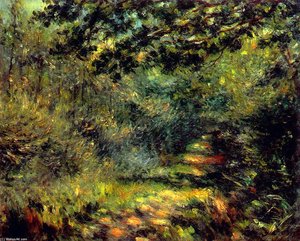
Pierre-Auguste Renoir's “Path Through the Woods,” painted in 1874, isn’t merely a landscape; it’s an invitation. This Impressionist masterpiece captures a golden hour bathed in dappled sunlight filtering through a dense forest, emphasizing peace and contemplation. Renoir’s loose brushstrokes and masterful use of light create a captivating scene.
Biografie kunstenaar
Kernwerken en Thema's</h2> <p>Renoirs oeuvre is een viering van de simpele genoegens des levens - intieme bijeenkomsten
Over het schilderij
A Serene Passage: Delving into Renoir’s “Path Through the Woods”
Pierre-Auguste Renoir's "Path Through the Woods," painted in 1874, isn’t merely a landscape; it’s an invitation. An invitation to step away from the bustle of Parisian life and immerse oneself within the tranquil embrace of nature. This quintessential Impressionist work, rendered in oil on canvas, captures a fleeting moment – a golden hour bathed in dappled sunlight filtering through a dense forest, creating an atmosphere of profound peace and quiet contemplation. The painting immediately draws the eye along the winding path, a subtle yet powerful directional element that guides us deeper into the scene’s heart. It's a testament to Renoir’s ability to distill the essence of a natural setting, not just its visual appearance, but also its emotional resonance.Composition and Technique: A Dance of Light and Brushstroke
Renoir masterfully employs Impressionist techniques to achieve this effect. The composition is deceptively simple – a winding path cutting through a tapestry of trees and grasses – yet it’s the *way* he renders these elements that truly captivates. Loose, expressive brushstrokes dominate the scene, avoiding sharp outlines and instead prioritizing the capture of light and color as they shift and change with every passing moment. The trees themselves aren't meticulously detailed; rather, they are suggested through a rapid succession of short, broken strokes in shades of green and brown, conveying movement and vitality. Similarly, the grasses ripple with an almost palpable sense of life, rendered with delicate, feathery textures that seem to shimmer in the sunlight. Notice how Renoir utilizes warm hues – ochres, yellows, and hints of red – in the background to create a sense of depth and distance, while cooler greens dominate the foreground, anchoring the viewer within the scene. The subtle inclusion of a solitary figure near the center adds a touch of scale and perspective, reminding us of our own presence within this natural world without disrupting its serenity.Contextualizing the Impression: Renoir and the Dawn of Modernity
“Path Through the Woods” firmly places itself within the broader artistic context of the late 19th century, a period marked by significant shifts in art and society. Pierre-Auguste Renoir was a pivotal figure in the burgeoning Impressionist movement, alongside artists like Claude Monet and Edgar Degas. Rejecting the rigid conventions of academic painting, the Impressionists sought to capture the fleeting effects of light and atmosphere – *impressions* – rather than striving for photographic realism. This focus on subjective experience is powerfully evident in “Path Through the Woods.” The painting reflects Renoir’s fascination with modern life and his desire to portray it with a sense of immediacy and spontaneity. Interestingly, this work also echoes the Realist movement, particularly in its depiction of everyday scenes and human interaction within nature – a bridge between the two styles that defined much of the era.Symbolism and Emotional Resonance: A Journey Within
Beyond its technical brilliance, “Path Through the Woods” possesses a subtle yet profound symbolic depth. The winding path itself can be interpreted as a metaphor for life’s journey – a meandering route through an uncertain world. The dappled sunlight suggests hope and optimism, while the dense forest represents both challenge and mystery. The solitary figure, though indistinct, embodies a sense of contemplation and connection with nature. It invites us to pause, breathe deeply, and reflect on our own place within the larger scheme of things. Renoir wasn’t simply painting a landscape; he was offering an experience – a momentary escape into a realm of beauty, tranquility, and quiet introspection. The painting's enduring appeal lies in its ability to evoke these emotions, transporting viewers to a world where time seems to slow down and the simple pleasures of nature take center stage.Bringing Renoir’s Vision Home: High-Quality Reproductions
TopImpressionists.com offers meticulously crafted oil painting reproductions that faithfully capture the essence of “Path Through the Woods.” Each reproduction is created using traditional techniques, employing hand-mixed pigments and archival-quality canvas to ensure lasting beauty and vibrancy. Whether you’re an art enthusiast seeking a stunning addition to your collection or an interior designer aiming to create a serene and inviting atmosphere, our reproductions provide a remarkable opportunity to bring Renoir's masterpiece into your own space. Explore the available sizes and options on TopImpressionists.com to discover the perfect way to experience the timeless beauty of “Path Through the Woods.”Veelgestelde vragen
Hoe past "Path through the Woods" binnen de thema's en stijl van Pierre-Auguste Renoir?
"Path through the Woods" deelt met andere werken van Pierre-Auguste Renoir de Impressionism-stijl en de terugkerende thema's: rubens, watteau, manet, realism, impressionist landscape, balance of nature & humanity, series exploration, leisure.
Zijn de kleuren van "Path through the Woods" door Pierre-Auguste Renoir verzadigd of gedempt?
Het kleurenpalet van "Path through the Woods" heeft een verzadiging van Balanced Soft.
Bij welke kunststroming behoort "Path through the Woods" door Pierre-Auguste Renoir?
De kunststroming die verbonden is aan "Path through the Woods" door Pierre-Auguste Renoir is Impressionism. Deze classificatie plaatst het werk binnen een context van verwante kunstenaars en kunstwerken.
Snelle feiten en kunstquiz
Over Pierre-Auguste Renoir

Pierre-Auguste Renoir
1841 - 1919, Frankrijk
Biografie kunstenaar
Een Leven in Licht: De Wereld van Pierre-Auguste Renoir
Geboren in het rustige provinciale stadje Limoges in 1841, is de reis van Pierre-Auguste Renoir van bescheiden porseleinschilder tot gevierd meester van het Impressionisme een getuigenis van zijn onwrikbare toewijding en artistieke visie. Zijn vroege leven werd gekenmerkt door een verhuizing naar Parijs met zijn familie, op zoek naar economische kansen – een ervaring die zijn artistieke gevoelens diepgaand zou beïnvloeden. De bruisende stad, met haar levendige straatleven en diverse personages, werd de bron van inspiratie voor veel van zijn latere werk. Aanvankelijk leerde hij porselein schilderen – een praktische noodzaak gedicteerd door financiële beperkingen – maar de jonge Renoir vond troost in frequente bezoeken aan het Louvre, waar hij nauwgezet de Oude Meesters bestudeerde en hun technieken assimileerde. Hij ontwikkelde zo een waardering voor schoonheid die een kenmerk van zijn stijl zou worden. Deze vroege blootstelling ontketende binnen hem een passie die verder ging dan puur vakmanschap; het was een roeping om de vluchtige kwaliteiten van licht en leven op canvas vast te leggen. Later schreef hij zich in aan de studio van Charles Gleyre, waar hij levenslange vriendschappen sloot met mede-aspirant kunstenaars Claude Monet, Alfred Sisley en Frédéric Bazille – een cruciaal moment dat de basis zou leggen voor de Impressionistische beweging.Van Realisme naar Stralende Indrukken
Renoirs artistieke ontwikkeling was een fascinerende evolutie, beïnvloed door een diverse reeks meesters. Aanvankelijk voelde hij zich aangetrokken tot het realisme van Gustave Courbet en Édouard Manet, bewonderend hun toewijding om het hedendaagse leven eerlijk en direct af te beelden. Het waren echter de lichtgevende paletten en sensuele vormen van Peter Paul Rubens en Jean-Antoine Watteau die hem werkelijk in vervoering brachten, waardoor zijn werk een diepe waardering voor schoonheid kreeg en een neiging om scènes van vreugde en ontspanning af te beelden. Deze vroege invloeden kwamen samen toen Renoir begon zijn eigen unieke stijl te smeden, gekenmerkt door levendige kleuren, gebroken penseelstreken en een focus op het vastleggen van de vluchtige effecten van licht. Zijn deelname aan de eerste Impressionistische tentoonstelling in 1874 was een keerpunt, hoewel aanvankelijk bekritiseerd door traditionele kunstkringen. Deze gedurfde stap betekende een afwijzing van academische conventies en een omarming van een nieuwe artistieke visie – er werd niet alleen vastgelegd wat het oog ziet, maar ook hoe het *voelt* om een bepaald moment in de tijd te ervaren. Schilderijen als Bal du moulin de la Galette (1876) zijn exemplarisch voor deze benadering en dompelen de kijker onder in de levendige sfeer van het Parijse nachtleven met zijn gespikkelde zonlicht en vrolijke figuren.Het Vangen van de Voorbijgaande Momenten: Belangrijke Werken en Thema's
Renoirs oeuvre is een viering van de eenvoudige genoegens des levens – intieme bijeenkomsten, zonnig landschap en de stralende schoonheid van het menselijk lichaam. Luncheon of the Boating Party (1880-81) staat misschien wel als zijn meest iconische werk, waarin een gezellige groep wordt afgebeeld die geniet van een ontspannen middag op de Seine. Het schilderij is een meesterwerk in het vastleggen van licht en beweging, met figuren badend in warm zonlicht en reflecties die glinsteren op het water. After the Bath (1885-87) toont Renoirs uitstekende vaardigheid in het portretteren van de naakte vrouwelijke figuur, waarbij de nadruk ligt op delicate huidtinten en gracieuze poses. Zijn schilderijen zijn niet louter representaties van de werkelijkheid; ze zijn doordrenkt met een gevoel van warmte, intimiteit en vreugde die diep resoneert bij de kijkers. Hij was niet geïnteresseerd in grootschalige historische verhalen of dramatische allegorieën; hij richtte zich liever op het vastleggen van de schoonheid inherent aan het dagelijks leven, waardoor gewone momenten werden verheven tot kunstwerken. Dance at Bougival, een ander gevierd stuk, demonstreert zijn vermogen om vluchtige indrukken en atmosferische effecten te vangen, waardoor een gevoel van beweging en spontaniteit ontstaat.Een Verschuiving naar Vorm en Structuur: Latere Jaren en Erfenis
In de jaren 1890 onderging Renoirs stijl een aanzienlijke transformatie. Hoewel hij zijn Impressionistische wortels nooit volledig verliet, begon hij zich meer te richten op een sculpturale en klassieke benadering, beïnvloed door zijn reizen naar Italië en een hernieuwde interesse in vorm en structuur. Deze verschuiving werd deels veroorzaakt door fysieke beperkingen – artritis beperkte geleidelijk zijn mobiliteit, waardoor hij zijn techniek moest aanpassen. Ondanks deze uitdagingen bleef Renoir met onwrikbare toewijding schilderen en produceerde werken die gekenmerkt werden door vollere figuren en een warmer palet. Zijn latere schilderijen weerspiegelen vaak een contemplatievere stemming, maar behouden de onderliggende viering van schoonheid die zijn eerdere werk definieerde. Naast zijn artistieke prestaties strekt Renoirs nalatenschap zich uit tot zijn familie; zijn zoon, Jean Renoir, werd een gerenommeerd filmmaker en droeg zo een creatieve geest over generaties heen voort. Pierre-Auguste Renoir stierf in 1919 en liet een duurzaam oeuvre achter dat wereldwijd blijft inspireren en verheugen. Hij blijft een van de meest geliefde figuren in de kunstgeschiedenis, gevierd om zijn vermogen om de vreugde van het leven en de schoonheid van de menselijke ervaring met ongeëvenaarde gevoeligheid en gratie vast te leggen.Blijvende Invloed
- Renoirs invloed op latere generaties kunstenaars is onmiskenbaar. Zijn nadruk op licht, kleur en het vastleggen van voorbijgaande momenten baande de weg voor vele moderne artistieke bewegingen.
- Zijn viering van schoonheid en sensualiteit blijft resoneren bij het publiek vandaag de dag, waardoor zijn werk universeel aantrekkelijk is.
- Hij speelde een cruciale rol in het vestigen van het Impressionisme als een belangrijke kracht in de kunstgeschiedenis, door traditionele conventies uit te dagen en nieuwe mogelijkheden voor artistieke expressie te openen.
- De aanhoudende populariteit van zijn schilderijen – gereproduceerd op talloze posters, kalenders en andere merchandise – getuigt van de tijdloze kwaliteit van zijn werk.
Snelle feiten over Pierre-Auguste Renoir
- Artistic Movement Or Style: Impressionisme
- Artists Or Movements Influenced By This Artist: ['Impressionisme']
- Artists Who Influenced This Artist:
- Rubens
- Watteau
- Courbet
- Manet
- Date Of Birth: 25 februari 1841
- Date Of Death: 3 december 1919
- Full Name: Pierre-Auguste Renoir
- Nationality: Frans
- Notable Artworks:
- Dance at Le Moulin de la Galette
- Luncheon of the Boating Party
- After the Bath
- Dance at Bougival
- Place Of Birth: Limoges, Frankrijk
Vergelijkbare kunstwerken



Ontdek kunstwerken georganiseerd op thema, stijl en kenmerk.


Pierre-Auguste Renoir
Path through the Woods
() ·
Inclusief lijst: · Met de hand geschilderd in olieverf op linnen
Totaal