
Shown: · With its frame:
 Voorvertoning
 Verstuur
 Delen
Delen
 Details bekijken
 Gids
Gids

 Download
 Vergelijkbare items
 Röntgenonderzoek
 Diavoorstelling
 Q&A
Q&A Statistieken

€ 237
Handgemaakte olieverfreproductie
Met de hand geschilderd in olieverf op canvas in uw gewenste maat en lijst, op bestelling gemaakt door onze kunstenaars. ( Schakel over naar print Schakel over naar digitale afbeeldingen)
Size
·Standaardformaat
op maat gemaakt
CM
INCH
Kies uit onze vooraf ingestelde maten die overeenkomen met de originele verhoudingen van het kunstwerk.
Loading sizes...

breedte
hoogte
Voer de breedte en hoogte in die u nodig heeft, passend bij uw lijst of uw muur. Omdat dit handgeschilderd is, kan de kunstenaar bij een afmeting met een andere beeldverhouding iets meer rondom het schilderij schilderen of juist iets meer weglaten — u kiest zelf. Wij sturen u een digitaal mockup ter goedkeuring voordat het schilderwerk begint. De afbeelding die op deze pagina wordt getoond, is niet het uiteindelijke resultaat — alleen de mockup geeft dit weer.
 Lees meer over
Finish
·
White €1

Blurside €1

Extended €1

P118B €10

P118H €10

P118W €10

P438Z €10

P508JH €12

P508YH €12

P805H €10

P805Z €10

P919BZ €10

P919G €10

P919XJ €10

P959ZH €10

P968JZ €12

W106C €8

W218G €10

W218JH €8

W218Y €10

W307PJ €10

W316G €10

W316PJ €8

W316Y €10

W398PJ €8

W4111J €10

W500HY €15

W500JH €15

W692G €12

W849H €8

W940BG €15

W953PJ €8

H24-GOLD €30

H24-SILVER €30

H36-GOLD €45

H36-SILVER €45
Shipped in a protective tube, ready for your own framer.
Above 105 cm the frame is shipped as a kit for a professional framer — read the details.
Extras
optionalWhat do the extras include?
Examples of what can be changed: Replace face with customer photo; Add pet (e.g., replace cat with dog); Include hidden message in background; Change background landscape or elements.
After order, TopImpressionists.com team will email client for instructions and provide a mockup preview
After order, TopImpressionists.com team will email client for instructions and provide a mockup preview
Wereldwijde levering () binnen 3 tot 4 weken in plaats van de standaard 5 weken. (30 oktober). Zonder concessies aan de kwaliteit.
Beschermende vernislaag
Naamplaatje
Details van de gegraveerde bronzen plaat
This elegant plaque features the artist's name and the title of the artwork, finely engraved for a timeless presentation.
It is made from bronze with a refined, elegant finish. The text is precisely laser-engraved for a sharp and permanent result. Measuring 9x2 cm, the plaque is compact yet easy to read. It's built to be durable and scratch-resistant, offering a professional, museum-quality look. Mounting is simple thanks to the included adhesive backing.
Details transparante acrylplaat
The plaque includes essential engraved details such as the artist's name, the title of the artwork, the date it was created, the type of media used-like oil on canvas or watercolor-a brief description of the piece, and a QR code that links to the complete artwork information.
It is crafted from clear acrylic, offering a sleek, modern appearance. The text is UV-engraved in black to ensure strong visual contrast. With a size of 10x15 cm, it ensures optimal readability. It comes equipped with two metal hooks for secure wall mounting. The plaque is designed to be weather-resistant, making it suitable for various environments, and it includes interactive features that work seamlessly with smartphone scanning.
Details zwarte acrylplaat
This elegant plaque includes engraved information such as the artist's name, the title of the artwork, the date it was created, the type of media used (like oil on canvas or watercolor), a short description of the artwork, and a QR code for quick access to more information.
The plaque itself is made from refined black acrylic with a premium finish. The text is laser-engraved in white for high contrast and readability. Its size is 10x15 cm, designed to be easy to read. It comes with two metal hooks for professional mounting. The design is sleek and fits any interior style. It is also weather-resistant and durable, with built-in digital integration for mobile compatibility.
De optie voor glas is alleen beschikbaar bij een formaat kleiner dan 110 cm.
 De optie voor glas is alleen beschikbaar bij een formaat kleiner dan 110 cm.
- Gratis wereldwijde expressverzending
- Hoogwaardig linnen canvas
- Volledige verzendverzekering
- Garantie op terugbetaling van invoerrechten
- Garantie op exacte kleurweergave
- Retourbeleid van 100 dagen (alleen bij defecten)
- 100% Geld-terug-garantie
- Korting bij meerdere afnames


Beschrijving verzamelobject
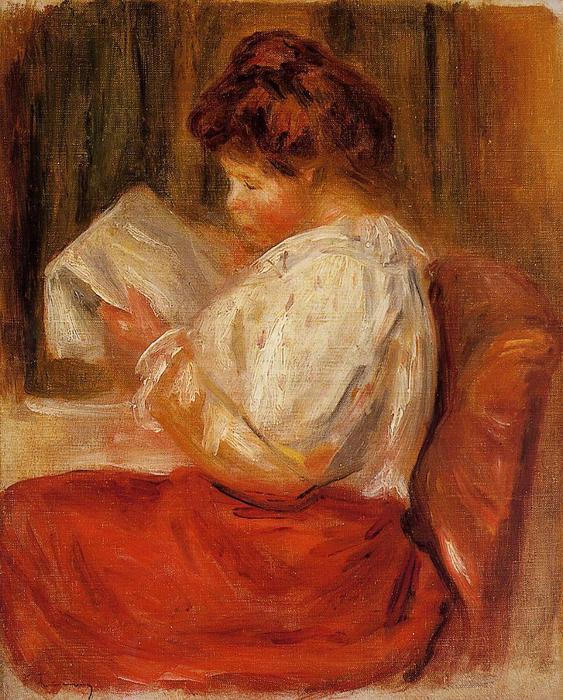
Discover Pierre-Auguste Renoir's 'The Little Reader,' a charming portrait capturing a young girl lost in a book. Explore Impressionism’s beauty through this iconic masterpiece and learn about the artist’s life.
Biografie kunstenaar
Kernwerken en Thema's</h2> <p>Renoirs oeuvre is een viering van de simpele genoegens des levens - intieme bijeenkomsten
About the painting
A Moment of Quietude: The Story Behind "The Little Reader"
Pierre-Auguste Renoir’s “The Little Reader,” painted circa 1890, isn't merely a portrait; it’s a distillation of Parisian life and the quiet beauty of domesticity. It captures a fleeting moment – a young girl lost in the world contained within the pages of a book – yet resonates with an enduring sense of peace and contemplation. The painting immediately draws the eye to its subject, a young woman seated comfortably in a chair, bathed in soft light, utterly absorbed in her reading. This isn’t a dramatic scene; there are no grand gestures or sweeping landscapes. Instead, Renoir masterfully focuses on the intimacy of the interior space and the simple pleasure of intellectual engagement.
The setting itself is crucial to understanding the painting's mood. The muted colors – predominantly reds, browns, and creams – create a warm, inviting atmosphere. A partially visible figure in the background suggests a family life unfolding beyond the frame, hinting at connection and continuity while simultaneously emphasizing the girl’s solitary focus. A couch sits behind her, further reinforcing the sense of a comfortable, lived-in space—a sanctuary for quiet reflection.
Impressionism's Embrace: Technique and Style
“The Little Reader” is a quintessential example of Renoir’s mature Impressionist style. He employs loose, visible brushstrokes – a hallmark of the movement – to capture the play of light and shadow on the girl’s face, dress, and the book itself. Notice how he doesn't attempt to render every detail with photographic precision; rather, he prioritizes conveying the *impression* of these elements, using color and texture to evoke feeling and atmosphere. The dappled effect created by his brushwork adds a sense of movement and vibrancy to the scene, as if the light is constantly shifting.
Renoir’s use of color is particularly noteworthy. He employs broken colors – applying small dabs of paint side-by-side rather than blending them smoothly—to create a luminous effect. The red dress stands out against the warmer tones of the background, drawing attention to the girl and adding a touch of youthful energy to the composition. The subtle variations in color also contribute to the painting’s overall sense of depth and realism.
Symbolism and Emotional Resonance
Beyond its technical brilliance, “The Little Reader” is rich in symbolism. The act of reading itself represents knowledge, imagination, and escape – a refuge from the complexities of life. The girl's absorption in her book suggests a desire for intellectual growth and self-discovery. Renoir was deeply interested in portraying women, often depicting them as beautiful, sensual figures, and this painting is no exception. The young woman’s serene expression and posture convey a sense of contentment and inner peace.
Furthermore, the scene evokes a nostalgic longing for simpler times—a time when childhood innocence and quiet contemplation were valued. It's a reminder that beauty can be found in the most ordinary moments, and that even a simple act like reading can hold profound meaning. The painting’s enduring appeal lies in its ability to transport us back to a moment of tranquility and invite us to share in the girl’s peaceful solitude.
A Timeless Masterpiece: Reproductions for Your Home
TopImpressionists offers meticulously crafted, hand-painted reproductions of “The Little Reader” that capture the essence of Renoir's original masterpiece. Each reproduction is created by skilled artists using traditional techniques and high-quality materials, ensuring a faithful representation of the painting’s beauty and detail. Whether you are an art collector, interior designer, or simply someone who appreciates fine art, our reproductions provide a stunning way to bring this iconic image into your home or office.
Veelgestelde vragen
Met welke techniek is "The Little Reader" gemaakt?
"The Little Reader" is uitgevoerd in Oil On Canvas.
Is "The Little Reader" vrij van auteursrecht?
"The Little Reader" door Pierre-Auguste Renoir valt onder bevindt zich in het publiek domein - de auteursrechten zijn verlopen. Deze status bepaalt hoe de afbeelding van het werk mag worden gereproduceerd.
Welke ruimte past bij de kleuren van "The Little Reader" door Pierre-Auguste Renoir?
Gezien het Dark kleurenpalet wordt "The Little Reader" aanbevolen voor een Living Room.
Quick facts and art quiz
About Pierre-Auguste Renoir

Pierre-Auguste Renoir
1841 - 1919, Frankrijk
Biografie kunstenaar
Een Leven in Licht: De Wereld van Pierre-Auguste Renoir
Geboren in het rustige provinciale stadje Limoges in 1841, is de reis van Pierre-Auguste Renoir van bescheiden porseleinschilder tot gevierd meester van het Impressionisme een getuigenis van zijn onwrikbare toewijding en artistieke visie. Zijn vroege leven werd gekenmerkt door een verhuizing naar Parijs met zijn familie, op zoek naar economische kansen – een ervaring die zijn artistieke gevoelens diepgaand zou beïnvloeden. De bruisende stad, met haar levendige straatleven en diverse personages, werd de bron van inspiratie voor veel van zijn latere werk. Aanvankelijk leerde hij porselein schilderen – een praktische noodzaak gedicteerd door financiële beperkingen – maar de jonge Renoir vond troost in frequente bezoeken aan het Louvre, waar hij nauwgezet de Oude Meesters bestudeerde en hun technieken assimileerde. Hij ontwikkelde zo een waardering voor schoonheid die een kenmerk van zijn stijl zou worden. Deze vroege blootstelling ontketende binnen hem een passie die verder ging dan puur vakmanschap; het was een roeping om de vluchtige kwaliteiten van licht en leven op canvas vast te leggen. Later schreef hij zich in aan de studio van Charles Gleyre, waar hij levenslange vriendschappen sloot met mede-aspirant kunstenaars Claude Monet, Alfred Sisley en Frédéric Bazille – een cruciaal moment dat de basis zou leggen voor de Impressionistische beweging.Van Realisme naar Stralende Indrukken
Renoirs artistieke ontwikkeling was een fascinerende evolutie, beïnvloed door een diverse reeks meesters. Aanvankelijk voelde hij zich aangetrokken tot het realisme van Gustave Courbet en Édouard Manet, bewonderend hun toewijding om het hedendaagse leven eerlijk en direct af te beelden. Het waren echter de lichtgevende paletten en sensuele vormen van Peter Paul Rubens en Jean-Antoine Watteau die hem werkelijk in vervoering brachten, waardoor zijn werk een diepe waardering voor schoonheid kreeg en een neiging om scènes van vreugde en ontspanning af te beelden. Deze vroege invloeden kwamen samen toen Renoir begon zijn eigen unieke stijl te smeden, gekenmerkt door levendige kleuren, gebroken penseelstreken en een focus op het vastleggen van de vluchtige effecten van licht. Zijn deelname aan de eerste Impressionistische tentoonstelling in 1874 was een keerpunt, hoewel aanvankelijk bekritiseerd door traditionele kunstkringen. Deze gedurfde stap betekende een afwijzing van academische conventies en een omarming van een nieuwe artistieke visie – er werd niet alleen vastgelegd wat het oog ziet, maar ook hoe het *voelt* om een bepaald moment in de tijd te ervaren. Schilderijen als Bal du moulin de la Galette (1876) zijn exemplarisch voor deze benadering en dompelen de kijker onder in de levendige sfeer van het Parijse nachtleven met zijn gespikkelde zonlicht en vrolijke figuren.Het Vangen van de Voorbijgaande Momenten: Belangrijke Werken en Thema's
Renoirs oeuvre is een viering van de eenvoudige genoegens des levens – intieme bijeenkomsten, zonnig landschap en de stralende schoonheid van het menselijk lichaam. Luncheon of the Boating Party (1880-81) staat misschien wel als zijn meest iconische werk, waarin een gezellige groep wordt afgebeeld die geniet van een ontspannen middag op de Seine. Het schilderij is een meesterwerk in het vastleggen van licht en beweging, met figuren badend in warm zonlicht en reflecties die glinsteren op het water. After the Bath (1885-87) toont Renoirs uitstekende vaardigheid in het portretteren van de naakte vrouwelijke figuur, waarbij de nadruk ligt op delicate huidtinten en gracieuze poses. Zijn schilderijen zijn niet louter representaties van de werkelijkheid; ze zijn doordrenkt met een gevoel van warmte, intimiteit en vreugde die diep resoneert bij de kijkers. Hij was niet geïnteresseerd in grootschalige historische verhalen of dramatische allegorieën; hij richtte zich liever op het vastleggen van de schoonheid inherent aan het dagelijks leven, waardoor gewone momenten werden verheven tot kunstwerken. Dance at Bougival, een ander gevierd stuk, demonstreert zijn vermogen om vluchtige indrukken en atmosferische effecten te vangen, waardoor een gevoel van beweging en spontaniteit ontstaat.Een Verschuiving naar Vorm en Structuur: Latere Jaren en Erfenis
In de jaren 1890 onderging Renoirs stijl een aanzienlijke transformatie. Hoewel hij zijn Impressionistische wortels nooit volledig verliet, begon hij zich meer te richten op een sculpturale en klassieke benadering, beïnvloed door zijn reizen naar Italië en een hernieuwde interesse in vorm en structuur. Deze verschuiving werd deels veroorzaakt door fysieke beperkingen – artritis beperkte geleidelijk zijn mobiliteit, waardoor hij zijn techniek moest aanpassen. Ondanks deze uitdagingen bleef Renoir met onwrikbare toewijding schilderen en produceerde werken die gekenmerkt werden door vollere figuren en een warmer palet. Zijn latere schilderijen weerspiegelen vaak een contemplatievere stemming, maar behouden de onderliggende viering van schoonheid die zijn eerdere werk definieerde. Naast zijn artistieke prestaties strekt Renoirs nalatenschap zich uit tot zijn familie; zijn zoon, Jean Renoir, werd een gerenommeerd filmmaker en droeg zo een creatieve geest over generaties heen voort. Pierre-Auguste Renoir stierf in 1919 en liet een duurzaam oeuvre achter dat wereldwijd blijft inspireren en verheugen. Hij blijft een van de meest geliefde figuren in de kunstgeschiedenis, gevierd om zijn vermogen om de vreugde van het leven en de schoonheid van de menselijke ervaring met ongeëvenaarde gevoeligheid en gratie vast te leggen.Blijvende Invloed
- Renoirs invloed op latere generaties kunstenaars is onmiskenbaar. Zijn nadruk op licht, kleur en het vastleggen van voorbijgaande momenten baande de weg voor vele moderne artistieke bewegingen.
- Zijn viering van schoonheid en sensualiteit blijft resoneren bij het publiek vandaag de dag, waardoor zijn werk universeel aantrekkelijk is.
- Hij speelde een cruciale rol in het vestigen van het Impressionisme als een belangrijke kracht in de kunstgeschiedenis, door traditionele conventies uit te dagen en nieuwe mogelijkheden voor artistieke expressie te openen.
- De aanhoudende populariteit van zijn schilderijen – gereproduceerd op talloze posters, kalenders en andere merchandise – getuigt van de tijdloze kwaliteit van zijn werk.
Quick facts about Pierre-Auguste Renoir
- Artistic Movement Or Style: Impressionisme
- Artists Or Movements Influenced By This Artist: ['Impressionisme']
- Artists Who Influenced This Artist:
- Rubens
- Watteau
- Courbet
- Manet
- Date Of Birth: 25 februari 1841
- Date Of Death: 3 december 1919
- Full Name: Pierre-Auguste Renoir
- Nationality: Frans
- Notable Artworks:
- Dance at Le Moulin de la Galette
- Luncheon of the Boating Party
- After the Bath
- Dance at Bougival
- Place Of Birth: Limoges, Frankrijk
Vergelijkbare kunstwerken


Ontdek kunstwerken georganiseerd op thema, stijl en kenmerk.


Pierre-Auguste Renoir
The Little Reader
() ·
With its frame: · Hand-painted in oil on linen
Total