

Getoond: · Inclusief lijst:
 Voorvertoning
 Verstuur
 Delen
Delen
 Details bekijken
 Gids
Gids

 Download
 Vergelijkbare items
 Röntgenonderzoek
 Diavoorstelling
 Vraag & antwoord
 Statistieken

€ 240
Handgemaakte olieverfreproductie
Met de hand geschilderd in olieverf op canvas in uw gewenste maat en lijst, op bestelling gemaakt door onze kunstenaars. ( Schakel over naar print Schakel over naar digitale afbeeldingen)
Dit kunstwerk is auteursrechtelijk beschermd
De kunstwerken die op deze pagina worden weergegeven, zijn beschermd door de auteursrechtwetgeving, wat betekent dat het ons wettelijk niet is toegestaan om identieke reproducties te maken of te verkopen. Deze bescherming wordt gehandhaafd onder internationale overeenkomsten zoals de Conventie van Bern en door nationale wetgeving, waaronder de bepalingen van de Amerikaanse auteurswet - Titel 17. Alle rechten voorbehouden. Reproduceren of distribueren van afbeeldingen is niet toegestaan zonder uitdrukkelijke schriftelijke toestemming van WahooArt.com en de rechthebbenden.
Als een respectvol en legaal alternatief bieden wij op maat gemaakte, handgeschilderde kunstwerken aan die geïnspireerd zijn op het origineel. Onze bekwame en professionele kunstenaars bestuderen zorgvuldig de stijl, sfeer en artistieke essentie van het origineel om een nieuw, uniek werk te creëren dat dezelfde emotie oproept – terwijl het een op zichzelf staande, originele creatie blijft.
Deze methode voldoet volledig aan de auteursrechtwetgeving, omdat het niet gaat om het kopiëren of dupliceren van het beschermde kunstwerk. In plaats daarvan is er sprake van een creatieve herinterpretatie — een nieuw schilderij dat door het origineel wordt geïnspireerd, maar er niet identiek aan is.
 Lees meer over
Formaat
·Standaardformaat
op maat gemaakt
CM
INCH
Kies uit onze vooraf ingestelde maten die overeenkomen met de originele verhoudingen van het kunstwerk.
Afmetingen laden...

breedte
hoogte
Voer de breedte en hoogte in die u nodig heeft, passend bij uw lijst of uw muur. Omdat dit handgeschilderd is, kan de kunstenaar bij een afmeting met een andere beeldverhouding iets meer rondom het schilderij schilderen of juist iets meer weglaten — u kiest zelf. Wij sturen u een digitaal mockup ter goedkeuring voordat het schilderwerk begint. De afbeelding die op deze pagina wordt getoond, is niet het uiteindelijke resultaat — alleen de mockup geeft dit weer.
Afronden
·
Wit €1

Vervagende randen €1

Doorlopende rand €1

P118B €10

P118H €10

P118W €10

P438Z €10

P508JH €12

P508YH €12

P805H €10

P805Z €10

P919BZ €10

P919G €10

P919XJ €10

P959ZH €10

P968JZ €12

W106C €8

W218G €10

W218JH €8

W218Y €10

W307PJ €10

W316G €10

W316PJ €8

W316Y €10

W398PJ €8

W4111J €10

W500HY €15

W500JH €15

W692G €12

W849H €8

W940BG €15

W953PJ €8

H24-GOLD €30

H24-SILVER €30

H36-GOLD €45

H36-SILVER €45
Verzonden in een beschermende koker, klaar om door uw eigen frameur te worden ingelijst.
Extra's
optioneelWat zijn de extra's precies?
Voorbeelden van wat aangepast kan worden: Vervang het gezicht door een foto van de klant; Voeg een huisdier toe (bijv. vervang de kat door een hond); Voeg een verborgen boodschap toe aan de achtergrond; Wijzig het landschap of de elementen in de achtergrond.
Na de bestelling zal het team van TopImpressionists.com per e-mail contact opnemen met de klant voor instructies en een mockup-voorbeeld verstrekken
Na de bestelling zal het team van TopImpressionists.com per e-mail contact opnemen met de klant voor instructies en een mockup-voorbeeld verstrekken
Wereldwijde levering () binnen 3 tot 4 weken in plaats van de standaard 5 weken. (7 november). Zonder concessies aan de kwaliteit.
Beschermende vernislaag
Naamplaatje
Details van de gegraveerde bronzen plaat
This elegant plaque features the artist's name and the title of the artwork, finely engraved for a timeless presentation.
It is made from bronze with a refined, elegant finish. The text is precisely laser-engraved for a sharp and permanent result. Measuring 9x2 cm, the plaque is compact yet easy to read. It's built to be durable and scratch-resistant, offering a professional, museum-quality look. Mounting is simple thanks to the included adhesive backing.
Details transparante acrylplaat
The plaque includes essential engraved details such as the artist's name, the title of the artwork, the date it was created, the type of media used-like oil on canvas or watercolor-a brief description of the piece, and a QR code that links to the complete artwork information.
It is crafted from clear acrylic, offering a sleek, modern appearance. The text is UV-engraved in black to ensure strong visual contrast. With a size of 10x15 cm, it ensures optimal readability. It comes equipped with two metal hooks for secure wall mounting. The plaque is designed to be weather-resistant, making it suitable for various environments, and it includes interactive features that work seamlessly with smartphone scanning.
Details zwarte acrylplaat
This elegant plaque includes engraved information such as the artist's name, the title of the artwork, the date it was created, the type of media used (like oil on canvas or watercolor), a short description of the artwork, and a QR code for quick access to more information.
The plaque itself is made from refined black acrylic with a premium finish. The text is laser-engraved in white for high contrast and readability. Its size is 10x15 cm, designed to be easy to read. It comes with two metal hooks for professional mounting. The design is sleek and fits any interior style. It is also weather-resistant and durable, with built-in digital integration for mobile compatibility.
De optie voor glas is alleen beschikbaar bij een formaat kleiner dan 110 cm.
 De optie voor glas is alleen beschikbaar bij een formaat kleiner dan 110 cm.
- Gratis wereldwijde expressverzending
- Hoogwaardig linnen canvas
- Volledige verzendverzekering
- Garantie op terugbetaling van invoerrechten
- Garantie op exacte kleurweergave
- Retourbeleid van 100 dagen (alleen bij defecten)
- 100% Geld-terug-garantie
- Korting bij meerdere afnames


Beschrijving verzamelobject
René Magritte's 'Einde van de Tijd': Een dromerige en mysterieuze schilderij die de werkelijkheid uitdaagt. Ontdek de surrealistische betekenis achter dit iconische kunstwerk.
Biografie kunstenaar
René Magritte (1898-1967): Belgische surrealist meester van dromerige kunstwerken, bekend om 'De Trecheerschap van Beelden' en 'Tijd in Beweging'. Ontdek zijn mysterieuze wereld!
Over het schilderij
René Magritte’s ‘The End of Time’: A Window into Surrealist Mystery
René Magritte's “The End of Time,” painted in 1938, isn’t merely a depiction of a train and a fireplace; it’s an invitation to contemplate the very nature of reality. This iconic work, now housed within The Art Institute of Chicago’s Winterbotham Collection, exemplifies Magritte’s signature style – a masterful blend of meticulous realism and unsettling surrealism that continues to captivate viewers decades after its creation. It's a painting that demands attention, prompting questions about perception, time, and the hidden connections between seemingly disparate elements.
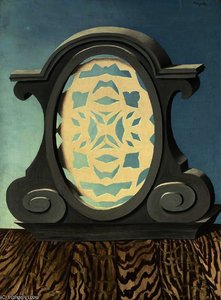
The composition itself is deceptively simple yet profoundly complex. A dark, ornate frame dominates the foreground, containing an oval pattern reminiscent of a stylized leaf or flower. Within this frame, we encounter a meticulously rendered train, its smokestack billowing against a backdrop of zebra stripes – a jarring juxtaposition that immediately establishes the painting’s surreal quality. Above the train, a fireplace emits a plume of smoke, subtly connecting the industrial world of travel with the domesticity of warmth and hearth. This deliberate arrangement isn't about literal representation; it’s about creating an evocative atmosphere, a feeling of suspended time and unsettling familiarity.
Decoding Symbolism: A Journey into the Subconscious
Magritte was a master of symbolic language, often employing everyday objects in unexpected contexts to challenge our assumptions. The frame, with its intricate details, can be interpreted as a portal – a window into another realm or perhaps simply a barrier between the conscious and subconscious mind. The oval pattern within the frame is particularly intriguing; some believe it represents an abstract idea, a hidden truth, or even a fleeting memory. The zebra stripes, frequently associated with wildness and exoticism, introduce an element of duality and contrast – suggesting a tension between order and chaos, reason and instinct.
The train itself has multiple layers of symbolism. It can represent progress, movement, and the relentless march of time. However, its stillness within the frame suggests that this progress is ultimately illusory, trapped within a constructed reality. The fireplace, conversely, symbolizes comfort, domesticity, and the past – elements that are seemingly incompatible with the forward momentum of the train. The smoke connecting them hints at a continuous flow between these opposing forces, suggesting that time isn’t linear but cyclical.
A Masterclass in Surrealist Technique
“The End of Time” is a testament to Magritte's technical skill and his deep understanding of the principles of surrealism. Executed primarily with oil paints on canvas, the painting showcases a remarkable level of detail – from the intricate scrollwork of the frame to the textured surface of the zebra stripes. Yet, despite this meticulous realism, the overall effect is dreamlike and unsettling. Magritte deliberately avoids traditional perspective techniques, creating a flattened image that further enhances the sense of disorientation and mystery.
The muted color palette – dominated by dark browns, blues, and tans – contributes significantly to the painting’s somber mood. The careful gradation of colors in the background creates a subtle sense of depth without relying on conventional shading. This restrained aesthetic allows the symbolic elements to take center stage, inviting viewers to engage with the painting's underlying themes on an emotional level. It is a piece that rewards repeated viewing, revealing new layers of meaning and nuance with each encounter.
A Timeless Masterpiece for Your Space
“The End of Time” remains one of René Magritte’s most enduringly captivating works. Its enigmatic symbolism, masterful technique, and profound emotional resonance make it a truly timeless masterpiece. Whether displayed in a contemporary living room or a sophisticated study, this reproduction offers a unique opportunity to bring a touch of surreal elegance into your home – sparking conversation, inspiring contemplation, and reminding us that reality is often far more complex and mysterious than it appears.
Veelgestelde vragen
Kan ik "Einde van de Tijd" in meer detail bekijken?
De röntgenweergave van "Einde van de Tijd" door René Magritte is te vinden op de Röntgenanalyse-pagina van het kunstwerk: een interactieve verkenning van het beeld door middel van elf optische lagen.
Welke afdrukinstellingen worden aanbevolen voor "Einde van de Tijd" door René Magritte?
Voor "Einde van de Tijd" is de aanbevolen afdrukinstelling een formaat van Middelgroot en een Staand formaat oriëntatie.
Toont "Einde van de Tijd" sterke licht-donkercontrasten?
Het contrastniveau van "Einde van de Tijd" door René Magritte is Verklaring.
Snelle feiten en kunstquiz
Over René Magritte

René Magritte
1898 - 1967, België
Biografie kunstenaar
Early Life and the Seeds of Surrealism
René Magritte, geboren René François Ghislain Magritte op 21 november 1898 in Lessines, België, kwam in een wereld terecht die zijn enigmatische artistieke visie diepgaand zou vormen. Zijn vroege jaren werden gekenmerkt door een onheilspellend incident – de zelfmoord van zijn moeder toen hij slechts dertien jaar oud was. Het beeld van haar lichaam dat uit de Samber werd opgegraven, met haar jurk die haar gezicht bedekte, werd een spookachtig motief dat subtiel terugkeerde in zijn latere werk, zich manifesteerde in verduisterde figuren en een voortdurende zoektocht naar verborgen realiteiten. Deze vroege trauma’s zaaiden een fascinatie met mysterie, verlies en de verstikkende kracht van wat onthuld blijft. Hoewel details van zijn jeugd enigszins ongrijpbaar zijn, is duidelijk dat deze vormende ervaring de basis legde voor zijn levenslange vraaging naar perceptie en representatie. Hij begon op tienjarige leeftijd met tekenen, wat een innige neiging tot visuele expressie onthulde, maar experimenteerde aanvankelijk met Impressionisme voordat hij een pad insloeg dat hem zou leiden tot het worden van een van de meest significante figuren in de Surrealistische kunst.Artistic Development and Influences
Magritte’s artistieke reis was niet direct of rechtlijnig. Hij studeerde aan de Académie Royale des Beaux-Arts in Brussel, maar vond de traditionele methoden daar verstikkend. Zijn vroege werk experimenteerde met Futurisme en Cubisme, waardoor elementen van deze avantgardistische bewegingen werden opgenomen, maar uiteindelijk weigerde hun puur formele bezorgdheid. Het was pas in 1922, toen hij de schilderij *The Song of Love* van Giorgio de Chirico ontmoette, dat Magritte een resonatie ontdekte die zijn artistieke koers onherstelbaar zou veranderen. De Chirico’s dromerige landschappen en verontrustende juxtaposities openden voor Magritte een nieuwe manier van kijken – een wereld waar het bekende vreemd kon worden gemaakt, en het alledaagse met diepe mystiek werd ingezaaid. Dit ontmoeting leidde tot zijn toewijding aan Surrealisme, hoewel hij vaak een unieke afstand behield van de meer expliciet psychologische of automatische aspecten ervan. Hij prefereerde een nauwkeurige, bijna klinische precisie in zijn schilderkunst, waarbij hij realistische technieken gebruikte om illogische scenario’s weer te geven.The Heart of Surrealism: Challenging Reality
Vanaf 1926 had Magritte zich volledig ingezet voor de principes van Surrealisme, waarbij hij *Le Jockey Perdu (The Lost Jockey)* produceerde, die breed wordt beschouwd als zijn eerste echt surrealistische werk. Echter, zijn soort Surrealisme was uniek. Hij was niet geïnteresseerd in het verkennen van het onbewuste door vrije associatie of dromerige beelden zoals sommige van zijn tijdgenoten. In plaats daarvan zocht Magritte naar een manier om de perceptie van de werkelijkheid uit te dagen door alledaagse objecten in onverwachte contexten te presenteren, waardoor kijkers werden aangemoedigd hun aannames over de wereld om hen heen in twijfel te trekken. Iconische werken zoals *The Treachery of Images (This is not a pipe)* (1929) ontleden het relatie tussen beeld en object briljant, herinnerend ons dat een representatie nooit het ding zelf is. *Les Amants (The Lovers)* (1927-1928), met zijn verduisterde figuren, echoë de trauma’s van zijn moeder dood terwijl tegelijkertijd intimiteit en verborgenheid worden onderzocht. *Time Transfixed* (1938) presenteert een locomatief die door een bakstenen muur barst, waardoor onze perceptie van ruimte en tijd wordt verstoord. En *The Human Condition* (1933), een doek in een doek, vervaagt de grenzen tussen representatie en werkelijkheid, waardoor we worden aangemoedigd om te overwegen hoe we de wereld waarnemen en interpreteren.Later Life, Recognition, and Enduring Legacy
Ondanks initiële moeilijkheden met erkenning, kreeg Magritte’s werk geleidelijk aan meer bekendheid, vooral in de Verenigde Staten door tentoonstellingen in 1936 en latere retrospectieve tentoonstellingen op het Museum of Modern Art (1965) en het Metropolitan Museum of Art (1992). Hij bleef politiek actief gedurende zijn hele leven, waarbij hij artistieke autonomie verdedigde. Hij bleef zijn kenmerkende stijl verfijnen, thema’s van herhaling, illusie en de kracht van taal onderzoeken in schilderijen die zowel intellectueel stimulerend als visueel aantrekkelijk zijn. Magritte stierf op 15 augustus 1967, waardoor een oeuvre achterbleef dat nog steeds kijkers wereldwijd fascineert en uitdaagt. Zijn invloed strekt zich verder uit dan de schilderkunst, beïnvloedt pop art, minimalistische kunst, conceptuele kunst en zelfs reclame en film. Vandaag de dag worden zijn schilderijen in belangrijke museumcollecties over de hele wereld gehouden, waaronder de Musées royaux des beaux-arts de Belgique in Brussel, die het Magritte Museum herbergen – gewijd geheel aan zijn werk en dat de grootste collectie van zijn creaties bezit.- Museum Collecties: Musées royaux des beaux-arts de Belgique, Brussels; Magritte Museum.
Snelle feiten over René Magritte
- Artistic Movement Or Style: Surrealisme
- Artists Or Movements Influenced By This Artist:
- Pop art
- Minimalisme
- Artists Who Influenced This Artist: ['Giorgio de Chirico']
- Date Of Birth: 21 november 1898
- Date Of Death: 15 augustus 1967
- Full Name: René François Ghislain Magritte
- Nationality: Belgisch
- Notable Artworks:
- De Lovers
- Treurkaart
- Tijd verstijfd
- Place Of Birth: Lessines, België
Ontdek kunstwerken georganiseerd op thema, stijl en kenmerk.


René Magritte
Einde van de Tijd
() ·
Inclusief lijst: · Met de hand geschilderd in olieverf op linnen
Totaal