


 Verstuur
 Delen
Delen
 Details bekijken
 Gids
Gids

 Download
 Vergelijkbare items
 Diavoorstelling
 Statistieken
Five Pieces for Orchestra, op. 16/5 – First written copy
 Giclée Print
- Digital
- Expressionist Atonality
Expressionist Atonality
 1909
1909 36.0 x 28.0 cm
 Arnold Schönberg Center
Experience Arnold Schoenberg's groundbreaking "Five Pieces for Orchestra" (1909), a pivotal work of atonal music and musical prose, captured in this meticulously preserved score. Discover the innovative soundscapes of early 20th-century expressionism and bring this iconic piece to your collection.
 Lees meer
Ontdek de revolutionaire muziek van Arnold Schoenberg – atonaliteit, twaalftoonstechniek & invloed op 20e-eeuwse componisten. Ontdek zijn nalatenschap in het Schönberg Center.
Handgemaakte olieverfreproductie
Met de hand geschilderd in olieverf op canvas in uw gewenste maat en lijst, op bestelling gemaakt door onze kunstenaars. ( Schakel over naar print Schakel over naar digitale afbeeldingen)




































Standaardformaat
op maat gemaakt
CM
INCH
Kies uit onze vooraf ingestelde maten die overeenkomen met de originele verhoudingen van het kunstwerk.
Loading sizes...

breedte
hoogte
U kunt uw eigen afmetingen invoeren om in een specifieke lijst of ruimte te passen. Als de door u gekozen maat niet overeenkomt met de verhoudingen van het originele beeld, zullen we het kunstwerk bijsnijden of het schilderij uitbreiden met extra handgeschilderde elementen. Een digitale mockup wordt ter goedkeuring naar u verzonden voordat de productie begint.
Houd er rekening mee dat de preview op het scherm niet de werkelijke uitsnede of uitbreiding weergeeft. Alleen de mockup toont de uiteindelijke compositie nauwkeurig.
Hoewel aangepaste afmetingen mogelijk zijn, raden we aan een maat uit de vooraf gedefinieerde lijst te selecteren om de originele verhoudingen te behouden.
Voorbeelden van wat aangepast kan worden: Vervang het gezicht met een eigen foto; Voeg een huisdier toe (bijv. vervang de kat door een hond); Verwerk een verborgen boodschap in de achtergrond; Wijzig het landschap of andere elementen in de achtergrond.
Na de bestelling zal het team van TopImpressionists.com per e-mail contact opnemen met de klant voor instructies en een mockup-voorbeeld sturen.
Na de bestelling zal het team van TopImpressionists.com per e-mail contact opnemen met de klant voor instructies en een mockup-voorbeeld sturen.
Wereldwijde levering () binnen 3 tot 4 weken in plaats van de standaard 5 weken. (23 september). Zonder concessies aan de kwaliteit.

Gratis wereldwijde expressverzending

Hoogwaardig linnen canvas

Volledige verzendverzekering

Garantie op terugbetaling van invoerrechten

Garantie op exacte kleurweergave

Retourbeleid van 100 dagen (alleen bij defecten)

100% Geld-terug-garantie

Korting bij meerdere afnames
 De optie voor glas is alleen beschikbaar bij een formaat kleiner dan 110 cm.

Five Pieces for Orchestra, op. 16/5 – First written copy
Reproductiemethode
Formaat reproductie
-


Totaalprijs
$ 269
A Window into Schoenberg's Revolutionary Soundscape
This meticulously crafted hand-painted reproduction offers an intimate glimpse into the genesis of Arnold Schoenberg’s groundbreaking “Five Pieces for Orchestra, op. 16/5,” a composition born from a summer of intense creative exploration in 1909. The original score, painstakingly preserved and now faithfully recreated, is not merely musical notation; it's a tangible artifact of a pivotal moment in the history of Western music – a testament to Schoenberg’s radical departure from traditional tonal harmony and his pioneering embrace of atonality.
- The Context: Steinakirchen 1909 The summer of 1909 found Schoenberg, alongside fellow modernist giants Zemlinsky, Berg, Webern, and Oppenheimer, sequestered in the idyllic Austrian village of Steinakirchen. This period proved extraordinarily productive, yielding not only the “Five Pieces” but also the Piano Piece op. 11 and the unsettling monodrama, *Erwartung* (Waiting), foreshadowing his later explorations into expressionism.
- Strauss’s Vision Schoenberg's correspondence with Richard Strauss reveals a deliberate intention to create music that eschewed grand symphonic structures. He envisioned “short orchestra pieces” – fleeting moments of color and mood, prioritizing emotional impact over architectural form. This directive shaped the very essence of *Five Pieces*.
- “Musical Prose” The score’s syntax is deliberately unconventional: atextonic melodies, thematic absence, and an emphasis on dynamic variation. Schoenberg termed this approach “musical prose,” describing it as music unlike anything heard before – a bold proclamation of new tonal beauty, seeking out unexpected accents and contrasts, and exploring previously uncharted emotional territories.
Decoding the Score: Technique and Style
The hand-painted reproduction faithfully captures the intricate details of Schoenberg’s original score. The delicate lines representing individual notes, the precise placement of rests, and the nuanced markings indicating dynamics and tempo are rendered with exceptional care. The artist has skillfully recreated the characteristic handwriting style prevalent in early 20th-century musical scores, adding to the piece's historical authenticity. Note the use of clefs and staves – fundamental elements of musical notation that define the structure and organization of the composition.
- Material & Technique The reproduction utilizes archival quality paper mimicking the texture of period manuscripts, and traditional hand-painting techniques to achieve a level of detail and nuance that digital reproductions simply cannot replicate.
- Color Palette While a black and white photograph represents the original score, this reproduction employs a subtle tonal palette – primarily grays and browns – evocative of aged parchment, further enhancing its historical feel.
Symbolism and Emotional Resonance
More than just a musical score, this piece embodies Schoenberg’s revolutionary spirit. The “Five Pieces” represent a deliberate rejection of established conventions, a fearless exploration of dissonance and atonality, and an attempt to capture the raw essence of human emotion without the constraints of traditional harmony. The emphasis on "speaking music," as Schoenberg himself described it, suggests a desire for direct communication – a musical language that transcends words and speaks directly to the listener’s soul.
- Atonality's Impact The piece exemplifies atonality, a compositional technique where no single note is inherently "correct" or establishes a tonal center. This creates a sense of instability and ambiguity, reflecting the anxieties and uncertainties of the modern age.
- Emotional Intensity Despite its unconventional structure, the score conveys a profound emotional intensity – a blend of melancholy, longing, and perhaps even a hint of unease. The carefully crafted dynamics and melodic contours contribute to this powerful effect.
Dimensions & Acquisition
This hand-painted reproduction measures 36 x 28 cm (14 x 11 inches), making it suitable for display in a variety of settings – from private study to art gallery. It’s an ideal addition to any collection of modern art, musical memorabilia, or simply as a conversation starter.
Biografie van de kunstenaar
vroege leven en muzikale beginj
arnold schoenberg, een Oostenrijks-Amerikaanse componist, werd op 13 september 1874 geboren in vienna, oostenrijk. zijn vroege jaren werden gekenmerkt door een bescheiden begin, met een vader die schoenwinkelier was. ondanks deze eenvoudige omstandigheden leidde schoenbergs aangeboren passie voor muziek ertoe dat hij zichzelf grotendeels in dit vakgebied onderwees.muzikale evolutie en bepalende werken
schoenbergs vroege werken, zoals verklärte nacht (1899), toonden een brahmsiaanse-wagneriaanse synthese. naarmate hij zich verder ontwikkelde, werd hij de centrale figuur van de tweede Weense school, samen met anton webern en alban berg. zijn composities, waaronder het strijkkwartet nr. 2 (1907–1908), erwartung (1909) en pierrot lunaire (1912), vormden de belichaming van zijn innovatieve benadering van atonaliteit.onderwijs, emigratie en het latere leven
in 1933 trad schoenberg terug bij de Pruisische academie voor kunst vanwege de opkomst van de nazi's, die zijn muziek als "ontaard" bestempelden. hij ging vervolgens lesgeven in de Verenigde Staten, onder andere aan de University of California, Los Angeles (1936–1944), waar faciliteiten naar hem vernoemd zijn. [https://TopImpressionists.com/@/arnold-schaenberg](ontdek meer over het leven en de werken van schoenberg op TopImpressionists).- schoenberg verkende filmmuziek en schreef meer tonale muziek, waarbij hij zijn kamer symfonie nr. 2 voltooide in 1939.
- hij leverde satire op fascistische tirannen in ode aan napoleon (1942), naar byron.
- het naoorlogse vienna bood hem het ereburgerschap aan, maar hij was ziek, zoals afgebeeld in zijn strijk trio (1946).
erfenis en invloed
terwijl de wereld kennismaakte met de holocaust, eerde schoenberg de slachtoffers in a survivor from warsaw (1947). het Israëlisch conservatorium en de academie voor muziek benoemden hem in 1951 tot erevoorzitter. [https://TopImpressionists.com/@@/a@d3bqc7-the-museum-destroyed-by-fire-(united-states)](leer meer over de impact van zijn werk op TopImpressionists). kernpunten:- schoenbergs innovatieve muziek behoorde tot de meest invloedrijke en omstreden werken van de klassieke muziek uit de 20e eeuw.
- minstens drie generaties componisten hebben zijn enigszins formele principes voortgezet.
- zijn esthetische en muziekhistorische visies beïnvloedden musicologen theodor w. adorno en carl dahlhaus.

Arnold Schönberg
1874 - 1951 , Oostenrijk
Snelle feiten
- Artistic Movement Or Style: Twaalftoonstechniek; Expressionisme
- Artists Or Movements Influenced By This Artist:
- Anton Webern
- Alban Berg
- Artists Who Influenced This Artist:
- Johannes Brahms
- Richard Wagner
- Date Of Birth: 13 september 1874
- Date Of Death: 1951
- Full Name: Arnold Schoenberg
- Nationality: Oostenrijks-Amerikaans
- Notable Artworks:
- Suite, op. 29
- Music Typewriter
- Staffliner
- Place Of Birth: Wenen, Oostenrijk
Gerelateerde artikelen

The Enduring Legacy of Fine Art Prints: Technique, History & Aesthetic Impact
Explore the rich history & techniques of fine art prints. Discover investment potential, assess authenticity, and learn how to preserve your collection with expert guidance. Trusted insights for discerning collectors.
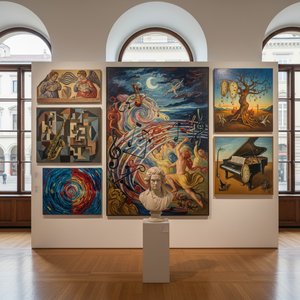
Harmonies on Canvas: Exploring the Visual Representation of Music in Art History
Explore the fascinating history of music's visual representation in art! From ancient symbolism to modern abstraction, discover how artists have captured sound and emotion on canvas. Expert insights & stunning examples.

The Enduring Legacy of Printmaking: Techniques, Themes & Artistic Innovation Across Centuries
Explore the rich history of printmaking with TopImpressionists. Discover techniques from intaglio to lithography, learn about collecting valuable prints & find museum-quality reproductions. Expert insights for art enthusiasts and collectors.

Giclée Prints: Archival Quality & Aesthetic Nuances for the Discerning Collector
Explore the world of giclée prints with TopImpressionists. Learn about archival quality, aesthetic nuances & investment potential. Expert guidance for discerning art collectors seeking museum-quality reproductions and lasting value.

Echoes of Time: Exploring the Enduring Appeal & Historical Context of Vintage Art Prints
Explore the captivating world of vintage art prints! Discover their history, collecting tips & enduring appeal. Expert insights on chromolithography and building a legacy collection with TopImpressionists.
Ontdek kunstwerken georganiseerd op thema, stijl en kenmerk.


