Bekijk op ware grootte
 Verstuur
 Delen
Delen
 Details bekijken
 Gids voor studentenkunstwerken

 Download
 Vergelijkbare items
 Röntgenonderzoek
 Diavoorstelling
 Statistieken
Path through Trees
 Acrylic
- WallArt
- Post-Impressionistic Landscape
 112.0 x 114.0 cm
 Royal Scottish Academy of Art - Architecture
Explore the serene landscapes and evocative still lifes of Sir William George Gillies RA RSA PRSW, a Scottish Colourist celebrated for capturing the beauty of Lothian and Fife with masterful Impressionistic brushstrokes.
 Lees meer
"meta_description": "W.G. Gillies schilderde betoverende Schotse landschappen en stillevens met invloeden van Cubisme en Klee. Zijn werk is gekenmerkt door kleurrijke composities en een unieke, nationale stijl – ontdek de meester van de Schotse kunst!"
De kunstwerken die op deze pagina worden weergegeven, zijn beschermd door de auteursrechtwetgeving, wat betekent dat het ons wettelijk niet is toegestaan om identieke reproducties te maken of te verkopen. Deze bescherming wordt gehandhaafd onder internationale overeenkomsten zoals de Conventie van Bern en door nationale wetgeving, waaronder de bepalingen van de Amerikaanse auteurswet - Titel 17. Alle rechten voorbehouden. Reproduceren of distribueren van afbeeldingen is niet toegestaan zonder uitdrukkelijke schriftelijke toestemming van WahooArt.com en de rechthebbenden.
Deze methode voldoet volledig aan de auteursrechtwetgeving, omdat het niet gaat om het kopiëren of dupliceren van het beschermde kunstwerk. In plaats daarvan is er sprake van een creatieve herinterpretatie — een nieuw schilderij dat door het origineel wordt geïnspireerd, maar er niet identiek aan is.
Giclée / Kunstafdrukken
Giclée- of canvasafdruk van museumkwaliteit met een snelle productie en flexibele afwerkingsmogelijkheden. ( Koop handgeschilderd kunstwerk Schakel over naar digitale afbeeldingen)




P118B €10

P118H €10

P118W €10

P438Z €10

P508JH €12

P508YH €12

P805H €10

P805Z €10

P919BZ €10

P919G €10

P919XJ €10

P959ZH €10

P968JZ €12

W106C €8

W218G €10

W218JH €8

W218Y €10

W307PJ €10

W316G €10

W316PJ €8

W316Y €10

W398PJ €8

W4111J €10

W500HY €15

W500JH €15

W692G €12

W849H €8

W940BG €15

W953PJ €8




Standaardformaat
op maat gemaakt
CM
INCH
Kies uit onze vooraf ingestelde maten die overeenkomen met de originele verhoudingen van het kunstwerk.
Loading sizes...

breedte
hoogte
Voer de breedte en de hoogte in die u nodig heeft, passend bij uw lijst of uw muur. Een afdruk kan alleen worden ingekort, nooit groter worden gemaakt dan het origineel, waardoor een formaat met een andere verhouding een deel van de afbeelding verliest. Wij sturen u een digitaal mockup ter goedkeuring voordat we iets drukken. De afbeelding op deze pagina toont niet de werkelijke uitsnede — dit is alleen te zien op het mockup.
Wereldwijde levering () binnen 2 weken in plaats van de standaard 4/5 weken. (25 oktober)

Gratis wereldwijde expressverzending

Hoogwaardig linnen canvas

Volledige verzendverzekering

Garantie op terugbetaling van invoerrechten

Garantie op exacte kleurweergave

Retourbeleid van 100 dagen (alleen bij defecten)

100% Geld-terug-garantie

Korting bij meerdere afnames
 De optie voor glas is alleen beschikbaar bij een formaat kleiner dan 110 cm.

Path through Trees
Giclée / Kunstafdrukken
Formaat reproductie
-


Totaalprijs
€ 61
A Journey Through Light and Texture: Exploring Gillies’ “Path through Trees”
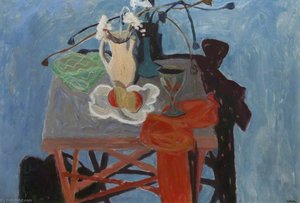
The painting "Path through Trees" by Sir William George Gillies stands as a testament to the enduring allure of Impressionism blended with a distinctly Scottish sensibility. Executed sometime before 1973, this piece captures not merely a visual representation of woodland scenery but delves into a deeper exploration of mood and atmosphere—a hallmark of Gillies’ artistic vision. Measuring 112 x 114 cm, the canvas invites contemplation as much as it pleases the eye with its harmonious blend of color and texture.The Impressionistic Embrace: Style and Technique
Gillies' stylistic choices firmly situate “Path through Trees” within the broader context of early 20th-century art movements. While undeniably influenced by Cubism’s geometric fragmentation – evident in his formative studies under André Lhote – Gillies swiftly moved beyond rigid formalism, prioritizing instead the expressive qualities of color and light. Characteristic Impressionistic brushstrokes dominate the composition, layering pigment onto the canvas with loose, visible marks that convey a palpable sense of spontaneity. Unlike meticulously rendered landscapes of earlier eras, Gillies eschewed detailed botanical accuracy; rather, he sought to distill the essence of the forest into its dominant hues—warm yellows and browns punctuated by subtle blues in the sky and foliage. This technique prioritizes capturing fleeting moments of illumination and shadow, mirroring the artist’s fascination with observing nature directly.Scottish Roots: Historical Context and Inspiration
Gillies' artistic development was profoundly shaped by his upbringing in Haddington, Scotland, where he absorbed the rugged beauty of the Lothian countryside. The painting reflects this connection to place, conveying a feeling of quiet contemplation and reverence for the natural world—a sentiment echoed throughout Gillies’ oeuvre. His encounter with Paul Klee proved particularly influential, prompting him to embrace a more imaginative approach to color palettes and compositional arrangements. Klee's playful use of childlike spontaneity resonated deeply with Gillies, encouraging him to infuse his paintings with an element of wonder and emotional resonance.Symbolism Within the Frame: Layers of Meaning
Beyond its aesthetic appeal, “Path through Trees” possesses symbolic depth. The dominant tree trunk serves as a focal point, representing resilience and strength—qualities associated with Scottish folklore and tradition. The dappled sunlight filtering through the branches symbolizes hope and renewal, mirroring the cyclical rhythms of nature. Furthermore, the fallen leaves at the base of the trunks subtly evoke themes of mortality and transformation, reminding viewers that beauty exists alongside impermanence. Gillies’ masterful manipulation of color and texture contributes to this layered interpretation, inviting contemplation on broader philosophical concepts.Emotional Resonance: A Tranquil Vista
Ultimately, “Path through Trees” succeeds in transporting the viewer into a serene woodland setting. The painting's subdued palette and expressive brushstrokes evoke feelings of peace and tranquility—a deliberate aim reflecting Gillies’ desire to capture not just what he saw but how he felt when observing the natural world. It is precisely this emotive quality, combined with Gillies’ skillful technique and stylistic innovation, that ensures “Path through Trees” continues to captivate audiences today, serving as an enduring emblem of Impressionistic beauty and Scottish artistic heritage.Vragen & Antwoorden
Waar kan ik een handgeschilderde reproductie van "Path through Trees" door William Gillies kopen?
U kunt een met de hand geschilderde reproductie van "Path through Trees" door William Gillies rechtstreeks bestellen op de Met de hand geschilderde reproductie pagina: een met de hand geschilderde olieverfreproductie op linnen canvas, op bestelling vervaardigd.
Hoe verhouden de kleuren van "Path through Trees" zich tot elkaar?
De kleurharmonie van "Path through Trees" wordt beschreven als Balanced Harmony.
In welke stroming en in welk tijdperk is "Path through Trees" door William Gillies geplaatst?
"Path through Trees" door William Gillies wordt geplaatst binnen de Post-Impressionistic Landscape-stroming, uit de Moderne tijd-periode van de maker.
Gerelateerde kunstwerken


Biografie van de kunstenaar
Early Life and Education
Sir William George Gillies, geboren in Haddington in East Lothian, Schotland, in 1898, was een kunstenaar wiens leven en werk diep verweven waren met de landschappen en tradities van zijn geboortegemeenschap. Zijn artistieke reis begon niet direct op het doek; hij startte zijn opleiding aan de Edinburgh College of Art, maar deze werd onderbroken door dienstplicht in de Royal Engineers tijdens de Eerste Wereldoorlog. Deze ervaring, die hem vroegtijdig blootstelde aan de realiteit van conflict en verlies, zou een blijvende invloed hebben op zijn artistieke visie.
Na de oorlog keerde Gillies terug om zijn studie af te maken aan het Edinburgh College of Art. Daar werd hij niet alleen een getalenteerd kunstenaar, maar ook een toegewijde leraar, die meer dan veertig jaar lang de School for Drawing and Painting leidde. Zijn betrokkenheid bij het onderwijs was een essentieel onderdeel van zijn leven en droeg bij aan de ontwikkeling van vele toekomstige kunstenaars.
Artistic Development and Influences
Gillies’ artistieke reis begon met een fascinatie voor Cubisme, een beweging die hij ontdekte na het studeren onder André Lhote in Parijs (1923) en een bezoek aan Italië in 1924. Deze periode was cruciaal voor zijn ontwikkeling, waarbij hij de principes van geometrische fragmentatie en perspectiefonderzoek leerde toepassen. Zijn vroege werken, zoals “Two Pots, Saucer and Fruit” (1933), getuigen hiervan; ze vertonen een invloed van Cézanne, met zijn zorgvuldige composities en het gebruik van kleur om volume en diepte te suggereren, in combinatie met de understatement van kunstenaars als Braque en Picasso.
Een fundamentele verandering in Gillies’ artistieke benadering kwam in 1934 tot stand door de ontmoeting met de werk van Paul Klee. Klee’s gebruik van kleur, zijn speelse composities en het vermogen om emotie te overbrengen via eenvoudige vormen inspireerden Gillies om een meer expressieve en intuïtieve benadering van de kleur te ontwikkelen. Hij begon elementen uit de folklore en traditie van Schotland op te nemen in zijn werk, waardoor zijn stijl zich onderscheidde van de rigide principes van Cubisme.
The 1922 Group and Collaborative Spirit
In 1922 richtte Gillies samen met andere kunstenaars, waaronder William Crozier, William Geissler en William MacTaggart, de “1922 Group” op. Deze groep was meer dan alleen een artistieke vereniging; het was een platform voor jonge Schotse kunstenaars om hun werk te presenteren aan het publiek via tentoonstellingen in de New Gallery in Edinburgh. De 1922 Group bevorderde een gevoel van gemeenschap en innovatie binnen de Schotse kunstscene, waardoor een vruchtbare omgeving ontstond voor experimenteren en uitwisselen van ideeën.
De groep speelde een cruciale rol bij het stimuleren van de ontwikkeling van nieuwe talenten en het creëren van een platform voor hun werk. De tentoonstellingen waren niet alleen een manier om kunst te presenteren, maar ook om kunstenaars met elkaar in contact te brengen en hen te inspireren.
Themes and Subject Matter
Gillies’ oeuvre is voornamelijk gekenmerkt door zijn liefde voor de Schotse landschappen. Hij schilderde de Lothian, Fife en Border regio's met een intense gevoeligheid, vastleggend niet alleen de fysieke kenmerken van het terrein, maar ook de sfeer en de emoties die hij ermee associeerde. Zijn landschappen zijn vaak doordrenkt van licht en kleur, en ze vertonen een diepe verbinding met de natuur.
Naast landschappen was Gillies ook gefascineerd door stillevenschilderingen. Deze werken, vaak gekenmerkt door de aanwezigheid van keramiek gemaakt door zijn jongere zus, Emma Smith Gillies – wiens vroege dood hem diep heeft getroffen – waren een bron van zowel schoonheid als verdriet. De stillevenschilderingen werden vaak gebruikt om emotionele reflectie te bieden en de complexiteit van het leven te onderzoeken.
Major Achievements and Recognition
Sir William George Gillies werd in 1970 ridder, een erkenning voor zijn bijdrage aan de kunst in Schotland. In 1957 ontving hij de CBE (Commander of the Order of the British Empire) voor zijn diensten aan de kunst. Na zijn pensionering van het Edinburgh College of Art bleef Gillies actief als kunstenaar en werd hij benoemd tot hoofd van de school in 1961, een positie die hij tot 1966 bekleedde. Tijdens deze periode werden belangrijke ontwikkelingen doorgevoerd, waaronder de bouw van een nieuwe architectuurfaculteit.
Zijn werk is te vinden in musea en collecties in heel Schotland, waaronder Aberdeen, Dundee, Edinburgh, Glasgow, en in nationale galerijen in Londen, Ottawa en Peru. De retrospectieve tentoonstelling die de Scottish Arts Council hem gaf trok meer dan 30.000 bezoekers, wat een bewijs is van zijn invloed en populariteit.
Historical Significance and Legacy
Sir William George Gillies wordt beschouwd als een van de meest prominente Schotse kunstenaars van de 20e eeuw. Zijn werk vertegenwoordigt een unieke synthese van moderne invloeden en traditionele Schotse esthetiek. Hij was een belangrijke figuur in de Edinburgh School, een beweging die zich kenmerkte door het gebruik van kleur en licht om emotie te overbrengen. Gillies’ nalatenschap strekt zich verder uit dan zijn eigen kunst; hij heeft generaties van kunstenaars geïnspireerd en de richting van Schotse kunst beïnvloed.
Hij stierf vredig in zijn bed op 15 april 1973, maar zijn werk blijft een bron van inspiratie en bewondering. Gillies’ artistieke visie, gekenmerkt door zijn liefde voor Schotland, zijn expressieve kleurgebruik en zijn vermogen om emotie te overbrengen, zal nog lang voortleven in de geschiedenis van de kunst.

William Gillies
1898 - 1973 , Verenigd Koninkrijk
Snelle feiten
- Artistic Movement Or Style:
- Cubisme
- Landschappen
- Artists Or Movements Influenced By This Artist:
- Cézanne
- Picasso
- Artists Who Influenced This Artist:
- André Lhote
- Paul Klee
- Date Of Birth: 1898
- Date Of Death: 1973
- Full Name: Sir William George Gillies
- Nationality: Schots
- Notable Artworks:
- Twee potten, schaal en fruit
- Mediterrane Landschap
- Place Of Birth: Haddington, Verenigd Koninkrijk
Gerelateerde artikelen

Beyond the Light: Discovering the Soul and Emotional Depth of Post-Impressionism
Embark on a cultural journey through Post-Impressionism. Discover the profound emotional depth of masters like Van Gogh and Cézanne, exploring how they moved beyond light to capture the very soul of human experience through vibrant color and symbolic form.

Beyond the Light: Capturing Raw Emotion and Subjective Vision in Post-Impressionist Landscapes
Explore the profound emotional depth of Post-Impressionist landscapes. Discover how masters like Van Gogh moved beyond light to capture raw human feeling through vibrant color and expressive texture in this expert art history retrospective.
Ontdek kunstwerken georganiseerd op thema, stijl en kenmerk.