

Shown: · With its frame:
 Voorvertoning
 Verstuur
 Delen
Delen
 Details bekijken
 Gids
Gids

 Download
 Vergelijkbare items
 Röntgenonderzoek
 Diavoorstelling
 Q&A
Q&A Statistieken
- 22.0 x 34.0 cm


€ 261
Handgemaakte olieverfreproductie
Met de hand geschilderd in olieverf op canvas in uw gewenste maat en lijst, op bestelling gemaakt door onze kunstenaars. ( Schakel over naar print Schakel over naar digitale afbeeldingen)
Size
·Standaardformaat
op maat gemaakt
CM
INCH
Kies uit onze vooraf ingestelde maten die overeenkomen met de originele verhoudingen van het kunstwerk.
Loading sizes...

breedte
hoogte
Voer de breedte en hoogte in die u nodig heeft, passend bij uw lijst of uw muur. Omdat dit handgeschilderd is, kan de kunstenaar bij een afmeting met een andere beeldverhouding iets meer rondom het schilderij schilderen of juist iets meer weglaten — u kiest zelf. Wij sturen u een digitaal mockup ter goedkeuring voordat het schilderwerk begint. De afbeelding die op deze pagina wordt getoond, is niet het uiteindelijke resultaat — alleen de mockup geeft dit weer.
 Lees meer over
Finish
·
White €1

Blurside €1

Extended €1

P118B €10

P118H €10

P118W €10

P438Z €10

P508JH €12

P508YH €12

P805H €10

P805Z €10

P919BZ €10

P919G €10

P919XJ €10

P959ZH €10

P968JZ €12

W106C €8

W218G €10

W218JH €8

W218Y €10

W307PJ €10

W316G €10

W316PJ €8

W316Y €10

W398PJ €8

W4111J €10

W500HY €15

W500JH €15

W692G €12

W849H €8

W940BG €15

W953PJ €8

H24-GOLD €30

H24-SILVER €30

H36-GOLD €45

H36-SILVER €45
Shipped in a protective tube, ready for your own framer.
Above 105 cm the frame is shipped as a kit for a professional framer — read the details.
Extras
optionalWhat do the extras include?
Examples of what can be changed: Replace face with customer photo; Add pet (e.g., replace cat with dog); Include hidden message in background; Change background landscape or elements.
After order, TopImpressionists.com team will email client for instructions and provide a mockup preview
After order, TopImpressionists.com team will email client for instructions and provide a mockup preview
Wereldwijde levering () binnen 3 tot 4 weken in plaats van de standaard 5 weken. (2 november). Zonder concessies aan de kwaliteit.
Beschermende vernislaag
Naamplaatje
Details van de gegraveerde bronzen plaat
This elegant plaque features the artist's name and the title of the artwork, finely engraved for a timeless presentation.
It is made from bronze with a refined, elegant finish. The text is precisely laser-engraved for a sharp and permanent result. Measuring 9x2 cm, the plaque is compact yet easy to read. It's built to be durable and scratch-resistant, offering a professional, museum-quality look. Mounting is simple thanks to the included adhesive backing.
Details transparante acrylplaat
The plaque includes essential engraved details such as the artist's name, the title of the artwork, the date it was created, the type of media used-like oil on canvas or watercolor-a brief description of the piece, and a QR code that links to the complete artwork information.
It is crafted from clear acrylic, offering a sleek, modern appearance. The text is UV-engraved in black to ensure strong visual contrast. With a size of 10x15 cm, it ensures optimal readability. It comes equipped with two metal hooks for secure wall mounting. The plaque is designed to be weather-resistant, making it suitable for various environments, and it includes interactive features that work seamlessly with smartphone scanning.
Details zwarte acrylplaat
This elegant plaque includes engraved information such as the artist's name, the title of the artwork, the date it was created, the type of media used (like oil on canvas or watercolor), a short description of the artwork, and a QR code for quick access to more information.
The plaque itself is made from refined black acrylic with a premium finish. The text is laser-engraved in white for high contrast and readability. Its size is 10x15 cm, designed to be easy to read. It comes with two metal hooks for professional mounting. The design is sleek and fits any interior style. It is also weather-resistant and durable, with built-in digital integration for mobile compatibility.
De optie voor glas is alleen beschikbaar bij een formaat kleiner dan 110 cm.
 De optie voor glas is alleen beschikbaar bij een formaat kleiner dan 110 cm.
- Gratis wereldwijde expressverzending
- Hoogwaardig linnen canvas
- Volledige verzendverzekering
- Garantie op terugbetaling van invoerrechten
- Garantie op exacte kleurweergave
- Retourbeleid van 100 dagen (alleen bij defecten)
- 100% Geld-terug-garantie
- Korting bij meerdere afnames


Beschrijving verzamelobject
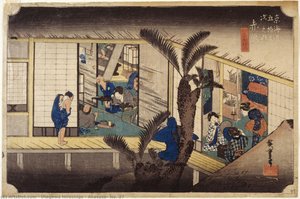
Discover 'Evening Snow at Kanbara' by Utagawa Hiroshige – a serene 1834 ukiyo-e print showcasing winter village life. Admire its monochrome beauty & tranquil composition.
Biografie kunstenaar
"meta_description": "Utagawa Hiroshige (1797-1858) was a Japanes master of ukiyo-e prints, famed for his evocative landscapes like 'Fifty-three Stations' and 'One Hundred Famous Views of Edo'. His work profoundly influenced Impressionism & Van Gogh."
About the painting
A Moment Frozen in Time: The Essence of Utagawa Hiroshige
“Evening Snow at Kanbara,” a captivating woodblock print by the legendary Utagawa Hiroshige, isn't merely a depiction of a winter landscape; it’s an invitation to step into a serene and contemplative world. Created in 1834 during the vibrant Edo period, this piece embodies the core tenets of *ukiyo-e*, or “pictures of the floating world,” transforming everyday scenes into profound artistic statements. Hiroshige, often considered the last great master of this genre, possessed an extraordinary ability to capture not just the appearance of a place but also its very spirit – a quality powerfully evident in this evocative print.
The scene unfolds within a small Japanese village nestled amidst a vast expanse of snow-covered hills. The composition is deliberately restrained, prioritizing atmosphere and mood over meticulous detail. Buildings are rendered with simplified forms, their outlines softened by the printing technique, while figures – bundled in umbrellas against the biting cold – appear as fleeting glimpses of human life within this frozen landscape. This strategic use of negative space—the overwhelming presence of snow—draws attention to the delicate balance between humanity and nature, highlighting the resilience and quiet dignity of those who endure the harsh winter conditions.
The Language of Woodblock: Technique and Artistic Vision
Hiroshige’s mastery lies not only in his subject matter but also in his technical execution. The print is a testament to the intricate process of *ukiyo-e* production, relying on multiple woodblocks carved with painstaking precision. The base layer of grey tones establishes the foundational structure of the scene, while subtle gradations – achieved through layering and careful manipulation of ink—create depth and volume. Notice how the snow itself isn’t uniformly white; it’s infused with delicate shades of grey, suggesting the play of light and shadow as the sun dips below the horizon. The deliberate lack of strong shading contributes to the print's ethereal quality, lending a dreamlike atmosphere to the winter scene.
Furthermore, Hiroshige’s use of *bokashi*, or color gradation, is particularly noteworthy. This technique involved applying multiple layers of ink in varying concentrations to achieve subtle transitions and nuanced tonal effects—a hallmark of his style and a key element in conveying the atmospheric depth of the landscape. The monochrome palette, dominated by shades of grey and white, amplifies the sense of stillness and solitude, inviting viewers to contemplate the beauty of simplicity.
Symbolism and the Poetics of Nature
Beyond its aesthetic appeal, “Evening Snow at Kanbara” is rich in symbolic meaning. The snow itself represents purity, resilience, and the cyclical nature of life – a reminder that even amidst hardship, there’s an inherent beauty to be found. The villagers, huddled beneath their umbrellas, embody human adaptability and perseverance in the face of adversity. Their presence serves as a poignant counterpoint to the vastness and indifference of the natural world.
This print was part of Hiroshige's celebrated “Fifty-three Stations of the Tōkaidō” series, documenting his journey along Japan’s main highway. Each station offered a unique glimpse into the diverse landscapes and communities of Edo period Japan. Hiroshige’s ability to capture the essence of these locations—not just their physical appearance but also their atmosphere and spirit—solidified his reputation as one of the most influential artists in Japanese history, profoundly impacting both traditional *ukiyo-e* and later Western art movements like Impressionism.
Bringing Hiroshige’s Vision Home
Reproductions of “Evening Snow at Kanbara” offer a remarkable opportunity to bring this timeless masterpiece into your own space. Whether you choose an authentic woodblock print or a high-quality digital reproduction, the print's serene beauty and evocative atmosphere will undoubtedly enhance any room. Consider framing it in a simple, understated manner to allow the artwork’s inherent elegance to shine through – a subtle reminder of Hiroshige’s poetic vision and the enduring power of Japanese art.
Veelgestelde vragen
Welke plaatsing past bij het formaat van "Evening Snow at Kanbara" door Hiroshige?
Formaat (Landscape) en aanbevolen ruimte (Living Room) zijn de twee plaatsingskenmerken vastgelegd voor "Evening Snow at Kanbara" door Hiroshige.
Welke afmeting voor de reproductie wordt aanbevolen voor "Evening Snow at Kanbara" door Hiroshige?
Voor "Evening Snow at Kanbara" wordt een afdrukformaat van Medium aanbevolen. Andere formaten zijn beschikbaar met dezelfde verhoudingen.
Welk palet en welke hoofdkleur bepalen "Evening Snow at Kanbara"?
"Evening Snow at Kanbara" wordt gekenmerkt door een Neutrals palet met Espresso (#474131) als dominante kleur.
Quick facts and art quiz
About Hiroshige

Hiroshige
1797 - 1858, Japan
Biografie kunstenaar
A Poetic Vision of Edo Japan: The Life and Art of Utagawa Hiroshige
Utagawa Hiroshige, geboren als Andō Tokutarō in 1797 in de bruisende stad Edo (het moderne Tokio), staat als een cruciale figuur in de wereld van *ukiyo-e*, of “afbeeldingen van de drijvende wereld.” Hoewel diep geworteld in de tradities van Japanse houtsnipkunst, overstond Hiroshige het simpele nabootsen, door zijn landschappen te verzegelen met een poëtische gevoeligheid die resoneren deed zowel binnen Japan als later, over de hele wereld. Zijn leven ontviel tijdens een periode van relatieve vrede en welvaart onder het Tokugawa-shogunaat, maar ook één gemarkeerd door toenemende sociale veranderingen en uiteindelijk westernisatie – krachten die uiteindelijk bijdroegen aan de achteruitgang van *ukiyo-e*, hoewel ze tegelijkertijd zijn blijvende nalatenschap versterkten. In eerste instantie was hij bestemd voor een meer conventionele weg binnen een samurai-familie—zijn vader diende als brandwacht—Hiroshige’s artistieke neigingen leidden hem naar de leerling van Utagawa Toyohiro, een meester van de Utagawa school. Dit bleek een cruciale wending, die hem afstuurde van populaire afbeeldingen van hoerenshows en acteurs, die door velen in de *ukiyo-e*-wereld werden geprezen, naar een focus op landschap, een genre waar hij uiteindelijk zijn eigen stijl zou herdefiniëren.Van Genre Scènes tot Evocative Landschappen
Hiroshige’s vroege werk volgde de conventies van zijn school, met portretten en scènes uit het dagelijks leven. Echter, zijn omhelzing van landschap was wat hem werkelijk onderscheidde. Hij werd beïnvloed door eerdere meesters zoals Hokusai—waarvan *Drie-en-zestig Uitzichten op Fuji* al publiek interesse wekte—Hiroshige ontwikkelde een unieke stijl gekenmerkt door atmosferische perspectieven, subtiele kleurenpaletten en een diepe gevoeligheid voor de veranderende seizoenen. Hij beschouwde plaatsen niet alleen; hij roepde hun stemming op, vastlegde de essentie van een bepaald moment in de tijd. De serie *De Vijftig-drie Posten van de Tōkaidō* (1833–1834), wellicht zijn meest beroemde prestatie, documenteerde het reisverloop langs de Tōkaidō-weg, de belangrijkste route tussen Edo en Kyoto, niet als een simpele reisgids maar als een reeks evocatieve bijschriften—een plotselinge regenbui in Shono, een verre blik op Fuji uit Kanaya, de drukte in Odawara. Elke prent is doordrenkt van een gevoel van vluchtigheid en rustige schoonheid, die kijkers uitnodigt om mee te reizen met de reizigers. Hij maakte meesterschappelijk *bokashi*, een techniek waarbij meerdere stempels worden gebruikt voor één kleur, waardoor hij subtiele schaduwen en atmosferische effecten kon creëren die moeilijk te repliceren waren. De delicate blauwtinten in zijn afbeeldingen van regen of mist, de warme tinten van herfstblaadwerk—dit was niet toevallig; het waren zorgvuldig overwogen elementen ontworpen om specifieke emoties en zintuigen op te roepen. Naast *bokashi* was Hiroshige bekwam in het gebruik van leegte – *ma*, een concept centraal in Japanse esthetiek, waardoor gebieden in de prent konden “ademen” en de algehele sfeer van sereniteit versterkten. Zijn serie *Eén Honderd Bekende Uitzichten van Edo* (1856–1858) toonde verder zijn meesterschap, waarbij intieme blikken werden geschenkt naar het leven en de landschappen in zijn geliefde stad.Een Meester van Atmosfeer en Techniek
Hiroshige’s technische vaardigheid was net zo opmerkelijk als zijn artistieke visie. Hij was niet alleen geïnteresseerd in nauwkeurige weergave; hij zocht de *gevoel* van een plaats vast te leggen. Zijn gebruik van kleur, hoewel vaak ingetreden vergeleken met dat van sommige van zijn tijdgenoten, was cruciaal om dit effect te bereiken. Hij gebruikte vaak meerdere blokken voor één kleur, waardoor hij subtiele tinten en atmosferische effecten kon creëren die moeilijk te repliceren waren. De delicate washes van blauw in zijn afbeeldingen van regen of mist, de warme tonen van herfstblaadwerk—dit was niet toevallig; het waren zorgvuldig overwogen elementen ontworpen om specifieke emoties en zintuigen op te roepen. Buiten *bokashi* was Hiroshige bekwam in het gebruik van leegte – *ma*, een concept centraal in Japanse esthetiek, waardoor gebieden in de prent konden “ademen” en de algehele sfeer van rust versterkten. Zijn serie *Eén Honderd Bekende Uitzichten van Edo* (1856–1858) toonde verder zijn meesterschap, waarbij intieme blikken werden geschenkt naar het leven en de landschappen in zijn geliefde stad.De Duurzaamheid: Japonisme en Verder
Hoewel de *ukiyo-e*-traditie aan het vervagen begon na Hiroshige’s dood in 1858—een achteruitgang versneld door de Meiji Restauratie en de daaropvolgende toestroom van westerse cultuur—zijn invloed op de kunstwereld bleek buitengewoon duurzaam. In de late negentiende eeuw stroomden Japanse prints naar Europa, wat leidde tot een fenomeen dat bekend staat als *Japonisme*. Kunstenaars zoals Édouard Manet, Claude Monet en Edgar Degas werden gefascineerd door de gedurfde composities, platte perspectieven en onconventionele kleurenschema’s van *ukiyo-e*, die deze elementen integreerden in hun eigen werk. Vincent van Gogh was bijzonder gefascineerd door Hiroshige’s prints, waarbij hij een aantal kopieën maakte, waaronder “Bloeiende Peer in Kameido,” wat zijn diepe bewondering voor de Japanse meester’s gebruik van kleur en compositie demonstreert. Hiroshige’s invloed strekte zich uit tot architectuur, design en zelfs literatuur. Vandaag de dag wordt Utagawa Hiroshige herinnerd niet alleen als een briljante kunstenaar maar ook als een culturele ambassadeur die de kloof tussen Oost en West heeft geslagen, een onuitwisbare stempel op de geschiedenis van de kunst heeft achtergelaten.Bekende Werken
- De Vijftig-drie Posten van de Tōkaidō: Hiroshige’s meest beroemde serie, die het reisverloop langs de belangrijkste route tussen Edo en Kyoto weergeeft.
- Eén Honderd Bekende Uitzichten van Edo: Een boeiend portret van het leven en de landschappen in zijn geliefde stad.
- Invloed op Vincent van Gogh’s Japonaiserie Serie: Inclusief “Bloeiende Peerboom na Hiroshige,” wat Van Gogh’s diepe bewondering voor de Japanse meester’s gebruik van kleur en compositie demonstreert.
Quick facts about Hiroshige
- Artistic Movement Or Style: *Ukiyo-e*
- Artists Or Movements Influenced By This Artist: ['Impressionisten']
- Artists Who Influenced This Artist: ['Hokusai']
- Date Of Birth: 1797
- Date Of Death: 1858
- Full Name: Utagawa Hiroshige
- Nationality: Japanse
- Notable Artworks:
- 53 Halteplaatsen
- 100 Bekende Zichten
- Place Of Birth: Tokyo, Japan
Ontdek kunstwerken georganiseerd op thema, stijl en kenmerk.




Hiroshige
Evening Snow at Kanbara
() ·
With its frame: · Hand-painted in oil on linen
Total