

Getoond: · Inclusief lijst:
 Voorvertoning
 Verstuur
 Delen
Delen
 Details bekijken
 Gids
Gids

 Download
 Vergelijkbare items
 Röntgenonderzoek
 Diavoorstelling
 Vraag & antwoord
 Statistieken
- 72.0 x 91.0 cm


€ 239
Handgemaakte olieverfreproductie
Met de hand geschilderd in olieverf op canvas in uw gewenste maat en lijst, op bestelling gemaakt door onze kunstenaars. ( Schakel over naar print Schakel over naar digitale afbeeldingen)
Formaat
·Standaardformaat
op maat gemaakt
CM
INCH
Kies uit onze vooraf ingestelde maten die overeenkomen met de originele verhoudingen van het kunstwerk.
Afmetingen laden...

breedte
hoogte
Voer de breedte en hoogte in die u nodig heeft, passend bij uw lijst of uw muur. Omdat dit handgeschilderd is, kan de kunstenaar bij een afmeting met een andere beeldverhouding iets meer rondom het schilderij schilderen of juist iets meer weglaten — u kiest zelf. Wij sturen u een digitaal mockup ter goedkeuring voordat het schilderwerk begint. De afbeelding die op deze pagina wordt getoond, is niet het uiteindelijke resultaat — alleen de mockup geeft dit weer.
 Lees meer over
Afronden
·
Wit €1

Vervagende randen €1

Doorlopende rand €1

P118B €10

P118H €10

P118W €10

P438Z €10

P508JH €12

P508YH €12

P805H €10

P805Z €10

P919BZ €10

P919G €10

P919XJ €10

P959ZH €10

P968JZ €12

W106C €8

W218G €10

W218JH €8

W218Y €10

W307PJ €10

W316G €10

W316PJ €8

W316Y €10

W398PJ €8

W4111J €10

W500HY €15

W500JH €15

W692G €12

W849H €8

W940BG €15

W953PJ €8

H24-GOLD €30

H24-SILVER €30

H36-GOLD €45

H36-SILVER €45
Verzonden in een beschermende koker, klaar om door uw eigen frameur te worden ingelijst.
Extra's
optioneelWat zijn de extra's precies?
Voorbeelden van wat aangepast kan worden: Vervang het gezicht door een foto van de klant; Voeg een huisdier toe (bijv. vervang de kat door een hond); Voeg een verborgen boodschap toe aan de achtergrond; Wijzig het landschap of de elementen in de achtergrond.
Na de bestelling zal het team van TopImpressionists.com per e-mail contact opnemen met de klant voor instructies en een mockup-voorbeeld verstrekken
Na de bestelling zal het team van TopImpressionists.com per e-mail contact opnemen met de klant voor instructies en een mockup-voorbeeld verstrekken
Wereldwijde levering () binnen 3 tot 4 weken in plaats van de standaard 5 weken. (4 november). Zonder concessies aan de kwaliteit.
Beschermende vernislaag
Naamplaatje
Details van de gegraveerde bronzen plaat
This elegant plaque features the artist's name and the title of the artwork, finely engraved for a timeless presentation.
It is made from bronze with a refined, elegant finish. The text is precisely laser-engraved for a sharp and permanent result. Measuring 9x2 cm, the plaque is compact yet easy to read. It's built to be durable and scratch-resistant, offering a professional, museum-quality look. Mounting is simple thanks to the included adhesive backing.
Details transparante acrylplaat
The plaque includes essential engraved details such as the artist's name, the title of the artwork, the date it was created, the type of media used-like oil on canvas or watercolor-a brief description of the piece, and a QR code that links to the complete artwork information.
It is crafted from clear acrylic, offering a sleek, modern appearance. The text is UV-engraved in black to ensure strong visual contrast. With a size of 10x15 cm, it ensures optimal readability. It comes equipped with two metal hooks for secure wall mounting. The plaque is designed to be weather-resistant, making it suitable for various environments, and it includes interactive features that work seamlessly with smartphone scanning.
Details zwarte acrylplaat
This elegant plaque includes engraved information such as the artist's name, the title of the artwork, the date it was created, the type of media used (like oil on canvas or watercolor), a short description of the artwork, and a QR code for quick access to more information.
The plaque itself is made from refined black acrylic with a premium finish. The text is laser-engraved in white for high contrast and readability. Its size is 10x15 cm, designed to be easy to read. It comes with two metal hooks for professional mounting. The design is sleek and fits any interior style. It is also weather-resistant and durable, with built-in digital integration for mobile compatibility.
De optie voor glas is alleen beschikbaar bij een formaat kleiner dan 110 cm.
 De optie voor glas is alleen beschikbaar bij een formaat kleiner dan 110 cm.
- Gratis wereldwijde expressverzending
- Hoogwaardig linnen canvas
- Volledige verzendverzekering
- Garantie op terugbetaling van invoerrechten
- Garantie op exacte kleurweergave
- Retourbeleid van 100 dagen (alleen bij defecten)
- 100% Geld-terug-garantie
- Korting bij meerdere afnames


Beschrijving verzamelobject
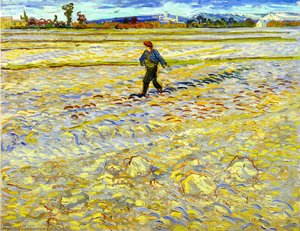
Experience Vincent van Gogh's 'Sower' – a poignant depiction of rural life brimming with vibrant color and emotional depth. Explore the symbolism, artistic style & lasting legacy of this masterpiece.
Biografie kunstenaar
Vincent van Gogh (1853-1890): Ontdek het leven en de kunst van de Nederlandse Postimpressionistische meester achter 'Sterrennacht' en 'Zonnebloemen'. Ontdek zijn gedurfde stijl en blijvende impact op de moderne kunst.
Over het schilderij
The Soul of the Harvest: Unveiling Van Gogh’s “Sower”
Vincent van Gogh's "Sower," painted in 1888, isn’t merely a depiction of rural labor; it’s a profound meditation on hope, renewal, and the cyclical nature of life itself. Born from a deep admiration for Jean-François Millet’s “The Sower,” Van Gogh sought to transcend mere imitation, imbuing his subject with an intensely personal and emotionally charged vision. This wasn't simply about capturing a farmer sowing seeds; it was about distilling the essence of faith, perseverance, and the enduring promise held within the earth.
The painting immediately draws the eye to the solitary figure, rendered in bold, earthy tones – ochre, umber, and a vibrant, almost luminous, orange. He’s not presented as a heroic figure, but rather as an ordinary man, his posture suggesting quiet determination as he casts his seeds across the field. The composition is deceptively simple: a vast expanse of plowed earth receding into the distance, punctuated by the dark silhouette of the sower and the warm glow of the setting sun. Yet, within this apparent austerity lies a remarkable dynamism – a sense of movement and energy that vibrates through every brushstroke.
Post-Impressionist Brilliance: Technique and Style
“Sower” is a quintessential example of Van Gogh’s distinctive Post-Impressionist style. He abandoned the muted palette and observational accuracy favored by his Impressionist predecessors, opting instead for an intensely subjective approach to color and form. Thick, impasto brushstrokes—a hallmark of his technique—create a tactile surface that seems almost sculptural. The paint is applied with a raw energy, capturing not just the appearance of the field but also the feeling of its texture and warmth. Notice how he builds up layers of pigment, creating a sense of depth and volume, as if inviting you to step into the scene.
The use of color is particularly striking. The vibrant orange of the sun isn’t merely a representation of light; it's an embodiment of hope and vitality. The deep blues and purples of the twilight sky contrast dramatically with the warm earth tones, creating a powerful visual tension that underscores the painting’s central theme – the transition from day to night, from labor to rest, from sowing to harvest.
Symbolism and the Language of the Land
The sower himself is laden with symbolic weight. He represents not just a farmer but also humanity's role in nurturing life and ensuring its continuation. Van Gogh’s choice to depict him in the act of sowing, rather than reaping the harvest, suggests that his work is focused on the *process* of creation—the planting of seeds for future generations. The fact that the field behind him already contains a hint of ripe grain hints at the promise of abundance and fulfillment, even amidst hardship.
Furthermore, the painting can be interpreted as an allegory for faith and spiritual renewal. Just as the sower plants seeds in the earth, Van Gogh believed that God planted ideas within the human soul—ideas that needed to be nurtured and cultivated. The setting sun, a recurring motif in his work, often symbolizes both death and rebirth, reinforcing this theme of cyclical transformation.
A Timeless Resonance: Legacy and Inspiration
“Sower” continues to resonate with audiences today because it speaks to fundamental human experiences—the connection between humanity and nature, the struggle for survival, and the enduring hope for a better future. Van Gogh’s innovative use of color and composition has profoundly influenced generations of artists, from Expressionists like Edvard Munch to Abstract Expressionists like Jackson Pollock. It remains a powerful testament to the transformative power of art—a reminder that even in the simplest scenes, profound truths can be revealed.
Veelgestelde vragen
Hoe oud was Vincent Van Gogh toen "Sower" werd gemaakt?
Toen "Sower" werd gemaakt in 1888, was Vincent Van Gogh - geboren in 1853 - 35 jaar oud.
Wat zijn de techniek en de afmetingen van "Sower" door Vincent Van Gogh?
"Sower" door Vincent Van Gogh is uitgevoerd in Acryl op canvas en heeft de afmetingen 72 x 91 cm.
Behoort "Sower" door Vincent Van Gogh tot het publiek domein?
Wat betreft het auteursrecht valt "Sower" onder bevindt zich in het publiek domein - de auteursrechten zijn verlopen.
Snelle feiten en kunstquiz
Over Vincent Van Gogh

Vincent Van Gogh
1853 - 1890, Nederland
Biografie kunstenaar
Een leven geschilderd in passie: Vincent van Gogh
Vincent Willem van Gogh, een naam die synoniem staat voor levendige kleur en rauwe emotie, blijft een van de meest herkenbare en geliefde figuren uit de kunstgeschiedenis. Geboren op 30 maart 1853 in Zundert, Nederland, is zijn reis van een getroebleerde jonge man op zoek naar een doel tot een artistiek visionair een ontroerend verhaal van toewijding, strijd en uiteindelijk een blijvende erfenis. Hoewel hij tijdens zijn leven weinig commercieel succes behaalde – hij verkocht slechts één schilderij, Het rode wijngaard, voor zijn dood – is de impact van Van Gogh op de moderne kunst onmetelijk; hij plaveide de weg voor het expressionisme en beïnvloedde talloze kunstenaars die hem volgden. Zijn verhaal gaat niet alleen over penseelstreken en canvas; het is een getuigenis van de kracht van menselijke expressie in het aangezicht van tegenspoed.
De vroege jaren en artistieke ontwaking
Van Goghs vroege leven werd gekenmerkt door een reeks onvervulde ambities. Hij probeerde verschillende beroepen – kunsthandelaar, leraar en zelfs missionaris – voordat hij zich op relatief late leeftijd van 27 jaar volledig aan de schilderkunst wijdde. Deze eerdere ervaringen vormden zijn wereldbeeld diepgaand en vonden hun weg naar zijn kunst. Zijn eerste werken, waarin scènes uit het boerenleven in het landelijke België werden afgebeeld, weerspiegelen een diepe empathie voor de arbeidersklasse en een somber palet dat hun ontberingen reflecteerde. Beïnvloed door kunstenaars als Jean-François Millet, zocht Van Gogh naar een manier om de waardigheid en veerkracht van deze mensen vast te leggen door middel van rauw realisme. Het was echter zijn verhuizing naar Parijs in 1886 die transformatief bleek te zijn. Daar maakte hij kennis met het impressionisme en postimpressionisme, waarbij hij de technieken van meesters als Monet, Renoir en Pissarro absorbeerde. Deze blootstelling verbredde zijn artistische horizon en leidde hem tot experimenten met helderdere kleuren en lossere penseelstreken, hoewel hij een duidelijke emotionele intensiteit behield die bij veel van zijn tijdgenoten ontbrak. Zijn broer Theo, een kunsthandelaar, speelde een cruciale rol in deze periode door financiële steun te bieden en als een vitale schakel naar de Parijse kunstwereld te fungeren. Hun uitgebreide correspondentie biedt onschatbare inzichten in Van Goghs artistieke ontwikkeling en persoonlijke strijd.
loosHet zuidelijke licht en explosieve creativiteit
Op zoek naar een levendiger landschap en een gevoel van vernieuwing, verhuisde Van Gogh in 1888 naar Arles in Zuid-Frankrijk. Deze verhuizing markeerde een periode van intense creatieve productie, gekenmerkt door een explosie van kleur en een kenmerkende impasto-techniek – het dik aanbrengen van verf op het canvas, waardoor een textuur ontstaat die lijkt te pulseren met energie. Het was hier dat hij enkele van zijn meest iconische werken produceerde: Zonnebloemen, Het nachtcafé en De sterrennacht. Het intense zonlicht van de Provence leek zijn verbeelding aan te wakkeren, waardoor hij landschappen en stillevens met een ongekende levendigheid kon afbeelden. Zijn verlangen naar artistieke samenwerking leidde ertoe dat hij Paul Gauguin uitnodigde om zich bij hem in Arles te voegen, in de hoop een utopische kunstenaarskolonie te stichten. Hun relatie bleek echter stormachtig en culmineerde in een dramatische confrontatie die resulteerde in het verminken van zijn eigen oor. Deze gebeurtenis onderstreepte de kwetsbaarheid van zijn mentale toestand en markeerde het begin van een periode van institutionalisering en toenemende psychologische nood.
De latere jaren en een blijvende erfenis
Na zijn inzinking trad Van Gogh vrijwillig een inrichting binnen in Saint-Rémy, waar hij productief bleef schilderen en de omringende landschappen met zowel schoonheid als onrust vastlegde. Werken zoals De sterrennacht, geschilderd tijdens deze tijd, zijn doordrenkt van een gevoel van kosmisch wonder en diepe emotionele gelaagdheid. Later verhuisde hij naar Auvers-sur-Oise onder de zorg van Dr. Paul Gachet, maar zijn strijd hield aan. Op 29 juli 1890 stierf Van Gogh op 37-jarige leeftijd tragisch aan een zelfveroorzaakt schotwond. Ondanks het feit dat hij tijdens zijn leven weinig erkenning kreeg, begon zijn werk na zijn dood lof te oogsten, grotendeels dankzij de onvermoeibare inspanningen van zijn schoonzus, Johanna van Gogh-Bonger, die zijn nalatenschap erfde en zich wijdde aan het promoten van zijn kunst. Vandaag de dag worden de schilderijen van Van Gogh wereldwijd gevierd om hun emotionele intensiteit, innovatieve technieken en blijvende schoonheid. Zijn nalatenschap reikt veel verder dan het canvas; hij is een symbool geworden van artistieke passie, doorzettingsvermogen in tijden van tegenspoed en de kracht van kunst om de diepste menselijke emoties uit te drukken.
Belangrijke invloeden en artistieke ontwikkeling
- Vroeg realisme: De afbeeldingen van het boerenleven door Jean-François Millet beïnvloedden Van Goghs vroege werken.
- Impressionisme & Postimpressionisme: Blootstelling aan Monet, Renoir, Pissarro en anderen in Parijs verbreedden zijn palet en techniek.
- Japanse prenten: Van Gogh werd diep beïnvloed door Japanse houtsneden, die hij met passie verzamelde. Hun gedurfde composities en vlakke kleurvlakken hadden een grote impact op zijn eigen stijl.
- Emotionele expressie: Bovenal probeerde Van Gogh emotie over te brengen via zijn kunst, waarbij hij de subjectieve ervaring boven de objectieve representatie stelde. Deze focus op emotionele intensiteit werd een bepalend kenmerk van zijn werk en plaveide de weg voor het expressionisme.
Snelle feiten over Vincent Van Gogh
- Artistic Movement Or Style: Post-Impressionisme
- Artists Or Movements Influenced By This Artist:
- Expressionisme
- Fauvisme
- Artists Who Influenced This Artist:
- Rembrandt
- Millet
- Date Of Birth: 30 maart 1853
- Date Of Death: 29 juli 1890
- Full Name: Vincent Willem van Gogh
- Nationality: Nederlands
- Notable Artworks:
- Pommes de terre
- Zonnebloemen
- Sterrennacht
- Place Of Birth: Zundert, Nederland
Vergelijkbare kunstwerken




Ontdek kunstwerken georganiseerd op thema, stijl en kenmerk.


Vincent Van Gogh
Sower
() ·
Inclusief lijst: · Met de hand geschilderd in olieverf op linnen
Totaal