

Getoond: · Inclusief lijst:
 Voorvertoning
 Verstuur
 Delen
Delen
 Details bekijken
 Gids
Gids

 Download
 Vergelijkbare items
 Röntgenonderzoek
 Diavoorstelling
 Vraag & antwoord
 Statistieken

€ 285
Handgemaakte olieverfreproductie
Met de hand geschilderd in olieverf op canvas in uw gewenste maat en lijst, op bestelling gemaakt door onze kunstenaars. ( Schakel over naar print Schakel over naar digitale afbeeldingen)
Formaat
·Standaardformaat
op maat gemaakt
CM
INCH
Kies uit onze vooraf ingestelde maten die overeenkomen met de originele verhoudingen van het kunstwerk.
Afmetingen laden...

breedte
hoogte
Voer de breedte en hoogte in die u nodig heeft, passend bij uw lijst of uw muur. Omdat dit handgeschilderd is, kan de kunstenaar bij een afmeting met een andere beeldverhouding iets meer rondom het schilderij schilderen of juist iets meer weglaten — u kiest zelf. Wij sturen u een digitaal mockup ter goedkeuring voordat het schilderwerk begint. De afbeelding die op deze pagina wordt getoond, is niet het uiteindelijke resultaat — alleen de mockup geeft dit weer.
 Lees meer over
Afronden
·
Wit €1

Vervagende randen €1

Doorlopende rand €1

P118B €10

P118H €10

P118W €10

P438Z €10

P508JH €12

P508YH €12

P805H €10

P805Z €10

P919BZ €10

P919G €10

P919XJ €10

P959ZH €10

P968JZ €12

W106C €8

W218G €10

W218JH €8

W218Y €10

W307PJ €10

W316G €10

W316PJ €8

W316Y €10

W398PJ €8

W4111J €10

W500HY €15

W500JH €15

W692G €12

W849H €8

W940BG €15

W953PJ €8

H24-GOLD €30

H24-SILVER €30

H36-GOLD €45

H36-SILVER €45
Verzonden in een beschermende koker, klaar om door uw eigen frameur te worden ingelijst.
Extra's
optioneelWat zijn de extra's precies?
Voorbeelden van wat aangepast kan worden: Vervang het gezicht door een foto van de klant; Voeg een huisdier toe (bijv. vervang de kat door een hond); Voeg een verborgen boodschap toe aan de achtergrond; Wijzig het landschap of de elementen in de achtergrond.
Na de bestelling zal het team van TopImpressionists.com per e-mail contact opnemen met de klant voor instructies en een mockup-voorbeeld verstrekken
Na de bestelling zal het team van TopImpressionists.com per e-mail contact opnemen met de klant voor instructies en een mockup-voorbeeld verstrekken
Wereldwijde levering () binnen 3 tot 4 weken in plaats van de standaard 5 weken. (7 november). Zonder concessies aan de kwaliteit.
Beschermende vernislaag
Naamplaatje
Details van de gegraveerde bronzen plaat
This elegant plaque features the artist's name and the title of the artwork, finely engraved for a timeless presentation.
It is made from bronze with a refined, elegant finish. The text is precisely laser-engraved for a sharp and permanent result. Measuring 9x2 cm, the plaque is compact yet easy to read. It's built to be durable and scratch-resistant, offering a professional, museum-quality look. Mounting is simple thanks to the included adhesive backing.
Details transparante acrylplaat
The plaque includes essential engraved details such as the artist's name, the title of the artwork, the date it was created, the type of media used-like oil on canvas or watercolor-a brief description of the piece, and a QR code that links to the complete artwork information.
It is crafted from clear acrylic, offering a sleek, modern appearance. The text is UV-engraved in black to ensure strong visual contrast. With a size of 10x15 cm, it ensures optimal readability. It comes equipped with two metal hooks for secure wall mounting. The plaque is designed to be weather-resistant, making it suitable for various environments, and it includes interactive features that work seamlessly with smartphone scanning.
Details zwarte acrylplaat
This elegant plaque includes engraved information such as the artist's name, the title of the artwork, the date it was created, the type of media used (like oil on canvas or watercolor), a short description of the artwork, and a QR code for quick access to more information.
The plaque itself is made from refined black acrylic with a premium finish. The text is laser-engraved in white for high contrast and readability. Its size is 10x15 cm, designed to be easy to read. It comes with two metal hooks for professional mounting. The design is sleek and fits any interior style. It is also weather-resistant and durable, with built-in digital integration for mobile compatibility.
De optie voor glas is alleen beschikbaar bij een formaat kleiner dan 110 cm.
 De optie voor glas is alleen beschikbaar bij een formaat kleiner dan 110 cm.
- Gratis wereldwijde expressverzending
- Hoogwaardig linnen canvas
- Volledige verzendverzekering
- Garantie op terugbetaling van invoerrechten
- Garantie op exacte kleurweergave
- Retourbeleid van 100 dagen (alleen bij defecten)
- 100% Geld-terug-garantie
- Korting bij meerdere afnames


Beschrijving verzamelobject
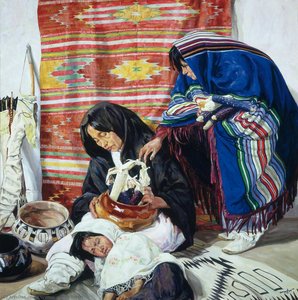
Explore Walter Ufer’s ‘Sleep,’ a poignant oil painting of Native American women in Taos. Discover realism, rich detail & cultural symbolism – a unique 20th-century artwork.
Biografie kunstenaar
Walter Ufer (1876-1936) was een in Duitsland geboren Amerikaanse kunstenaar, beroemd om zijn evocatieve schilderijen van het Native American leven in Taos, New Mexico. Kernlid van de 'Taos Ten', bekend om genrescènes en landschappen.
Over het schilderij
The Weight of Tradition: An Encounter with Walter Ufer’s “Sleep”
Walter Ufer's "Sleep," painted in 1923, isn’t merely a depiction of three Native American women; it’s an immersion into a world steeped in ritual and profound reverence. The painting immediately draws the viewer in with its rich tapestry of color – predominantly warm reds, oranges, and browns that evoke the earth itself, grounded by cooler blues and greens woven through the textiles and pottery. This palette isn't simply decorative; it speaks to the cultural heritage of the subjects, hinting at a deep connection to the land and ancestral traditions. The composition is carefully orchestrated, centering on the kneeling woman as a focal point, yet subtly inviting us into the periphery of the scene, suggesting an active participation in this sacred space.
Ufer’s masterful technique reveals layers of painstaking detail. He employs a layered oil painting approach, building up texture with deliberate brushstrokes that create a palpable sense of roughness on the clothing – perhaps representing the wear and tear of daily life intertwined with ceremonial garb – while simultaneously rendering the pottery with smooth, almost polished surfaces. This juxtaposition speaks to the duality inherent in Native American culture: the balance between practicality and spirituality, the tangible and the intangible. The lighting, soft and diffused, isn’t dramatic; it's deliberately muted, casting subtle shadows that lend a sense of solemnity and depth to the figures and objects, as if illuminating a secret whispered within a sacred space.
A Window into Taos: Contextualizing Ufer’s Vision
To fully appreciate “Sleep,” it's crucial to understand its historical context. Painted in 1923, during his time in Taos Pueblo, New Mexico, the artwork represents a pivotal moment in Walter Ufer’s career and his deep engagement with Native American culture. He was part of the "Taos Ten," a group of artists who sought to document and celebrate the lives and traditions of the region's indigenous communities. This wasn’t simply an act of observation; it was a deliberate attempt at understanding and portraying these cultures with respect and authenticity, a rare undertaking for American art at the time.
Ufer’s background as a German-born artist profoundly shaped his approach. His training in Europe instilled a meticulous attention to detail and a sophisticated understanding of composition – elements he skillfully translated into his depictions of Native American life. However, it was his immersion within the Taos community that truly informed his work, allowing him to capture not just appearances but also the spirit and essence of these traditions. The painting’s realism is tempered by an underlying sense of mystery, inviting viewers to contemplate the deeper meanings embedded within the scene.
Symbolism Woven into the Fabric
The details within “Sleep” are laden with symbolic significance. The intricately patterned rug serves as a visual anchor, framing the central figures and providing a rich backdrop that speaks to the importance of storytelling and communal life within Native American culture. The pottery, often adorned with geometric designs and natural motifs, represents both artistic skill and spiritual connection – a tangible link to ancestors and the earth. The women themselves, engaged in what appears to be a ritualistic activity, are not simply subjects; they embody generations of tradition, wisdom, and connection to the divine.
The act depicted—kneeling in reverence—suggests healing or a profound spiritual ceremony. The quiet dignity of the figures, coupled with the muted colors and soft lighting, evokes a sense of solemnity and timelessness. It’s an image that transcends mere representation, offering a glimpse into a world governed by ancient beliefs and deeply rooted traditions.
A Legacy of Authenticity: Reproductions and Beyond
Walter Ufer's "Sleep" remains a powerful testament to the beauty and complexity of Native American culture. TopImpressionists offers high-quality, hand-painted reproductions that faithfully capture the painting’s rich detail and evocative atmosphere. These reproductions are more than just images; they are windows into another world—a world of sacred rituals, profound traditions, and enduring wisdom. Investing in a reproduction is an investment in preserving this important piece of American art history and honoring the legacy of Walter Ufer's insightful portrayal.
Veelgestelde vragen
Hoe brengt "Sleep" licht en donker in evenwicht?
De vastgestelde waarden voor "Sleep" door Walter Ufer zijn: bright helderheid en Gentle Luminance luminantie.
Welke stemming straalt "Sleep" door Walter Ufer uit binnen Contemporary Realism?
De Melancholic emotie van "Sleep" gaat samen met de Contemporary Realism stijl.
Wie is de maker van "Sleep" en bij welke stroming hoort dit werk?
"Sleep" werd gecreëerd door Walter Ufer in de Contemporary Realism-stijl. De kunstenaar en de stroming bepalen de traditie van het werk.
Snelle feiten en kunstquiz
Over Walter Ufer

Walter Ufer
1876 - 1936, Duitsland
Biografie kunstenaar
De Ziel van het Zuidwesten: Het Leven en de Nalatenschap van Walter Ufer
Walter Ufer staat te boek als een spilfiguur binnen het Amerikaans Impressionisme, een schilder wiens penseelstreken meer deden dan enkel licht vangen; ze legden de hartslag van een hele cultuur vast. Geboren in 1876 in Hückeswagen, Duitsland, werd Ufers reis naar de hooggelegen woestijnen van New Mexico geplaveid met een rigoureuze Europese opleiding en een diepgewortelde nieuwsgierigheid naar de menselijke conditie. Zijn vroege jaren werden gevormd door de Duits-Amerikaanse diaspora in Louisville, Kentucky, waar hij voor het eerst begon de rijke texturen van zijn erfgoed te absorberen. Deze fundamentele periode, gekenmerkt door studies in lithografie en prentkunst, schonk hem een technische precisie die hem later in staat zou stellen om de complexiteit van licht en schaduw met ongeëvenaarde meesterschap te navigeren.
Zijn streven naar artistieke excellentie leidde hem op een transformerende odyssee door Europa. Als reizend gezel doopte Ufer zichzelf in de diverse artistieke tradities van het continent en verfijnde zijn techniek aan de prestigieuze academies van Hamburg en Dresden. Deze periode van intense intellectuele en creatieve expansie culmineerde in zijn tijd in München, waar hij zich wijdde aan een intensief atelierwerk. Toen hij in 1911 uiteindelijk terugkeerde naar de Verenigde Staten, bracht hij een verfijnde Europese sensibiliteit met zich mee, die klaarstond voor een diepgaande ontmoeting met de ruige, zonovergoten landschappen van het Amerikaanse Westen.
Een Visionair van de Taos Ten
Het jaar 1914 markeerde een definitief keerpunt in Ufers leven en de koers van de Amerikaanse kunst. Bij zijn avontuur in Taos Pueblo, New Mexico, werd hij onderdeel van een buitengewone artistieke revolutie. Door zich aan te sluiten bij de invloedrijke groep die bekend staat als de "Taos Ten," werd Ufer een centrale figuur in een collectief dat streefde naar meer dan louter landschapsschilderkunst; zij zochten naar een authentiekere, visceraalere weergave van het leven van de Native Americans. In tegenstelling tot veel van zijn tijdgenoten, die het Zuidwesten door een geromantiseerde of koloniale lens bekeken, benaderde Ufer zijn onderwerpen met diep respect en een oog voor de waardigheid van het dagelijks bestaan.
Zijn werk werd een brug tussen Europese impressionistische technieken en de rauwe, spirituele energie van het Pueblo-volk. Hij was niet louter een observator, maar een chroniqueur van rituelen, landschappen en de stille ritmes van het gemeenschapsleven. Centraal in deze creatieve evolutie stond zijn relatie met Jim Mirabal, een Taos-Indiaan die zowel als muze als collaborator voor Ufer diende. Door deze verbinding verkreeg Ufer een intiem begrip van de culturele nuances die de regio definiert, waardoor hij zijn doeken kon doordrenken met een gevoel van geleefde waarheid dat ver buiten de grenzen van New Mexico resoneerde.
Techniek, Symboliek en Historisch Belang
Het oeuvre van Ufer kenmerkt zich door een meesterlijk beheerst kleurgebruik en een gedurfde, expressieve applicatie van verf. Hoewel zijn stijl geworteld was in de principes van het Amerikaans Impressionisme, neigde hij vaak naar een robuustere en textuurrijke benadering die de hitte van de woestijnzon en het gewicht van de aarde wist te vangen. Hij gebruikte licht niet alleen om vorm te verlichten, maar om emotie op te roepen—waardoor scènes ontstonden waarin de atmosfeer zwaar aanvoelt van historie en traditie.
De historische betekenis van Walter Ufer ligt in zijn vermogen om genreschilderkunst te verheffen tot een diepgaand sociaal en cultureel statement. Zijn prestaties omvatten:
- Authentieke Representatie: Het doorbreken van de "pittoreske" stereotypen van het leven van Native Americans om een genuanceerder en menselijker portret van het Taos-volk te presenteren.
- Artistieke Synthese: Het succesvol versmelten van de formele academische training uit Duitsland met de levendige, ongetemde geest van het Amerikaanse Zuidwesten.
- Nalatenschap van de Taos Ten: Het spelen van een cruciale rol bij het vestigen van Taos als een vooraanstaande bestemming voor het Amerikaans modernisme en als een vitaal centrum voor kunst met een inheemse focus.
Vandaag de dag blijven de schilderijen van Ufer blijvende getuigenissen van een periode van intense culturele kruisbestuiving. Zijn vermogen om de technische strengheid van zijn Europese opleiding te verweven met de spirituele diepgang van de Pueblo-cultuur zorgt ervoor dat zijn werk blijft boeien, en nodigt moderne toeschouwers uit om via zijn evocatieve en meesterlijke ogen getuige te zijn van de tijdloze geest van de Taos Valley.
Snelle feiten over Walter Ufer
- Artistic Movement Or Style: Taos Impressionisme
- Artists Or Movements Influenced By This Artist: ['']
- Artists Who Influenced This Artist: ['']
- Date Of Birth: 1876
- Date Of Death: 1936
- Full Name: Walter Ufer
- Nationality: Duits-Amerikaans
- Notable Artworks:
- Haar dochter
- Bouwers van de woestijn
- Na hen
- Place Of Birth: Hückeswagen, Duitsland


Walter Ufer
Sleep
() ·
Inclusief lijst: · Met de hand geschilderd in olieverf op linnen
Totaal