

 Voorvertoning
 Verstuur
 Delen
Delen
 Details bekijken
 Gids
Gids

 Download
 Vergelijkbare items
 Röntgenonderzoek
 Diavoorstelling
 Statistieken
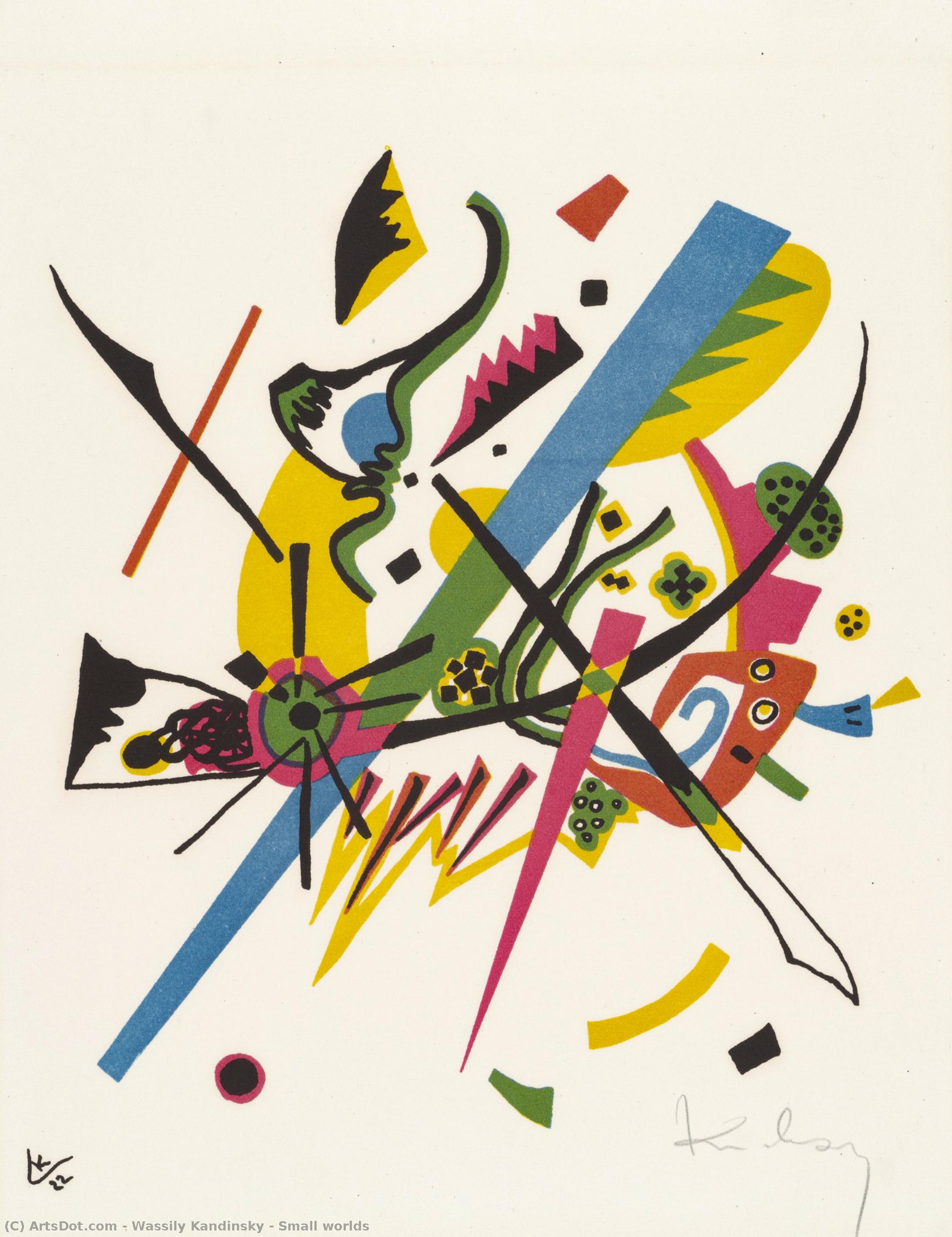
Small worlds
 Gouache
- WallArt
- Abstract Expressionism
 1922
1922- Modern
 24.0 x 21.0 cm
Explore Wassily Kandinsky’s ‘Small Worlds’! A vibrant 1922 lithograph showcasing abstract expressionism & dynamic geometric forms. Discover a captivating piece of modern art.
 Lees meer
Ontdek Wassily Kandinsky (1866-1944), de pionier van abstracte kunst! Verken zijn levendige expressionisme, spirituele thema's & Bauhaus erfenis via prachtige reproducties.
Giclée / Kunstafdrukken
Giclée- of canvasafdruk van museumkwaliteit met een snelle productie en flexibele afwerkingsmogelijkheden. ( Bestel handgeschilderde reproductie Schakel over naar digitale afbeeldingen)




P118B €10

P118H €10

P118W €10

P438Z €10

P508JH €12

P508YH €12

P805H €10

P805Z €10

P919BZ €10

P919G €10

P919XJ €10

P959ZH €10

P968JZ €12

W106C €8

W218G €10

W218JH €8

W218Y €10

W307PJ €10

W316G €10

W316PJ €8

W316Y €10

W398PJ €8

W4111J €10

W500HY €15

W500JH €15

W692G €12

W849H €8

W940BG €15

W953PJ €8




Standaardformaat
op maat gemaakt
CM
INCH
Kies uit onze vooraf ingestelde maten die overeenkomen met de originele verhoudingen van het kunstwerk.
Loading sizes...

breedte
hoogte
Voer de gewenste breedte en hoogte in, passend bij uw lijst of muur. Een afdruk kan alleen worden ingekort en nooit groter worden gemaakt dan het origineel; een formaat met andere verhoudingen zal daarom een deel van de afbeelding verliezen. Wij sturen u een digitaal mockup ter goedkeuring voordat we tot drukwerk overgaan. De afbeelding op deze pagina toont niet de werkelijke uitsnede — dit is alleen te zien op het mockup.
Wereldwijde levering () binnen 2 weken in plaats van de standaard 4/5 weken. (27 oktober)

Gratis wereldwijde expressverzending

Hoogwaardig linnen canvas

Volledige verzendverzekering

Garantie op terugbetaling van invoerrechten

Garantie op exacte kleurweergave

Retourbeleid van 100 dagen (alleen bij defecten)

100% Geld-terug-garantie

Korting bij meerdere afnames
 De optie voor glas is alleen beschikbaar bij een formaat kleiner dan 110 cm.

Small worlds
Giclée / Kunstafdrukken
Afmetingen reproductie
-


Eindtotaal
€ 61
A Universe in Miniature: Exploring Kandinsky’s ‘Small Worlds’
Wassily Kandinsky's 1922 lithograph, *Small Worlds*, is a pivotal work demonstrating his fully realized abstract style. It isn’t merely an artwork; it’s a visual poem – a distillation of Kandinsky’s lifelong exploration into the spiritual and emotional power of form and color. This piece, measuring 24 x 21 cm, offers a captivating glimpse into the artist's unique worldview and remains profoundly relevant today.The Birth of Abstraction & Bauhaus Influence
Kandinsky is celebrated as a pioneer of abstract art, believing that painting could – and *should* – transcend representation to directly evoke feeling. This conviction arose from his synesthetic experiences (a blending of senses) and a deep interest in theosophy. Created while Kandinsky was teaching at the Bauhaus school in Germany, *Small Worlds* reflects the institution’s emphasis on experimentation with materials and techniques. The Bauhaus fostered an environment where art, craft, and technology converged, influencing Kandinsky's printmaking explorations.Composition & Symbolic Language
The composition of *Small Worlds* is deceptively simple yet remarkably dynamic. A central yellow circle dominates the space, radiating outwards amidst a constellation of smaller circles, triangles, and linear elements against a predominantly white background. This arrangement isn’t arbitrary. Kandinsky assigned symbolic meaning to colors: yellow representing warmth and solar energy, red signifying vibrancy and passion, and green evoking nature and tranquility. The geometric forms themselves were not intended as representations of objects but rather as vehicles for expressing inner states and spiritual concepts.Lithography & Artistic Technique
Kandinsky’s choice of lithography was deliberate. This technique allowed him to achieve smooth surfaces, nuanced tonal variations, and a wide range of colors – qualities he valued in his pursuit of modern artistic expression. Lithography's relative accessibility also aligned with the Bauhaus ideal of “art for all,” making art production more democratic. The precise lines and flat planes within *Small Worlds* showcase Kandinsky’s mastery of this medium.Emotional Resonance & Lasting Legacy
*Small Worlds* isn’t a painting to be ‘read’ but rather *experienced*. It invites viewers into a realm of pure sensation, prompting introspection and emotional response. The interplay of colors and forms creates a sense of movement, tension, and harmony simultaneously. Kandinsky's work profoundly influenced subsequent generations of artists, paving the way for abstract expressionism and other non-representational movements.Collecting & Interior Design
- For Art Lovers: *Small Worlds* is a cornerstone piece for any collection focused on modern art or abstraction.
- For Collectors: As part of the *Kleine Welten* portfolio, this lithograph holds significant historical and artistic value.
- For Interior Designers: The vibrant color palette and dynamic composition make *Small Worlds* a striking focal point in contemporary spaces. Its abstract nature allows it to complement a wide range of interior styles – from minimalist to eclectic.
Veelgestelde vragen
Wat zijn de afmetingen en het formaat van "Small worlds"?
Het formaat van "Small worlds" is Portrait en het origineel heeft de afmetingen 24 x 21 cm. Beide zijn nuttig bij het plannen van een reproductie.
Hoe oud was Wassily Wassilyevich Kandinsky bij het creëren van "Small worlds" in 1922?
Wassily Wassilyevich Kandinsky was 56 jaar oud bij het creëren van "Small worlds" in 1922. De leeftijd is berekend op basis van het geboortejaar van de kunstenaar, 1866.
Wat wordt er afgebeeld in "Small worlds" door Wassily Wassilyevich Kandinsky?
De thema's die aanwezig zijn in "Small worlds" door Wassily Wassilyevich Kandinsky omvatten abstract art, geometric forms, color theory, kandinsky, symbolism, modern art, printmaking, dynamic composition. Samen vatten zij de onderwerpen van het kunstwerk samen.
Biografie kunstenaar
A Life Immersed in Color and Spirit
Wassily Wassilyevich Kandinsky, geboren in Moskou in 1866, was een revolutionaire figuur die de koers van moderne kunst onherstelbaar heeft veranderd. Zijn reis was geen directe artistieke roeping; aanvankelijk was hij bestemd voor een carrière in de rechten en economie aan de Universiteit van Moskou, maar het was een diepgaande ontmoeting met impressionistische schilderkunst – specifiek Claude Monet’s “Haystacks” – en een aangrijpend ervaring tijdens het bijwonen van Wagners opera "Lohengrin" die in hem een onweerstaanbare drang ontstond om kunst te beoefenen. Dit cruciale moment, rond de leeftijd van dertig, markeerde niet alleen een carrièreverandering, maar ook een complete verschuiving in perspectief, waardoor hij op weg werd gesteld naar het pionierswerk van abstractie. Kort daarna verhuisde hij naar München en meldde zich aan bij de prestigieuze Academie voor Beeldende Kunsten en studeerde daar onder Franz von Stuck, hoewel zelfs binnen formele training Kandinsky’s geest hunkerde naar exploratie buiten conventionele grenzen.
Vroege invloeden omvatten Russische volkskunst, verkregen tijdens een etnografische expeditie naar de Vologda-regio in 1889, wat een fascinatie wekte voor levendige kleurenpaletten en symbolische beelden. Deze basis zou cruciaal blijken te zijn terwijl hij begon zijn unieke artistieke taal te ontwikkelen. Deze vroege verkenningsreizen waren niet alleen gebaseerd op esthetische voorkeuren; ze waren geworteld in een diepe culturele verbinding en een groeiend begrip van hoe kunst kan communiceren buiten de letterlijke betekenis. De invloed van Wagner’s opera's was bijzonder belangrijk, omdat het Kandinsky’s verlangen naar expressie en spiritualiteit stimuleerde.
The Dawn of Abstraction: From Expressionism to Inner Necessity
Kandinsky’s vroege werken tonen een sterke expressionistische neiging, gekenmerkt door felle kleuren en emotionele intensiteit – schilderijen zoals “Papeln (Poplars)” uit 1902 illustreren deze periode. Echter, hij was niet tevreden om de buitenwereld te representeren; hij zocht naar het uiten van innerlijke realiteiten, spirituele waarheden die verder gingen dan eenvoudige visuele weergave. Deze zoektocht leidde hem geleidelijk weg van representatiekunst en richting een revolutionaire verkenning van kleur, vorm en hun emotionele resonans. Hij geloofde dat kleuren inherent psychologische effecten hadden, in staat om specifieke gevoelens en zintuiglijke ervaringen bij de kijker op te roepen.
Hij begon te geloven dat kleuren een intrinsieke betekenis hadden, die verband hield met zijn toenemende interesse in de Theosophie, een spirituele beweging die esoterische kennis en universele broederschap benadrukte. Door zich verder te verdiepen in deze ideeën, werden Kandinsky’s schilderijen steeds meer niet-objectief, waarbij herkenbare vormen werden losgelaten ten gunste van abstracte composities gedreven door een “innerlijke noodzaak”. Dit was niet alleen het opgeven van representatie; het was het ontdekken van een nieuwe visuele taal die in staat was om de ongrijpbare rijkdommen van emotie en spiritualiteit uit te drukken. Hij streefde ernaar om een visueel equivalent te creëren voor muziek, waarbij kleur en vorm harmonieerden om diepgaande emotionele reacties op te wekken.
Geometric Harmony and Spiritual Resonance
De periode na zijn betrokkenheid bij de invloedrijke kunstenaarsgroep Der Blaue Reiter (De Blauwe Reiter), die hij in 1911 in München mede-stigde, zag een verdere evolutie in Kandinsky’s stijl. Hoewel eerdere werken vaak vloeiende, organische vormen vertoonden, begon hij te experimenteren met abstracte geometrie, waarbij de nadruk lag op het samenspel van cirkels, driehoeken en vierkanten. “Several Circles” (140 x 140 cm) is een voorbeeld van deze fase – een dynamische compositie waarin kleur en vorm in een harmonieus maar energiek dansje interageren. De kleuren werden zorgvuldig gekozen om specifieke emoties en ideeën te oproepen, wat de essentie van Kandinsky’s artistieke visie weerspiegelt.
Deze geometrie was niet koud of steril; het was doordrenkt met spirituele betekenis. Kandinsky geloofde dat geometrische vormen inherente symbolische betekenissen hadden, en hun arrangement binnen de doek kon specifieke emotionele reacties oproepen. Zijn theoretische geschriften, waaronder “Concerning the Spiritual in Art” (1911), legden deze overtuigingen vast, waardoor een nieuwe benadering van abstracte kunst als een middel tot expressie van diepgaande spirituele waarheden werd gecreëerd. Hij betoogde dat kunst niet de bedoeling had om de natuur na te bootsen, maar eerder om de innerlijke wereld van de kunstenaar te onthullen en verbinding te maken met de kijker op een dieper, intuïtiever niveau.
Bauhaus Influence and Lasting Legacy
De uitbraak van de Eerste Wereldoorlog dwingde Kandinsky in 1914 terug naar Rusland, maar na de Russische Revolutie bevond hij zich steeds meer op tegenstrijdige wijze met het heersende artistieke klimaat. In 1920 accepteerde hij een lespost aan de Bauhaus school in Duitsland, waar hij generaties kunstenaars beïnvloedde met zijn theorieën over kleur, vorm en abstractie. De Bauhaus bood een ideale omgeving voor Kandinsky om zijn ideeën verder te ontwikkelen en nieuwe creatieve paden te verkennen.
Hij bleef experimenteren met geometrische vormen en levendige kleuren, waarbij hij vaak ingewikkelde impasto-technieken gebruikte om texturen te creëren die de diepte en complexiteit van zijn composities verhoogden – zoals blijkt uit latere werken zoals “An Intimate Party” (1942). Na het sluiten van de Bauhaus door het Nazi-regime in 1933, verhuisde Kandinsky naar Frankrijk, waar hij zijn leven beëindigde. Zijn impact op moderne kunst is onmiskenbaar; hij wordt algemeen beschouwd als een pionier van abstract expressionisme en een sleutelfiguur in de ontwikkeling van niet-representatieve schilderkunst. Zijn werken worden in belangrijke musea over de hele wereld tentoongesteld, waaronder de Tretyakov Gallery in Moskou, die zijn monumentale “Composition VII” herbergt – een getuigenis van zijn artistieke visie en blijvende nalatenschap.
Kandinsky’s verkenning van kleur, vorm en spiritualiteit inspireert kunstenaars tot op de dag van vandaag, waardoor hij zijn plaats als een van de meest belangrijke figuren in de 20e-eeuwse kunstgeschiedenis wordt bevestigd. Hij schilderde niet alleen plaatjes; hij schilderde emoties, ideeën en de essentie van het menselijk spirituele.

Wassily Wassilyevich Kandinsky
1866 - 1944 , Rusland
Belangrijkste feiten
- Artistic Movement Or Style: Abstract kunst, Expressionisme
- Artists Or Movements Influenced By This Artist:
- Expressionisme
- Der Blaue Reiter
- Artists Who Influenced This Artist:
- Claude Monet
- Richard Wagner
- Date Of Birth: 1866
- Full Name: Wassily Wassilyevich Kandinsky
- Nationality: Russisch, Frans
- Notable Artworks:
- Murnau met Regenboog
- Tempered Elan
- An Intieme Party
- Meerdere Cirkels
- Place Of Birth: Moskou, Rusland
Gerelateerde artikelen

Capturing the Unseen: A Sophisticated Journey Through the Emotional Depths of Contemporary Abstract Art
Explore the profound emotional depths of contemporary abstract art. From Kandinsky's pioneers to modern textures, discover how to curate soulful, museum-quality masterpieces for your collection with expert guidance and bespoke hand-painted reproductions.
Ontdek kunstwerken georganiseerd op thema, stijl en kenmerk.


